The discovery was waiting on an ordinary shelf in a public library.
In 2008, Jennifer Teege was browsing books in Hamburg when she noticed a red cover carrying a photograph of a woman she recognized. She pulled it down, opened it, and saw another familiar face.
Her mother.
The book was about Teege’s biological mother, Monika Hertwig. But as Teege continued reading, the family history she thought she understood began collapsing around her.
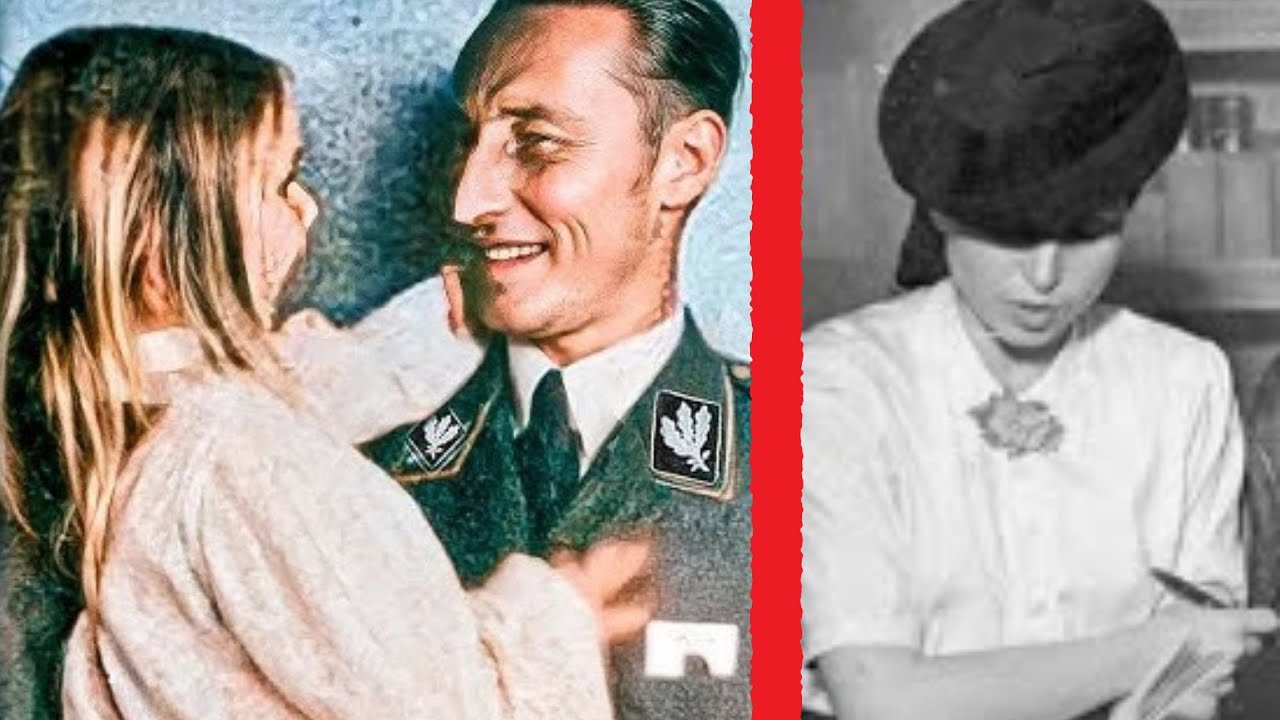
Her grandfather, the book revealed, was Amon Göth—the SS commandant of the Płaszów concentration camp in Nazi-occupied Poland.
The man remembered for shooting prisoners from the balcony of his villa.
The man convicted after the war and executed for crimes against humanity.
The man portrayed as a cold-blooded killer in Schindler’s List.
Jennifer Teege was 38 years old when she learned his blood ran through her family.
And there was another fact that made the discovery almost impossible to absorb: Teege’s father was Nigerian. She was a Black German woman whose grandfather had helped enforce a racial system that regarded people like her as inferior.
Göth would not merely have rejected his granddaughter.
Under the world he was trying to build, he might have killed her.
Teege left the library carrying more than a book.
She carried a second identity.
Until that moment, Amon Göth had belonged to history—to documentaries, court records and black-and-white photographs. Now he belonged to her family.
She had not chosen his name. She had not committed his crimes. She had not even known the connection existed.
Yet in one afternoon, she became one of the Third Reich’s heirs.
Not an heir to its ideology.
An heir to its unfinished consequences.
That distinction matters, because the descendants of Nazi officials, SS officers and industrial collaborators did not inherit the same things.
Some inherited money.
Some inherited companies, property and social influence.
Others inherited only a surname that made strangers recoil.
Many inherited silence.
And nearly all eventually faced the same question:
What does an innocent person owe the victims of a crime that made their own family powerful?
After Germany surrendered in May 1945, the institutions of the Third Reich were dismantled. Hitler was dead. Senior officials were captured, tried or hunted. Nazi symbols were removed from government buildings.
But family fortunes did not disappear with the flags.
Neither did the habits that had protected them.
The Nazi economy had depended on more than soldiers and party officials. It required factory owners, bankers, engineers, lawyers and managers. Businesses produced weapons, aircraft engines, batteries, uniforms and military equipment while prisoners, deportees and civilians from occupied countries were forced to work under brutal conditions.
BMW itself has acknowledged that it became a major armaments manufacturer during the Nazi period and exploited forced labor. At its Munich-Allach aircraft-engine plant, forced laborers, prisoners of war and concentration camp inmates made up the overwhelming majority of the workforce near the end of the conflict.
Among the most powerful industrial families was the Quandt dynasty.
Günther Quandt controlled a vast network of battery, textile and armaments businesses. During the Third Reich, his companies expanded through military production, the acquisition of Jewish-owned property and the labor of tens of thousands of people who had no freedom to refuse.
A historical investigation commissioned decades later by the family estimated that approximately 50,000 forced laborers had worked in Quandt factories. The research concluded that Günther Quandt and his son Herbert were deeply entangled with the Nazi system and benefited from its crimes.
Yet the relationship between the Quandts and BMW is often told inaccurately.
The Quandt family did not control BMW during the war. BMW had its own documented record of forced labor and wartime production.
Herbert Quandt became BMW’s decisive shareholder later, when he rejected a proposed takeover and backed a rescue plan around 1959 and 1960. That investment eventually became one of the foundations of the family’s modern wealth.
The fortune associated with BMW therefore sits beside an older industrial fortune whose expansion had been aided by Nazi rule—not because wartime BMW belonged to the Quandts, but because the postwar family capital that helped secure BMW had survived the dictatorship largely intact.
This was the material legacy.
Factories could be repaired. Corporate names could be modernized. Shares could be transferred to children. Lawyers could reorganize assets into structures that looked toward the future rather than backward at the people who had suffered to create them.
The moral legacy was harder to place on a balance sheet.
Inside many families, the safest strategy was not denial in the loud, theatrical sense.
It was simply not speaking.
Children learned that certain questions changed the atmosphere at the dinner table.
What did Grandfather do during the war?
Why did the business grow so quickly?
Who owned that house before us?
Why are there prisoners in the old factory photographs?
The answers were replaced with phrases that sounded harmless: everyone had suffered, no one had known, Grandfather had merely done his duty, the family had only been trying to survive.
Silence became a form of inheritance protection.
It protected reputations.
It protected relationships.
And sometimes, it protected enormous amounts of money.
For decades, the Quandt family avoided a full public examination of its wartime history. Then, in 2007, a German television documentary titled The Silence of the Quandts brought the allegations before a mass audience.
The family could no longer control the story by declining to tell it.
They commissioned historian Joachim Scholtyseck to investigate. His extensive study, published in 2011, did not vindicate the dynasty. It exposed deeper involvement.
Gabriele Quandt, one of Günther Quandt’s grandchildren, publicly acknowledged that the family had been wrong to avoid confronting that history for so long.
That admission represented a moment of recognition.
For years, wealth had allowed the family to keep the past at a distance. Now the documents were in public view, the forced laborers had numbers, and the polished corporate story had acquired faces it could no longer exclude.
The power had shifted.
The family still possessed its fortune.
But it no longer possessed exclusive control over what that fortune meant.
The Quandt story also contains one of the strangest surviving links to Hitler’s inner circle.
Günther Quandt’s former wife, Magda, later married Joseph Goebbels, Hitler’s propaganda minister. She and Goebbels had six children together.
Those six children did not grow up to become wealthy heirs. In May 1945, as Berlin fell, their parents murdered them inside Hitler’s bunker before taking their own lives.
Magda, however, had an older son from her marriage to Günther Quandt.
His name was Harald.
Harald Quandt was serving in the German military and had been captured by Allied forces. Because he was a prisoner of war far from Berlin, he survived the destruction of the Goebbels household.
After his release, he returned to Germany. When Günther Quandt died in 1954, Harald and his half-brother Herbert inherited the industrial empire.
Thus, the surviving family line associated with Magda Goebbels did not descend from Joseph Goebbels. It continued through the son she had with an industrialist whose factories had profited from the Nazi war economy.
Harald later had five daughters, who inherited significant financial interests after his death.
It is a disturbing intersection of two forms of power.
On one side stood propaganda—the machinery that taught millions whom to fear, hate and obey.
On the other stood industry—the machinery that armed the regime and converted persecution into production.
The Goebbels children died in the bunker.
The industrial capital survived.
But money was not the only thing passed down.
Hans Frank, Hitler’s governor-general in occupied Poland, lived with his family in extraordinary comfort while his administration oversaw terror, deportation, exploitation and mass murder.
After the war, he was convicted at Nuremberg and executed.
His youngest son, Niklas Frank, spent much of his adult life refusing to protect his father’s reputation.
He interviewed witnesses, studied records and wrote with an anger so severe that some readers found it shocking. While other relatives struggled to separate the father they remembered from the criminal history recorded in archives, Niklas publicly attacked the family mythology.
He did not want a softer portrait.
He wanted the crimes to remain visible.
His response illustrates one path available to the children of perpetrators: radical confrontation.
It was not peaceful.
It did not restore the dead or repair his childhood.
It divided him from relatives who remembered the family differently.
But it prevented affection from being used as evidence of innocence.
A man can be warm to his children and merciless to other people’s children.
A family photograph can show tenderness without disproving a crime.
That may be one of the most difficult truths these descendants have had to accept. The perpetrators were not monsters every minute of every day. Many were ordinary at breakfast, affectionate on birthdays and murderous at work.
That contradiction was precisely what made family silence so powerful.
Katrin Himmler faced a different version of it.
She was the great-niece of Heinrich Himmler, leader of the SS and one of the central architects of the Holocaust. Within her family, Heinrich’s brothers were often presented as comparatively harmless men standing beside the infamous figure.
Katrin began investigating.
The documents dismantled the comforting distinction.
Her grandfather Ernst Himmler had not been merely an apolitical relative trapped by his brother’s prominence. He had joined the Nazi Party, served as an SS officer and participated in the system from which the family benefited.
Katrin published The Himmler Brothers, exposing how respectable family life, professional ambition and murderous ideology could exist within the same household.
She also chose to keep the surname Himmler.
Not as an act of pride.
As a refusal to disappear behind another name and leave the history unchallenged.
For descendants like Katrin Himmler and Niklas Frank, speaking publicly carried a price. They risked family rejection, public suspicion and the permanent reduction of their identities to the worst person in their bloodline.
For others, silence felt safer.
Some changed names.
Some avoided interviews.
Some tried to build lives in which the past was treated as an unwanted stranger who might leave if no one opened the door.
But silence rarely erased the history.
It merely transferred the discovery to the next generation.
That was what happened to Jennifer Teege.
Her biological mother had lived with the knowledge that Amon Göth was her father. Teege, who had spent part of her childhood in foster care before being adopted, had not.
She had built an adult life, studied in France, lived in Israel and formed close relationships without knowing that one of the Holocaust’s notorious perpetrators stood at the center of her own family tree.
Then she opened the library book.
The most devastating inheritance arrived not through a lawyer’s letter, but through recognition.
A photograph.
A name.
A few printed sentences that reorganized everything she knew about herself.
This is where the story of the Third Reich’s heirs turns.
At first, it appears to be about descendants trying to escape the crimes of their ancestors.
But Jennifer Teege’s existence reveals something larger.
She was not simply descended from Amon Göth.
She embodied the future his ideology had tried to prevent.
A Black German woman.
A woman who had lived among Jewish friends in Israel.
A mother and author capable of speaking publicly in a world where Göth’s authority had been destroyed and his victims’ testimony preserved.
The family secret that initially seemed to give Göth power over her eventually gave her a platform from which to expose him.
She researched the past, confronted its effect on her identity and wrote the memoir My Grandfather Would Have Shot Me.
The title did not claim responsibility for his crimes.
It announced the moral distance between them.
He was her ancestor.
He did not get to define her.
That is the legacy the descendants did not choose.
They did not choose their bloodlines.
They did not choose the photographs hidden in drawers, the companies built by coerced workers, the surnames that make rooms fall silent or the relatives who protected family myths.
They are not guilty merely because they were born.
Guilt belongs to the person who commits the crime.
But inheritance creates a different question.
When someone receives wealth created through exploitation, benefits from a name protected by silence or discovers evidence previous generations concealed, neutrality becomes difficult.
The responsibility is not to perform endless shame.
It is to refuse a profitable lie.
Open the archives.
Name the victims.
Correct the corporate histories.
Support restitution and education where they are possible.
Do not demand admiration for finally acknowledging facts that survivors carried alone for decades.
And never confuse family loyalty with the obligation to defend everything a family member did.
History does not remain inside history books.
It lives in company shares, inherited homes, missing names, altered biographies and the sudden silence that follows an innocent question at dinner.
The Third Reich fell in 1945.
Its emotional and financial inheritances did not.
Perhaps no generation can choose what it receives from the past.
But every generation chooses whether to hide that inheritance—or finally tell the truth about what it cost.