At 5:42 on a freezing Tuesday morning, Audrey Harrington stood inside the largest hangar at Harrington Meridian Air and realized that someone had been lying to her for months.
Twenty-two aircraft sat beneath the white industrial lights, aligned nose to tail in two perfect rows.
By noon, those planes were supposed to determine whether her family’s airline survived.
The audit team from Blackwell Crown Capital had arrived before sunrise. They wore dark coats, carried hard cases, and spoke in the flat, careful voices of people who understood that a single sentence could move millions of dollars.
Behind them stood Sterling Blackwell.
He did not inspect the aircraft himself.
He simply watched.
That was worse.
Sterling had spent six months presenting himself as the man willing to rescue Harrington Meridian from bankruptcy. His investment could cover payroll, refinance the company’s debt, and keep more than four hundred employees working.
Or he could walk away and let the airline collapse.
Audrey had slept less than two hours.
For weeks, the internal reports on her desk had warned of a maintenance department in decline. Parts were delayed. Budgets had been cut. Older aircraft were developing recurring faults. Graham Hollis, the company’s chief operating officer, had repeatedly told her that the technical crews were struggling to meet expectations.
Audrey expected the audit to expose every weakness at once.
Instead, the first inspector emerged from beneath aircraft 817 and looked confused.
“The hydraulic system is clean,” he said.
A second inspector closed a panel on aircraft 804.
“Brake assemblies were serviced recently.”
Another auditor checked the auxiliary power unit records.
“No irregularities.”
Then came the logbooks.
Page after page showed completed repairs, verified pressure tests, replaced wiring, corrected vibration readings, serviced brakes, and clean engine-start cycles.
The aircraft were not perfect.
But they were far better than Audrey had been told.
Harold Vance, the lead auditor, looked up from the maintenance records.
“Ms. Harrington, these aircraft have received an extraordinary amount of corrective work over the past six months.”
Audrey stared at him.
“That’s impossible.”
Harold turned the logbook toward her.
“It’s documented.”
Her eyes moved across the hangar.
Pilots stood near the tool cabinets. Mechanics gathered beside the work platforms. Shift supervisors looked at the floor.
Graham Hollis remained several steps behind her, his expression carefully neutral.
Audrey raised her voice.
“Who repaired all twenty-two of these aircraft?”
No one answered.
The hum of the ventilation system suddenly seemed deafening.
She looked from one employee to another.
“Someone authorized this work. Someone completed it. Someone signed the technical entries. Who was it?”
Still nothing.
Then Ethan Pike, a veteran pilot with thirty-one years in the air, stepped forward.
He did not look at Graham.
He looked toward the open hangar door.
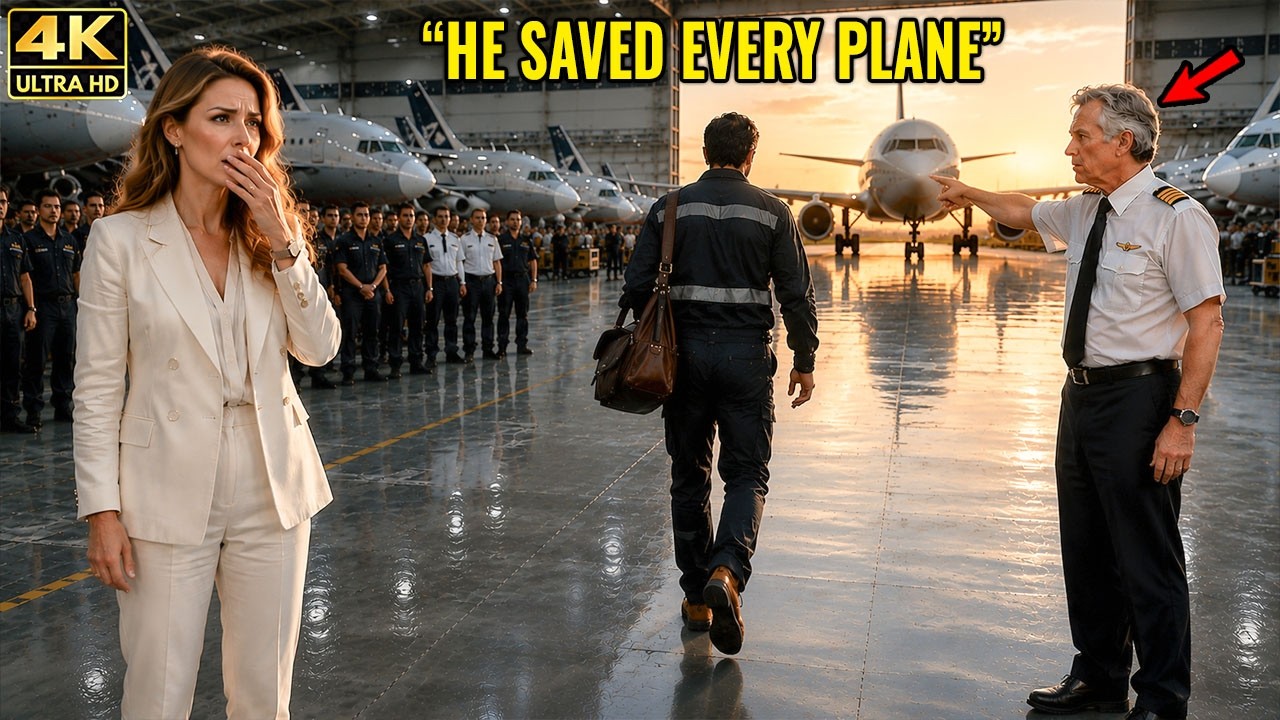
“The man you just fired.”
Audrey turned.
Outside, under the gray light before dawn, a mechanic was walking across the wet tarmac with a canvas tool bag in one hand.
Noah Whitlock never looked back.
Three hours earlier, Noah had been lying beneath the fuel-control housing of aircraft 822, listening to a sound no one else had noticed.
He was forty years old, a night-shift mechanic, and the kind of man who could identify a failing bearing from a change in pitch during engine startup.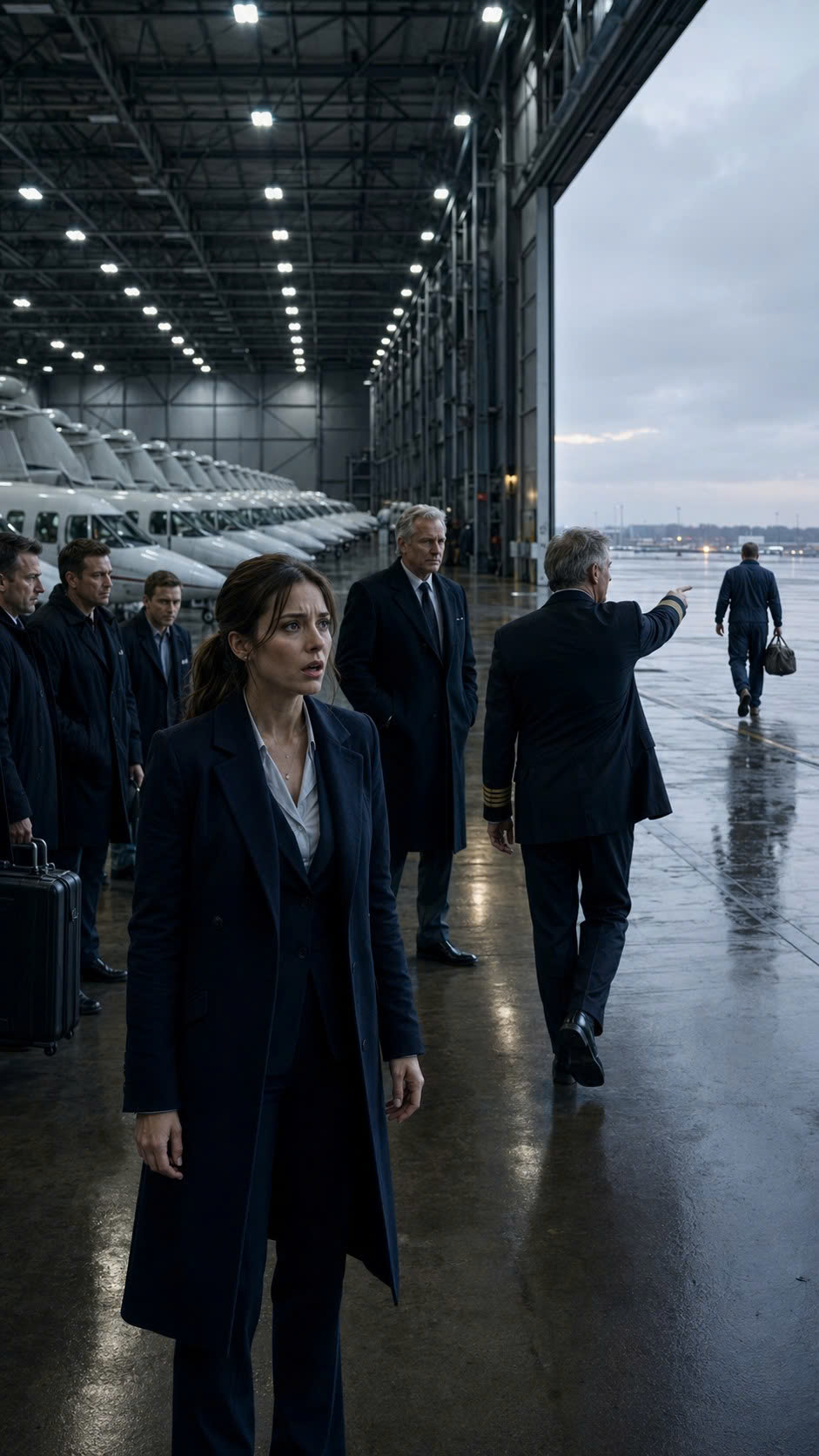
He was not loud.
He did not attend executive meetings.
He did not know how to make a room notice him.
But he knew aircraft.
That morning, aircraft 822 had displayed an intermittent fuel-pressure warning during a diagnostic cycle. The warning disappeared after a reset, but Noah did not trust disappearing warnings.
He traced the sensor line, checked the connector pins, and found light abrasion on a wire running behind the mounting bracket.
It was not yet a failure.
It could become one.
Noah documented the fault, photographed the damaged insulation, and entered a recommendation to hold the aircraft for a complete wiring inspection.
At 2:31 a.m., Graham Hollis entered the hangar wearing a wool coat over his suit.
“Tell me that aircraft is ready,” he said.
Noah remained beside the open panel.
“It needs another inspection.”
“The warning cleared.”
“The warning returned twice.”
Graham glanced toward the maintenance office.
“Twenty-two aircraft are scheduled for presentation. We are not showing Blackwell twenty-one.”
“I’m not concerned with what we show him.”
Graham’s face tightened.
“You should be concerned with whether this company exists next month.”
Noah pointed to the exposed wire.
“This can be fixed. But not by pretending it isn’t there.”
Graham lowered his voice.
“Change the classification. Mark it as non-urgent and sign the aircraft back into service.”
Noah looked at him for a long moment.
“Maintenance reports are not decorations.”
“You’re being difficult.”
“I’m being accurate.”
Graham stepped closer.
“People will lose their jobs if this investment fails.”
“People can lose more than jobs if this aircraft fails.”
That was when Graham sent Audrey a message.
Night technician refusing final clearance. Delaying audit preparation. Repeated pattern of insubordination. Appears to be leveraging safety language to challenge management authority.
Audrey arrived twenty minutes later.
She was exhausted, angry, and already terrified that Sterling Blackwell would use any delay to reduce his offer.
Graham met her near the maintenance office with a folder in his hand.
“He has done this before,” he said. “Every time we approach a deadline, he finds another reason to stop the process.”
Audrey opened the folder.
The pages inside showed missed timelines, disputed maintenance classifications, and comments describing Noah as uncooperative.
What she did not see were the original reports attached to those incidents.
Graham had removed them.
Audrey walked onto the hangar floor and found Noah beside aircraft 822.
“You are holding this aircraft?”
“Yes.”
“Graham says the warning was cleared.”
“The warning disappeared. That is not the same thing.”
“We have an audit in less than three hours.”
“That does not change the wire.”
Audrey felt every sleepless night, every unpaid invoice, and every conversation with her father pressing down at once.
“My family built this company.”
Noah closed the access panel slowly.
“Then your family should want it to be safe.”
She heard disrespect.
What he had meant was responsibility.
“Sign the clearance,” she said.
“I can’t.”
“You mean you won’t.”
“I mean the aircraft needs inspection.”
Audrey’s voice hardened.
“There are twenty-two aircraft in this hangar. I need twenty-two aircraft certified for review.”
Noah met her eyes.
“They should be safe, not just declared safe.”
Graham stood behind her, silent.
Audrey took one step forward.
“This is your final instruction.”
Noah removed his gloves.
“A good mechanic is sometimes the last person standing between a schedule and a funeral. Someone has to be willing to say no before the sky makes the decision for us.”
Audrey felt the sentence strike every weakness she had been trying to hide.
She mistook that feeling for defiance.
“You’re terminated.”
The mechanics nearby stopped moving.
Noah did not argue.
He placed his badge on the edge of the workbench, packed his tools, and walked away.
While everyone watched him leave, Graham entered the maintenance office and removed Noah’s original report from the audit file.
By the time Audrey saw him crossing the tarmac three hours later, the truth had already begun to surface without him.
At home, Noah’s eight-year-old daughter Clara had once drawn a blue aircraft with yellow wings and taped it to the refrigerator.
Beneath it, in uneven letters, she had written:
MY DAD FIXES PLANES SO PEOPLE COME HOME.
Noah had kept the picture there for two years.
Before Clara’s mother died, Noah had worked for a larger airline with better pay and a clear path into engineering management. After the funeral, he transferred to night work at Harrington Meridian.
Night shifts allowed him to pick Clara up from school.
They allowed him to attend parent meetings.
They allowed him to be home when she woke from nightmares.
The job was smaller.
The life was not.
During Harrington Meridian’s financial crisis, maintenance budgets were reduced three times in six months. Inspection intervals were stretched wherever regulations allowed. Replacement parts were delayed. Mechanics were expected to support the same schedule with fewer people.
Noah stayed late.
He came in early.
He repaired brake lines after midnight, replaced worn connectors before sunrise, and trained younger mechanics on aircraft older than some of them.
He never requested recognition.
But he kept records.
Inside a black notebook, Noah documented every significant repair: dates, component numbers, photographs, names of witnesses, email warnings, and the original versions of reports later altered by management.
It was not a diary.
It was insurance against erasure.
Back in the hangar, Audrey began questioning the supervisors one by one.
“Who completed the hydraulic repairs?”
Silence.
“Who replaced the brake control modules?”
No answer.
Ethan Pike stepped closer.
“Noah did most of it.”
Graham shook his head.
“That is an exaggeration.”
Ethan turned toward him.
“Last January, aircraft 809 developed a brake-pressure imbalance before a winter departure. Operations wanted it released. Noah stayed six hours past his shift and rebuilt the assembly.”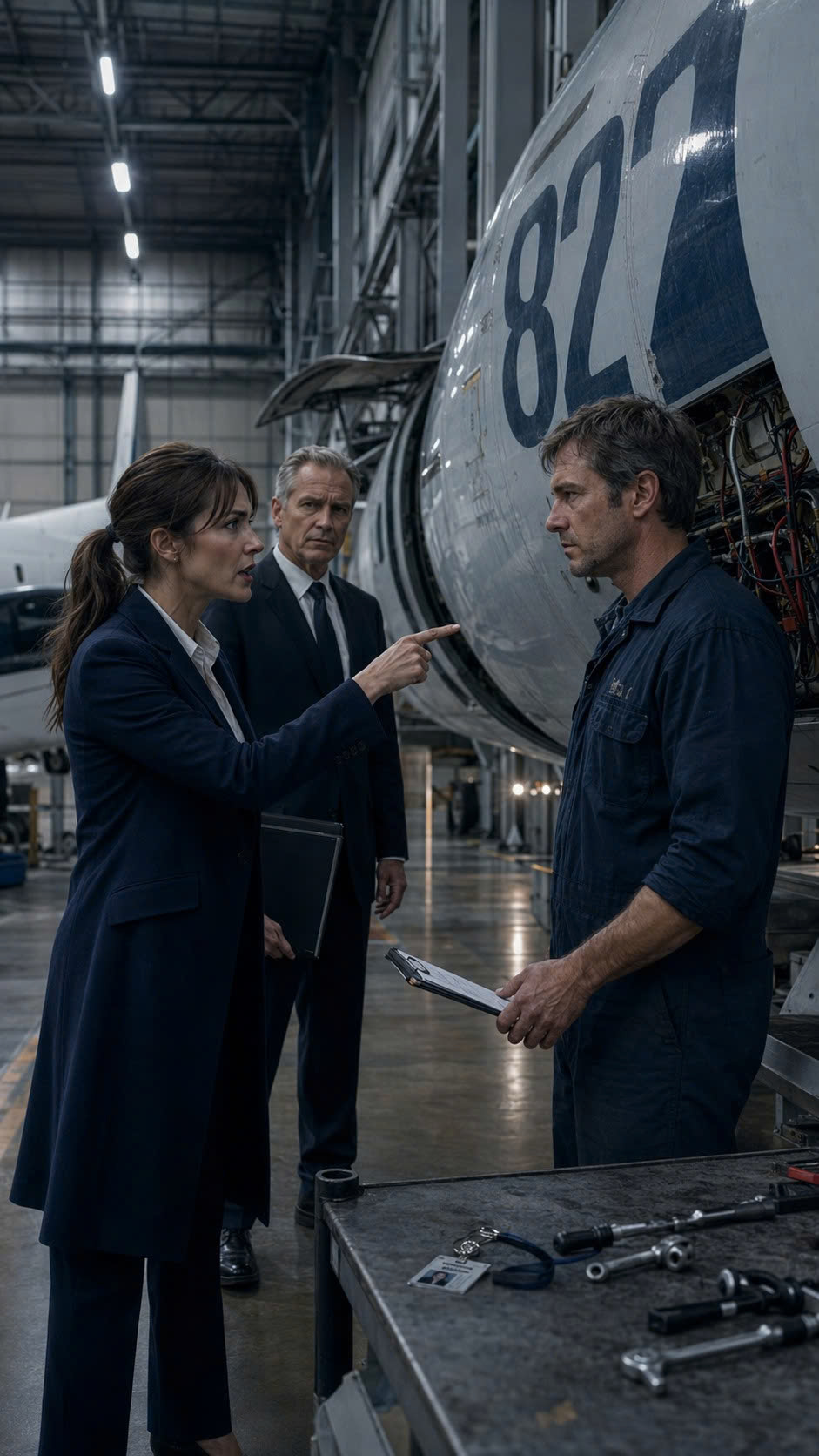
“That was a team repair,” Graham said.
“No. The team had been sent home to reduce overtime.”
A young mechanic named Mason Reed lifted his head.
“Noah taught us how to inspect the old assemblies,” he said. “Half the night crew didn’t know the failure pattern because the company had canceled the training session.”
Graham looked at him sharply.
Mason continued.
“He never asked for credit. He just didn’t want anyone flying something he wouldn’t put his own daughter on.”
The hangar remained quiet, but the silence had changed.
Before, it had protected authority.
Now it protected the truth long enough for someone to say it.
Graham crossed his arms.
“Employees work beyond their formal assignments all the time. That does not make this some kind of conspiracy.”
Ethan’s reply was quiet.
“The company forgot us. Noah kept us alive.”
Audrey looked toward Harold Vance.
“Show me the original logbooks.”
Graham stepped forward.
“The audit summaries contain everything relevant.”
“I didn’t ask for summaries.”
Harold requested the physical maintenance records, component histories, and electronic revision logs.
Within twenty minutes, he found discrepancies.
Several reports had been shortened after submission.
Technical comments had been removed.
Names had disappeared from the final versions.
But deeper inside the maintenance software, every entry carried an individual identifier that could not be deleted without leaving a revision trace.
The same identifier appeared across all twenty-two aircraft.
NW-417.
Noah Whitlock.
Audrey felt the color leave her face.
Graham saw it too.
For the first time that morning, he stopped speaking.
His jaw loosened.
His eyes moved from the screen to Sterling Blackwell and then toward the hangar door, as though calculating which exit was closest.
That tiny movement told Audrey more than any report had.
Noah had not been obstructing the company.
He had been holding it together.
And someone had been removing his name.
By 7:15 a.m., Noah was sitting in a diner across from the airport, drinking coffee he had forgotten to touch.
Clara called before school.
“Are you coming home early?”
“Yes.”
“Did you fix the plane?”
Noah looked through the window toward the hangars.
“I fixed what I could.”
Ethan found him twenty minutes later.
“They found your identifiers in the logs.”
Noah closed the notebook in front of him.
“Then they know enough to start asking questions.”
“They also know you were fired.”
Noah’s expression did not change.
“Graham will blame you,” Ethan said. “He’ll say you worked outside procedure.”
“He has said that before.”
“You need to come back.”
“I will meet Audrey under two conditions.”
Ethan waited.
“An official record of the meeting and an independent safety representative in the room.”
“You don’t trust her.”
“No,” Noah said. “But this is not about trust anymore.”
When Ethan opened the black notebook, he stopped turning pages after the first few minutes.
There were photographs of damaged components, copies of emails, serial numbers, timestamps, and twenty-two original safety reports.
Seventeen formal warnings had been sent to Graham in six months.
All had been delayed, reclassified, or marked non-urgent.
The meeting took place in the technical office beside the hangar.
Audrey arrived with Daphne Monroe, the company’s general counsel. Harold Vance joined as the independent representative.
Noah sat across from them with the notebook on the table.
Audrey began defensively.
“Why didn’t you send these reports to me?”
“I did.”
“I never received them.”
Noah opened the notebook and placed printed email receipts in front of her.
“They went to operations. Your policy required maintenance concerns to pass through the COO.”
Audrey examined the messages.
Each one had been received.
Each one had been intercepted by Graham.
Daphne began comparing the emails with executive files.
Then she found the contract provision.
Blackwell Crown Capital’s acquisition agreement allowed the buyer to reduce the purchase price if undisclosed maintenance abnormalities were discovered after signing.
The language sounded ordinary.
Its effect was not.
If Audrey signed before the true condition of the airline was documented, Sterling could claim the company had hidden critical defects and force the price down after gaining control.
He did not fear the maintenance problems.
He needed them.
Daphne searched the disclosure archive and found something worse.
Graham had sent Blackwell the original technical reports weeks earlier.
Sterling already knew.
He had allowed Audrey to believe she was presenting a stronger airline than the records supported while quietly preserving evidence he could later use against her.
The rescue had never been a rescue.
It was a trap.
An emergency board meeting was called before noon.
The glass conference room overlooked the hangar, where all twenty-two aircraft remained parked below like silent witnesses.
Victor Harrington, Audrey’s father, arrived furious.
Sterling Blackwell sat beside his attorneys.
Graham took a seat near the financial team.
Daphne, Ethan, Harold, and Noah sat opposite them.
Victor spoke first.
“You will not destroy a family company over the complaints of one mechanic.”
Audrey looked at Noah.
He did not react.
Sterling folded his hands.
“No one wants conflict. We are still prepared to complete the transaction today.”
Graham nodded.
“The cleanest solution is to acknowledge procedural failures in the technical department, terminate the individuals involved, and move forward.”
“Individuals?” Audrey asked.
“Whitlock operated outside approved authorization. The night staff followed undocumented practices. We can contain this.”
 Noah connected a laptop to the conference screen.
Aircraft 801 appeared first.
“Brake-pressure fault reported February 3. Replacement delayed by operations. Repair completed February 7 after shift.”
Aircraft 804.
“Hydraulic leak discovered March 11. Initial report classified urgent. Classification changed six hours later.”
Aircraft 809.
“Brake control imbalance. Requested grounding denied. Repair completed during unpaid holdover.”
One aircraft after another filled the screen.
Each had a date.
Each had a warning.
Each had evidence of delay.
Each had Noah’s repair record.
Ethan confirmed the operational incidents from the pilots’ side.
Mason confirmed the technical work from the hangar floor.
Then Daphne placed a bank record on the table.
Graham Hollis had received consulting payments from an advisory company connected to Blackwell Crown Capital.
The payments began shortly after the maintenance budget cuts.
Graham’s face went still.
Sterling leaned back.
Victor stopped moving.
Daphne continued.
“Mr. Hollis suppressed safety reports, reduced documented maintenance liabilities, and provided the unedited information to the proposed buyer. That created the appearance of nondisclosure while ensuring the buyer retained proof.”
Graham looked at Noah.
“You performed unauthorized work.”
Noah’s voice remained calm.
“I worked outside my hours. I did not work outside the law.”
That was the moment Graham understood that no one in the room was going to save him.
His eyes dropped to the table.
The skin beneath his collar turned red.
Sterling’s attorneys began whispering.
Victor stared through the glass at the aircraft below.
Audrey stood.
For most of her life, leadership had meant never allowing anyone to see uncertainty.
That morning, uncertainty had become the only honest place left to stand.
“The Blackwell transaction is suspended immediately,” she said.
Sterling’s expression hardened.
“You may want to reconsider.”
“I already have.”
She turned toward Graham.
“You are suspended pending an independent investigation.”
Then she faced Noah.
“I am appointing you to lead a complete safety review, under independent oversight, if you are willing.”
Noah did not answer immediately.
When he did, his conditions were clear.
Safety reports would no longer pass through operations.
Any qualified technician could ground an aircraft based on a reasonable safety concern without fear of retaliation.
And all twenty-two aircraft would be re-inspected from the beginning, using physical evidence rather than altered summaries.
Audrey agreed.
The Blackwell deal collapsed that afternoon.
The following weeks were worse than the sale would have been.
The board divided.
Victor accused his daughter of humiliating the family.
Flights were canceled.
Revenue fell.
Reporters appeared at the airport gates.
Employees did not suddenly trust Audrey because she had made one correct decision.
When she walked through the hangar, conversations stopped.
No one applauded her.
No one owed her forgiveness.
So she kept coming back.
She attended overnight maintenance briefings.
She read the original technical reports.
She asked mechanics what they saw before asking executives what the numbers meant.
One evening, she found Noah alone beside aircraft 817, listening to an engine cycle down.
“Why didn’t you shout?” she asked.
He looked at her.
“When you fired me. Why didn’t you fight harder?”
Noah closed the diagnostic case.
“Noise makes faults harder to hear.”
“That’s your answer?”
“It’s the one I have.”
Audrey looked across the hangar.
“I was wrong.”
“Yes.”
“I trusted the wrong people.”
“Yes.”
“I’m sorry.”
Noah studied her face.
“An apology matters less than what happens to the next person who says an aircraft isn’t safe.”
She nodded.
He picked up his tools.
“Build a company where that person keeps their job.”
Two months later, Audrey stood before the entire workforce.
Pilots, mechanics, dispatchers, flight attendants, office staff, and ground crews filled the hangar.
She did not speak from a stage.
She stood on the concrete floor.
“Noah Whitlock kept twenty-two aircraft safe during the most financially desperate period in this company’s history,” she said. “Management removed his name from records, ignored his warnings, and fired him for refusing to approve something he believed was unsafe.”
No one moved.
“That failure was not his. It was ours. And it was mine.”
The company released the original maintenance records.
Graham was formally investigated for falsifying reports and receiving undisclosed payments connected to the acquisition attempt.
Victor Harrington was removed from his honorary board role.
Blackwell Crown Capital withdrew its offer after its internal communications were subpoenaed.
Harrington Meridian survived, but not by pretending to be stronger than it was.
The airline reduced its schedule.
It sold two aging aircraft.
It increased technical staffing and separated safety authority from financial operations.
The company became smaller.
It also became honest.
Six months later, the first aircraft cleared under the new safety system prepared for departure.
The entire maintenance crew gathered near the hangar doors.
Audrey stood beside Noah as the aircraft taxied toward the runway.
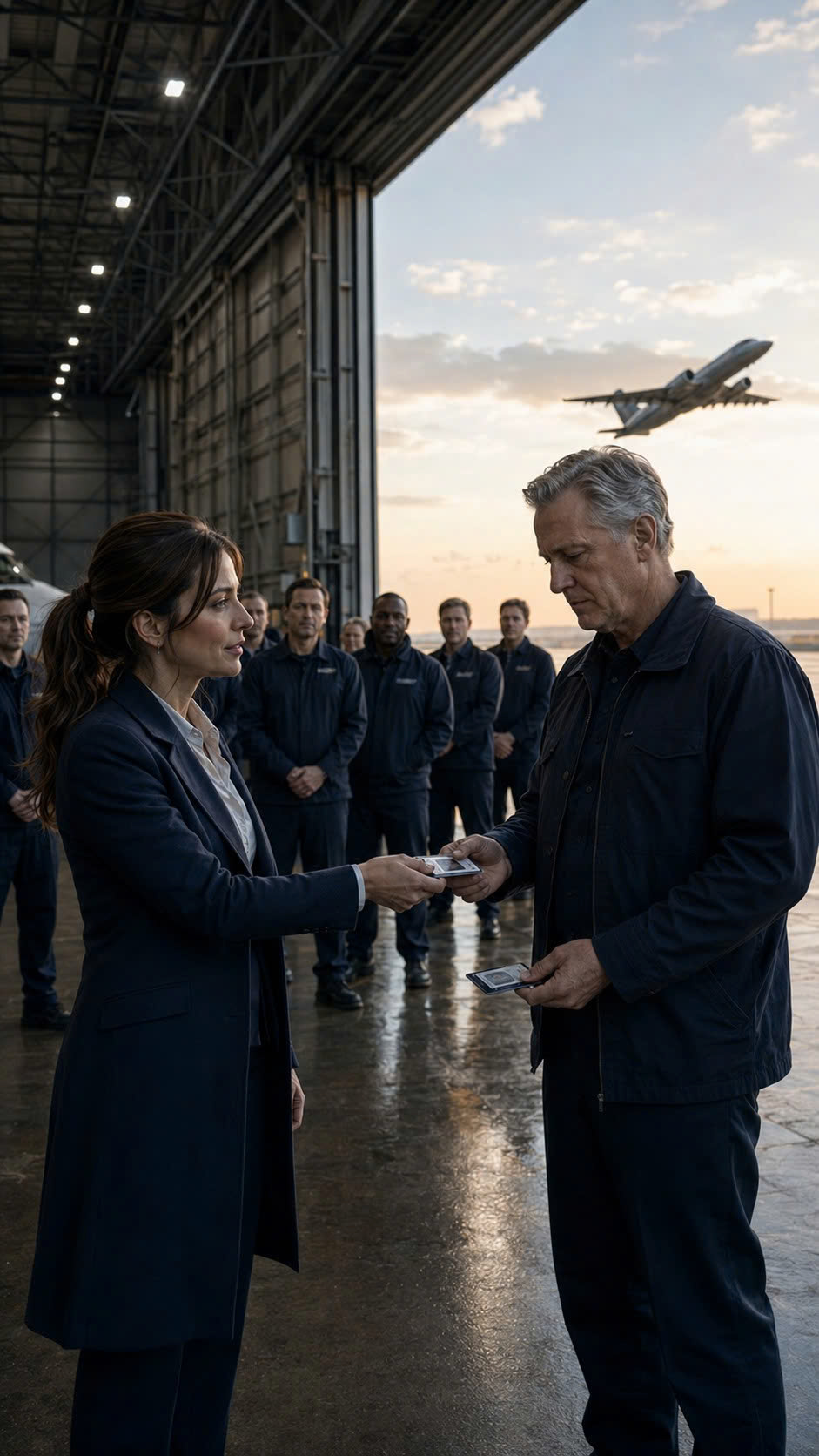
She handed him a new badge.
DIRECTOR OF FLIGHT SAFETY OPERATIONS.
Noah turned it over once.
Then he reached into his pocket and removed the old badge he had left on the workbench the morning he was fired.
“You kept it?” Audrey asked.
“Mason picked it up.”
“Why carry both?”
Noah watched the aircraft turn onto the runway.
“So I remember what happens when a company stops asking the people closest to the problem what is true.”
The engines rose.
The aircraft accelerated and lifted into the morning sky.
Noah did not smile like a hero.
He simply watched until the wheels disappeared.
Because aircraft do not fly on family names, investment promises, polished presentations, or executive confidence.
They fly because someone tightened the right bolt, recorded the real fault, and had the courage to say, “Not yet. It isn’t safe.”
And sometimes, the person everyone is willing to overlook is the only one keeping the whole system in the air.