They Called Her “Just Maintenance” — Until She Stood Up and Said, “I Can Fly the Hog”
Chapter One
The Empty Chair
The first mortar landed eighteen yards from the flight line.
It struck beyond the concrete blast wall with a flat, metallic crack, throwing a column of black sand into the white morning sky. The shock wave slapped toolboxes open, rattled fuel drums against their chains, and sent three young airmen diving beneath the wing of an A-10 Thunderbolt II.
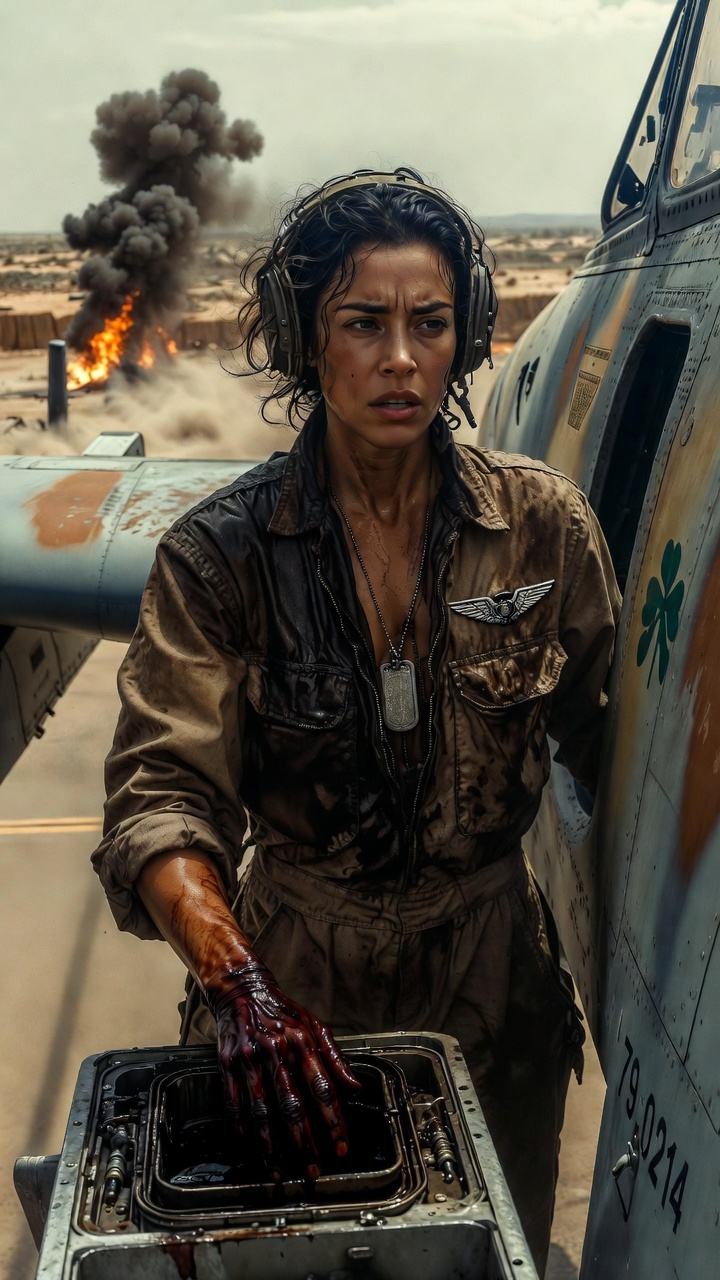
Staff Sergeant Mara Velez did not move.
She stood on a maintenance ladder beside the left engine nacelle, one hand buried wrist-deep inside an access panel, listening.
The desert went silent for half a second.
Then the base alarm began to howl.
“Indirect fire! Indirect fire! Seek shelter immediately!”
Men and women ran between revetments as a second impact rolled across Forward Operating Site Blackglass. The sun had not fully cleared the eastern ridge, but the heat was already climbing through Mara’s boots.
She pulled her hand from the aircraft.
Hydraulic fluid gleamed across her fingers like dark blood.
“Sergeant!” Airman Cole Patterson shouted from beneath the wing. “We need to move!”
Mara looked toward the control tower.
A third mortar struck near the perimeter fence.
This one was closer.
The tower windows flashed orange. A cloud of dust swallowed the lower half of the structure, followed by the shriek of twisting sheet metal.
Mara stepped down from the ladder.
“Patterson, bring the diagnostic case.”
He stared at her.
“Sergeant, they’re shooting at us.”
“They were shooting at us yesterday.”
“That was farther away.”
“Then walk faster.”
Patterson was twenty-one, narrow-shouldered, sunburned, and still carried the nervous politeness of someone who had grown up saying yes, ma’am to women older than his mother. He grabbed the diagnostic case with both hands and followed her toward the hardened shelter.
Above them, the A-10 sat heavy and ugly beneath its camouflage netting.
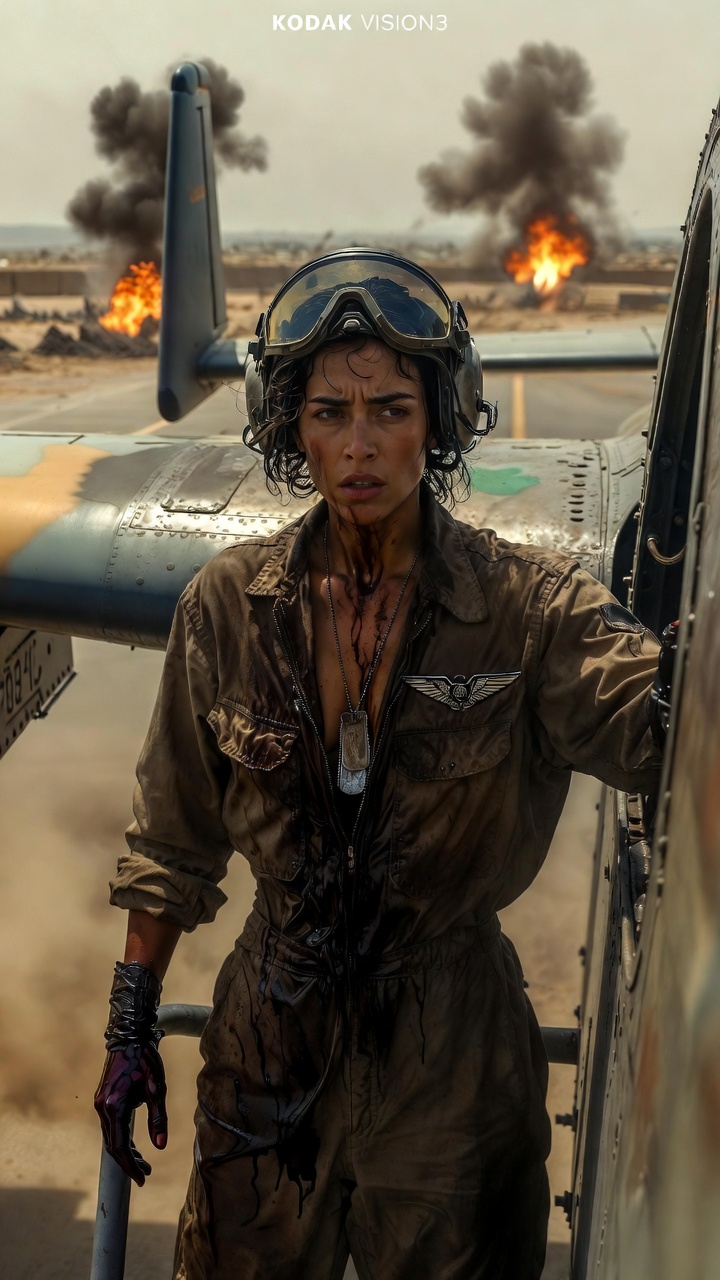
Its official tail number was 79-0214.
The crew called it Grendel.
Paint had blistered near the gun housing. The right wing carried three patched sections from old combat damage. A faded green shamrock had been painted beneath the cockpit by a crew chief who had retired twelve years earlier.
To Mara, it was not ugly.
It was honest.
Every rivet announced its purpose. Every scar meant it had returned.
Another explosion shook the revetment.
Mara stopped.
Something had changed.
She looked toward the aircraft operations building, where figures emerged through dust and smoke. Two medics carried a man between them. His boots dragged over the gravel.
Even from a distance, Mara recognized Major Ethan Cross by the red cloth tied around the handle of his survival knife.
He was one of only two qualified A-10 pilots currently at Blackglass.
Blood covered the right side of his flight suit.
“Move,” Mara said.
Patterson followed her through the shelter doors.
Inside, thirty people crowded beneath dim emergency lights. Radios barked from every corner. Someone was crying behind a stack of water crates. A security forces captain pressed a bandage against his own scalp while shouting grid coordinates into a handset.
Lieutenant Colonel Grant Harlan stood over a folding table in the center of the room.
At forty-eight, Harlan had a long, controlled face, silver beginning to show at his temples, and the rigid posture of a man who believed chaos could be defeated by standing straighter than everyone else.
His flight suit was zipped to the throat.
“Impact pattern is shifting north,” he said. “They’re walking rounds toward the fuel farm.”
Captain Elise Navarro, the squadron intelligence officer, leaned over a satellite image.
“The firing point is mobile. They’re using two pickup trucks and a spotter team in the ridge settlement.”
“Can we reach them?”
“Not with the Reapers. Satellite link is still unstable.”
Harlan looked toward the shelter entrance as the medics brought Cross inside.
“What happened?”
“Tower glass,” one medic said. “Shrapnel through the shoulder and neck. He’s conscious, but he’s losing blood.”
Cross’s face had gone gray.
His eyes found Mara.
For a moment, neither of them spoke.
Then Cross lifted two fingers weakly toward the sky.
“Convoy,” he whispered.
Harlan crouched beside him. “What convoy?”
“Raven Six.”
Navarro’s head snapped up.
She reached for a radio.
A burst of static filled the shelter, followed by a man’s voice fighting through gunfire.
“Blackglass, Raven Six. We are taking heavy fire at checkpoint Cedar. Three vehicles disabled. We have twenty-three civilians and nine wounded. Request immediate close air support.”
The transmission broke apart.
Navarro adjusted the frequency.
“Raven Six, this is Blackglass. Say enemy strength.”
Static.
Then:
“Multiple technicals. Mortars. Possible recoilless rifle. They’re closing from the south.”
Harlan turned toward the operations map.
“How long until coalition fighters arrive?”
“Forty-seven minutes,” Navarro said.
“Raven Six doesn’t have forty-seven minutes.”
Everyone in the shelter understood what was not being said.
Two A-10s were parked outside.
One pilot was bleeding onto the floor.
The other pilot, Captain Lucas Bell, had been airlifted out the previous evening with acute appendicitis.
The aircraft were ready.
The pilots were not.
Patterson placed the diagnostic case beside Mara’s boot.
Harlan noticed her for the first time.
“Why are you here?”
Mara held up her stained hand.
“Grendel has a hydraulic pressure fluctuation in the left system.”
“Then fix it when the all-clear sounds.”
“It may not be a mechanical fluctuation.”
Harlan’s expression hardened.
“Staff Sergeant, there are people in this room handling an active attack.”
“And there are people outside this base who will die if Grendel launches with a false pressure indication.”
Captain Navarro looked between them.
“What do you mean, false?”
Mara set the diagnostic case on the table.
“The pressure transducer is giving a three-point oscillation. Same interval every eleven seconds.”
Harlan’s eyes narrowed.
“Sand ingestion.”
“No.”
“You determined that in the middle of a mortar attack?”
“I determined it before the first round landed.”
“Then write it in the maintenance log.”
Mara did not move.
Cross groaned as the medics cut open his flight suit.
The radio came alive again.
“Blackglass, Raven Six. We are losing the western barricade.”
Behind the transmission came the unmistakable hammering of a heavy machine gun.
A child screamed somewhere near the microphone.
Harlan turned away from Mara.
“Navarro, contact the Jordanian quick reaction force.”
“They’re pinned down at Wadi Nasr.”
“Then call the French detachment.”
“Their jets are two hundred miles north.”
Mara looked toward the operations board.
Two aircraft symbols.
No pilot names beside them.
An empty chair at the planning table.
On the wall, a digital clock counted seconds in red.
Cross’s blood reached the edge of the stretcher and dripped onto the floor.
Mara watched one drop fall.
Then another.
Eleven seconds apart.
She unzipped the top of her coveralls and pulled a thin chain from beneath her shirt.
A pair of tarnished silver wings hung from it.
Harlan saw them.
The color left his face.
Mara placed the wings on the table.
“I can fly the Hog.”
No one in the shelter moved.
Outside, another mortar began its descent.
Chapter Two
Rook
The explosion struck the far side of the aircraft shelter.
Dust sifted from the ceiling.
Patterson stared at the silver wings on the table as if they had appeared through magic.
Captain Navarro picked them up.
They were not maintenance badges.
They were United States Air Force pilot wings, worn smooth at the edges.
Harlan’s voice dropped.
“Put those away.”
Mara met his eyes.
“You knew.”
“I knew what you used to be.”
Cross turned his head on the stretcher.
“Rook,” he whispered.
Several faces shifted toward Mara.
The call sign moved through the shelter more quietly than the mortar blasts.
Rook.
Patterson’s mouth opened.
“You’re Captain Velez?”
“Not anymore.”
Harlan stepped between Mara and the operations table.
“You have not flown operationally in six years.”
“Five years, nine months.”
“You are not on flight status.”
“I have eighteen hundred hours in the A-10.”
“You have no current medical clearance.”
“My medical clearance was suspended pending review. It was never revoked.”
“Your instrument certification expired.”
“Then the sky will have to stay visible.”
“This is not a conversation.”
The radio cracked.
“Blackglass, Raven Six. Enemy vehicle approaching from southeast. We need air now.”
A second voice cut in behind it.
“Medic! Get the medic over here!”
Harlan looked toward the radio but did not answer.
Mara could see the arithmetic in his face.
Rules on one side.
Bodies on the other.
She knew the expression because she had worn it once.
Six years earlier, over a different desert, she had sat in an A-10 cockpit while a warning tone pulsed in her headset.
Her wingman, Captain Aaron Pike, had been below her, disappearing into brown cloud.
The mission computer had told him the terrain ahead was clear.
Mara’s eyes had told her it was not.
She had ordered him to climb.
The mission commander had ordered him to continue.
Pike had obeyed the higher-ranking voice.
The mountain had taken three seconds to prove the computer wrong.
Harlan had been the mission commander.
Mara curled her stained fingers against the table.
“Authorize me.”
Harlan leaned closer.
“You walked away from flying.”
“No. I walked away from your report.”
The words struck harder than the mortar.
Navarro looked at Harlan.
“What report?”
“Not now,” he said.
Mara spoke without raising her voice.
“The report that blamed Pike for spatial disorientation. The report that said the software fault was pilot error.”
Harlan’s jaw tightened.
“You were emotionally compromised.”
“I watched my wingman follow a bad command into a ridge.”
“You disobeyed a direct order.”
“And survived.”
A medic glanced up from Cross.
“Harlan.”
It was Cross speaking.
His voice barely carried.
The colonel approached the stretcher.
Cross swallowed through pain.
“She’s the best Hog driver I’ve ever seen.”
“You’ve never flown with her.”
“I studied Dust Lantern.”
Harlan’s eyes flickered.
That small movement told Mara everything.
Cross knew.
Perhaps more people knew than Harlan had believed.
Project Dust Lantern had been a classified test program designed to determine whether A-10s could operate from damaged roads, dry lake beds, and improvised desert strips without conventional support. Mara had been one of six pilots selected.
She had landed Grendel on a salt flat with half its instruments dead and nineteen holes in the left wing.
The citation had vanished into a locked archive.
The scars on the airplane had not.
Harlan looked toward the silver wings.
“You are not current.”
Mara pointed through the shelter wall toward Grendel.
“I know every system in that aircraft. I know how the left engine sounds at idle when the temperature passes one hundred ten. I know the gun pulls two degrees left after four hundred rounds because the mounting collar was machined before Patterson was born. I know the fuel flow gauge reads high when the aft tank drops below twelve hundred pounds.”
Patterson blinked.
“You knew that?”
“I wrote it on the panel.”
“I thought that was a calibration note.”
“It was.”
Harlan’s restraint began to crack.
“Knowing an aircraft is not the same as flying one.”
“No. Flying is easier.”
Navarro covered a smile that lasted less than a second.
Then Raven Six transmitted again.
“We have movement inside the civilian vehicles. Repeat, civilians are being pulled from the vehicles.”
Gunfire swallowed the rest.
Harlan closed his eyes.
Mara studied him.
He had aged since Dust Lantern. The lines beside his mouth had deepened. The left hand he kept behind his back trembled slightly.
She wondered how often he still saw Pike’s aircraft vanish.
She wondered whether that was why he had fought so hard to bury the truth.
Not because he felt nothing.
Because he felt too much.
“Colonel,” Navarro said, “we need a decision.”
Harlan opened his eyes.
“If I authorize this, every person here becomes part of it.”
“No,” Mara said. “You authorize the launch. Everything after that belongs to me.”
“That is not how command works.”
“It is how guilt works.”
For a moment, anger flared in his face.
Then it disappeared.
Harlan picked up the field telephone.
“Maintenance control.”
A voice answered.
“This is Colonel Harlan. Prepare aircraft zero-two-one-four for immediate combat launch.”
Patterson inhaled sharply.
Harlan continued.
“Load two AGM-65s, full gun, rockets, and defensive countermeasures.”
He looked directly at Mara.
“Pilot will be Staff Sergeant Velez.”
Silence answered through the telephone.
Then the maintenance controller said, “Sir, did you say Staff Sergeant?”
“I did.”
Harlan put down the receiver.
“You launch in twelve minutes.”
Mara took her wings from Navarro.
“Ten.”
She turned toward the door.
Harlan caught her arm.
His grip was hard.
“Grendel’s flight computer received a software patch last night.”
Mara stopped.
“What patch?”
“Terrain and threat database synchronization.”
“Source?”
“Central Air Operations.”
“Did you verify the package signature?”
Harlan hesitated.
Mara felt cold move through her despite the desert heat.
“You didn’t.”
“It was marked priority.”
“So was the update that killed Pike.”
Harlan released her.
The radio screamed with another message from Raven Six.
This time there were no words.
Only gunfire.
Then the signal went dead.
Chapter Three
The Old Animal
The flight line looked like the end of the world.
Smoke rolled over the perimeter wall. Sirens wailed beneath the rising scream of wind. The sun had turned copper behind a curtain of blowing sand.
Mara ran toward Grendel with Patterson at her side.
Around the aircraft, crew members moved with the practiced speed of people who knew panic wasted oxygen. Weapons troops rolled missiles beneath the wings. A fuel hose snaked across the concrete. Chaff and flare magazines disappeared into their housings.
Technical Sergeant Amos Reed stood beneath the cockpit ladder.
He was fifty-one, broad through the chest, with a shaved head and hands that looked carved from old wood. He had worked on A-10s longer than some of their pilots had been alive.
Reed looked at Mara’s coveralls.
Then at the parachute harness Patterson carried behind her.
“Thought you buried that part of yourself.”
Mara stopped.
“Thought you retired.”
“Paperwork mistake.”
Reed held out a helmet.
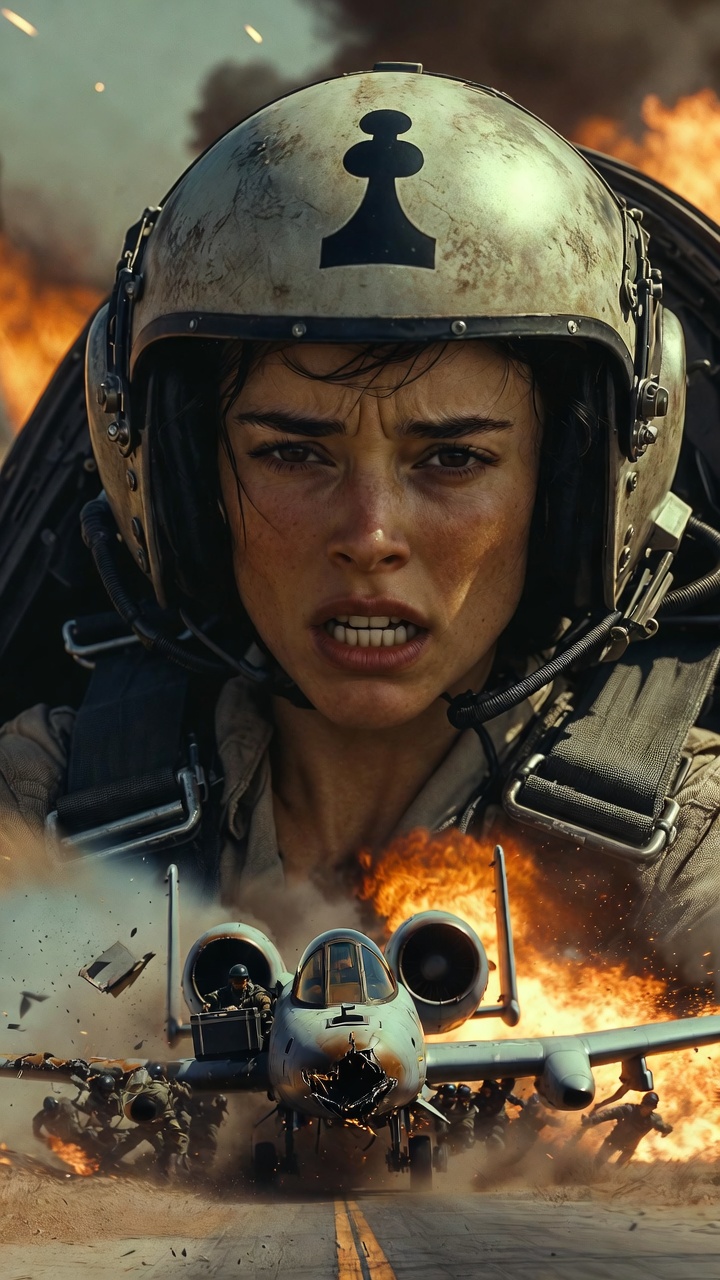
Across the back, faded beneath scratches and dust, was a black chess rook.
Mara stared at it.
“You kept it.”
“Aircraft parts aren’t the only things people misplace.”
She took the helmet.
The padding smelled of rubber, sweat, and a life she had trained herself not to remember.
Reed lowered his voice.
“Harlan told me to destroy it after the investigation.”
“Why didn’t you?”
“Same reason I don’t throw away a wrench because an officer used it wrong.”
Mara put on the harness.
Her fingers found every buckle without looking.
Patterson stood near the ladder, pale beneath his sunburn.
“Sergeant?”
She turned.
He held the diagnostic tablet.
“The oscillation changed. It’s every seven seconds now.”
Mara took the tablet.
A green pressure line rose and fell in exact, unnatural intervals.
Mechanical faults wandered.
Software faults kept time.
“Disconnect the flight computer from the maintenance network.”
Patterson looked toward the cockpit.
“Can we do that without shutting down the avionics?”
“We can isolate the data bus.”
“The manual says—”
“The manual assumes no one is trying to put an airplane into the ground.”
Reed heard her.
“You think the patch is hostile?”
“I think it’s familiar.”
They climbed beneath the fuselage.
Mara opened an access panel behind the nose gear and reached into a cluster of connectors.
The aircraft seemed to breathe above her, metal ticking as the skin warmed.
Patterson crouched beside her.
“Which bus?”
“Channel Bravo.”
“There are four blue connectors.”
“Third from the left.”
“They all look the same.”
“Then count.”
A burst of machine-gun fire sounded from the eastern perimeter.
Someone shouted that enemy scouts had reached the outer wire.
Patterson’s hands began to shake.
Mara covered them with her own.
“Look at me.”
He did.
“When your body gets afraid, it tries to make every problem happen at once.”
Another explosion rolled across the base.
Mara kept her voice even.
“Don’t solve the base. Solve the connector.”
His breathing slowed.
He found the latch.
“Got it.”
“Pull.”
The connector came free.
The hydraulic oscillation vanished from the tablet.
Patterson stared at the flat line.
“It was coming from the flight computer.”
“Yes.”
“Can you fly without that channel?”
“I can fly without half the airplane.”
Mara slid from beneath the fuselage.
Reed was waiting.
“What happens when you leave line-of-sight navigation?”
“I use the inertial backup.”
“What happens when the threat receiver loses the central database?”
“I believe my eyes.”
Reed studied her.
“That worked out badly for you last time.”
“No. Not believing them worked out badly for Pike.”
He nodded once.
No comfort.
No argument.
Only acknowledgment.
Mara climbed the ladder.
The cockpit was narrower than she remembered.
Or perhaps she had become larger in the places grief lived.
She lowered herself into the ejection seat. Her knees found the panel. Her boots rested on the rudder pedals. Every gauge surrounded her like an old language.
For years she had repaired these machines while other pilots climbed into them.
She had told herself proximity was enough.
The first time an engine started after her maintenance, the vibration traveled through the ground into her bones. For a few seconds, she could pretend she was still inside the cockpit.
Then the aircraft would taxi away.
Mara connected the oxygen hose.
Patterson appeared beside the canopy.
“Hydraulics checked.”
“Gun?”
“Eleven hundred fifty rounds.”
“Fuel?”
“Full internal.”
“Countermeasures?”
“Loaded.”
“Your shoelace is untied.”
He looked down instinctively.
Mara almost smiled.
Patterson caught himself.
“That wasn’t funny.”
“It made you breathe.”
Reed climbed the ladder and leaned into the cockpit.
“Harlan ordered you to hold south of the base until command confirms Raven Six’s position.”
“That wastes six minutes.”
“It also prevents you from shooting civilians.”
“I know where the convoy was.”
“You know where it was before the radio died.”
Mara tightened her shoulder straps.
“Then I’ll find it.”
Reed’s face remained close to hers.
“Coming back matters too.”
“I know.”
“No. You used to know. Then Pike died, and you started treating survival like an insult.”
The words found a gap in her armor.
Reed tapped the side of her helmet.
“This airplane has enough ghosts. Don’t add yours.”
He climbed down.
Mara closed the canopy.
The world outside became muted.
She switched on battery power.
Warning lights filled the panel.
One by one, she brought the aircraft to life.
Auxiliary power.
Fuel boost.
Left engine.
The turbine began to turn behind her.
A deep mechanical whine grew into a roar.
Right engine.
Hydraulic pressure stabilized.
The old animal awakened.
Mara rested her hand on the twin throttles.
“Blackglass Tower, Grendel One. Request immediate taxi.”
Static answered.
The tower had been damaged.
Navarro’s voice came over the emergency frequency.
“Grendel One, Blackglass Command. You are cleared to taxi Runway Two-Niner. Wind two-seven-zero at thirty-five knots. Visibility four miles and decreasing.”
“Copy.”
“Colonel Harlan orders you to hold south of the field.”
Mara released the parking brake.
“Tell Colonel Harlan the convoy is east.”
“He knows.”
“Then he knows why I’m not holding south.”
A pause.
Navarro lowered her voice.
“Mara, enemy vehicles were seen near the highway. We cannot distinguish them from civilian transports in this dust.”
“Then I won’t shoot until I can.”
She advanced the throttles.
The A-10 rolled from its revetment.
Airmen stopped along the flight line to watch.
Some knew who she had been.
Others only saw a maintenance sergeant wearing an old helmet.
At the runway threshold, the wind struck the aircraft broadside.
Sand swept across the pavement in long, living sheets.
Mara aligned the nose.
Her hand settled over the throttles.
For the first time in nearly six years, there was nothing between her and the sky.
“Grendel One,” Navarro said, “you are cleared for takeoff.”
Mara pushed the throttles forward.
The engines rose behind her.
The runway began to move.
Fifty knots.
Eighty.
One hundred.
The aircraft shuddered as the crosswind clawed at the wings.
At one hundred twenty knots, every warning light on the left side of the cockpit illuminated at once.
MASTER CAUTION.
HYDRAULIC FAILURE.
FIRE DETECTION.
FLIGHT CONTROL DEGRADATION.
Mara’s hand tightened on the throttles.
She had seen the pattern before.
The same false cascade that had appeared in Pike’s cockpit three seconds before he hit the mountain.
Grendel was moving too fast to stop.
The end of the runway rushed toward her.
Chapter Four
Bad Information
Mara did not look at the warning lights.
She looked at the aircraft.
The nose was steady.
The throttles responded.
Hydraulic pressure on the isolated analog gauge remained normal.
The computer was screaming.
The airplane was not.
“One hundred thirty,” she said.
The runway end approached through blowing sand.
She pulled back.
Grendel’s nose lifted.
For one terrible second, the aircraft seemed to remain trapped in the desert.
Then the wheels left the ground.
Mara raised the landing gear.
The warning tones multiplied in her headset.
“Grendel One, you have multiple emergencies,” Navarro said. “Abort mission and return.”
“Negative.”
“Your data feed shows flight control failure.”
“My hands show flight control.”
She climbed through five hundred feet.
“Disconnecting primary mission computer.”
Harlan’s voice replaced Navarro’s.
“If you shut down that computer, you lose digital navigation, weapons calculation, threat mapping, and encrypted targeting.”
“I also lose whoever is lying to it.”
“You do not know the system is compromised.”
“I knew six years ago.”
The radio went silent.
Mara reached forward and selected the emergency reversion mode.
Half the displays went black.
The cockpit became quieter.
Old analog instruments remained alive: airspeed, altitude, attitude, engine temperature, hydraulic pressure.
Things that measured the physical world rather than interpreting it.
She leveled at two thousand feet.
Below, the desert stretched beneath a veil of tan dust. Dry riverbeds cut across the land like scars. The highway to Checkpoint Cedar appeared and disappeared between curtains of sand.
Mara turned east.
“Blackglass, give me Raven Six’s last coordinates.”
Navarro read them.
Mara marked the location on a paper kneeboard.
“No digital transfer,” she said.
“Understood.”
Harlan came back on the frequency.
“You will not engage without positive identification.”
“That was already my plan.”
“You are not in command of this mission.”
Mara looked at the desert.
“No. The people being shot at are.”
She descended.
At eight hundred feet, the wind began throwing the aircraft from side to side. Grendel’s broad wings caught every current.
Mara trimmed manually.
Her body remembered.
Not perfectly.
Her right calf tightened from holding rudder pressure. Her breathing became too shallow during the turns. The old instinct to scan the instruments had dulled.
She hated that.
She also welcomed it.
Fear meant she understood the cost.
A voice appeared faintly on the radio.
“Any station… Raven Six…”
Mara adjusted the receiver.
“Raven Six, this is Grendel One. Say position.”
Static covered the reply.
Then a different transmission cut across it.
“Grendel One, turn south immediately. Friendly convoy has moved south of Checkpoint Cedar.”
The voice used a valid coalition frequency.
Mara looked at her radio panel.
“Identify.”
“Sunray Actual.”
“What is your authentication?”
A pause.
Then the correct code word for the day.
“Copper.”
Harlan spoke from Blackglass.
“Grendel One, we do not have Sunray Actual on our command net.”
Mara’s pulse slowed.
Someone had the frequency.
Someone had the authentication code.
Someone wanted her south.
She remained on course.
The false Sunray voice returned.
“Grendel One, you are approaching friendly vehicles. Turn south.”
Mara saw movement through the dust.
Four vehicles in a dry riverbed.
Two pickup trucks with mounted guns.
One armored truck.
One white bus.
The pickup trucks fired north toward a cluster of disabled convoy vehicles beside the highway.
The bus was positioned between them.
Human shields.
Mara descended to four hundred feet.
The gun trucks scattered as her shadow crossed the riverbed.
Men jumped from the beds.
One vehicle fired upward.
Tracer rounds climbed behind her.
Mara banked hard left.
Her body pressed into the seat.
The A-10’s wings seemed to bite the air.
For one glorious, frightening instant, she was no longer a maintainer pretending to remember.
She was Rook.
Then the past entered the cockpit.
A flash against a mountain.
Pike’s voice.
Terrain clear.
Continuing.
Mara’s hands stiffened.
Grendel rolled too far.
The desert filled the canopy.
She forced herself to breathe.
Not then.
Now.
She corrected the bank and climbed.
“Visual contact,” she transmitted. “Enemy technicals using civilian bus as cover. Raven Six approximately one kilometer north.”
“Can you engage?” Navarro asked.
“Not safely with missiles.”
“What about the gun?”
Mara looked at the riverbed.
The technicals had moved close to the bus. Civilians were visible through broken windows.
The famous GAU-8 cannon beneath her feet could tear a tank open.
It could also erase a bus.
“Negative.”
Harlan’s voice was quiet.
“Then wait for coalition fighters.”
“They’re thirty-one minutes away.”
“You cannot change the geometry.”
Mara watched the gun trucks.
One began moving north toward Raven Six.
She studied the dry riverbed, the wind, the walls of dust, and the narrow gap between the bus and the eastern ridge.
“I can change where they look.”
She climbed to fifteen hundred feet and turned west.
“Grendel One, what are you doing?” Harlan asked.
“Maintenance.”
Mara armed the rocket pods.
She selected white phosphorus marker rockets, used for illumination and marking rather than direct destruction.
At the top of the turn, she rolled inverted for half a heartbeat and pulled the nose down.
The gun trucks pointed their weapons toward her.
She fired two rockets into the empty ground east of the riverbed.
The impacts threw up brilliant white clouds.
The wind caught the smoke and drove it west.
Within seconds, the bus disappeared behind a glowing wall.
The enemy gunners lost sight of the civilians.
They also lost sight of Mara.
She came around low from the north.
The first technical emerged from the smoke directly beneath her nose.
Mara placed the fixed sight ahead of it.
Her finger rested on the trigger.
The gun began to fire.
The aircraft vibrated around her as if a giant had struck it with a hammer.
The sound came after the rounds.
A brutal, tearing roar.
The technical vanished beneath a line of explosions.
Mara released the trigger after less than a second.
The truck rolled onto its side.
The second technical accelerated toward the highway.
Mara followed.
It passed dangerously close to the trapped convoy.
She could see men firing from the bed.
A soldier beside one disabled vehicle dragged a wounded civilian through the dirt.
Mara could not use the gun.
She selected a Maverick missile.
Without the mission computer, targeting would be slow and imprecise.
The seeker image flickered on a backup display.
The truck merged with the heat of burning wreckage.
No clean lock.
The enemy vehicle stopped.
Its mounted weapon rotated toward the convoy.
Mara heard Raven Six on the radio.
“Grendel, they’re lining up on us.”
The gunner lowered the barrel.
Mara’s seeker continued to drift.
“Come on,” she whispered.
The lock tone wavered.
Then sharpened.
She fired.
The missile dropped from the wing and streaked forward.
At the same moment, the truck began moving behind a damaged civilian SUV.
The seeker shifted.
The missile’s path changed.
Mara watched the wrong vehicle fill the targeting screen.
Chapter Five
Eleven Seconds
The missile corrected one final time.
Mara held her breath.
At the last moment, the enemy truck emerged beyond the civilian SUV.
The Maverick followed its engine heat.
The impact lifted the technical from the ground.
A ball of fire rolled across the highway.
The civilian SUV rocked on its suspension but remained intact.
Raven Six transmitted over a chorus of shouting.
“Good hit! Good hit!”
Mara climbed through the smoke.
Her hands trembled once.
She tightened them around the controls until they stopped.
“Blackglass, two technicals destroyed. One armored truck remains in riverbed. Civilian bus intact.”
“Copy,” Navarro said. “Raven Six reports eleven wounded but still holding.”
“Tell them to move north when the smoke covers them.”
Harlan’s voice followed.
“You have enemy vehicles approaching from the east.”
“How many?”
“Satellite imagery shows six.”
“Armed?”
“Unknown.”
Mara looked toward the eastern horizon.
The storm had thickened. The ridge had disappeared. Visibility dropped below two miles.
“Source of imagery?”
Harlan did not answer immediately.
“Central Air Operations.”
“The same network that pushed the patch?”
“Yes.”
“Then we don’t know if there are six vehicles.”
“We cannot ignore the warning.”
“We also cannot obey it blindly.”
Mara circled the convoy.
Below, soldiers were loading wounded people into the remaining vehicles. The white bus rolled slowly through smoke, its front windshield shattered.
A woman in a red headscarf stood in the open doorway, waving civilians forward.
Mara saw a small boy look up.
He raised both arms toward the A-10.
Not cheering.
Covering his ears.
Mara remembered a different child from another mission.
A village.
A collapsed roof.
A father carrying a blanket that was too light to contain a living person.
She had flown home with ammunition still in the gun and vomited beside the landing gear.
Pilots liked to talk about protecting troops on the ground.
They spoke less often about the people beneath every missed calculation.
“Raven Six,” Mara said, “begin movement north. Stay close to the ridge.”
“Grendel, we have one disabled armored vehicle. Three casualties cannot be moved without stretchers.”
“I’ll hold.”
“We have enemy approaching.”
“Do you see them?”
“Negative.”
“Then don’t let a computer scare you before the enemy does.”
A new warning appeared on Mara’s analog threat indicator.
Radar energy from the east.
Real this time.
The needle pulsed.
A tone growled in her headset.
“Blackglass, I’m being painted.”
Navarro answered. “We show no radar emitters near your location.”
Mara looked east.
The threat needle swept again.
“Your network doesn’t show it because your network belongs to them.”
Harlan came onto the frequency.
“Break west. Return to base.”
“Raven Six is still exposed.”
“You cannot help them if you are shot down.”
“Now you sound like Reed.”
“Mara.”
It was the first time Harlan had used her name.
“Break west,” he said. “That is an order.”
The radar warning changed pitch.
Launch indication.
Mara dropped low.
“Missile in the air.”
She banked toward the riverbed and released flares.
Bright points streamed behind the A-10.
A missile cut through the dust above her left wing, close enough to rock the aircraft.
The explosion came behind her.
Fragments struck the tail.
Grendel lurched.
Warning lights flashed.
This time the aircraft moved with them.
Mara corrected with rudder.
“Grendel One, status?” Navarro called.
“Still flying.”
The left engine temperature climbed.
Mara reduced power.
Below, the white bus and convoy vehicles began moving north.
The armored truck in the riverbed remained hidden behind smoke.
Mara’s threat receiver pulsed again.
Another missile launch.
She turned toward the eastern ridge.
The air defense radar was not six vehicles.
It was one mobile surface-to-air system positioned inside a stone quarry.
The same quarry used by local workers during daylight hours.
Someone had known coalition pilots would hesitate to strike it.
Mara selected her second Maverick.
The seeker display filled with static.
The corrupted mission computer was offline, but part of the hostile code remained active in the targeting processor.
Every eleven seconds, the image jumped.
Mara watched the interval.
One.
Two.
Three.
At eleven, the seeker shifted six degrees right.
Exactly as Pike’s terrain display had shifted before impact.
This was not merely the same kind of failure.
It was the same architecture.
Possibly the same person.
“Mara,” Harlan said, “return immediately.”
“Who signed the original Dust Lantern software package?”
No answer.
“Grant, who signed it?”
The use of his first name broke something between them.
Harlan spoke quietly.
“Dr. Adrian Vale.”
Mara knew the name.
Vale had been a civilian systems architect attached to the test program. Brilliant, impatient, allergic to criticism. After Pike’s death, he had testified that the software could not have produced the terrain shift Mara described.
His testimony had ended her career.
“What happened to him?”
“He left the program.”
“Where is he now?”
“Consultant to Central Air Operations.”
The second missile launched.
Mara rolled left and descended toward the quarry.
The missile followed.
She released chaff and pulled sharply behind a sandstone ridge.
The missile lost radar contact and struck the rock face.
The explosion filled the canyon with dust.
Grendel burst through the cloud at two hundred feet.
The quarry appeared ahead.
A radar vehicle sat between two abandoned excavators.
Workers’ shelters stood nearby.
No civilians visible.
Mara aimed the Maverick seeker manually.
The image jumped.
She corrected.
It jumped again.
The launch tone refused to stabilize.
“Rook,” Cross’s voice appeared faintly on the radio.
He should have been in surgery.
“Cross?”
“Medics moved me to the command shelter.”
“You should be unconscious.”
“Working on it.”
His breath sounded wet.
“I’m looking at the raw diagnostic feed from Grendel.”
“How?”
“Patterson routed it manually.”
Mara pictured the young maintainer crouched over a field terminal while mortars fell outside.
Cross continued.
“The targeting processor is receiving a reset command every eleven seconds.”
“Can you stop it?”
“Not remotely.”
“What can?”
A pause.
“Pulling circuit breaker Charlie-Seven.”
Mara looked at the panel beside her left knee.
Charlie-Seven controlled more than the targeting processor.
It also powered weapon release confirmation.
“If I pull it, the missile won’t recognize the launch command.”
“It may.”
“May?”
“Depends how much Grendel likes you.”
Mara looked at the radar vehicle.
Its launcher rotated toward her.
She pulled Charlie-Seven.
The targeting display went black.
Mara pressed the weapon release.
Nothing happened.
The launch warning screamed.
The enemy missile left its rail.
Chapter Six
The Man Who Signed
Mara pressed the release again.
The Maverick remained beneath the wing.
The incoming missile climbed from the quarry, a white spear against brown air.
“Come on, Grendel.”
She struck the release switch a third time.
The Maverick dropped.
Its motor ignited.
Without digital guidance from the aircraft, the missile’s internal seeker held the final target image it had received.
The radar vehicle filled the center of it.
Both missiles crossed in the air.
Mara pulled hard right.
The enemy missile passed beneath Grendel and exploded behind the tail.
The Maverick hit the radar vehicle.
The quarry flashed white.
A pressure wave rose from the ground and lifted Mara’s left wing.
She fought the roll.
Engine temperature surged.
The left engine began to cough.
“Blackglass, air defense site destroyed.”
Navarro answered first.
“Raven Six is moving. They report no further enemy contact.”
Mara exhaled.
Then every light in the cockpit flickered.
The left engine fire warning illuminated.
This one was real.
Mara shut off fuel to the engine.
The A-10 yawed left as the turbine wound down.
Grendel continued on one engine.
The aircraft had been built for this.
So had she.
“Returning to base,” Mara said.
No one replied.
“Blackglass, do you copy?”
Static.
Then a voice she did not recognize entered the frequency.
“Grendel One, this is Central Air Operations. Maintain present heading and climb to flight level one-zero-zero.”
Mara looked west.
Blackglass lay on a heading of two-seven-five.
The voice was directing her south.
“Authenticate.”
“Copper.”
The stolen code again.
“Who is this?”
“Colonel Adrian Vale, Central Systems Command.”
Mara’s blood cooled.
Vale had not been a colonel six years earlier.
He had been a civilian.
The voice was older but unmistakable. Smooth, measured, faintly annoyed by anything it could not control.
“You remember me,” Vale said.
“I remember you lying under oath.”
“I remember you confusing trauma with evidence.”
Mara kept Grendel pointed west.
“Did you send the software patch?”
“I approved a theater-wide security update.”
“That update injected false system failures.”
“It detected anomalies in an aging aircraft.”
“It tried to send me south.”
“To a safe recovery corridor.”
“Where a surface-to-air system was waiting.”
Vale paused.
“Your interpretation is becoming unstable.”
Mara almost laughed.
Six years ago, those words would have hollowed her out.
Now they sounded small.
“Why Raven Six?” she asked.
“I do not know what you mean.”
“The convoy. The stolen authentication codes. The compromised radar picture.”
“You are operating outside your authorization. Return control of the aircraft’s mission systems.”
“I disconnected them.”
“That was irresponsible.”
“It saved my life.”
Vale’s voice sharpened.
“You are a maintenance sergeant in unauthorized possession of a combat aircraft.”
“There it is.”
“What?”
“The part where you make the person smaller so the evidence looks smaller too.”
The radio went quiet.
Mara scanned the desert.
Grendel’s remaining engine held steady, but fuel was dropping faster than expected. The explosion may have damaged a line.
She had twenty minutes before the tanks reached critical level.
Blackglass was fourteen minutes away.
If the wind did not worsen.
Harlan’s voice finally returned through heavy static.
“Grendel One, Blackglass Command. We lost communications for ninety seconds.”
“Vale was on the frequency.”
“I heard the end.”
“Can he access the base network?”
“We’re isolating systems now.”
A siren sounded faintly behind Harlan.
Not the indirect-fire alarm.
A ground attack alarm.
Navarro spoke rapidly in the background.
Harlan came back.
“Enemy vehicles have breached the southern service gate.”
Mara looked toward the horizon.
A column of smoke rose where Blackglass should have been.
“How many?”
“At least four armored vehicles and twelve dismounts.”
“Security forces?”
“Holding the inner perimeter.”
“Runway status?”
“Runway Two-Nine cratered. Runway One-One has debris and an abandoned fuel truck.”
“Clear it.”
“We may not have time.”
Mara checked fuel.
“You have thirteen minutes.”
Harlan lowered his voice.
“They knew the base defense positions. They knew when our Reapers lost satellite control. They knew our pilots were unavailable.”
“Cross’s injury wasn’t random.”
“We found explosive residue in the tower frame. The mortar strike triggered a charge placed inside the wall.”
Someone had prepared Blackglass before the attack.
Someone with access.
Mara thought of technicians, contractors, local drivers, coalition staff. Hundreds of people crossed the base every week.
“You have an insider.”
“We have more than one.”
Gunfire crackled behind Harlan.
He gave an order away from the microphone.
Mara turned toward Blackglass.
“Raven Six is clear. I’m coming back.”
“Negative.”
“What?”
“You have one engine and possible fuel loss. Divert to Falcon Field.”
“Falcon is thirty-eight minutes away.”
“Then eject before fuel exhaustion.”
Mara stared at the smoke on the horizon.
“You want me to abandon Grendel.”
“I want you alive.”
“Security forces need air support.”
“The enemy is inside the base perimeter. You cannot distinguish them from our people through the storm.”
“Put Navarro on a laser designator.”
“We lost the primary observation post.”
“Then put Patterson on the roof.”
“He is an aircraft maintainer.”
“So am I.”
A burst of gunfire cut through the transmission.
Harlan breathed once.
Then said, “Stand by.”
Mara could imagine him inside the command shelter, surrounded by screens he no longer trusted.
The man who had once chosen information over eyesight.
The man who had lived with what followed.
Harlan returned.
“Patterson is moving to the water tower with a designator.”
Mara checked the remaining gun ammunition.
Eight hundred rounds.
“Tell him to mark only targets outside friendly cover.”
“Mara.”
“Yes?”
“If the base falls, Vale gets access to the local authentication server.”
“Destroy it.”
“That server contains coalition agent identities across the region.”
“Then remove the drives.”
“We’re trying.”
“Harlan.”
The engine temperature climbed another degree.
“What aren’t you telling me?”
Silence.
Then:
“Vale is here.”
Mara’s hand froze on the throttle.
“At Blackglass?”
“He arrived three days ago under a classified inspection authorization. His aircraft was scheduled to leave this morning.”
“Where is he now?”
“We don’t know.”
A fresh plume of smoke rose from the base.
Harlan’s voice dropped until it was barely audible.
“But the southern gate opened from inside.”
Chapter Seven
The Tower
Blackglass appeared through the storm six minutes later.
The base was burning.
A fuel bladder near the eastern wall sent black smoke folding across the runway. Tracer fire moved between buildings. One armored vehicle sat inside the southern gate, firing toward the security forces compound.
Grendel approached at five hundred feet.
Mara saw figures running below.
Uniforms were indistinguishable in dust.
“Patterson,” she called.
His breathing came hard over the radio.
“I’m on the water tower.”
“Do you have the designator?”
“Yes.”
“Do not mark anything unless you are certain.”
“Copy.”
“Tell me what you see.”
“One armored truck beside Hangar Three. Another near the communications building. Friendly personnel are behind the maintenance berm.”
Mara banked north.
“Mark the truck at Hangar Three.”
A coded symbol appeared briefly on her backup laser receiver.
The disconnected mission computer could not calculate a weapon solution, but the marker gave her a location.
She saw the truck.
Its gun fired toward the maintenance berm where Reed and the weapons crews were trapped.
Mara descended.
“Friendlies within one hundred yards,” Patterson warned.
“I see them.”
“You’re too close for a missile.”
“I know.”
She selected the cannon.
The armored truck moved beside Hangar Three.
If she fired too long, rounds would pass through the vehicle and strike the building.
Mara adjusted her angle until the maintenance berm disappeared behind the truck’s engine block.
“Clear the roof line,” she said.
“What?”
“Patterson, get down.”
Mara squeezed the trigger.
The cannon fired a fraction-of-a-second burst.
Rounds struck the ground short, walked into the truck, and shattered its engine compartment.
The turret stopped turning.
Mara pulled up before crossing the hangar.
Small-arms fire rose from below.
Rounds struck the underside of the aircraft.
Grendel did not seem impressed.
“Target disabled,” Patterson shouted.
“Second vehicle?”
“Communications building. I can’t mark it. Friendlies and hostiles are mixed.”
“Then don’t.”
Mara circled.
The fuel gauge dropped toward emergency reserve.
“Blackglass, runway status?”
Navarro answered.
“Fuel truck is still blocking One-One. Two-Nine has three craters.”
“Taxiway Alpha?”
“Too narrow.”
“Not for a Hog.”
“Mara, there are concrete barriers at the western end.”
“How far apart?”
“Forty-six feet.”
The A-10’s wingspan was more than fifty-seven.
“Then remove one.”
“With what?”
Mara looked at her final Maverick station.
Empty.
She looked at the gun ammunition.
“Never mind.”
Harlan interrupted.
“We found Vale.”
“Where?”
“Operations vault.”
“Alive?”
“He locked himself inside.”
“Get him out.”
“He has the coalition identity drives.”
Mara banked toward the communications building.
A group of men emerged from behind it, escorting someone in a tan uniform toward a black armored SUV.
Even through the dust, Mara recognized the posture.
Adrian Vale walked with his head slightly forward, as though the world existed to be corrected by him.
Two armed men guided him, but they were not guarding a prisoner.
They were guarding an asset.
“Patterson, mark the black SUV.”
The laser symbol appeared.
“Marked.”
Vale reached the vehicle.
Mara descended.
The SUV accelerated north between buildings.
She could not use the cannon.
The road led past the medical shelter.
Cross and dozens of wounded personnel were inside.
“Security forces, stop that vehicle,” Harlan ordered.
Rifle fire erupted from the western barricade.
The SUV swerved but continued.
Mara followed at three hundred feet.
The road ended near the aircraft revetments.
Beyond it stood Grendel’s maintenance shelter, fuel drums, and the A-10’s sister aircraft.
The SUV turned sharply.
Vale’s men were heading toward the second A-10.
Not to fly it.
To destroy it.
One of them raised a rocket launcher from the rear hatch.
Mara fired the cannon into the empty road ahead.
The burst tore a trench across the pavement.
The driver slammed the brakes.
The SUV rolled sideways.
Vale crawled from a rear door.
One armed man aimed the launcher at the parked A-10.
Mara came around for another pass.
The man moved behind a group of kneeling maintenance personnel.
Reed was among them.
Mara saw his shaved head and broad shoulders.
The armed man pressed the launcher against Reed’s neck.
Mara’s sight crossed over them.
She could not fire.
Vale stood behind the SUV, looking upward.
Even at that distance, Mara felt him watching her.
Then he raised a handheld radio.
“You will land,” he said over the frequency.
Mara kept circling.
“Clear the hostages.”
“You have nine minutes of fuel at your current consumption.”
“You always liked numbers more than people.”
“Numbers do not betray you.”
“No. People use them to hide betrayal.”
Vale stepped closer to Reed.
The gunman pushed the launcher harder against him.
“Land the aircraft and surrender the onboard storage module.”
“I disconnected the mission computer.”
“The memory core remains intact. It contains evidence of the remote commands.”
Mara understood.
Vale did not merely want Grendel destroyed.
He wanted the record erased.
“You could have deleted the logs remotely,” she said.
“Your maintenance isolation prevented it.”
Patterson had saved the evidence when he pulled the connector.
Vale continued.
“Land, Sergeant Velez.”
“Captain.”
“You forfeited that title.”
“No. You buried it.”
The remaining engine shuddered.
Fuel pressure flickered.
Mara had minutes now.
Below, Reed slowly moved one hand toward the ground.
Vale did not notice.
Patterson spoke in Mara’s headset, barely above a whisper.
“Sergeant, Reed has a wheel chock.”
Mara saw it.
A yellow rubber chock lay near his right hand.
The gunman watched the aircraft.
Reed’s fingers closed around the rope attached to the chock.
Mara knew what he intended.
It would not be enough.
Unless everyone moved at once.
“Harlan,” she said.
“I’m here.”
“On my gun burst, move security forces from the western barricade.”
“You cannot fire near the hostages.”
“I’m not firing near them.”
Mara turned toward the runway.
A row of metal maintenance containers stood fifty yards behind Vale’s position.
She aligned the cannon.
“Patterson, when you hear the gun, paint Vale’s SUV.”
“I’m already painting it.”
“I know.”
Mara smiled despite herself.
She pulled the trigger.
The cannon burst struck the maintenance containers.
Metal walls exploded inward.
The sound hit the ground like thunder.
Every gunman turned.
Reed swung the wheel chock.
It struck his captor’s knee.
Security forces rose from the barricade.
Patterson’s laser danced across the SUV windshield.
Mara lowered Grendel directly toward Vale.
The A-10 filled his sky.
He dropped to the ground.
Reed drove his shoulder into the gunman.
Rifle fire cracked from the barricade.
One attacker fell.
Another ran behind the revetment.
Vale crawled beneath the SUV.
Mara pulled up so low that her exhaust threw sand across the entire position.
The fuel pressure warning became steady.
“Hostages moving!” Patterson shouted.
Reed dragged two airmen behind the maintenance shelter.
Security forces closed on the SUV.
Vale emerged from the opposite side and ran toward the second A-10.
He carried a small black case in one hand.
The identity drives.
He climbed the maintenance ladder.
Mara stared in disbelief.
Vale was entering the cockpit.
“He cannot fly,” Harlan said.
“He doesn’t need to.”
The aircraft was fully fueled and armed.
If Vale started the engines and detonated the ammunition, half the flight line would disappear.
Mara turned Grendel toward him.
The remaining engine coughed again.
Fuel pressure dropped to zero.
The turbine began to wind down.
The A-10 became quiet.
Mara was four hundred feet above the base with no thrust.
Below her, Vale closed the canopy of the second Hog.
Chapter Eight
Dead Stick
An A-10 without engines did not fall gracefully.
It became thirty thousand pounds of metal arguing with gravity.
Mara lowered the nose.
Airspeed was life now.
Behind her, the right engine spun down.
The cockpit filled with warning tones.
“Grendel One, eject,” Harlan ordered.
Mara looked at the base.
The runway was damaged.
The taxiway was narrow.
The flight line was crowded with wounded people, fuel, weapons, and the second aircraft Vale was preparing to destroy.
If she ejected, Grendel would strike somewhere inside Blackglass.
Possibly the medical shelter.
Possibly the fuel farm.
“No.”
“You have no power.”
“I noticed.”
“Eject now.”
Mara banked toward Taxiway Alpha.
Concrete barriers stood at the western end.
Forty-six feet apart.
Her wings would not fit.
She reached for the emergency landing gear handle.
Lowering the gear would increase drag and reduce her glide.
Keeping it raised would turn the aircraft into a sliding weapon.
She looked at her altitude.
Three hundred feet.
“Reed,” she called.
His voice came over the radio.
“Still here.”
“Get everyone off Alpha.”
“Already moving.”
“Barriers?”
“Too heavy.”
“Then I’ll lose the wings.”
Silence.
Reed understood before anyone else.
“Mara, don’t.”
“Grendel has come home with less.”
“Not without both wings.”
“I only need the middle.”
She lowered the landing gear manually.
The wheels locked.
Airspeed decayed.
Two hundred fifty feet.
On the ramp, the second A-10’s auxiliary power unit began to scream.
Vale had found the start sequence.
He had known more about the aircraft than Mara expected.
Or someone had trained him.
“Security team cannot reach him,” Harlan said. “Cockpit is locked.”
Mara aligned with Taxiway Alpha.
The barriers waited at the far end.
“If I stop before him, get the memory core out of Grendel.”
“You are not planning to stop.”
“I’m planning to interrupt.”
The taxiway rushed closer.
One hundred feet.
Mara flared.
The main wheels struck hard.
A tire burst.
Grendel bounced, slammed down again, and began rolling.
Without engines, there was no reverse thrust.
Mara applied wheel brakes.
The damaged tire pulled left.
She corrected with rudder.
Vale’s A-10 sat ahead, nose angled toward the taxiway. Heat shimmered behind its first starting engine.
He intended to taxi across her path.
Or collide deliberately.
The canopy reflected the burning fuel farm.
Mara saw his face behind it.
Calm.
Certain.
Men like Vale believed courage belonged to people who did not understand risk.
He had always mistaken control for bravery.
Grendel rolled faster than Mara could stop.
The concrete barriers approached beyond Vale’s aircraft.
Vale advanced his throttle.
The second A-10 began to move.
“Mara, eject on the ground!” Harlan shouted.
The ejection seat could save her at this speed.
It could also fire her into the debris and burning fuel around the taxiway.
Mara stayed strapped in.
Vale turned across her path.
The two aircraft closed.
At the final moment, Mara applied full left brake.
The burst tire collapsed.
Grendel spun.
Its right wing swept toward Vale’s aircraft.
The wingtip struck the second A-10’s nose gear.
Metal screamed.
Vale’s aircraft pivoted sideways and crashed into a sand berm.
Its engine ingested dust and died.
Grendel continued sliding backward.
The right wing struck the first concrete barrier.
The outer section tore away.
The aircraft spun again.
The left wing missed the second barrier by inches.
The nose gear collapsed.
Grendel dropped onto its armored belly and slid through the final hundred feet in a storm of sparks.
The aircraft stopped beside the maintenance shelter.
For several seconds, Mara heard nothing but her own breathing.
Then pain arrived.
Her shoulder burned beneath the harness.
Blood ran from a cut above her eye.
Smoke drifted past the canopy.
She reached for the release handle.
It would not move.
The cockpit frame had twisted.
“Mara!” Reed shouted outside.
She struck the canopy release.
Nothing.
Fire appeared beneath the damaged right wing.
Reed climbed onto the fuselage with an emergency tool.
Patterson followed him.
“Get back!” Mara shouted through the canopy.
They could not hear her.
Reed hammered at the frame.
Patterson pulled on the external release.
The fire moved closer to the ammunition drum beneath the cockpit.
Mara looked toward Vale’s aircraft.
Its canopy opened.
Vale climbed out.
Blood covered his forehead, but he still held the black case.
Security forces moved around the sand berm.
Vale raised a pistol.
He fired twice.
One security officer fell.
Vale ran toward the outer wall.
Mara struck the canopy with both fists.
“Go after him!”
Reed kept cutting.
Vale reached the maintenance building and disappeared behind it.
The fire spread beneath Grendel.
The cannon ammunition would cook off soon.
Mara saw Patterson glance toward it.
He understood.
“Leave me,” she said.
He looked through the canopy.
Their eyes met.
Mara pointed toward the fire.
Patterson shook his head.
He raised the emergency tool and struck the frame again.
The canopy cracked.
Reed wedged his hands into the gap.
Together, they pulled.
The canopy shifted three inches.
Heat entered the cockpit.
Mara unfastened her harness and forced her shoulder through the opening.
Pain turned the world white.
Reed caught her beneath the arms.
They dragged her across the fuselage.
The ammunition began to pop inside the drum.
Small sounds at first.
Like stones striking metal.
“Run!” Reed shouted.
They jumped from the aircraft.
Patterson landed badly and rolled.
Mara pulled him up with her good arm.
The three of them ran behind the maintenance berm.
Grendel exploded.
The blast lifted them from the ground.
Mara struck the sand face-first.
For a while, the desert became sound without shape.
Then the world returned in fragments.
A burning wing.
Reed’s hand pressing her down.
Patterson laughing and crying at the same time.
Mara lifted her head.
Across the base, Vale emerged near the outer wall.
He had found a utility vehicle.
The black case sat beside him.
He drove through a breach in the fence and disappeared into the storm.
Mara tried to stand.
Her legs folded.
Harlan reached her first.
His flight suit was torn at the sleeve, and blood ran from one ear.
He knelt in the sand.
“Stay down.”
“Vale has the drives.”
“We saw him.”
“Send Raven Six.”
“They’re ten miles north.”
“Helicopter?”
“Grounded by the storm.”
Mara looked toward the burning remains of Grendel.
The aircraft that had carried her back into the sky was gone.
Inside its armor, however, the maintenance isolation recorder might have survived.
The proof Vale feared could still exist.
Harlan followed her eyes.
“We’ll recover the memory core.”
“He’ll come back for it.”
“No.”
Harlan looked toward the storm where Vale had vanished.
“He’ll come back for you.”
Chapter Nine
What Survives Fire
Vale did not return that night.
Neither did the storm leave.
It pressed against Blackglass until dawn, turning the world beyond the perimeter lights into a wall of moving dust.
The dead were carried into a refrigerated supply shelter.
The wounded filled the medical bay.
The white bus from Raven Six arrived shortly before midnight with seventeen bullet holes, a broken axle, and every civilian alive.
Mara watched it through a narrow medical window.
Her shoulder had been dislocated. Six stitches closed the cut above her eye. A purple bruise spread across her ribs where the harness had stopped her from meeting the instrument panel.
Patterson sat on the neighboring bed with his ankle wrapped.
He had refused pain medication because he believed it might make him say something embarrassing.
Reed stood between them drinking coffee that smelled as though it had been filtered through an engine rag.
“You destroyed my airplane,” he said.
Mara looked at him.
“Your airplane?”
“I had seniority.”
“It was assigned to my name before you arrived.”
“You stopped being a pilot.”
“You stopped being charming.”
“I was never charming.”
Patterson looked between them.
“Is this how older people show affection?”
Reed pointed toward the door.
“Your ankle seems healed. Walk outside.”
Patterson smiled.
The smile faded when Harlan entered.
The colonel carried a scorched metal case.
He placed it on Mara’s bed.
“Recovery team found it beneath the forward fuselage.”
Inside lay a blackened data module.
One corner had melted.
Mara touched the casing.
“Can we read it?”
“Navarro is working on it.”
“Not through the base network.”
“She built an isolated terminal.”
“Good.”
Harlan pulled a chair beside the bed.
For the first time since Mara had known him, he looked uncertain where to place his hands.
Reed took Patterson’s coffee.
“Come on.”
“Why?”
“Because colonels only sit when they plan to confess or fire someone.”
Patterson stood carefully.
“Which one is this?”
“Both, probably.”
They left.
Harlan watched the door close.
“I signed Vale’s certification report.”
“I know.”
“No. You know my signature was on it. You don’t know why.”
Mara waited.
Harlan looked at the scorched module.
“Dust Lantern was already over budget. Two members of Congress were threatening to cancel the entire A-10 modernization package. Vale told us the terrain shift you reported was impossible.”
“You saw the simulation.”
“I saw what he showed me.”
“You heard Pike’s recording.”
“I heard him say the terrain display was clear.”
“And you ordered him lower.”
Harlan’s eyes lifted to hers.
“Yes.”
The word stayed between them.
No defense.
No qualification.
Mara had imagined this moment many times.
In some versions, she struck him.
In others, he begged forgiveness.
Reality was quieter.
A tired man sat in a metal chair while generators hummed outside.
“I told myself Pike made the final decision,” Harlan said. “I told myself you were blaming software because blaming a machine hurt less than blaming your wingman.”
“I never blamed Pike.”
“I know that now.”
“You knew it then.”
Harlan’s face tightened.
“Yes.”
Mara looked through the window.
The white bus stood beneath floodlights. The woman in the red headscarf helped a medic lift a sleeping child from the doorway.
“What did Vale have on you?”
Harlan flinched almost imperceptibly.
There it was.
The missing piece.
“Not on me,” he said.
“On whom?”
“My younger brother.”
Mara said nothing.
“He was an intelligence contractor in Kabul. He sold restricted logistics data to pay gambling debts. No deaths were connected to it, but he would have gone to prison for twenty years.”
“Vale buried the investigation.”
“In exchange for your report.”
“In exchange for my silence.”
Harlan nodded.
Mara’s throat tightened.
For six years, she had pictured Harlan choosing his career.
The truth was less clean.
He had chosen his brother.
Then chosen himself.
Then spent years pretending those choices were the same as protecting the service.
“Did your brother know?”
“No.”
“Where is he now?”
“Dead. Overdose, three years ago.”
Harlan stared at his hands.
“I saved him from prison and lost him anyway.”
Mara did not offer comfort.
Some grief had to remain the shape of what caused it.
“Why bring Vale to Blackglass?”
“I didn’t. His authorization came from Central Air Operations.”
“He chose this base because Grendel was here.”
“And because you were here.”
Mara looked at him.
Harlan continued.
“After you transferred to maintenance, you filed twelve separate anomaly reports connected to the same software architecture. Most were dismissed as aging hardware.”
“I kept copies.”
“Vale knew.”
“Then why wait until now?”
“Because Central Air Operations was preparing to deploy the update across every close-air-support platform in theater.”
Mara understood.
Grendel’s logs would prove the update could inject false warnings, redirect aircraft, corrupt targeting systems, and imitate valid command traffic.
Not an accident.
A weapon.
“Who was Vale selling it to?”
“We don’t know.”
Navarro entered the medical bay carrying a tablet.
Her face was pale.
“We recovered forty-two seconds of data from the module.”
Mara sat straighter.
“What does it show?”
“Remote commands from Vale’s local authorization key.”
Harlan stood.
“That is enough to arrest him.”
“No,” Navarro said. “That is not the worst part.”
She set the tablet on the bed.
A map appeared.
Dots covered the region.
Airfields.
Convoys.
Surveillance sites.
Coalition positions.
“Vale accessed the agent identity server,” Navarro said. “He did not steal only the current files.”
She enlarged a section of the map.
“He uploaded a dormant package six months ago. It has been collecting names, movements, radio codes, and aircraft maintenance data from twelve bases.”
Mara looked at the pattern.
Blackglass was not the operation.
It was the test.
“Where is the data transmitting?”
Navarro pointed toward the northern mountains.
“An abandoned weather station sixty-two miles from here.”
Harlan reached for the radio on his belt.
“I’ll notify theater command.”
Navarro did not move.
“There is another problem.”
“What?”
“The upload is scheduled to transmit in fifty-four minutes.”
Harlan looked at the storm outside.
“No aircraft can launch.”
“Raven Six cannot reach it in time,” Navarro said.
Mara touched the edge of the scorched memory module.
“Vale can.”
They both turned toward her.
“He escaped in a utility vehicle,” Mara continued. “There are no roads through the northern wash after a storm. He has another extraction method.”
Navarro checked the map.
“There’s a dry lake bed eight miles south of the weather station.”
Harlan’s expression changed.
“Austere landing zone.”
Dust Lantern.
Vale had planned an escape route using the very program he had corrupted.
A small aircraft could land on the lake bed, collect him and the stolen drives, then disappear across the border.
“How many flyable aircraft do we have?” Mara asked.
Harlan looked through the window toward the ruined flight line.
“One.”
The second A-10 sat damaged in the sand berm.
Its nose gear was broken.
Its left engine had ingested debris.
Its right wingtip had been crushed by Grendel.
Reed appeared in the doorway behind them.
He had heard everything.
“No,” he said.
Mara looked at him.
“No what?”
“No, it cannot fly.”
“How long to replace the nose gear?”
“Six hours.”
“We don’t have six hours.”
“Then it cannot fly.”
Mara slid her feet from the bed.
Pain traveled through her ribs.
Harlan stepped toward her.
“You are not going anywhere.”
Mara stood.
Her knees trembled, then held.
“The Hog was designed to take off from damaged surfaces.”
“Not without a nose wheel.”
She looked at Reed.
“What about the test skid from Dust Lantern?”
His face changed.
The program had experimented with an emergency steel skid that could replace a damaged nose wheel for one takeoff from an austere strip.
It had never entered standard service.
“The prototype was scrapped,” Reed said.
“You kept my helmet.”
“A helmet fits in a locker.”
Mara waited.
Reed looked toward the floor.
Patterson appeared behind him on one crutch.
“You kept the skid too, didn’t you?”
Reed glared at him.
Patterson smiled.
“Older people show affection through stolen government equipment.”
Reed closed his eyes.
Then he sighed.
“It’s in Container Seven.”
Harlan shook his head.
“Even if you repair the gear, the left engine is destroyed.”
Mara picked up her flight suit from the chair.
“One engine brought me home.”
“You are injured.”
“So is the airplane.”
“You are not medically cleared.”
Mara stepped closer to him.
“You have already used that argument.”
Harlan looked at the clock.
Forty-eight minutes remained.
He turned to Reed.
“Can you make it fly?”
Reed considered the question with the seriousness of a surgeon being asked whether a dead man might stand.
Finally, he said, “I can make it leave the ground.”
Harlan looked at Mara.
“Coming back?”
Reed shook his head.
“That part belongs to her.”
Chapter Ten
The Last Pass
The repaired A-10 looked wounded before it began moving.
Its temporary steel skid scraped beneath the nose. The crushed right wingtip had been cut away, leaving exposed ribs beneath a jagged metal edge. Only the right engine ran.
Its call sign had once been Mercy Two.
Mara renamed it Grendel One over the radio.
Machines did not care what people called them.
People did.
The storm began to break as she reached the end of Taxiway Alpha.
A thin strip of blue appeared above the western ridge.
Harlan stood beside the runway with Navarro, Reed, Patterson, and half the surviving base personnel.
No one saluted.
There were moments when ceremony became too small.
Mara advanced the throttle.
The A-10 began to roll.
The steel skid threw sparks behind the nose.
The aircraft fought every yard.
Seventy knots.
Ninety.
The remaining engine screamed.
One hundred ten.
The taxiway barriers approached.
Reed had moved them twelve feet farther apart using an armored recovery vehicle.
It was enough.
Barely.
Mara pulled back.
The nose skid lifted.
The main wheels followed.
The damaged Hog climbed over the barrier with less than five feet to spare.
Cheers broke across the radio.
Mara did not hear them for long.
She turned north.
The weather station lay forty-five minutes away at normal cruise speed.
She had thirty-seven minutes before the data transmission.
The damaged wing limited speed.
She calculated fuel, distance, and altitude on paper.
The numbers did not work.
Harlan came over the radio.
“You cannot reach the station before upload.”
“I know.”
“Then what is your plan?”
“Vale does not need to reach the station.”
Silence.
Mara continued.
“He only needs line-of-sight to activate the transmitter.”
Navarro understood first.
“The lake bed.”
“His extraction aircraft will carry a relay.”
Harlan checked intelligence channels.
“We have no radar contact.”
“You won’t. It will fly low.”
“How will you find it?”
Mara looked at the sunlight moving across the desert.
“By believing my eyes.”
She descended.
The damaged A-10 crossed the desert at two hundred feet.
Dry washes flashed beneath the wings. Herds of goats scattered from the sound. The mountains rose ahead, dark against the clearing sky.
Twenty-one minutes remained.
Mara saw the lake bed.
A pale oval between black ridges.
A small twin-engine aircraft sat near the southern edge.
Vale’s utility vehicle approached it from the east.
Men loaded cases through the cargo door.
Mara climbed slightly.
“Visual on extraction aircraft.”
“Can you engage?” Harlan asked.
The transport was unmarked.
It might carry foreign agents.
It might also carry coerced crew members or civilians.
Mara had no missiles left.
The cannon remained operational.
She could destroy the aircraft in one pass.
She thought of the boy covering his ears.
“Not yet.”
Vale’s vehicle reached the transport.
He climbed out with the black case.
Mara flew over the lake bed.
The extraction team scattered.
The transport began taxiing.
Mara circled.
Vale looked up from beside the open cargo door.
He raised his radio.
“You continue to mistake hesitation for morality,” he said.
“And you mistake certainty for innocence.”
“The information in this case will prevent wars.”
“By selling everyone who trusted us?”
“By making unilateral military action impossible.”
Mara understood his logic.
Vale believed secrecy created violence. He believed exposing agents, bases, and capabilities would force governments to retreat from hidden conflicts.
He had built a weapon that could sabotage aircraft because, in his mind, grounding them saved lives.
Raven Six and the civilians at Cedar were acceptable costs inside a larger equation.
“You don’t want peace,” Mara said. “You want a world where no one can act without your permission.”
Vale stepped onto the transport.
“I want a world where pilots cannot erase villages because a screen tells them the target is clean.”
For the first time, Mara heard something beneath his control.
Grief.
“Who did you lose?” she asked.
Vale did not answer.
“You lost someone.”
The transport turned toward the lake bed’s longest axis.
Its engines increased power.
Vale’s voice returned.
“My daughter was a medical volunteer in Al-Qaim.”
Mara remembered the operation.
A coalition strike had hit a warehouse believed to contain weapons.
The secondary explosion had destroyed a neighboring clinic.
Twenty-eight people died.
“Her name was Anna,” Vale said. “The investigation called it an unavoidable consequence of incomplete intelligence.”
His words became sharper.
“The pilot believed his instruments. Command believed the algorithm. Everyone believed the system, and my daughter became a paragraph.”
Mara watched the transport accelerate.
Vale had not begun with greed.
He had begun where she had.
At the grave of someone killed by bad information.
The difference was what they had built from it.
“I’m sorry about Anna,” Mara said.
“Do not use her name.”
“You used Pike’s death to protect your software.”
“I used your military’s indifference against itself.”
“You became the thing you hated.”
The transport lifted from the lake bed.
Mara turned behind it.
“Grendel One,” Harlan said, “the upload sequence begins in six minutes.”
Mara closed the distance.
Vale appeared in the open cargo doorway, secured by a harness.
He held the black case.
“If you shoot us down,” he said, “you prove me right.”
Mara placed the gun sight over the transport.
Her finger rested on the trigger.
The aircraft crossed above a narrow canyon.
Wreckage would scatter for miles.
The case might be destroyed.
The crew would certainly die.
Mara lowered the sight.
Vale smiled.
“You cannot stop the transmission.”
Mara looked at the transport’s antennas.
A directional relay array sat beneath the fuselage.
It required stable orientation toward the weather station.
She did not need to destroy the aircraft.
She needed to change where it looked.
Mara advanced the throttle and pulled alongside.
The transport pilot turned his head.
His face showed terror.
Not loyalty.
Vale had forced him.
Mara banked toward the transport.
The pilot reacted instinctively, turning away.
The relay antenna lost alignment.
The upload timer stopped.
Then resumed as the aircraft corrected.
“Four minutes,” Navarro said.
Mara crossed ahead of the transport.
Wake turbulence struck it.
The aircraft rolled.
The relay lost alignment again.
Vale shouted through the radio.
“Stay on course!”
The pilot struggled to comply.
Mara circled for another pass.
The A-10’s damaged wing shuddered.
A warning light indicated structural stress.
She could not keep maneuvering.
“Three minutes,” Navarro said.
Vale moved toward the cockpit.
He placed a pistol against the pilot’s head.
The transport steadied.
Mara saw the black case on the cargo floor.
Unsecured.
She looked at the open rear door.
An impossible idea formed.
Reed’s voice entered the radio.
“Mara, your right wing spar is failing.”
“How long?”
“Could be thirty seconds. Could be five minutes.”
“Useful.”
“I try.”
Mara moved behind the transport.
She lowered the nose.
The A-10’s cannon aligned with the air beneath the cargo door.
“Mara,” Harlan said, “what are you doing?”
“Changing the geometry.”
She fired a short burst.
Not at the transport.
Below it.
The cannon rounds struck the canyon wall.
The impact threw a rising cloud of rock and dust into the transport’s path.
The pilot pulled up.
Vale lost his footing.
The black case slid toward the open cargo door.
He dropped the pistol and grabbed for it.
His fingers caught the handle.
For a moment, he hung half outside the aircraft, one arm wrapped around the case strap.
The pilot continued climbing.
The relay antenna pointed away from the weather station.
“Upload interrupted,” Navarro said.
Vale looked back at Mara.
His face no longer showed certainty.
Only desperation.
He pulled himself toward the cargo floor.
The case strap began to tear.
Mara could have fired.
One burst would end everything.
Instead, she flew closer.
“Let it go,” she said.
Vale clung to the case.
“It is the only evidence that any of them existed.”
“No. It’s the weapon you built from their graves.”
“You think your testimony will change anything?”
“No.”
The answer surprised him.
Mara held the damaged A-10 beside the transport.
“I think people will lie. I think institutions will protect themselves. I think truth can lose for years.”
The wing shuddered violently.
“But losing slowly is not the same as being wrong.”
Vale looked down at the canyon.
The case strap tore another inch.
Mara saw Anna’s grief in his face.
She saw Pike’s in her own reflection.
“Let it go,” she repeated.
Vale closed his eyes.
Then released the case.
It fell into the canyon.
The transmission signal vanished.
Navarro shouted over the radio.
“Upload terminated!”
Vale pulled himself into the aircraft.
The pilot banked south.
Mara turned west.
The damaged wing bent upward.
A sharp crack traveled through the airframe.
The right outer wing separated.
The A-10 rolled violently.
Mara fought the controls, but there was no longer enough wing to answer.
The desert rotated around her.
Sky.
Rock.
Sky again.
Harlan’s voice filled her headset.
“Eject!”
This time, Mara did not argue.
She pulled the handle.
The canopy blew away.
The seat fired.
The last Hog rolled beneath her, trailing metal and smoke.
Her parachute opened over the canyon.
For several seconds, Mara floated in silence.
Below, the A-10 struck an empty slope and disappeared in a rising cloud.
The sound reached her later.
A deep, final impact.
Mara looked south.
The extraction aircraft circled once.
Then turned toward Blackglass.
Vale had ordered the pilot back.
Or the pilot had made the choice himself.
Mara could not know.
Her boots struck the rocky ground.
Pain shot through her injured shoulder.
She collapsed, rolled, and lay staring at the enormous blue sky.
The radio attached to her vest crackled.
Harlan’s voice emerged.
“Rook, report.”
Mara closed her eyes.
Wind moved through the canyon.
Somewhere above, the transport continued south.
“Mara, report.”
She reached for the radio.
“This is Rook.”
Her voice broke.
She tried again.
“This is Rook. I’m on the ground.”
A pause followed.
Then Harlan answered.
“Copy, Rook.”
His breath trembled across the frequency.
“We’re coming to bring you home.”
Epilogue
Not Just Anything
Three months later, Mara stood beneath the wing of another A-10.
This one was clean.
Too clean.
It waited inside a hangar at Davis-Monthan Air Force Base beneath rows of white lights. No dust covered its tires. No patched bullet holes marked the fuselage.
It had not yet learned anything.
Mara wore a blue service uniform rather than maintenance coveralls. Her shoulder still stiffened in cold rooms. A thin scar crossed her eyebrow.
On a table beside the aircraft sat two sets of insignia.
Staff sergeant stripes.
Captain’s bars.
Harlan stood at the edge of the hangar in civilian clothes.
He had resigned his commission after giving full testimony to the Inspector General, Congress, and the military court investigating Vale’s network.
He would still face judgment for the Dust Lantern report.
Truth did not erase responsibility.
It only made responsibility visible.
Vale had survived.
He had surrendered after the transport landed at Blackglass. During interrogation, he provided encryption keys that allowed coalition officials to warn compromised agents before their identities were transmitted.
He did not ask forgiveness.
Mara respected him more for that than she would have respected a performance of regret.
Patterson stood near the hangar doors wearing a new set of staff sergeant stripes he had not yet grown accustomed to.
Reed stood beside him with his arms crossed.
“You could have worn a clean uniform,” Patterson said.
Reed looked down at the grease stain on his sleeve.
“It was clean this morning.”
“No, it wasn’t.”
“No one asked you.”
Captain Navarro approached Mara with a folder.
“Flight review board’s final decision.”
Mara took it but did not open it.
“You already read it.”
“I read everything.”
“Approved?”
Navarro smiled.
“Full reinstatement, conditional on medical qualification and refresher training.”
Mara looked toward the aircraft.
Through the canopy, the empty seat waited.
For years, she had dreamed of returning to it.
Then she had learned that dreams could become cages too.
“You don’t have to decide today,” Navarro said.
“Yes, I do.”
Mara crossed the hangar.
Patterson and Reed fell silent.
Harlan remained near the wall.
Mara stopped beside the table.
She picked up the captain’s bars.
The metal felt cold in her palm.
Then she picked up the staff sergeant stripes.
One represented the sky.
The other represented every pair of hands that made the sky possible.
For too long, people had treated them as different kinds of worth.
Mara placed both insignia back on the table.
“I requested a new assignment,” she said.
Reed raised an eyebrow.
“Doing what?”
“Austere operations training.”
“As a pilot?”
“And a maintenance officer.”
Patterson blinked.
“Can you be both?”
“No one has written a regulation saying I can’t yet.”
Navarro laughed.
Harlan stepped forward.
“What will the program be called?”
Mara looked up at the A-10.
Beneath its cockpit, the crew had painted a small black rook.
“Dust Lantern,” she said.
Harlan lowered his eyes.
Mara walked to him.
For a moment, they stood with six years of anger, guilt, and silence between them.
“I’m sorry,” he said.
“I know.”
“I should have believed you.”
“You should have looked.”
He nodded.
Mara held out her hand.
Harlan stared at it before taking it.
This was not forgiveness.
Not yet.
Perhaps not ever.
It was only the decision not to carry the same war forever.
A group of young pilots entered the hangar for orientation. Several glanced at Mara’s scar, then at the rook painted beneath the cockpit.
One lieutenant approached Patterson.
“Who’s the woman?”
Patterson looked at Mara.
A smile appeared at the corner of his mouth.
“Maintenance.”
The lieutenant frowned.
“Just maintenance?”
Mara heard him.
So did Reed.
The old crew chief shook his head slowly, almost pitying the young officer.
Mara climbed the ladder and stopped beside the cockpit.
She looked down at the lieutenant.
“No,” she said.
The hangar became quiet.
Mara rested one hand on the canopy frame.
“Never just anything.”
Then she lowered herself into the seat.
Outside, the afternoon sun struck the hangar doors.
The engines had not started yet.
But somewhere deep inside the aircraft, metal cooled with a soft ticking sound.
Like a clock beginning again.