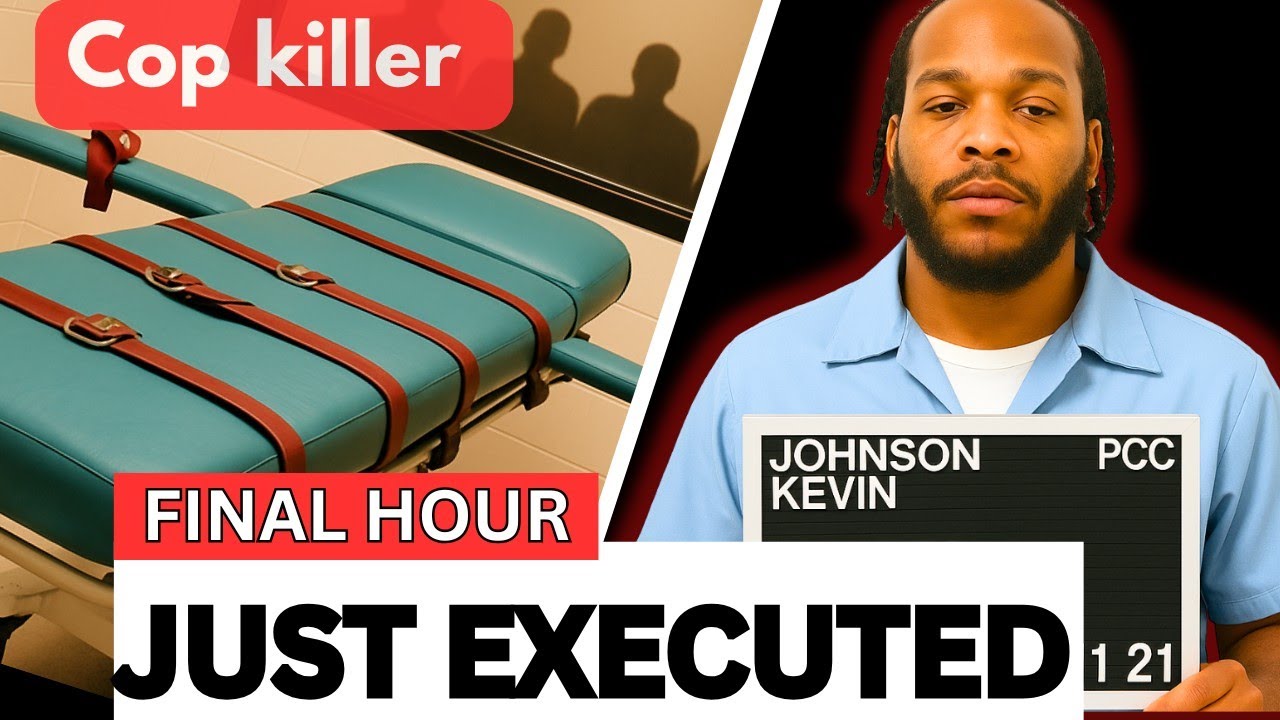
Missouri executed Kevin Johnson Jr. by lethal injection Tuesday evening at the Eastern Reception Diagnostic and Correctional Center in Bonne Terre, ending a 17‑year legal battle that divided a community and sparked fierce debate over racial bias in capital punishment. The 37‑year‑old death row inmate, convicted of killing Kirkwood police sergeant William McIntyre in 2005, was pronounced dead at 7:40 p.
m. after a final statement in which he expressed remorse for his crime and love for his daughter.
 Johnson’s final hours unfolded under the glare of national attention. His last meal consisted of a peanut butter and jelly sandwich, scrambled eggs, cereal, and milk — a standard prison tray he requested without any special accommodations. “I don’t want pity,” he told guards earlier in the day.
Outside the prison walls, hundreds of protesters braved freezing temperatures, holding candles and signs reading “Justice for Kevin” as clergy members and civil rights activists pleaded for clemency.
The execution proceeded despite a last‑minute petition from Johnson’s legal team, which argued that his death sentence was tainted by prosecutorial misconduct and racial discrimination. Missouri Governor Mike Parson denied clemency, stating in a brief declaration that “Mr. Johnson’s crime was horrific and the sentence was appropriate.”
The U. S. Supreme Court rejected the final appeal hours before the scheduled 6 p.
m. execution time.
Johnson’s final words, delivered calmly from the gurney, offered an apology to the McIntyre family while maintaining that he had grown beyond the person who committed the murder. “I am sorry for what I did. I am not the same person that I was.
I love my daughter. I love my family. I love my supporters.
Thank you for fighting for me. God is good,” he said, his voice steady as the lethal injection began.
The story of Kevin Johnson begins on July 5, 2005, in the historically Black neighborhood of Meacham Park in Kirkwood, Missouri. That afternoon, police arrived at the family home with a warrant for Johnson’s arrest over a minor probation violation. Johnson was not inside.
He watched from across the street as officers conducted a sweep of the property, ordering everyone out. In the chaos, his 12‑year‑old half‑brother, Joseph “Bam Bam” Long — who suffered from a severe congenital heart condition — collapsed on the front porch, gasping for air.
The family’s mother tried to reach her son, but Sergeant McIntyre prevented her from re‑entering the house until the search was complete. No immediate medical aid was rendered. By the time an ambulance arrived, Bam Bam was unresponsive.
 He died at the hospital from heart failure. Johnson, then 19, later recounted standing frozen as paramedics wheeled his brother away, convinced the officers’ rigid adherence to protocol had cost his sibling his life.
Just hours later, Johnson spotted McIntyre alone in his patrol car responding to a fireworks complaint. Overcome with grief and rage, Johnson raised a stolen 9mm handgun and opened fire. He shot McIntyre five times through the windshield.
The wounded sergeant drove a block before crashing into a tree. Johnson approached the stopped vehicle, stood over the fallen officer, and fired two more shots — one into McIntyre’s back, one into his head.
McIntyre, a 20‑year veteran and father of three, died at the scene. Johnson fled but surrendered the next morning at his sister’s apartment without resistance. He was charged with first‑degree murder.
The trial that followed became a flashpoint for deeper questions about justice, race, and accountability.
During the 2007 trial, prosecutors painted Johnson as a cold‑blooded executioner who ambushed a police officer in broad daylight. The defense argued that Johnson acted impulsively, driven by the trauma of his brother’s death and a childhood marked by poverty, a father serving life in prison, and a mother struggling with addiction. The jury found Johnson guilty of first‑degree murder but could not agree on a death sentence.
Under Missouri law, the judge overruled the deadlock and sentenced Johnson to death.
That decision ignited controversy. Civil rights groups, legal experts, and even some jurors argued that the case was a textbook example of racial bias in capital punishment. They noted that prosecutor Bob McCulloch had a history of seeking the death penalty disproportionately against Black defendants, especially in cases involving the killing of a police officer.
Special prosecutor E. Keenan later filed a 20‑page brief outlining evidence of selective prosecution, but no court granted relief.
Over the next 17 years, Johnson’s attorneys filed a series of appeals and clemency requests, each citing racial bias, prosecutorial misconduct, and the judge’s override of the jury’s deadlock. The U. S.
 Supreme Court declined to hear his case. As the execution date approached, Johnson’s daughter, Khorry — 19 years old — sought permission to witness his final moments. Missouri law requires witnesses to be at least 21.
The state denied her request.
Khorry said in a public statement, “My dad is the most important person in my life. The state is robbing me of the chance to say goodbye.” Johnson, heartbroken but resigned, wrote her a final letter.
In it, he urged her to live her life, be strong, and continue telling the truth about the system that allowed his execution to proceed.
Outside the prison gates, the protest crowd included ministers, students, activists, and families from both sides of the issue. St. Louis Circuit Attorney Kim Gardner, who had supported re‑examining the case, pleaded for a stay, citing “deep flaws in the process.”
Clergy members led prayers. But the state’s machinery moved forward.
At 5:30 p. m. , guards entered Johnson’s death watch cell.
He stood without resistance and walked calmly to the execution chamber, flanked by officers. The gurney waited. Strapped down, Johnson looked through the glass at the witnesses — among them members of McIntyre’s family.
He had repeatedly said he never hated the officer, but believed the system that failed his brother also led him down this path.
His final words completed. The lethal drugs began flowing. At 7:40 p.
 m. , Kevin Johnson was pronounced dead. His daughter, waiting in a separate room, held the letter he wrote her the night before.
Outside, the crowd fell into silence. Some held candles. Some wept.
Some shouted in anger.
The execution raises uncomfortable questions that persist long after the intravenous line is removed. Was this justice — the disciplined state response to a deliberate killing of a police officer? Or was this vengeance dressed in legal form, imposed on a young man shaped by poverty, trauma, and a system that failed him at every turn?
Johnson pulled the trigger. He admitted that. But the circumstances that led him to that moment — a dying brother, ignored by police; a childhood of neglect; a father in prison — complicate the narrative of pure villainy.
Missouri executed its seventh inmate in 2022. Johnson is the first Black man put to death in the state since a moratorium on executions was effectively lifted. His case echoes broader statistics: Black defendants are disproportionately sentenced to death, especially when the victim is white.
The judge’s override of a deadlocked jury remains a rare and controversial practice, one that critics say undermines the mandate of a unanimous jury.
For the McIntyre family, the execution closes a painful chapter. Sergeant William McIntyre left behind a wife, three children, and a legacy of service. They have endured decades of legal appeals and public scrutiny.
Johnson’s apology, while acknowledged, does not erase the loss.
But for Johnson’s supporters, the execution represents a moment of deep injustice. They argue that if the system had recognized his trauma and mental state, if the judge had respected the jury’s hesitation, if the process had accounted for racial bias, Kevin Johnson might still be alive today. Instead, he died with a peanut butter and jelly sandwich in his stomach and his daughter waiting in another room.
The question of mercy versus accountability will not be resolved by one execution. As the crowd outside Bonne Terre dispersed, the candles flickered out, and the prison gates closed, the debate did not end. It only moved on to the next case, the next appeal, the next death warrant.
For Kevin Johnson Jr. , the story is over. For the families, the lawyers, the activists, and the public, the reckoning continues.