Chapter One
The Daughter at the Service Entrance
My father called me a disappointment beneath a row of white wedding lanterns while I was carrying the folder that contained evidence of his bank fraud.
He did not know about the evidence.
He only knew the folder was heavy and that my younger brother had already gone inside.
“Peter has guests waiting,” Richard Riley said. “Try to move with some purpose.”
Rain swept across Chesapeake Bay, turning the late-October water the color of hammered iron. The Riley Harbor Club stood above the marina in a blaze of warm windows, cedar beams, and expensive promises. Inside, nearly two hundred guests drank champagne beneath arrangements of ivory roses.
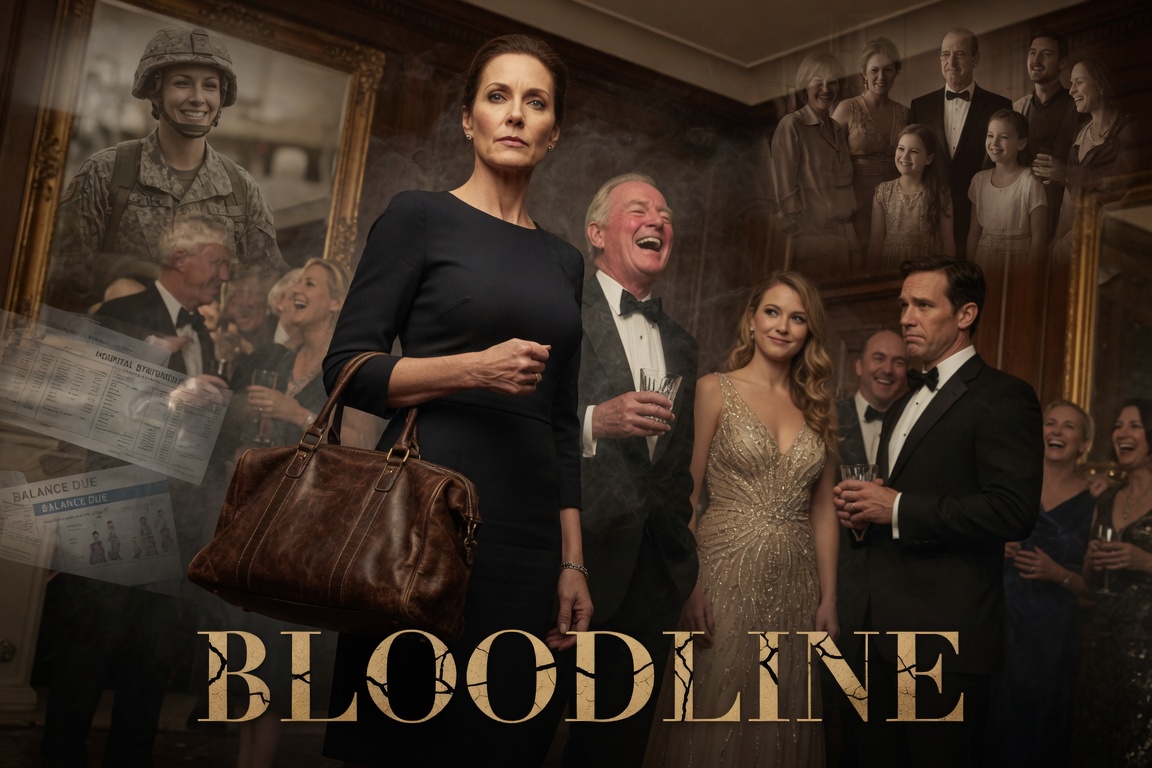
Outside, I held my father’s leather document case in one hand and the train of my sister’s wedding dress in the other.
Claire had run back inside when the wind threatened her veil. Her bridesmaids followed. My brother Peter disappeared with the banker.
That left me beside Dad beneath the service portico, exactly where the family had always found me most useful.
At fifty-one, I had learned how to hold more than one uncomfortable thing without dropping either.
Dad pointed toward the luggage cart.
“Your garment bag is still in the car.”
“I’m not changing.”
His gaze traveled over my midnight-blue suit, low shoes, and the silver beginning near my temples.
“You came to your sister’s wedding dressed for a deposition.”
“I came dressed for weather.”
“You always have an explanation.”
The corner of the document case pressed into my palm. My left wrist ached where a rescue hatch had crushed it thirteen years earlier. Cold rain made the damaged nerves twitch beneath the skin.
Dad noticed the movement and mistook it for uncertainty.
He often did.
“You could have made something of yourself if you had stayed in one place long enough,” he said.
The words were quiet, meant for family.
They reached three ushers, the photographer, and the retired Navy captain waiting near the entrance.
I adjusted Claire’s lace train over my forearm.
“I stayed in the Navy for twenty-seven years.”
“You stayed near the Navy.”
He gave a dry laugh.
“Paperwork. Committees. Washington offices. Your mother used to tell people you were involved in planning because she didn’t know how else to make it sound respectable.”
My mother had known exactly what I did.
She simply knew better than to describe classified rescue operations over church coffee.
Dad continued.
“Peter built a company. Claire built this place. You built a collection of airport receipts.”
The retired captain looked away.
I did not.
“Are you finished?”
His mouth tightened.
“That tone is why you have no family of your own.”
The rain hit the harbor roof hard enough to blur the silence that followed.
There were old insults a person could learn to ignore.
Then there were sentences that found fresh tissue every time.
I handed him the leather case.
He refused to take it.
“You’re already carrying it.”
Of course I was.
A gust lifted Claire’s train from my arm. I caught the lace before it touched the wet stone.
Behind us, the glass doors opened.
Commander Noah Grant stepped onto the portico in Navy dress whites.
He was forty-three, tall and lean, with a slight hitch in his right leg. A ribbon rack covered the left side of his uniform. The gold Trident above it told the guests he was a SEAL. The scar disappearing into his collar told a smaller group that he had survived something the medals could not explain.
Tomorrow, he would marry my sister.
Until that moment, we had spoken only twice.
Both conversations lasted less than a minute.
Claire had introduced me as her older sister who “did administrative work for the Navy.” Noah had studied my face with a concentration I recognized but could not place.
Now he stopped in the doorway.
His attention moved from my father to the leather case, then to my injured wrist.
Finally, he looked directly into my eyes.
The harbor wind pressed his white uniform against his frame.
“Say something,” he said.
Dad frowned.
“What?”
Noah did not look at him.
His gaze remained on me.
I understood.
Fifteen years earlier, inside the flooded engine compartment of the USS Harrier, I had kept a young lieutenant conscious by ordering him to recite the names of every man trapped behind the bulkhead.
He had never seen my face clearly. Emergency smoke covered the compartment. My helmet microphone distorted my voice.
But some memories do not require a face.
“Commander Grant,” I said, “your bride is waiting inside.”
His shoulders snapped back.
The groom came to attention on the rain-swept portico.
Every active-duty guest visible through the glass turned.
Noah raised his right hand.
“Rear Admiral Riley, ma’am.”
The words cut through the rain.
The retired captain near the door came to attention.
Then the ushers.
Inside the club, officers began standing before they understood why.
I returned Noah’s salute.
“At ease, Commander.”
He lowered his hand slowly.
Dad stared at me.
The color left his face in stages.
“Rear admiral?”
Two silver stars were not visible on my civilian clothes.
Noah’s recognition had made them appear anyway.
I handed Claire’s train to a bridesmaid who had returned to the doorway.
“Lower half,” I said. “Two-star.”
My father looked almost offended by the precision.
“You never told me.”
“You never asked a question long enough to hear the answer.”
His eyes flicked toward the guests now watching through the glass.
Humiliation moved across his face.
Not regret.
Not yet.
The distinction mattered.
He seized my elbow and lowered his voice.
“We are not doing this here.”
“You started it here.”
Peter Riley appeared behind him.
My brother wore a tuxedo that cost more than my first car and the smile he used when lenders needed confidence. At forty-six, he had inherited Dad’s height, Dad’s dark hair, and Dad’s belief that charm became truth when enough people depended on it.
“What happened?” Peter asked.
Dad pointed at me.
“She says she’s an admiral.”
Noah’s face hardened.
“She did not say it. I recognized my superior officer.”
Peter looked at the uniformed guests standing inside.
His smile vanished.
My father regained control first.
“Fine,” he said. “Wonderful. We will celebrate Amelia’s secret career after your sister’s wedding.”
He tapped the leather case against my hand.
“For now, take this upstairs. There are family trust documents inside. Sign the marked pages before dinner.”
I looked at the case.
“What documents?”
“The Harbor Club refinancing. Routine confirmations.”
“Why would I confirm a refinance?”
Dad’s jaw flexed.
“Because your mother left you an ownership interest.”
“How large?”
He glanced at Peter.
Peter looked toward the bay.
That answer was the first crack.
I opened the case.
Beneath place cards, seating charts, and a bottle of heart medication lay a blue legal folder.
Across the top page, in heavy black letters, were the words:
RATIFICATION OF PERSONAL GUARANTY AND MORTGAGE OBLIGATION
The borrower was Riley Maritime Holdings.
The guarantor was Rear Admiral Amelia Ruth Riley.
The debt was $8.4 million.
My signature already appeared on the final page.
I had never seen the document before.
Dad watched my face.
“Just sign beside the existing mark.”
I closed the folder.
“The existing mark is a forgery.”
The portico went silent.
Peter’s eyes moved toward the security cameras.
Dad’s voice dropped.
“Do not use that word at your sister’s wedding.”
“I did not choose the word.”
I placed the leather case on the luggage cart.
“Who notarized it?”
Peter spoke quickly.
“A digital service. There was a problem with the deployment paperwork.”
“I was in Guam on the date listed.”
“We know.”
Dad took one step closer.
His voice carried the old certainty that had controlled our family long before he learned to control companies.
“The estate needed you. You were unavailable. We handled it.”
Noah looked at the document.
“You forged a flag officer’s signature on an eight-million-dollar bank guarantee?”
Dad turned on him.
“This is family business.”
“No,” I said.
Rain blew beneath the portico and darkened the bottom of the legal folder.
“This became bank business when you borrowed the money.”
I looked at Peter.
“And federal business when someone falsified my travel records to make the signature appear possible.”
Peter stopped breathing normally.
Dad stared at me.
“You knew.”
“Yes.”
“For how long?”
“Five months.”
The first wedding bell rang from inside the club.
Claire would be standing near the staircase, wondering why no one had begun the rehearsal dinner.
My father’s face hardened.
“Then why are you here?”
I looked at the forged signature carrying my name.
“To see whether you would tell me the truth before asking me to lie.”
The second bell rang.
No one moved.
Then Peter’s phone vibrated.
He read the message.
His face went gray.
“The bank froze the closing account.”
Dad turned toward me.
“What did you do?”
I closed the folder.
“Not enough yet.”
Chapter Two
The Signature That Traveled Without Me
We moved the argument into the chart room because Claire’s wedding guests had begun collecting near the glass doors.
The room overlooked the marina from the second floor. Nautical maps covered the cedar walls. Brass lamps cast pools of yellow light over a table built from the polished deck of my grandfather’s first workboat.
My father sat at its head.
He had built the Riley family around tables like that.
Whoever occupied the largest chair controlled the story.
Peter closed the blinds.
Noah remained beside the door.
I did not ask him to stay.
He did not ask permission.
Dad placed both palms against the table.
“Unfreeze the account.”
“No.”
“Payroll is due Monday.”
“I know.”
“Eighty-six employees depend on that closing.”
“I know their names too.”
Peter looked at me.
“You pulled personnel records?”
“The court-appointed examiner did.”
Dad gave a sharp laugh.
“Court-appointed?”
“A temporary review order was signed this morning.”
“You went to court against your own family?”
“I went to court against fraudulent documents bearing my name.”
His jaw tightened.
“Language. You always hide inside language.”
“No.”
I looked at the folder.
“Language is where you hid the theft.”
Peter moved toward the window.
Outside, dock lines pulled against metal cleats. Wind made the sailboat masts strike one another in uneven notes.
“This was not theft,” he said.
“What would you call using someone’s identity to secure a loan without consent?”
“A bridge.”
“To where?”
Neither man answered.
Noah stepped forward.
“Admiral, do you want me to get Claire?”
Dad pointed toward him.
“You do not address her by rank in this room.”
Noah looked at my father.
“She earned the rank in rooms where men had much larger weapons than disapproval.”
Dad’s face flushed.
I raised one hand.
“Claire needs to know.”
“She needs to get married,” Dad said.
“Those are not competing events.”
“They are if you turn tomorrow into an arrest scene.”
I studied him.
“Is there a reason it should become one?”
The question found Peter.
His eyes moved to the floor.
Dad saw.
“Peter.”
My brother rubbed one hand across his mouth.
“The refinance was supposed to close tonight.”
“I know.”
“The east marina sale was tied to it.”
“What sale?”
He looked toward Dad.
Dad remained silent.
Peter answered.
“We sold the commercial pier to Marrow Development.”
The commercial pier had belonged to my mother’s trust.
My ownership interest covered forty-two percent.
“I did not approve a sale.”
Peter swallowed.
“The consent form contains the same digital signature.”
Noah’s jaw tightened.
“How many documents?”
Peter did not answer.
I opened my leather portfolio and placed a forensic report on the table.
“Twenty-three.”
My father’s face changed.
I continued.
“Four loan guarantees. Two property transfers. Seven board consents. Three insurance applications. A power of attorney created eighteen months after Mom’s death. The remaining documents opened revolving credit accounts linked to my military pension.”
Dad sat slowly.
Peter stared at the report.
“You have all of them?”
“The lender provided complete files after my security-clearance review flagged unexplained debt.”
Dad looked up.
“Your security clearance?”
“An admiral cannot owe eight million dollars without someone asking whether she is compromised.”
The words finally reached him.
He had not merely stolen a signature.
He had placed my career, clearance, and access to national-security information beneath his debt.
“You should have called me,” he said.
I almost laughed.
“You received four certified letters.”
“I thought they came from lawyers.”
“They did.”
“You know how many threats companies receive.”
“Those letters did not threaten the company. They invited you to explain.”
Peter sank into a chair.
Dad remained upright.
He had spent a lifetime turning posture into innocence.
“The Harbor Club was collapsing after your mother’s treatment,” he said. “Insurance denied half the claims. The shipyard lost the Navy subcontract. Banks would not touch us.”
“So you used my name.”
“You were deployed.”
“I was reachable.”
“You were never reachable when your mother needed you.”
The sentence was delivered softly.
That was how he made grief function as a weapon.
I felt the old call in my pocket again.
My mother had been dying in a hospice room in Norfolk while I directed the rescue of a submarine crew beneath the North Atlantic. I reached her six hours after she lost consciousness.
She never woke.
I had carried that absence longer than my father had carried any bag.
Noah watched my face.
He recognized the wound without knowing its history.
Dad continued.
“I made one decision to keep everything she built from disappearing.”
“One decision?”
He looked away.
I leaned forward.
“Forging my name once did not make you forge it twenty-two more times.”
“The first loan created obligations.”
“So did the first lie.”
Peter spoke.
“We believed the marina sale would clear everything.”
“And after the sale?”
“We would repay the guarantees.”
“With what money?”
His silence answered.
The company had become an engine consuming new credit to preserve the appearance of motion.
I turned to Dad.
“You called me here because the bank’s fraud review requires a wet signature.”
His eyes hardened.
“You are part owner.”
“I am also the person whose name you stole.”
“Family property belongs to the family.”
“Then why did the debt belong only to me?”
He looked toward Noah.
Because a stranger was watching, he straightened his cuffs before answering.
“You have no children. No mortgage. No one depending on you.”
The words were meant to reduce my life to available capacity.
Noah moved.
I stopped him with a glance.
“I have sailors depending on my judgment,” I said. “Employees depending on lawful payroll. A sister depending on tomorrow not becoming a lie she learns ten years from now.”
Dad’s mouth tightened.
“You think rank turned you into the only person qualified to decide.”
“No.”
I gathered the documents.
“I think consent still matters after people share a last name.”
The chart-room door opened.
Claire stood on the other side.
Her veil had been removed. Her auburn hair fell loose around her shoulders. She wore a white silk rehearsal dress and our mother’s pearl earrings.
“How much?” she asked.
Dad rose.
“Claire, sweetheart—”
“How much did you put in Amelia’s name?”
No one answered quickly enough.
Her eyes moved to me.
“Eight point four million,” I said. “Possibly more after contingent liabilities.”
She gripped the doorframe.
“Did you know about the east marina sale?” I asked.
“No.”
“Your signature appears on one consent.”
Her face emptied.
Peter stood.
“Claire, that document was administrative.”
She looked at him.
“Was it my signature?”
He said nothing.
Dad stepped around the table.
“This is not how we handle family problems.”
Claire backed away from him.
“How do we handle them?”
His hand stopped between them.
She continued.
“Do we sign for one another? Borrow through one another? Decide who can survive the truth?”
Dad’s face hardened.
“Everything you are standing inside exists because I refused to let this family fail.”
Claire looked beyond him toward the lanterns outside.
“The wedding?”
“The club. The marina. Your company. Peter’s shipyard. All of it.”
“And Amelia?”
Dad glanced toward me.
“She left.”
The word arrived as verdict.
Noah’s voice became quiet.
“She left because people were trapped beneath a burning ship.”
Dad turned.
“What?”
Noah looked at me.
I shook my head.
He ignored the warning.
“I was one of them.”
Claire stared.
Noah faced the family.
“Fifteen years ago, I served aboard the USS Harrier. An explosion flooded the engine compartments. Command believed the rescue corridor had collapsed.”
His fingers touched the scar beneath his collar.
“Rear Admiral Riley was a captain then. She entered through a maintenance shaft after the primary team withdrew.”
Dad looked at me.
“You never told us.”
Noah continued.
“She stayed in black water for forty-three minutes and opened the aft compartment by hand. Eleven sailors came out.”
His voice roughened.
“One did not.”
The room became still.
I saw Lieutenant Aaron Bell again beneath emergency light, his leg pinned behind the final hatch, ordering me to take the younger men first.
Noah said, “We knew her only as Harbor Six.”
Claire touched her mouth.
“You were Harbor Six?”
“Yes.”
Her eyes filled.
“Mom kept newspaper clippings about that rescue.”
“The articles did not name me.”
“She said the commander sounded like you.”
Dad looked from Noah to me.
For one second, pride almost reached him.
Then fear replaced it.
“If the public learns an admiral’s family committed financial fraud, what happens to us?”
There it was.
Not what happened to you.
What happens to us.
I closed the folder.
“The bank account remains frozen. Payroll and employee medical coverage are protected under a limited receivership.”
Peter looked up.
“You preserved payroll?”
“Yes.”
Dad stared.
“You already arranged a receiver.”
“A retired maritime judge and an independent operations team.”
“You are taking my company.”
“No.”
I held his gaze.
“I am stopping you from using employees as hostages to keep it.”
His phone vibrated.
He read the screen and went very still.
“What now?” Claire asked.
Dad looked toward me.
“The county recorder rejected the marina transfer.”
I nodded.
“The court order reached them first.”
His eyes narrowed.
“You planned this before coming.”
“Yes.”
“You came to watch me fail.”
“No.”
I looked through the closed blinds toward the wedding lanterns moving in the storm.
“I came hoping you would surprise me.”
Chapter Three
The Empire Built from Emergency
The rehearsal dinner began forty minutes late.
Claire insisted.
She changed into a simple blue dress, removed the pearls, and told the event staff to serve the guests without speeches. Noah remained near her. Peter disappeared into the office with three accountants.
Dad took his usual seat at the center table.
I sat near the back.
Not because anyone assigned me there.
Because I wanted to see the whole room.
Rain blurred the marina windows. Candlelight moved over silverware and faces pretending not to know something had happened upstairs.
Military guests glanced toward me.
Some knew my rank now.
Most understood enough from Noah’s salute.
No one approached.
For that, I was grateful.
A waiter placed untouched food before my father. He stared across the room at the family portraits mounted above the fireplace.
Riley shipbuilders.
Riley sailors.
Riley men shaking hands beside vessels bearing women’s names.
Our mother appeared in only two photographs.
I appeared in none.
Peter slid into the chair beside me.
“You could have warned me.”
“I did.”
“You warned Dad through lawyers.”
“I sent copies to you.”
His eyes flicked toward the room.
“Company mail is screened.”
“The letters went to your home.”
He rubbed his thumb against the edge of the tablecloth.
A childhood habit.
Peter had been ten when Dad first took him to the shipyard. He came home smelling of steel dust and admiration. I had been fifteen, already old enough to understand the invitation was not coming.
“Did you know the first signature was forged?” I asked.
“Yes.”
“Were you involved?”
“No.”
I waited.
He corrected himself.
“I scanned the Navy benefit form Dad used.”
“That is involvement.”
“I was twenty-one.”
“You were old enough to know my name was not his.”
His jaw tightened.
“Mom’s surgery was scheduled. The lender needed collateral. Dad said you would agree if we could reach you.”
“You could reach me.”
“You were on a submarine rescue exercise.”
“Messages still traveled underwater in 1996.”
He looked away.
“I was afraid you would say no.”
The answer was more honest than the others.
“Would that have been so terrible?”
“Mom might have died.”
My throat tightened.
The surgery extended her life by eighteen years.
Those years contained Claire’s graduation, Peter’s children, Sunday dinners I attended when operations permitted, and the final hospice room I reached too late.
The forged loan had purchased real time.
That did not transform theft into consent.
“I might have said yes,” I told him.
Peter looked at me.
“But you decided my answer was too dangerous to ask.”
He lowered his gaze.
“The business recovered. Dad repaid most of it.”
“Then used my name again.”
“The company expanded.”
“Without enough capital.”
“We employed people.”
“With debt hidden behind relatives.”
Peter’s voice hardened.
“You speak as if clean decisions exist.”
“I don’t.”
I looked toward the kitchen staff carrying plates.
“I speak as if dirty decisions still belong to the people who made them.”
He absorbed that.
At the center table, Dad stood and lifted his champagne glass.
Claire froze.
Noah’s hand covered hers.
Dad smiled toward the guests.
“My youngest daughter asked for no speeches.”
A few people laughed.
“She has spent thirty-eight years discovering that Rileys rarely follow instructions.”
More laughter.
Claire’s face remained still.
Dad continued.
“When my wife and I built this club, we wanted a place where family would always return.”
His eyes found me.
“Some children return because they love home. Others return because they believe a title gives them authority over it.”
The room quieted.
Peter whispered, “Dad, stop.”
He did not.
“I have one daughter who stayed and created beauty. One son who carried our workers through recessions. And another daughter who spent her life leaving, only to arrive tonight with lawyers.”
Claire stood.
“Dad.”
He raised the glass.
“I am proud of the children who understand loyalty is not written in court orders.”
I rose slowly.
The entire room watched.
Noah started toward me.
I shook my head.
My father expected anger.
Public anger would allow him to become the wounded patriarch and me the powerful officer destroying a wedding.
I lifted my water glass.
“To loyalty,” I said.
The room remained silent.
“It deserves a definition before anyone is punished for lacking it.”
Dad’s smile disappeared.
I continued.
“Loyalty does not require signing another person’s name. It does not require children to guarantee debts they never approved. It does not use employees’ paychecks to prevent questions.”
The bank’s regional compliance officer sat three tables from the front.
My father had invited him to celebrate the closing.
He now stared at his plate.
“I did not come with police,” I said. “I did not ask the receiver to interrupt the wedding. Payroll will clear. Medical coverage remains active. Every employee keeps working while the court reviews the company.”
Dad lowered his glass.
“But you and Peter no longer control the accounts.”
A murmur moved through the room.
Dad’s knuckles whitened.
“You planned to humiliate me.”
“If humiliation had been the goal, the service would have happened before dinner.”
Noah’s eyes met mine.
He understood.
A sheriff’s deputy and two bank investigators had waited in vehicles beyond the east gate since sunset.
I had asked them to remain there unless assets moved.
Dad stepped away from the microphone.
“You think you saved everyone.”
“No.”
My voice softened.
“I preserved their choices. That is different.”
He looked toward the windows.
A lightning flash illuminated the marina.
Then every light in the Harbor Club went out.
Guests gasped.
Emergency lanterns glowed red along the walls.
Peter checked his phone.
“No network.”
A distant engine started near the docks.
I looked toward my father’s empty place at the center table.
He was gone.
So was the hardware token required to move Riley Maritime’s reserve funds.
Chapter Four
Pier Nine
We found Dad on Pier Nine aboard the Margaret Ruth, the forty-six-foot motor yacht he had named after my mother.
Rain slashed sideways across the marina. Dock lines strained. White caps broke between the pilings as the Chesapeake storm pushed water over the lower boards.
Noah came with me.
Claire remained inside with the guests.
Peter stayed beside the accountants, attempting to restore the network Dad had ordered disconnected.
The yacht’s cabin glowed through rain-streaked windows.
Dad sat before a laptop at the navigation table. The hardware banking token rested in his palm.
I entered without drawing attention to the sheriff’s deputies waiting near the fuel shed.
Noah stopped outside the cabin.
This was not a tactical operation.
It was a daughter entering the room where her father had taken the money.
Dad looked at my wet suit.
“You brought the groom.”
“He brought himself.”
“You always collect loyal men.”
The remark carried old contempt.
I closed the door behind me.
“How much are you transferring?”
“Enough to keep Marrow Development from seizing the shipyard.”
“The court order prevents the seizure.”
“Temporary.”
“So is every transfer you make tonight.”
He typed a code.
The banking page displayed an overseas escrow account.
Three million one hundred thousand dollars.
“Where is that account?”
“A holding company.”
“Controlled by whom?”
His eyes remained on the screen.
“People who understand urgency.”
“Peter?”
“No.”
That concerned me.
Dad’s fingers trembled above the keyboard.
“The receiver will liquidate us,” he said.
“The receiver is required to preserve viable operations.”
“Judges have never built ships.”
“Neither have you in twelve years.”
He looked up.
Pain moved across his face before anger covered it.
“I built the company that taught your brother to lead.”
“You built a company Peter has been hiding losses inside.”
“To protect the workforce.”
“To protect your name.”
He struck the table with one palm.
“My name paid those men when the Navy canceled contracts. My name kept the club open when your mother’s bills arrived. My name persuaded banks to wait.”
“And when your name stopped being enough, you used mine.”
“You were family.”
“I was collateral.”
The yacht shifted beneath us.
A framed photograph slid from the table and struck the floor.
My mother stood in the picture beside Dad at the Harbor Club opening. She wore a blue dress and the tired smile of a woman who had spent the day solving problems nobody would later remember existed.
Dad looked at the photograph.
His anger lowered.
“My father lost his shipyard in 1979,” he said. “Two hundred men came to our house asking when they would be paid. He sat at the kitchen table with an unloaded revolver and told me he had become useless.”
I had heard only the version where my grandfather died of a stroke.
Dad continued.
“I took it from him before he found ammunition.”
Rain hammered the roof.
“He died six months later. Every person in town remembered the business failure. Nobody remembered the hulls he built during the war.”
His thumb moved over the bank token.
“I promised my children would never watch the Riley name collapse.”
There was the engine beneath everything.
Not greed.
Terror passed down as tradition.
“You thought failure was the worst thing a family could witness,” I said.
“It is.”
“No.”
I looked at the forged transfer authorization on the laptop.
“Watching someone call control love is worse.”
His face tightened.
“You learned to say things like that in Washington?”
“I learned it from sailors trapped behind doors designed by people who knew better.”
Dad looked toward the cabin entrance.
Noah stood in the rain beyond the glass.
“He saluted you.”
“Yes.”
“Did that feel good?”
The question surprised me.
I took time.
“For a second.”
“After all the years I called you a secretary.”
“Yes.”
His expression became bitter.
“So this is revenge.”
“No.”
I stepped closer.
“Revenge would be letting you transfer the money and watching the fraud charge become impossible to negotiate.”
His hand stopped.
“The account is frozen,” I said. “The page is a controlled mirror created by the bank.”
He stared at the screen.
The transfer button remained active.
The destination account did not exist.
“You trapped me.”
“I gave you one last opportunity to stop without being stopped.”
His shoulders lowered.
For the first time that night, he looked seventy-five.
“I was going to put it back.”
“From where?”
He had no answer.
The yacht lurched against the dock.
Dad rose too quickly. His knee struck the table. The heart medication fell from his coat and rolled beneath the bench.
He bent toward it.
The vessel shifted again.
His body struck the cabin door, which flew open toward the dark water.
I caught the back of his jacket before he went over the rail.
Pain tore through my injured wrist.
Noah grabbed Dad’s other arm and pulled him onto the dock.
For several seconds, my father lay on wet boards between us.
He looked at my hand locked around his sleeve.
“Why?”
Rain ran across his face.
“Why what?”
“Why save me?”
I released him.
“Because boundaries are not death wishes.”
He looked away.
A deputy approached from the fuel shed.
Dad saw the badge.
His body went still.
I knelt so we were level.
“You will not be arrested in front of the guests tonight unless you attempt to leave or destroy evidence.”
“You arranged that too.”
“Yes.”
“Why?”
“Claire deserves to choose what happens at her wedding.”
He stared at me.
“You arranged everything except forgiveness.”
“That part is not administrative.”
The deputy collected the bank token and laptop.
Dad sat against a piling while Noah found the heart medication.
Before swallowing the tablet, my father looked toward the Harbor Club.
“There is another loan.”
I waited.
“Peter signed Claire’s name.”
My chest tightened.
“Does she know?”
“No.”
“How much?”
“Two million.”
“What property?”
Dad closed his eyes.
“Her house.”
Chapter Five
The Bride Who Walked Herself
Claire did not cry when I told her.
She removed the wedding ring Noah had given her during their engagement and placed it on the reception table, not because she planned to leave him, but because her fingers had begun swelling around it.
“My house,” she said.
We sat in the club’s bridal room at two in the morning. Candles burned along the vanity because full power had not returned. Her white gown hung from a brass hook. Rain pressed against the windows.
Peter stood near the door.
Dad remained aboard the yacht under medical supervision and deputy observation.
“You signed my name?” Claire asked our brother.
Peter’s eyes reddened.
“I used the signature file from the wedding contracts.”
She looked at him.
“How much of my life is stored in places you can steal from?”
He flinched.
“The loan kept the event company operating.”
“You mean my company.”
“Yes.”
“You told me our clients paid late.”
“They did.”
“You told me the club covered payroll.”
“It couldn’t.”
Claire folded her arms around herself.
“So I thought Dad was supporting me while you were borrowing against my house.”
Peter’s face broke.
“I was going to fix it after the marina sale.”
“Everyone in this family plans to become honest after the next transaction.”
Noah stood beside the window.
He had changed from dress whites into a dark sweater and uniform trousers. Mud marked one knee.
Claire turned toward him.
“Did you know Amelia was an admiral before tonight?”
“No.”
“But you knew Harbor Six was a woman.”
“Yes.”
“And you suspected?”
“When she spoke on the portico.”
Claire looked toward me.
“Why didn’t you tell me?”
“Because Noah’s rescue remained partly classified.”
“That is the professional answer.”
I nodded.
“The personal answer is that I was afraid you would tell Dad.”
Her face tightened.
“And?”
“He would have used it.”
“For what?”
“Donations. Contracts. Invitations. Proof that the family mattered.”
Claire looked toward the mirror.
Our mother’s pearl earrings remained on the table.
“You thought all of us were him.”
“No.”
“But you treated us as possible extensions of him.”
The truth settled heavily.
“Yes.”
She faced me.
“You keep saying yes as if confession is enough.”
“It is not.”
“What do you want from me?”
“I want you to decide whether tomorrow happens.”
“My wedding?”
“Your wedding. Not Dad’s demonstration of family stability. Not the bank’s closing event. Yours.”
Noah stepped away from the window.
“Claire, I will marry you in this room, on the dock, or next year. I will not ask you to perform happiness for guests who came for dinner.”
She stared at him.
“What do you want?”
“You.”
“That sounds simple.”
“It isn’t.”
He looked toward Peter.
“I also want a marriage where nobody signs the other person’s name because they believe love guarantees permission.”
Claire’s eyes filled.
Peter lowered his head.
The bride crossed the room and opened the wardrobe.
She removed the elaborate gown.
Then she reached behind it for a plain ivory dress she had planned to wear at brunch.
“We marry at ten,” she said.
Noah’s breath caught.
“Here?”
“No.”
She looked toward the water.
“At the old boat chapel.”
The chapel stood beside the abandoned shipbuilding shed where our parents married. It held forty people if nobody objected to closeness.
“What about the guests?” Peter asked.
“They can have breakfast at the club.”
“And Dad?”
Claire’s face became still.
“He may attend if he does not walk me down the aisle, make a speech, discuss money, or ask anyone to protect his feelings.”
Peter stared.
“He’ll say you’re punishing him.”
“I am removing privileges he used as weapons.”
She looked at me.
“Does that sound like something an admiral would approve?”
“No.”
Her eyebrows rose.
“It sounds like something a woman who owns her name can decide without approval.”
Claire nodded.
Then she picked up the engagement ring and placed it back on her finger.
At nine forty-five, the storm broke.
The clouds opened above Chesapeake Bay, leaving the water bright and rough beneath a cold blue sky. Forty-two guests gathered inside the old chapel. No photographers stood in the aisle. No bankers waited near the reception.
Dad arrived alone.
He wore the same dark suit, wrinkled now, and carried no umbrella. A deputy remained near the road.
Claire met him outside.
I watched from the chapel doorway.
“You look beautiful,” he said.
She did not thank him automatically.
“Do you understand the conditions?”
“Yes.”
“No speech.”
“Yes.”
“No discussion of the company.”
“Yes.”
“You sit in the third row.”
Pain crossed his face.
“I am your father.”
“That is why you have a seat.”
He absorbed the line.
Then nodded.
Claire entered the chapel alone.
Halfway down the aisle, she stopped beside me.
“Walk with me?”
Dad looked up from the third row.
I looked at my sister.
“Are you sure?”
“Yes.”
I offered my arm.
We walked the remaining steps together.
Noah waited at the front in Navy dress whites.
When Claire reached him, he did not ask me for permission.
He asked her.
“Still your choice?”
She smiled through tears.
“Yes.”
Then Noah looked at me and came briefly to attention.
“Rear Admiral, ma’am.”
The room became quiet.
He did not salute this time.
“This is not a report,” I said.
“No, ma’am.”
“Then marry my sister before weather changes its mind.”
Laughter moved through the chapel.
Claire kissed his cheek before the vows began.
In the third row, my father lowered his face.
For once, nobody rushed to make the moment easier for him.
Chapter Six
The Difference Between Saving and Owning
The legal process took fourteen months.
There was no single cinematic verdict.
No judge struck a gavel and returned our childhoods.
Bank fraud came apart through audit trails, recorded meetings, notary logs, copied signatures, and men explaining why they believed temporary dishonesty would eventually become repayment.
Peter cooperated first.
He surrendered company devices, identified every forged document, and admitted he had used Claire’s signature. Prosecutors recommended probation, restitution, and a three-year ban from fiduciary positions.
Claire did not ask for prison.
She also did not ask the court to spare him.
“I’m his sister,” she told the judge. “That relationship should not be used as evidence against accountability.”
Dad pleaded guilty to conspiracy, bank fraud, and identity theft.
Age, heart disease, repayment efforts, and cooperation kept him out of federal prison. He received home confinement, probation, and restitution orders that required the sale of the Harbor Club.
He called the sale the death of the family legacy.
The employees called it Friday.
The court-appointed receiver separated the viable shipyard operations from the debt-heavy holding company. An employee ownership trust purchased fifty-one percent using recovered assets and a legitimate credit facility.
Eighty-one of the eighty-six jobs survived.
The event company survived too.
Claire renamed it Open Harbor.
No relatives could access accounts without dual independent approval.
My credit record was corrected. The false mortgage disappeared from my clearance file. The Navy inquiry found no misconduct by me, though I received formal criticism for allowing the fraud investigation to remain covert while classified-system access concerns were evaluated.
The criticism was fair.
I had let the case grow because I wanted a complete pattern.
People I loved carried part of the risk without knowing.
Noah understood that better than most.
“You saved the company,” Dad said during our first supervised conversation.
We sat in a therapist’s office overlooking a strip mall in Norfolk. He wore an ankle monitor beneath khaki trousers. I wore civilian clothes.
“I preserved part of it.”
“You could have preserved all of it.”
“Not under your control.”
His jaw tightened.
“There. That was the real goal.”
“No.”
I folded my hands.
“The goal was to separate people’s livelihoods from your fear.”
“You think I owned people?”
“You believed saving them gave you rights over them.”
He looked toward the therapist.
“She speaks like this even when no court reporter is present.”
The therapist waited.
Dad looked back at me.
“I paid for your academy preparation.”
“Yes.”
“Your mother’s treatment.”
“Yes.”
“Peter’s mistakes. Claire’s first business. Your grandfather’s debts.”
“Yes.”
“What did you ever pay for?”
The old question.
Not money.
Debt disguised as belonging.
I took time before answering.
“I spent twenty-seven years believing I had to become impressive enough that you would stop treating love as an invoice.”
His face changed.
“You think I didn’t love you?”
“I think you loved what you could require from me.”
“That is not fair.”
“No.”
I held his gaze.
“It is accurate.”
He looked toward the window.
Cars moved through afternoon rain outside. Ordinary people carried groceries, picked up children, and entered lives where our family name meant nothing.
“Did the salute make you happy?” he asked again.
“Yes.”
He nodded slowly.
“At least you admit it.”
“It felt like the room finally corrected you.”
His eyes dropped.
“And then?”
“Then I realized the room should not have needed a commander to decide I deserved respect.”
For the first time, Dad did not defend himself immediately.
He rubbed one thumb across the other hand.
“What do I call you now?”
“Amelia.”
“Not Admiral?”
“Not in family conversations.”
His mouth tightened with something like shame.
“I told everyone you dropped out.”
“Yes.”
“I knew you had stayed in the service.”
“You knew enough to know the story was false.”
“Yes.”
The word sounded difficult in his voice.
He looked at me.
“Why didn’t you correct me?”
“I did. For years.”
“No. Why didn’t you make me understand?”
The therapist shifted slightly.
Dad heard his own question.
He closed his eyes.
When he opened them, he looked older.
“That was another way of making you responsible.”
“Yes.”
He nodded.
Then he did something no medal, court order, or military title had ever forced him to do.
He sat with the answer.
Chapter Seven
The Question He Finally Asked
Two years after Claire’s wedding, the former Riley shipyard launched its first employee-owned rescue vessel.
The ceremony took place on a bright May morning. Steel rang through the harbor. Welders stood beside engineers, office staff, apprentices, and families. No portrait of my father hung above the platform.
His name remained on a small plaque listing the company’s founders.
History did not need to erase him in order to stop obeying him.
The new vessel was called Consent.
Peter thought the name was too pointed.
Claire said that was why she liked it.
Noah stood beside her holding their six-month-old daughter beneath a small white sunhat. When the baby began crying during the speeches, he carried her behind the stage and continued listening without pretending command required silence.
Dad attended under the terms of his probation.
He used a cane now.
The ankle monitor was gone.
Before the ceremony, he waited near the entrance beside two folding chairs.
When I approached, he lifted one.
“Would you like me to carry that?” I asked.
He looked suspicious.
“Is this a test?”
“No.”
He considered the chair.
Then held it out.
I took one.
He carried the other.
We walked toward the water side by side.
No one saluted.
Several retired sailors recognized me and nodded. Employees called me Amelia because that was how Claire introduced me.
Dad seemed uncomfortable without a title to borrow or dismiss.
We sat near the rear.
The vessel’s white hull reflected sunlight across his face.
After the launch, he remained quiet while people moved toward lunch tables.
Finally, he said, “What did you actually do in the Navy?”
I looked at him.
He did not say it mockingly.
He did not ask which admirals I knew, what contracts I could influence, or whether any of my operations would impress the men nearby.
He simply waited.
The question arrived nearly thirty years late.
It still counted as arriving.
“I commanded submarine rescue and maritime recovery operations,” I said.
“What does that mean?”
“Sometimes a ship or submarine is damaged where ordinary teams cannot reach it. We build a way in.”
“Did you dive?”
“Earlier in my career.”
“Were you good?”
“Good enough to understand why skill should never be confused with invulnerability.”
He nodded, absorbing rather than ranking.
“Noah said you saved him.”
“His team saved one another. I opened a hatch.”
“You always make your part smaller.”
“Sometimes.”
“Why?”
I looked toward the Consent as tugboats guided it into open water.
“Because people turn one visible person into the whole story. It helps them avoid learning how many quiet failures created the emergency.”
Dad watched the vessel.
“Did I do that with Peter?”
“Yes.”
“And make you the failure?”
“Yes.”
His fingers tightened around the cane.
“I don’t know whether I can repair that.”
“You cannot repair the years.”
He accepted the sentence.
“What can I do?”
“Stop telling my story for me.”
He nodded.
“Anything else?”
“Ask before using my name.”
A faint smile touched his mouth and vanished.
“Legally or conversationally?”
“Both.”
Claire called us toward the family table.
Dad began to rise, then paused.
“May I introduce you to one of the old shipyard foremen?”
The question was so ordinary that it hurt.
“Yes.”
“How?”
“Amelia. Your daughter.”
He stood.
“That is enough?”
“It always should have been.”
We walked toward the tables.
The former foreman rose when he saw us. He was nearly eighty, with hands shaped by steel work and hearing aids larger than Dad’s.
Richard Riley stopped beside him.
“This is Amelia,” he said.
He glanced at me before continuing.
“My daughter.”
Nothing about disappointment.
Nothing about dropping out.
Nothing borrowed from my rank.
The old foreman smiled and held out his hand.
“I’ve heard very little about you.”
Dad’s face tightened.
He could have filled the silence.
Corrected the record.
Displayed the rear admiral.
Instead, he looked at me.
I took the man’s hand.
“Then perhaps we should start with the truth.”
Behind us, the rescue vessel sounded its horn as it entered the Chesapeake.
The note rolled across the shipyard, deep enough to be felt through the concrete.
My father did not speak for me.
He stood beside me and listened.