The SS commander believed 97 dead prisoners could never testify against him.

He was almost right.
On January 21, 1949, inside Hamelin Prison in British-occupied Germany, former Waffen-SS officer Fritz Knöchlein was led toward the gallows.
Nine years earlier, he had commanded the SS company responsible for one of the most notorious massacres of British prisoners during the retreat to Dunkirk.
The victims had surrendered.
They had been disarmed.
Many were wounded.
Then they were marched into a field and placed in front of two machine guns.
Ninety-seven men died.
Knöchlein might have escaped justice completely—except two soldiers beneath the pile of bodies were still breathing.
This is the story of what happened at Le Paradis.
And of the two men who returned from the dead to face the officer accused of ordering their execution.
In May 1940, the British Expeditionary Force was collapsing toward Dunkirk.
German armored formations had broken through France with terrifying speed. Roads were crowded with retreating soldiers, abandoned vehicles, refugees and wounded men trying to reach the coast.
Every hour mattered.
While hundreds of thousands of Allied troops moved toward evacuation, small British units were ordered to hold crossroads, bridges and villages for as long as possible.
Their purpose was simple.
Delay the Germans.
Buy time for everyone else.
Near the hamlet of Le Paradis in northern France, men of the 2nd Battalion, Royal Norfolk Regiment, found themselves isolated.
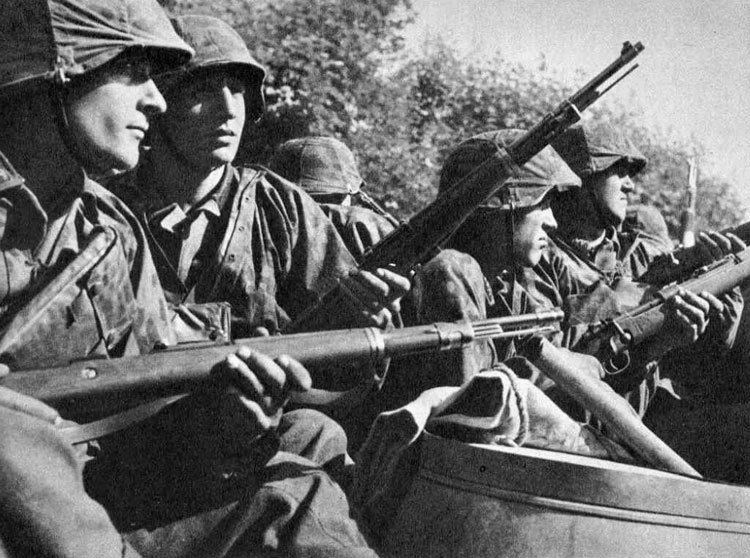
They had been defending positions around a farmhouse against troops from the SS Totenkopf Division—an organization shaped by Nazi ideology and closely associated with the concentration camp system.
The British defenders were exhausted.
Some were injured.
Their ammunition was disappearing.
Yet they continued firing because men farther north were still trying to reach Dunkirk.
The farmhouse walls were struck repeatedly. Bullets cut through windows and doors. German fire closed in from several directions.
There would be no rescue.
Eventually, the British soldiers reached the point every infantryman feared.
They had almost nothing left to shoot.
With their position surrounded and further resistance hopeless, the surviving defenders surrendered on May 27, 1940.
Under the laws of war, the fighting should have ended for them at that moment.
They were prisoners now.
They could be searched, questioned and transported to a camp.
They could not legally be executed.
The men emerged from their position with their hands raised.
Among them were Privates Albert Pooley and William O’Callaghan.
They had survived the battle.
They believed the worst was over.
It was only beginning.

The prisoners were disarmed and placed under guard.
Then the SS soldiers marched them along the road.
At first, nothing may have seemed unusual. Captured soldiers were routinely moved away from battlefields before being transported to the rear.
But the column was not taken toward a prisoner collection point.
It was turned through a gateway and into a meadow beside farm buildings.
Pooley saw what was waiting there.
Two machine guns had been positioned facing the prisoners.
The British soldiers were ordered into a line beside a wall.
There was nowhere to run.
No cover.
No warning that could change what was about to happen.
The machine guns opened fire.
Men collapsed into one another as bullets swept through the line. The wounded fell beneath the dead. The sound of gunfire was mixed with shouting, cries and the impact of bodies striking the ground.
Pooley was hit.
He fell with the others.
O’Callaghan also went down.
Within moments, almost the entire group lay motionless.
But the SS soldiers were not finished.
They moved among the bodies, checking for signs of life.
Some wounded prisoners were reportedly shot again or stabbed with bayonets.
Pooley remained still beneath the weight of dead comrades, forcing himself not to react as the soldiers approached.
A movement could mean a bullet.
A breath could mean a bayonet.
O’Callaghan was nearby, also alive beneath the bodies.
Neither man knew that the other had survived.
They only knew that the killers were close enough to hear.
Eventually, the SS soldiers left.
The meadow became silent.
Around Pooley and O’Callaghan lay 97 British servicemen who would never return home.
The place was called Le Paradis.
Paradise.
But on that afternoon, it had become an execution ground.
Pooley was badly wounded.
O’Callaghan pulled himself from beneath the bodies and found him.
The two survivors crawled away from the killing site and hid, knowing that the same soldiers might return.
They had no medical supplies.
No friendly unit nearby.
No clear route to safety.
French civilians eventually helped them, risking punishment if German forces discovered what they had done.
But the escape did not last.
The two men were later captured and spent the remainder of the war as prisoners.
For years, the massacre remained largely unknown outside a small circle.
The Germans had left almost no living witnesses.
The dead could not identify the officer in command.
The two survivors were behind barbed wire.
And Europe had descended into a war filled with so many atrocities that one remote field in northern France could easily disappear beneath the weight of everything that followed.
Knöchlein continued his military career.
He fought on other fronts, received decorations and rose through the Waffen-SS.
To those around him, he could still appear to be a successful officer.
The men in the meadow had become an inconvenient memory.
From his perspective, the evidence had been buried with them.
But Albert Pooley had not forgotten.
After the war ended in 1945, Pooley returned home carrying more than physical wounds.
He knew what he had seen.
He knew British soldiers had surrendered and been deliberately killed.
But a survivor’s account was not automatically enough to produce a prosecution.
Europe was in ruins. Governments were sorting through mountains of evidence from concentration camps, mass executions and battlefield crimes.
Records were missing.

Witnesses were scattered.
Suspects used false names or disappeared among millions of displaced people.
At first, Pooley struggled to make authorities understand the importance of Le Paradis.
Then William O’Callaghan returned from captivity.
Now there were two witnesses.
Two men who had entered the meadow.
Two men who had heard the machine guns.
Two men who had survived beneath the same pile of bodies.
Their accounts supported one another.
Investigators began reconstructing what had happened.
French civilians were interviewed.
German prisoners were questioned.
Military units were identified.
Documents were examined.
Gradually, the investigation moved toward the commander of the SS company involved.
Fritz Knöchlein.
The officer who had once stood on the side with weapons, soldiers and authority was now the man being hunted.
The prisoners he believed had been silenced were giving statements.
The battlefield hierarchy had begun to reverse.
Knöchlein was eventually located and brought before a British military court in Hamburg.
His trial began in October 1948.
The charge stated that he had been involved in the killing of British prisoners of war near Paradis on May 27, 1940.
Knöchlein pleaded not guilty.
His defense attempted to create distance between him and the massacre. It claimed he had not been present when the prisoners were killed.
Other allegations were raised about British conduct during the earlier fighting, including claims involving illegal ammunition and misuse of a flag of truce.
But those arguments could not erase the central issue.
The men in the meadow were prisoners.
They had surrendered.
Even accusations concerning their actions before surrender could not legally justify lining them up and killing them without trial.
Then the two survivors entered the case.
Albert Pooley testified.
William O’Callaghan testified.
For Knöchlein, they were no longer wounded soldiers hidden beneath bodies.
They were witnesses standing in a courtroom.
They described the surrender.
The march.
The machine guns.
The shooting.
The bodies.
The silence afterward.
French witnesses and evidence gathered by investigators helped connect Knöchlein to the SS unit responsible.
The courtroom now contained something the meadow had not.
A record.
Every statement was heard.
Every defense could be questioned.
Every contradiction could be examined.
The officer who had possessed absolute power over unarmed prisoners no longer controlled what happened next.
He had to sit and listen while men he had believed dead described the crime.
The moment of recognition did not arrive with machine-gun fire.
It arrived in silence.
On October 25, 1948, the court announced its decision.
Guilty.
Knöchlein had built his defense around distance, denial and uncertainty.
But the two survivors had closed that distance.
Their existence changed the entire case.
Without them, the massacre might have remained an allegation associated with an unidentified SS formation.
With them, the field at Le Paradis had voices.
The court sentenced Knöchlein to death.
After the verdict, the balance of power was complete.
The former SS commander appealed for mercy, referring to his wife and four children who depended on him.
Nine years earlier, 97 prisoners had stood helpless in front of his company’s machine guns.
They had families too.
Many had parents, wives, children, brothers or sisters waiting for news.
They had received no hearing.
No appeal.
No opportunity to ask for mercy.
Now Knöchlein was asking the court to consider the human consequences of taking a life.
It was a consideration the prisoners at Le Paradis had never been given.
On January 21, 1949, Fritz Knöchlein was executed by hanging at Hamelin Prison.
He was 37 years old.
His death could not restore the 97 men killed in the meadow.
It could not return lost years to their families.
It could not remove the memories carried by Pooley and O’Callaghan.
And it did not mean that every person involved in the massacre had been punished.
But the conviction established something that had once seemed impossible.
The surrendered men had not simply vanished in the chaos of war.
Their murder had been investigated.
The officer held responsible had been identified.
The survivors had been heard.
And a crime committed against powerless prisoners had followed its commander long after the battlefield uniforms, weapons and authority were gone.
The most important part of the story was not the rope at Hamelin.
It was the breath Albert Pooley and William O’Callaghan refused to surrender beneath the bodies of their friends.
The killers had machine guns.
The survivors had memory.
For nine years, memory was enough.
Because power can silence a man for a moment—but it cannot guarantee that the truth has died with him.