In the final days of World War II, a young woman walked toward her own death.

Her name was Hererta Kasparowa.
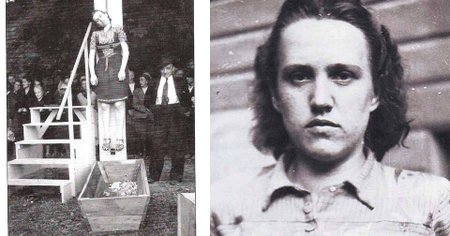
Only 23 years old, she was brought to the execution site in Trest, terrified and unable to control her fear. Soldiers had to support her as she approached the place where her life would end.
It was a shocking reversal.
Only weeks earlier, she had held power over others.
She had pointed at people and decided their fate.
Now, she was the one facing judgment.
But how did a girl from a small town become one of the most hated figures in her community?
Hererta was born on June 21, 1923, in Trest, a town in the Sudeten region where German and Czech communities lived side by side.
Her family was ordinary.
Her father worked on the railway.
At home, they spoke German and tried to adapt to the changing political world around them. Like many families in the region, they adjusted their identity depending on which side held power.
But Hererta grew up feeling different.
She was born with a disability in her right leg, causing her to walk with a noticeable limp.
At school, she experienced constant humiliation.
Other children mocked the way she walked. Some imitated her movements. Others whispered and laughed.
She tried to fit in.
She joined local activities.
She learned Czech.
She made friendships.
But the feeling of being an outsider remained.
Over time, shame turned into anger.
Then came the rise of Nazi Germany.
After Germany took control of the Sudetenland and later occupied the Czech lands, the balance of power changed completely.
Suddenly, German identity brought advantages.
The people who had once felt like outsiders gained influence.
For Hererta, the occupation created something she had never possessed before:
Power.
The same society that had once mocked her was now under the control of a regime that valued her background.
And she chose to use that opportunity.
Around 1940, Hererta began working with German police authorities.
Officially, she worked as an administrator and translator.
But her role placed her inside the machinery of Nazi repression.
She translated interrogations.
She assisted German investigators.
She stood close to prisoners being questioned and abused.
Her knowledge of Czech and German made her useful.
The same ability that once helped her communicate with different communities now helped a system designed to destroy them.
Instead of resisting the violence around her, Hererta became part of it.
She moved to Zlín, an important regional center for German security operations.
There, her position became more significant.
She was no longer just a translator.

She became a link between Nazi authorities and local information.
Every name she provided.
Every statement she translated.
Every person she identified.
Could lead to arrests, torture, and death.
But for Hererta, the Nazi system also offered something personal.
A chance to punish those she believed had humiliated her.
Her cooperation was not only political.
It was deeply connected to resentment that had followed her since childhood.
She used the power of the occupation to settle old feelings of anger.
Then, in May 1945, everything collapsed.
Germany was losing the war.
Hitler was dead.
The Nazi occupation was falling apart.
Across Czech lands, people rose against German control.
Trest also rebelled.
For a brief moment, the town believed freedom had arrived.
But the SS returned.
On May 7, 1945, German forces moved back into Trest to crush the uprising and punish those involved.
They needed information.
They needed someone who knew the town.
They needed someone who could identify people.
They turned to Hererta.
In the town square, men were gathered together.
Some had fought in the resistance.
Others were simply civilians caught in the chaos.
Workers.
Railway employees.
Local residents.
People who had hoped the war was ending.
Hererta sat with SS officers and pointed them out one by one.
Thirty-three people were selected.
They were separated from the crowd.
Later that day, they were executed.
The sound of gunfire echoed through Trest.
A town that had expected liberation instead witnessed one final act of Nazi revenge.
Among those killed were some people who had mocked Hererta during her childhood.
But many others were not her enemies at all.
They were simply victims of a collapsing regime and one woman’s decision to use power against her own community.
After the massacre, Hererta believed she could escape.
She fled toward Austria, hoping the confusion of the final days of the war would protect her.
But small communities remember.
Witnesses remembered her face.
They remembered her role.
They remembered the woman who had pointed at their neighbors.
In 1946, Hererta was arrested and brought back to Trest.
Her trial became a symbol of postwar justice.
The court heard testimony about her work with German security forces and her role in the May 1945 killings.
The most shocking moment came when Hererta admitted her motivation.
She did not claim she was only following orders.
She spoke of revenge.
She presented her actions as punishment against those who had hurt her in the past.
But the court saw something different.
A personal hatred that had been transformed into participation in a larger system of terror.
Hererta Kasparowa was sentenced to death.
The punishment was carried out publicly as a message to a society emerging from occupation.
The woman who once held power over life and death had lost everything.
Her story remains disturbing because it shows how personal resentment can become dangerous when combined with political violence.
Hererta was not the creator of Nazi terror.
But she became one of its local instruments.
Her life is a warning about what happens when anger, opportunity, and hatred come together.
A person who feels powerless may dream of gaining control.
But history shows that power built on cruelty eventually turns back on those who use it.