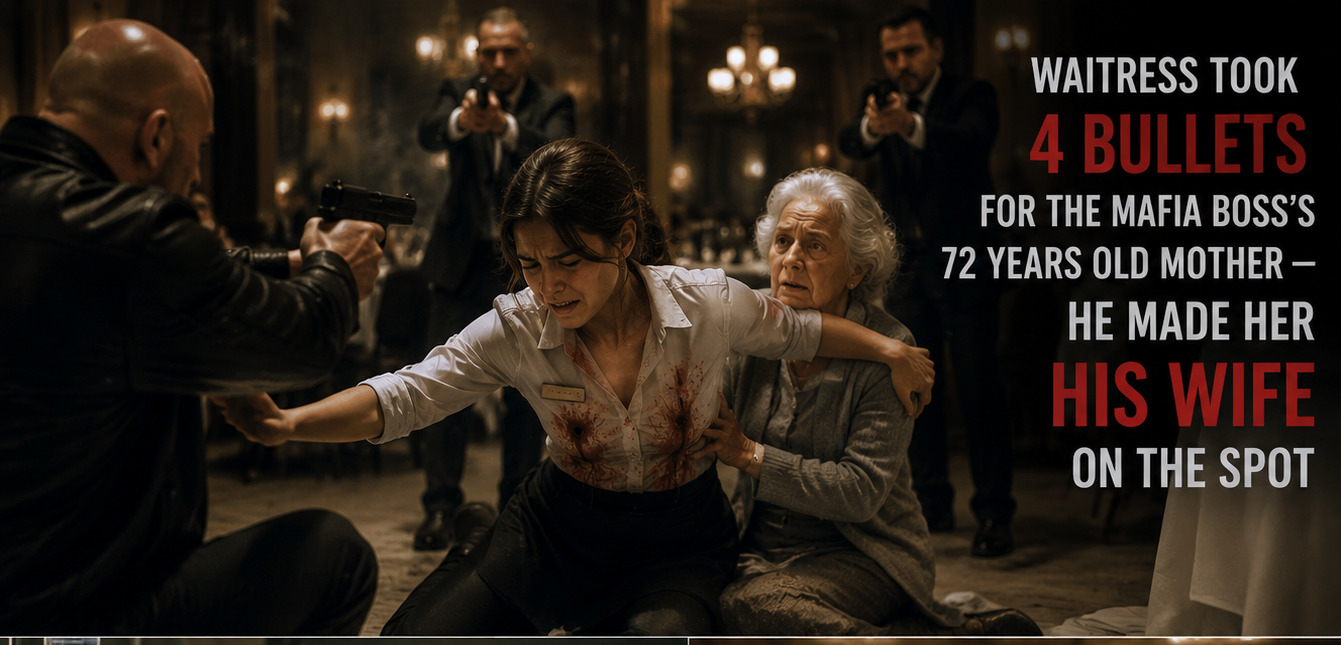
Waitress Took 4 Bullets for the Mafia Boss’s 72-Year-Old Mother — What He Did in Front of Everyone Left the City Speechless
The first bullet shattered the sugar jar.
The second buried itself in the brass espresso machine behind the counter.
By the time the third shot cracked through the restaurant, twenty-nine-year-old waitress Elena Marlowe was already moving.
She did not scream.
She did not look for the exits.
She threw her tray aside, crossed six feet of polished marble, and slammed her body over the elderly woman sitting alone in booth seven.
The fourth bullet entered Elena beneath her left shoulder.
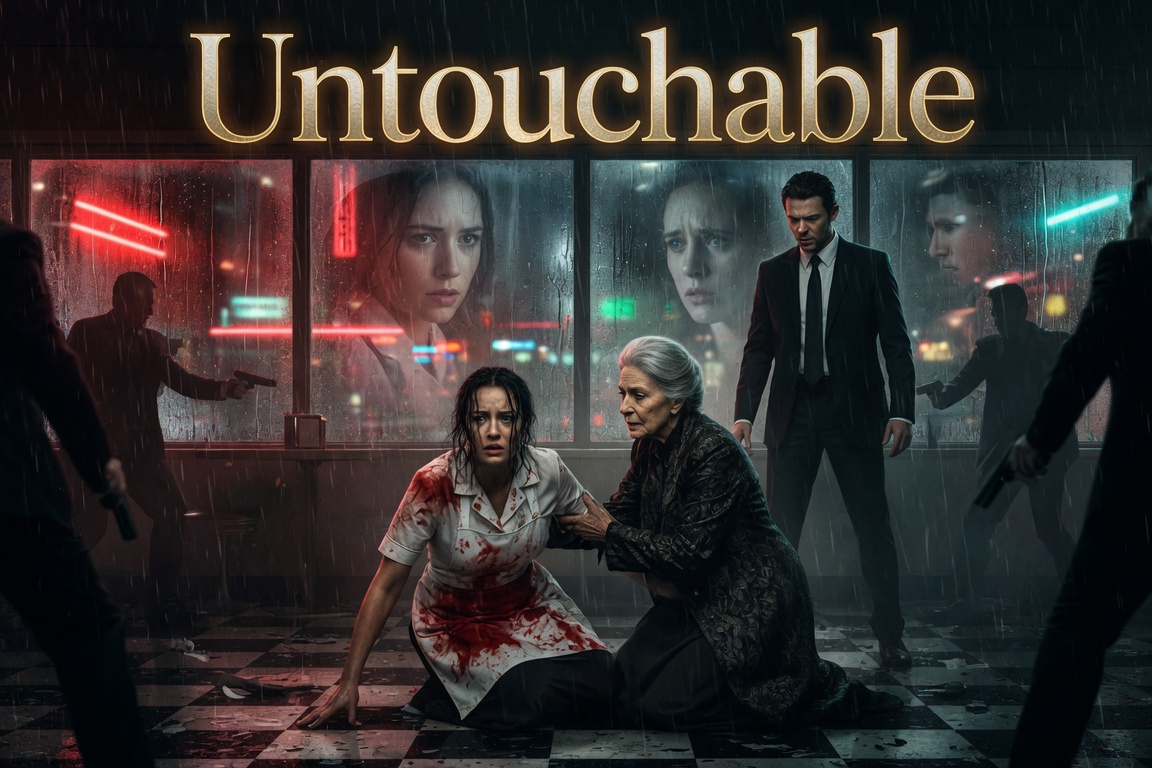
The fifth struck her ribs.
Two more tore through her side as she covered the old woman with everything she had.
When the shooting stopped, the restaurant smelled of gunpowder, scorched coffee, and blood.
For three full seconds, nobody moved.
Then the front doors burst open.
Men in dark suits flooded the room with weapons drawn, their shoes sliding across broken glass. At their center walked a tall man in a charcoal overcoat, his face stripped of every emotion except the kind that frightened armed people into lowering their voices.
Dante Bellandi saw his mother beneath the waitress.
He saw the blood spreading across Elena’s white uniform.
And for the first time in twenty years, the most feared man in Philadelphia forgot how to breathe.
“Ma.”
The old woman lifted her head slowly. Her silver hair had come loose from its pins. A thin red streak marked her cheek, but the blood was not hers.
“I’m alive,” Rosa Bellandi whispered.
Dante dropped to his knees.
Elena’s eyes fluttered open beneath him. They were gray, unfocused, and far too calm.
“Don’t move her,” she breathed. “The shooters may still have a line of sight.”
Dante stared at her.
She had four bullets in her body, and she was still protecting his mother.
Outside, sirens began to howl through the rain.
Inside, Rosa gripped her son’s sleeve.
“She saved me, Dante.”
His gaze moved from his mother to the dying waitress.
Then to the terrified diners filming from beneath tables.
Then to the security camera blinking above the bar.
Every witness in the room would later swear that something changed in his face.
Not softness.
Not mercy.
Decision.
Dante removed his coat and pressed it against Elena’s wounds.
“You’re not dying,” he said.
Elena gave a weak, almost annoyed smile.
“You don’t get to decide that.”
His jaw tightened.
“I decide more than you think.”
She tried to answer, but blood rose between her lips.
Dante leaned closer, lowering his voice until only she and Rosa could hear him.
“Stay alive,” he said. “And before this day ends, nobody in this city will ever be able to treat you as disposable again.”
Elena lost consciousness before she could ask what he meant.
Three hours later, she woke in a private hospital room with armed guards outside the door, a diamond ring on her finger, and the city’s most dangerous man sitting beside her bed.
He looked at her with cold, exhausted eyes.
“We were married twenty-seven minutes ago,” he said.
And that was only the beginning.
Chapter One: The Woman in Booth Seven
Six hours before the shooting, Elena Marlowe had been arguing with a coffee machine.
The machine hissed steam into her face as if personally offended by her existence.
“Do that again,” she muttered, tightening the valve with a butter knife, “and I’ll introduce you to the alley.”
Across the kitchen pass, Miguel Alvarez, the breakfast cook, glanced at her over a tower of pancakes.
“You threaten equipment like my ex-wife threatened me.”
“Did it work?”
“She got the house.”
“Then the espresso machine should be worried.”
Miguel laughed, but Elena’s smile disappeared the moment her manager stepped out of the office.
Curtis Vane wore a navy suit too expensive for the restaurant and a permanent expression suggesting everyone around him had disappointed him before speaking.
“Elena.”
She kept polishing a water glass. “Curtis.”
“My office.”
“Breakfast rush starts in twelve minutes.”
“Then we’ll make this quick.”
His office smelled of cologne, stale cigarettes, and the lemon disinfectant he made servers use after he spilled whiskey into his desk drawer.
Curtis shut the door.
On the desk lay Elena’s schedule.
Half her shifts had been crossed out.
She stared at the red ink. “What is this?”
“Corporate wants labor costs reduced.”
“You cut only my shifts.”
“You’re the highest-paid server.”
“I make four dollars and thirty-five cents an hour.”
“You’ve been here seven years. Raises accumulate.”
“Forty cents is not an empire, Curtis.”
He leaned back in his chair, folding his hands over his stomach.
“You also create tension.”
“With whom?”
“With management.”
“Because I reported that you were taking tips from the busboys?”
His eyes hardened.
“I was balancing pooled compensation.”
“You were stealing eighteen-year-olds’ rent money.”
Curtis rose slowly. “Careful.”
Elena did not move.
She had spent most of her life learning that some men relied on volume because they had nothing else. Her father had yelled before he hit. Her ex-fiancé had spoken softly before he emptied her savings account and disappeared. Curtis preferred threats delivered through clenched teeth.
Different packaging.
Same cowardice.
“I need the hours,” she said.
“Everyone needs something.”
“My younger brother’s rehabilitation clinic gets paid Friday.”
“Then perhaps you should become easier to schedule.”
The meaning sat between them.
Smile more.
Report less.
Accept the theft.
Elena slid the schedule toward herself and uncapped the red marker.
Curtis watched as she restored two of her shifts.
“You can’t do that.”
“I just did.”
“You think you’re untouchable because customers like you?”
“No.” She placed the marker down. “I think you won’t fire the only person here who knows the books well enough to prove what you’ve been doing.”
The color drained slightly from his face.
There it was.
The brief flash of fear.
Elena had seen it three weeks earlier when she found altered timecards in the office printer. She had quietly photographed every page.
She had not yet decided what to do with them.
Curtis stepped around the desk until only inches separated them.
“You have no idea how people with real power handle problems.”
Elena opened the door.
“Then I guess one of us is about to learn.”
She walked back onto the floor before he could answer.
At 8:17 a.m., Rosa Bellandi entered the restaurant.
She arrived without bodyguards, without jewelry beyond a plain gold wedding band, and without the kind of performance wealthy women often carried into places where the coffee cost less than a gallon of gas.
She wore a camel-colored coat beaded with rain.
Her shoulders were narrow. Her hands shook slightly as she removed her gloves.
Elena noticed three things immediately.
The woman was tired.
She was frightened.
And she kept checking the front windows.
“Table for one?” Elena asked.
The old woman looked toward booth seven, the only booth with a clear view of both entrances.
“That one, please.”
Elena led her over.
“Coffee?”
“Tea. Black. Lemon, no honey.”
“Food?”
Rosa opened the menu but did not look at it.
“What do people order when they are waiting for bad news?”
Elena paused.
“Usually pie.”
That earned the smallest smile.
“What kind?”
“Apple if they want comfort. Chocolate if they want courage.”
Rosa closed the menu. “Chocolate, then.”
Elena returned with tea and a thick slice of chocolate silk pie.
Rosa studied her name tag.
“Elena.”
“Yes, ma’am.”
“You have kind eyes.”
Elena nearly laughed.
“They’ve been accused of worse.”
“No.” Rosa touched the edge of her cup. “Kind eyes are not soft eyes. Yours have seen what kindness costs.”
The sentence landed too accurately.
Elena looked at the elderly woman more carefully.
A faint bruise showed beneath Rosa’s sleeve. Not the dark mark of a blow, but the yellowing shadow left by a recent IV.
“You came from a hospital,” Elena said.
Rosa’s gaze sharpened. “How did you know?”
“The tape mark near your wrist.”
“You notice too much.”
“It keeps people alive.”
For a moment, rain whispered against the windows.
Rosa glanced toward the door again.
“I had a son who noticed everything when he was young,” she said. “Then he grew up and decided feeling nothing was safer.”
“Was he right?”
“No one who chooses numbness is ever safe.”
Before Elena could respond, Curtis snapped his fingers near the service station.
“Elena. Less socializing.”
Rosa turned toward him.
Curtis gave her the polished smile he reserved for customers with expensive coats.
“Everything satisfactory, ma’am?”
“The waitress is.”
His smile tightened.
Elena walked away, but Rosa watched her go.
At 8:42, a black sedan stopped across the street.
At 8:43, Rosa’s phone vibrated.
She read the message, and the teacup rattled against its saucer.
Elena saw the change from twenty feet away.
She approached the booth.
“Do you need help?”
Rosa locked the phone and placed it facedown.
“No.”
“That wasn’t a convincing no.”
“You should stay behind the counter for the next few minutes.”
Elena’s eyes narrowed.
“What’s happening?”
Rosa reached into her handbag.
Elena’s muscles tightened, but the old woman withdrew only a sealed envelope.
“My son believes danger can be controlled if he keeps it close,” Rosa said. “He is wrong.”
She pushed the envelope across the table.
“If anything happens to me, give this to Dante Bellandi.”
The name froze the air between them.
Even people who pretended not to know the Bellandi name knew it.
Construction companies.
Nightclubs.
Political donations.
Unconfirmed bodies beneath confirmed highways.
Dante Bellandi had inherited the family organization at thirty-two after his father was murdered outside a courthouse. In the twelve years since, witnesses had forgotten faces, prosecutors had changed careers, and three rival syndicates had disappeared from the city.
Elena looked from the envelope to Rosa.
“You’re his mother.”
Rosa nodded once.
“And you came here alone?”
“My son has guards watching my guards. Today, I needed to know who was watching him.”
The front door opened.
Two men entered in rain jackets.
Neither wiped his shoes.
Neither looked at the hostess.
Both scanned the room.
Elena’s heartbeat slowed.
Not from calm.
From recognition.
Her father had taught her what violence looked like five seconds before it happened. Men preparing to hurt someone became strangely efficient. Their eyes stopped seeing people and began measuring distance.
One man reached inside his jacket.
Elena did not think.
She moved.
The first bullet shattered the sugar jar.
And by the time Dante Bellandi reached the restaurant, the woman he had never met had already changed the balance of his world.
Chapter Two: A Vow Signed in Blood
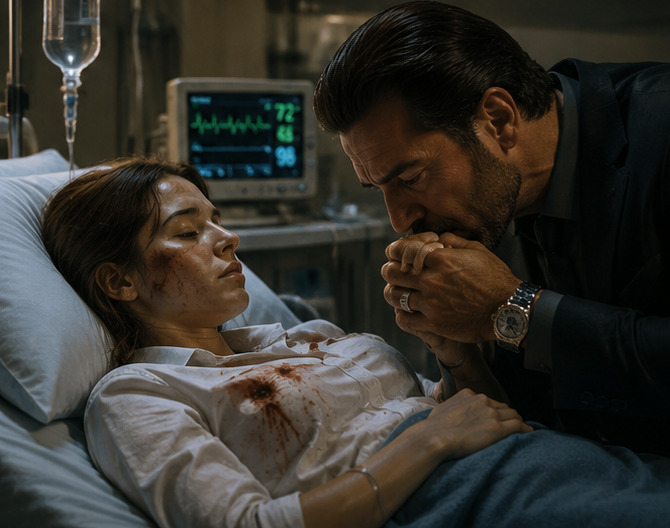
The surgeons worked on Elena for five hours.
One bullet had fractured a rib.
Another had punctured the upper lobe of her left lung.
A third passed through muscle near her hip.
The fourth stopped less than half an inch from her spine.
Dante stood behind the glass of the private surgical waiting area, staring into the corridor as if he could force the operating room doors to open.
Rosa sat nearby beneath a wool blanket, untouched except for the cut on her cheek.
“You’re frightening the nurses,” she said.
“They should be frightened.”
“They did not shoot her.”
“They’re slow.”
“They are trying to keep her alive.”
Dante turned.
At forty-four, he carried power without ornament. No gold watch. No visible weapon. No raised voice. His black hair was touched with gray at the temples, and a pale scar cut from beneath his right ear toward his collar.
Men twice his size watched his hands before making decisions.
But Rosa saw the boy he had once been in the rigid set of his shoulders.
“You blame yourself,” she said.
“I assigned you security.”
“I dismissed them.”
“You were able to dismiss them because I gave you weak men.”
“I dismissed them because I needed to meet someone without your permission.”
Dante’s eyes became still.
“Who?”
Rosa looked toward the guards.
“Send them away.”
“They stay.”
“Then I stay silent.”
Mother and son stared at one another.
Dante made a small gesture.
The room emptied in seconds.
Rosa removed the sealed envelope from beneath the blanket. Blood marked one corner.
“Elena pulled this from my handbag while she was covering me.”
Dante took it.
Inside were photocopies of bank transfers, shipping manifests, and photographs of a man shaking hands with two federal agents in a parking garage.
The man was Carlo Bellandi.
Dante’s cousin.
His second-in-command.
The person who controlled access to Rosa’s security detail.
Dante studied the pages without blinking.
Rosa watched recognition arrive in silence.
Not surprise.
Confirmation.
“You suspected him,” she said.
“I suspected everyone.”
“Except enough.”
His gaze lifted.
“Where did you get these?”
“Your brother’s old accountant sent them to me before he vanished.”
“Uncle Victor’s accountant died in 2019.”
“That is what Carlo told you.”
Dante crossed to the window.
Below, rain streaked the city into gray lines. Traffic crawled along Broad Street. Somewhere beyond the hospital walls, his men were searching apartments, warehouses, and back rooms for the shooters.
But suddenly the attack was no longer simple retaliation.
It was a message built around his mother’s death.
A death designed to make Dante react emotionally.
A death Carlo could use to trigger a war.
Rosa’s voice softened.
“I went to the restaurant because the accountant’s daughter works nearby. She never arrived.”
“You should have told me.”
“You stopped listening years ago.”
“I listen.”
“You hear threats. You hear opportunities. You hear lies before people finish speaking.” Rosa rose slowly. “But you no longer hear love unless it sounds like obedience.”
Dante looked down at the papers.
“The waitress heard you.”
“Elena saw fear and walked toward it.”
“She nearly died.”
“And that is why we owe her more than money.”
Dante’s expression closed.
“Name any amount.”
Rosa shook her head.
“You still think value can be transferred by wire.”
Before he could respond, a surgeon entered.
Dante’s hand tightened around the envelope.
The surgeon removed his mask.
“She survived.”
Rosa closed her eyes.
Dante did not move.
“The next twenty-four hours are critical,” the surgeon continued. “The spinal injury was avoided, but there was significant blood loss. Her lung is repaired. She may need additional surgery.”
“Will she walk?”
“We believe so.”
“Will she fully recover?”
“We don’t know yet.”
Dante took one step closer.
The surgeon’s throat moved.
Rosa touched her son’s arm.
“Thank you, doctor.”
After the surgeon left, one of Dante’s attorneys entered carrying a tablet.
“Mr. Bellandi, police want statements. The press knows your mother was involved. They’ve also identified the waitress.”
“Family?”
“A younger brother, Noah Marlowe, thirty-one. Former Army medic. Currently in opioid rehabilitation outside Scranton.”
Dante looked up sharply.
“A medic?”
“Discharged after an injury in Afghanistan. He listed Elena as emergency contact. There’s also an aunt in Baltimore. No spouse. No children.”
Rosa sat down.
“Why is that relevant?”
The attorney hesitated.
“Because Carlo’s people are already spreading a story that the waitress was involved in the attack.”
The room went cold.
Dante’s voice lowered. “Explain.”
“Anonymous police sources claim she may have known the shooters. Social media accounts are calling her an accomplice who changed sides.”
Rosa’s face hardened.
“She took four bullets.”
“Facts are slower than rumors,” the attorney said.
Dante understood immediately.
Carlo could not erase a restaurant full of witnesses.
So he would destroy Elena’s credibility.
If she died, she became a suspicious dead waitress.
If she lived, she became a compromised witness.
Either way, the attack would be buried beneath confusion.
Dante turned toward the hospital room where Elena lay unconscious.
“What protects her testimony?”
“Federal custody, potentially.”
“No.”
“A private security contract.”
“No.”
The attorney adjusted his glasses. “Then what are you considering?”
Rosa looked at her son.
For the first time that day, she seemed afraid of him.
Dante spoke without hesitation.
“Family.”
The attorney went silent.
Rosa stood. “Dante.”
“If she is merely a witness, they can discredit her. If she is an employee, they can buy her. If she is under my protection, the law calls it intimidation.”
His eyes moved to the gold ring on his mother’s hand.
“But if she becomes my wife, attacks on her become attacks on the Bellandi family. Her medical care becomes private. Her residence becomes secured. Her reputation becomes tied to mine, and Carlo will have to move before he is ready.”
Rosa stared at him in disbelief.
“You cannot marry an unconscious woman.”
“She can consent when she wakes.”
“She may tell you to go to hell.”
“Then she’ll be healthy enough to argue.”
“This is not strategy on a page. She is a human being.”
Dante’s expression shifted, almost imperceptibly.
“I know.”
It was the way he said it that made Rosa stop.
Not like a man claiming ownership.
Like a man remembering a debt he could never repay.
When Elena woke shortly after midnight, the lights were dim.
Pain pressed from every direction. Her mouth tasted of metal. Each breath felt stitched together with wire.
A man sat beside her bed.
She recognized him at once.
Dante Bellandi looked less frightening in stillness, but only because a sleeping wolf also looked less frightening before it opened its eyes.
“You’re Rosa’s son,” Elena whispered.
“Yes.”
“Is she alive?”
“Yes.”
Elena closed her eyes.
The relief was visible in the loosening of her jaw.
Dante watched it.
“You didn’t ask about yourself.”
“I assumed I was alive.”
“You nearly weren’t.”
“That sounds like a complaint.”
“It is.”
Her eyes opened again.
“Are you angry that I saved your mother?”
“I’m angry you had to.”
He placed a glass of water within reach but did not try to help her drink.
That restraint surprised her.
Most powerful men touched first and called permission unnecessary.
“Two men tried to kill my mother,” he said. “The person behind them will try to kill you next.”
Elena looked toward the door.
“Police?”
“Some are honest.”
“That was not an answer.”
“It was the only truthful one.”
Dante handed her a tablet displaying news headlines.
WAITRESS LINKED TO BELLANDI SHOOTING.
MYSTERY WOMAN MAY HAVE KNOWN GUNMEN.
RESTAURANT EMPLOYEE QUESTIONED IN MOB ATTACK.
Elena read silently.
Her face did not collapse.
That unsettled Dante more than tears would have.
“They’re making me part of it,” she said.
“Yes.”
“My manager will fire me.”
“He already has.”
The first crack appeared in her composure.
“My brother’s clinic payment is due Friday.”
“It has been paid.”
She turned her head toward him too quickly and winced.
“I didn’t ask you to do that.”
“No.”
“You don’t buy pieces of my life because I helped your mother.”
“I’m not trying to buy anything.”
“Then why are you here?”
Dante leaned forward.
“Because someone is trying to erase your value before you can speak.”
Elena’s breathing became shallow.
He waited until the pain passed.
“There is one way to make you untouchable quickly,” he said.
Her eyes narrowed.
“What way?”
“Marry me.”
The monitor beside her bed increased its rhythm.
Elena stared at him.
Then, despite four gunshot wounds, she laughed.
It ended in a gasp of pain.
“You’re insane.”
“Possibly.”
“You propose to every woman who gets shot near your family?”
“You are the first.”
“This is not funny.”
“I agree.”
She searched his face for mockery and found none.
“Why?”
He told her about Carlo.
The evidence.
The rumors.
The danger.
He did not romanticize the arrangement. He did not promise happiness or safety. He told her his name would put a larger target on her, but it would also force every hidden enemy into the open.
“You need bait,” she said.
His jaw flexed.
“I need a partner who cannot be dismissed.”
“You don’t know me.”
“I know you saw a gun before thirty people did.”
“That makes me observant.”
“You covered my mother without knowing her name.”
“That makes me reckless.”
“You protected the envelope while bleeding.”
“That makes me practical.”
“You threatened a surgeon while unconscious.”
Elena blinked.
“I did?”
“You told him his stitching was uneven.”
“That sounds like me.”
For one second, something almost human passed between them.
Then the pain returned to her face.
Dante’s voice became quieter.
“This marriage would be legal. Six months, with an exit contract entirely in your favor. Your brother’s treatment continues regardless of what you decide afterward. You receive independent counsel. Separate property. No obligations beyond public appearances and secure residence.”
“No obligations?”
“No physical expectations.”
She studied him.
“And if I say no?”
“I place guards outside your door and spend the next several weeks hoping Carlo does not own one of them.”
The honesty frightened her more than a threat would have.
Elena looked toward the rain-dark window.
All her life, people had underestimated her until they needed something.
Curtis needed silence.
Her ex-fiancé needed money.
Her father had needed someone weaker than himself.
Dante Bellandi needed her courage.
At least he had the decency to name the cost.
“Your mother,” Elena said. “What does she think?”
“That I am using strategy to avoid admitting gratitude.”
“Is she right?”
“Yes.”
The answer came without defense.
Elena turned back to him.
“What happens if I marry you?”
“My enemies panic.”
“And your family?”
“They panic more.”
She let silence stretch.
Then she extended her hand.
“Show me the contract.”
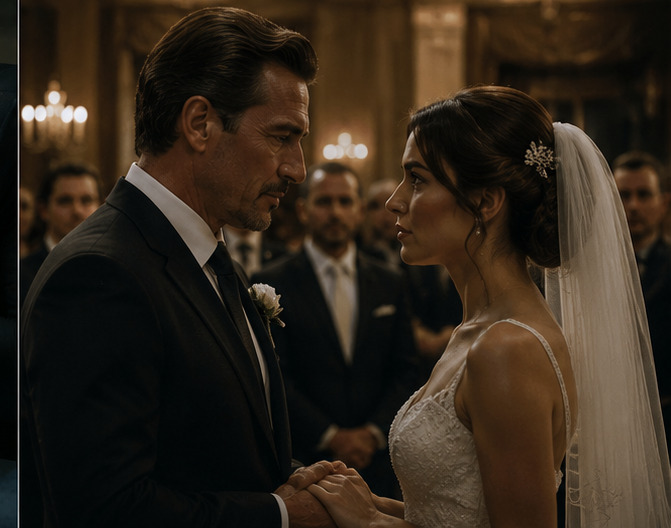
Twenty-seven minutes later, with a judge connected through a secure video call, Rosa holding Elena’s hand, and two hospital nurses serving as witnesses, Elena Marlowe became Elena Bellandi.
Dante slid a simple platinum band onto her finger.
His hands were steady.
Hers were not.
The judge pronounced them husband and wife.
Rosa kissed Elena’s forehead.
One nurse cried.
The other crossed herself.
Dante bent close enough for the cameras to capture the gesture, though none were present inside the room.
“From this moment forward,” he whispered, “no one calls you disposable.”
Elena’s eyes stayed on his.
“Make sure you remember that too.”
Outside the room, a guard received a text message.
He read it once.
Then deleted it.
Across the city, Carlo Bellandi poured himself a drink and smiled.
The marriage had forced Dante to reveal his weakness.
Now Carlo knew exactly where to aim.
Chapter Three: The House With No Warm Rooms
Elena left the hospital twelve days later.
Snow had replaced rain, coating Philadelphia in a hard white crust that made the city look temporarily innocent.
Dante’s home stood beyond iron gates in Chestnut Hill, an old stone mansion surrounded by bare sycamores and security cameras hidden inside copper lanterns.
The house was beautiful in the way museums were beautiful.
Nothing looked touched.
Nothing looked loved.
Elena entered using a cane, her side wrapped beneath a dark wool dress. Every step pulled at healing muscle. She refused the wheelchair waiting beside the front door.
Dante noticed but said nothing.
Rosa met her in the foyer.
The old woman ignored the doctors’ warnings and embraced her carefully.
“My daughter,” she said.
Elena stiffened.
The word entered a place inside her that had been locked for years.
Rosa felt it and released her without comment.
The rest of the Bellandi family waited in the drawing room.
Carlo stood by the fireplace, broad-shouldered and silver-haired, with a face made handsome by confidence rather than kindness. Beside him sat his wife, Vivian, who wore cream silk and evaluated Elena’s dress, shoes, and cane in a single glance.
Their son, Luca, lounged near the window with a drink despite the early hour.
Dante’s younger sister, Sofia, stood apart from them.
She was thirty-eight, sharp-featured, and dressed in a black pantsuit. Her expression held neither welcome nor contempt.
Only curiosity.
Carlo crossed the room first.
He opened his arms as if greeting family at a holiday.
“Our brave bride.”
Elena did not take the offered embrace.
“Mr. Bellandi.”
“We’re family now.”
“So I’ve been told.”
His smile remained.
But his eyes sharpened.
Dante entered behind her.
“Carlo.”
The room seemed to adjust around his voice.
Carlo lifted his glass.
“I hear congratulations are in order.”
“You sent flowers.”
“White lilies. Elegant.”
“They are also common at funerals.”
Vivian sighed. “Must every sentence in this family sound like a threat?”
“Only the honest ones,” Sofia said.
Rosa led Elena to a chair.
Vivian watched the movement.
“I hope the press does not turn this into one of those sentimental fairy tales,” she said. “The waitress and the kingpin. People love class confusion.”
Elena lowered herself carefully.
“The press called me an accomplice two weeks ago. Fairy tale would be an improvement.”
Luca laughed into his drink.
Vivian did not.
Carlo sat across from Elena.
“Your recovery is remarkable.”
“My surgeons were excellent.”
“And your memory?”
“Also excellent.”
The fire cracked.
Carlo’s glass paused halfway to his mouth.
There it was again.
Recognition, almost too quick to see.
Elena stored it away.
Dante had warned her that Carlo never asked questions without deciding beforehand which answer he wanted. Her task was not to expose him.
Not yet.
Her task was to make him believe she had seen less than she had.
“The men wore rain jackets,” she said. “One was tall. One was left-handed.”
Carlo relaxed slightly.
“Anything else?”
Elena tilted her head.
“One smelled like cloves.”
His fingers stopped on the glass.
Only for a second.
But Sofia noticed.
So did Dante.
Carlo smiled.
“Trauma creates strange memories.”
“Sometimes,” Elena said. “Sometimes it reveals them.”
That evening, Dante showed Elena to a suite on the second floor.
It had a bedroom, private sitting room, marble bathroom, and windows overlooking the frozen garden.
“My room is across the hall,” he said.
“Very medieval.”
“The locks work from inside.”
“That is surprisingly modern.”
He placed a phone on the table.
“Direct numbers for security, Rosa, the doctor, and me.”
“You’re across the hall.”
“I am frequently elsewhere.”
“Doing legal construction business?”
His gaze settled on her.
“Would you prefer a lie?”
“No. I prefer to know which truths can get me killed.”
Dante moved toward the door.
“Elena.”
She waited.
“My family will test you.”
“They already did.”
“Vivian will humiliate you because status is the only weapon she has ever learned to use. Luca will flirt because rejection is the only consequence he has never survived. Carlo will praise you while measuring where to cut.”
“And Sofia?”
He looked toward the hallway before answering.
“Sofia will decide whether you deserve the truth.”
Elena leaned against her cane.
“What about you?”
Dante’s face remained unreadable.
“I will try not to become the reason you regret surviving.”
He left before she could answer.
At midnight, Elena woke to footsteps outside her room.
Not the measured pace of guards.
These were lighter.
Barely audible.
She reached beneath her pillow for the small kitchen knife Rosa had secretly given her.
The handle turned.
The door opened three inches.
A shadow slipped inside.
Elena switched on the lamp.
Sofia stood near the doorway holding a laptop.
The two women stared at each other.
Sofia glanced at the knife.
“Good.”
“What are you doing here?”
“Saving your life.”
She placed the laptop on the table and opened a video file.
Security footage appeared.
The restaurant.
The shooting.
A camera angle Elena had never seen.
The image showed the gunmen entering.
Rosa looking up.
Elena moving.
Then, reflected in the restaurant window across the street, a third man sat inside the black sedan.
His face was blurred by rain.
But his hand was visible against the glass.
A heavy gold signet ring marked his smallest finger.
Elena had seen the same ring six hours earlier.
On Luca Bellandi’s hand.
She looked up.
Sofia’s face was pale.
“My cousin was in that car,” she said.
“Does Dante know?”
“No.”
“Why tell me first?”
“Because Dante loves family in the exact way drowning men love rope. Even when it is wrapped around their neck.”
Elena stared at the frozen frame.
Luca in the car.
Carlo asking about her memory.
The clove scent.
The attack had not been managed from a distant warehouse.
It had been watched by the family itself.
Then the lights went out.
A second later, glass shattered downstairs.
Sofia closed the laptop.
From the courtyard came the sharp, mechanical burst of automatic gunfire.
And across the hall, Dante’s bedroom door exploded inward.
Chapter Four: The Price of Being Believed
The attack lasted ninety-two seconds.
By the end, three security guards were wounded, two gunmen were dead, and the stone walls of the east corridor looked as if someone had attacked them with hammers.
Elena crouched behind an overturned desk with Sofia.
Her stitches burned beneath her dress.
“Can you shoot?” Sofia whispered.
“No.”
“Then why are you holding the gun like that?”
“Because it keeps people from asking.”
Footsteps approached.
Sofia raised her pistol.
Elena caught her wrist.
“Wait.”
A shadow moved beneath the door.
One person.
Slow pace.
Slight drag in the right foot.
Dante had been shot in the thigh during the first breach.
“Elena?” His voice came through the door.
She exhaled and opened it.
Blood darkened his trousers, but he remained upright.
His first glance went to Elena’s side.
“You’re bleeding.”
“Not mine.”
He looked at the gun in her hand.
“Also not mine.”
Sofia stepped forward with the laptop.
“We have a bigger problem.”
Dante watched the restaurant footage once.
His face did not change.
He watched it a second time.
Then he closed the screen.
“Where is Luca?”
“No one has seen him since dinner,” Sofia said.
Elena studied Dante.
The tendons in his neck tightened. His hand rested on the back of a chair, fingers spreading against the wood as though he needed proof it was solid.
For years, Luca had been more than a cousin.
After Dante’s father died, sixteen-year-old Luca had followed him through funeral homes, court hearings, and retaliatory violence. Dante had paid for his schools, covered his scandals, and buried evidence of a drunk-driving crash that left another boy permanently disabled.
Luca was not merely family.
He was one of Dante’s greatest failures disguised as loyalty.
“Carlo’s using him,” Sofia said.
Dante’s eyes remained on the black screen.
“Luca is thirty-four.”
“He has been desperate for his father’s approval since childhood.”
“So he helped murder my mother?”
“He may not have known the full plan.”
Elena spoke carefully.
“He watched.”
Dante turned to her.
She did not soften the words.
“He sat in that car while armed men walked into the restaurant. Whatever excuse he gives you, remember that.”
The truth hit him harder because she did not raise her voice.
Dante nodded once.
Then he ordered every exit sealed.
They found Luca at dawn in the old chapel behind the estate.
He sat beneath a stained-glass window with a pistol on the bench beside him.
Snowlight painted his face in red and blue fragments.
Dante entered alone.
Elena watched through the half-open door with Sofia and Rosa.
Luca looked up.
His eyes were swollen, but no tears remained.
“I didn’t know they would shoot her,” he said.
Dante stopped halfway down the aisle.
“You were there.”
“Dad said they would frighten her. Take the envelope.”
“They fired seven rounds.”
“I didn’t know.”
“You stayed.”
Luca’s mouth trembled.
“If I had gotten out, they would have killed me.”
Dante’s voice remained quiet.
“So you chose the possibility that they would kill my mother.”
“No.”
“You chose yourself.”
Luca grabbed the pistol.
Three guards moved outside the door, but Dante raised one hand.
Luca pressed the weapon beneath his chin.
Rosa made a sound behind Elena.
Dante did not move closer.
“You want me to forgive you before you pull the trigger,” he said. “That is why you waited here.”
Luca’s face crumpled.
“I’m sorry.”
“No. You are afraid.”
“I never wanted this.”
“But you accepted every benefit that came from it.”
Luca’s finger tightened against the trigger.
Elena stepped into the chapel.
Dante looked back sharply.
She ignored him and walked down the aisle with her cane.
Each step echoed.
“Elena, stop,” Dante said.
She continued until she stood six feet from Luca.
He stared at her, the woman whose body still carried the bullets meant for Rosa.
“You were in the car,” Elena said.
He lowered his eyes.
“Look at me.”
He did.
“You watched me cover her.”
His chin shook.
“I didn’t know—”
“You keep saying that as if ignorance is innocence.”
The pistol trembled beneath his jaw.
Elena’s voice softened.
“My father used to hit my mother, then tell me he lost control. For years, I believed losing control meant he was less responsible.”
Luca’s breathing broke.
“Then one night, I watched him stop in the middle of beating her to answer the phone politely.”
Silence filled the chapel.
“He had control,” Elena said. “He simply decided when other people deserved it.”
Luca’s hand weakened.
“You had control when you sat in that car. You decided fear mattered more than Rosa’s life. Now you’re trying to escape the part where you live long enough to admit it.”
The pistol lowered by an inch.
Then another.
Dante crossed the remaining distance and took it from him.
Luca collapsed onto the floor.
Rosa turned away, covering her mouth.
Dante looked at his cousin kneeling before him.
“Who ordered the attack on the house?”
Luca shook his head.
Dante crouched.
“Carlo already abandoned you. Your only remaining value to him is silence.”
“He said the marriage had to end.”
“Why?”
“Because she can testify.”
“That’s not enough.”
Luca stared at Elena.
“My father thinks she has something.”
Elena frowned.
“What?”
“A key.”
Her thoughts returned to the restaurant.
Rosa’s envelope.
The gunfire.
Her body over the old woman.
Her own hands pressing against Rosa’s handbag.
Then she remembered.
One of the gunmen had reached the booth before she tackled Rosa.
Something small had fallen from his coat.
Elena had picked it up without thinking and shoved it into her apron pocket.
At the hospital, her uniform had been cut from her body.
Her belongings had been boxed.
“Where are my clothes from the shooting?” she asked.
Dante stood.
“At the hospital.”
“No. A nurse gave them to your security team.”
Sofia was already on the phone.
The box arrived two hours later.
The white uniform was stiff with dried blood.
Elena searched the apron.
Inside a torn seam, her fingers found a tiny brass key wrapped in clear plastic.
Stamped into its surface were three characters.
C-19.
Dante recognized the format.
“Private vault,” he said. “Commonwealth National Bank.”
Carlo served on its board.
The key did not lead to money.
It opened a safe-deposit box containing accounting ledgers, recorded conversations, federal badge numbers, and a flash drive.
On the drive was a video.
Carlo sat in a warehouse office speaking to two federal agents and a city councilman.
He described the murder of Dante’s father.
Not as a crime he had witnessed.
As an operation he had designed.
Dante watched the recording in total silence.
Rosa stood beside him, one hand braced against the table.
Sofia wept without sound.
For twelve years, Dante had built his empire on the belief that rival families killed his father.
He had ordered retaliation.
Men had died.
Families had been destroyed.
Carlo had not merely betrayed him.
He had shaped him.
Every violent decision Dante made afterward had strengthened Carlo’s position.
The truth did not absolve Dante.
It made him understand how carefully his worst instincts had been cultivated.
On the video, Carlo leaned toward the federal agents.
“Dante thinks fear is power,” he said. “That’s why he’ll never see me coming. He doesn’t understand that the strongest cage is the one a man mistakes for a throne.”
The recording ended.
No one spoke.
Dante turned away from the screen.
For the first time since Elena had met him, he looked his age.
Not weak.
Wounded somewhere bullets could not reach.
She approached slowly.
“What will you do?”
His answer came cold and immediate.
“Kill him.”
Rosa closed her eyes.
Sofia looked down.
Elena stood between Dante and the door.
“No.”
Every person in the room froze.
Dante’s gaze lifted to hers.
“Move.”
“If you kill him, the evidence disappears into another mob story. Your family fights over succession. The agents erase what they can. Carlo dies believing he proved you were exactly what he made you.”
“He murdered my father.”
“And used that murder to control your life.”
Dante stepped closer.
“You do not get to tell me what justice looks like.”
“No.” Elena planted her cane against the floor. “But I can tell you what victory looks like.”
His face darkened.
She did not retreat.
“Carlo thinks your only language is violence. Speak one he cannot survive.”
The room remained silent.
Dante’s breathing slowed.
“What do you suggest?”
Elena looked toward the ledgers.
“Make him explain himself in front of everyone who believed him.”
That afternoon, invitations went out for Rosa Bellandi’s seventy-third birthday celebration.
Every family captain, business partner, attorney, city official, and trusted associate was ordered to attend.
The location was the Bellandi Grand Hotel.
The ballroom would hold three hundred people.
Carlo believed the party was designed to reassure the organization after the attacks.
He arrived in a tuxedo.
Smiling.
Certain he had won.
He did not know his voice was about to be played through every speaker in the room.
Chapter Five: The Night the Throne Broke
The Bellandi Grand ballroom glittered beneath eight crystal chandeliers.
A string quartet played near the windows.
Waiters moved through the crowd carrying champagne.
Outside, snow fell across Market Street in soft, expensive-looking silence.
Inside, everyone lied.
Politicians pretended they did not know criminals.
Criminals pretended they were businessmen.
Businessmen pretended fear had nothing to do with why they came.
Elena stood at the top of the staircase beside Dante.
Her dress was deep blue, cut simply to hide the medical brace around her ribs. The platinum wedding band reflected the chandelier light.
Below them, whispers moved through the crowd.
The waitress.
The opportunist.
The woman who married into power while still under anesthesia.
Vivian watched from the first row, her smile thin enough to cut paper.
Carlo stood near the stage accepting handshakes as though the hotel belonged to him.
Dante offered Elena his arm.
“You can still stay upstairs.”
She rested one hand against his sleeve.
“So can you.”
His mouth moved slightly.
Not quite a smile.
They descended together.
The whispers changed as people noticed Elena’s cane.
Not a prop.
Not a romantic detail.
Proof.
Four bullets had entered her body because she moved when everyone else ducked.
Rosa waited near the stage in a silver gown.
She embraced Elena before greeting her own son.
Vivian approached with two society women trailing behind her.
“Elena,” she said brightly. “You look transformed.”
“I’m wearing different clothes.”
One of the women hid a smile.
Vivian’s eyes cooled.
“I only meant it must be overwhelming. This world can be unforgiving when someone enters without preparation.”
Elena looked around the ballroom.
“Your world seems mostly prepared to forgive anything except the wrong last name.”
The second woman looked into her champagne glass.
Vivian lowered her voice.
“You may have saved Rosa, but heroism is not breeding.”
“No,” Elena said. “Breeding is what people claim when they inherit a seat they could never earn.”
Vivian’s face went still.
Behind her, Luca entered under guard.
The room noticed.
Carlo noticed most.
His smile faltered.
Only briefly.
Then he crossed toward Dante.
“Why is my son being escorted like a prisoner?”
Dante accepted a glass of water from a waiter.
“Because he is cooperating with investigators.”
Carlo’s gaze shifted to Luca.
Luca could not meet it.
The father’s expression did not become angry.
It became disappointed.
That was worse.
“You always were weak,” Carlo said.
Luca flinched.
Elena saw the entire history between them in that movement.
Every insult disguised as instruction.
Every scrap of affection offered only after obedience.
Carlo had not recruited his son into betrayal.
He had raised him to confuse usefulness with love.
Rosa stepped onto the stage.
The quartet fell silent.
Conversations faded.
She stood beneath the chandeliers, small and silver-haired, with a faint scar still visible on her cheek.
“I was supposed to die eighteen days ago,” she began.
No one moved.
“A woman who had never met me decided otherwise.”
She looked toward Elena.
Applause started near the back.
Then spread.
Some clapped from admiration.
Some from survival instinct.
Elena accepted neither interpretation. She simply stood.
Rosa continued.
“My family has always spoken about loyalty. We have praised it at weddings, funerals, baptisms, and business meetings. But loyalty without truth is only fear wearing a respectable coat.”
Carlo’s face changed.
He turned toward the exits.
Dante’s men had already closed them.
The ballroom screens came alive.
The warehouse video began.
Carlo’s recorded voice filled the room.
He described payments.
Bribes.
The murder of Dante’s father.
The arrangement with federal agents.
The plan to have Rosa killed and blame a rival syndicate.
Gasps broke across the ballroom.
A councilman dropped his champagne glass.
One of the federal agents shown in the video pushed through the crowd, but plainclothes state police officers stepped in front of him.
Carlo did not run.
Men like him rarely imagined consequences until every exit disappeared.
Instead, he laughed.
The sound echoed beneath the chandeliers.
Dante walked onto the stage.
Carlo looked up at him.
“So this is your grand performance?”
Dante said nothing.
“You think these people care that I killed your father?” Carlo spread his arms toward the crowd. “Half of them benefited from it.”
Several faces lowered.
Carlo’s voice grew stronger.
“Your father was reckless. He would have destroyed everything. I preserved the family.”
“You preserved yourself,” Sofia said from the front row.
Carlo looked at her with contempt.
“I kept you all alive.”
“You kept us dependent,” she replied.
He turned back to Dante.
“And you. I made you.”
Dante’s face remained unreadable.
Carlo climbed the first step of the stage.
“You were a grieving boy with a famous name. I gave you enemies. I gave you discipline. I gave you a reason to become feared.”
“You gave me lies.”
“I gave you power.”
“No.” Dante looked across the ballroom. “You taught me to mistake fear for power.”
Carlo’s smile faded.
Dante continued.
“For twelve years, I believed revenge made me strong. It only made me predictable.”
His eyes moved toward Elena.
“She was shot because you believed everyone chooses self-preservation.”
Carlo glanced at her.
“A waitress made one impulsive decision.”
Elena stepped onto the stage.
The room quieted again.
Carlo looked her up and down with open disdain.
“You have enjoyed this, haven’t you?” he asked. “The clothes. The house. A poor girl’s fantasy disguised as courage.”
Elena stopped three feet away.
“My fantasy was paying my brother’s medical bills without choosing which utility to shut off.”
A murmur moved through the crowd.
Carlo’s eyes narrowed.
“You married a stranger for money.”
“I married a dangerous man because an even more dangerous man assumed I could be bought.”
She raised the small brass key between two fingers.
Recognition struck him.
Not gradually.
All at once.
His lips parted.
The muscles around his eyes loosened.
The confident tilt of his head disappeared.
For the first time that evening, Carlo Bellandi looked exactly like what he was.
An aging man who had built his life around being the smartest person in every room.
And had just realized the woman he dismissed as a waitress had been holding the end of the thread that unraveled him.
The ballroom saw it.
The stillness.
The whitening knuckles.
The half-step backward.
The moment of recognition passed through the crowd like electricity.
Elena’s voice remained calm.
“You spent years buying judges, agents, politicians, and relatives. You believed everyone had a price because it protected you from understanding that some people have principles.”
Carlo glanced toward Dante.
“Are you going to let her speak to me this way?”
Dante looked at him almost sadly.
“That question is why you lost.”
State investigators moved toward the stage.
Carlo’s composure cracked.
“You cannot hand me to them. I know everything. Every account. Every body. Every favor.”
“That is the point,” Dante said.
Carlo stared at him.
Then at the officers.
Then at the room full of people who no longer avoided his eyes.
“You think prison is justice?” he spat. “I’ll make deals. I’ll name names. I’ll burn this entire family down.”
Rosa stepped forward.
“You already did.”
The words struck harder than shouting.
Carlo looked at her.
For one second, his face became younger.
A nephew seeking approval from the aunt who had once cooked for him after his mother died.
Then pride returned.
He lifted his chin.
“I did what was necessary.”
Rosa’s eyes glistened.
“No. You did what was useful to you, then called it necessary so you could sleep.”
The officers took Carlo by the arms.
He resisted only when they turned him toward the ballroom.
Three hundred witnesses watched him leave.
No gunfight.
No heroic escape.
No final command.
Only the quiet humiliation of a man walking through a crowd that had once parted for him.
Vivian remained near the front row, pale and rigid.
As Carlo passed, he looked at his wife.
She did not reach for him.
Luca did.
Despite everything, Luca stepped forward.
“Dad.”
Carlo stopped.
Hope appeared on Luca’s face with heartbreaking speed.
Carlo looked at his son.
“You ruined everything.”
Luca recoiled as if struck.
The officers continued walking.
Elena watched Luca’s face collapse.
She understood then that justice did not always arrive cleanly.
Sometimes the guilty were exposed while their children still mourned them.
Sometimes truth freed people and broke them in the same moment.
Dante stepped down from the stage and stood beside Luca.
His cousin did not look up.
“I’m sorry,” Luca whispered.
Dante’s face tightened.
“You will testify.”
Luca nodded.
“You will accept whatever sentence follows.”
Another nod.
“And when you leave prison, if you leave, you will spend the rest of your life becoming someone your father would not recognize.”
Luca covered his face.
Dante placed one hand on his shoulder.
Not forgiveness.
Not yet.
But not abandonment either.
Across the room, reporters pressed against the sealed doors.
The story would reach every major network before midnight.
But Elena knew the most important consequence would never fit into a headline.
The family had watched Dante choose exposure over execution.
They had watched him surrender control of the evidence to state investigators outside Carlo’s federal network.
They had watched the feared Bellandi boss reject the very violence that built his reputation.
The throne had not passed to a stronger king.
The throne itself had cracked.
And in the silence afterward, something else had room to grow.
Chapter Six: What Remained After Power
Three months later, Elena returned to the restaurant.
The bullet holes had been repaired.
The espresso machine had not.
A handwritten sign taped to it read: OUT OF ORDER, AGAIN.
Miguel hugged her so carefully that she laughed.
“You look expensive,” he said.
“I’m wearing a forty-dollar coat.”
“You stand expensive.”
“That is not a thing.”
“It is now.”
Curtis emerged from the office.
He looked smaller.
Not physically.
Consequentially.
The corporate investigation triggered by Elena’s evidence had uncovered stolen tips, altered timecards, false vendor payments, and years of payroll fraud.
Curtis was no longer manager.
He was waiting for trial.
The restaurant’s new owner had allowed him inside that morning to collect personal belongings under supervision.
He stopped when he saw Elena.
For years, he had spoken to her from doorways, behind desks, and across schedules he controlled.
Now two labor investigators stood behind him.
“Elena,” he said.
She waited.
“I suppose you’re pleased.”
“No.”
His face twisted.
“Don’t pretend.”
“I’m relieved.”
“That I’m losing everything?”
“That the people you stole from no longer have to prove they deserved what was already theirs.”
Curtis looked toward Dante, who stood near the entrance in a dark coat.
Two security men waited outside, but Dante had entered alone.
Curtis swallowed.
“You brought him to frighten me?”
Elena glanced back.
“No. He wanted pie.”
Dante’s expression did not change.
Miguel coughed to hide a laugh.
Curtis picked up his box and walked toward the door.
As he passed Elena, he lowered his voice.
“You think you’re better than us now.”
She looked at the man who once controlled whether her brother received treatment.
“I was never beneath you.”
He stopped.
For a moment, his face showed the same stunned realization Carlo’s had.
Different room.
Smaller audience.
Same truth.
Curtis walked out without another word.
Elena slid into booth seven.
Rosa joined her carrying tea.
Dante sat across from them, awkward in a place where the tables were too small and nobody cared about his last name unless he tipped well.
Miguel brought three slices of chocolate pie.
Rosa smiled.
“For courage.”
“For cholesterol,” Dante said.
Rosa ignored him.
The trials were still unfolding.
Carlo had been indicted on racketeering, conspiracy, murder, obstruction, and public corruption charges. The federal agents in the video had been arrested after a state-led investigation bypassed their own offices.
Luca had pleaded guilty to conspiracy and agreed to testify.
Vivian filed for divorce, then discovered most of the assets she expected to inherit had been frozen.
Sofia took control of the Bellandi construction companies and began dismantling their illegal contracts one by one.
Dante surrendered financial records through his attorneys.
Some of the evidence implicated him.
He accepted that.
He negotiated no immunity for violent crimes, only protection for uninvolved employees and family members.
The city expected him to flee.
Instead, he testified.
He admitted what he had done.
He named the people he had hurt.
The process would cost him businesses, property, and perhaps years of freedom.
For the first time in his adult life, he was choosing a future he could not control.
Elena watched him push pie around his plate.
“You hate it,” she said.
“It is too sweet.”
“You ordered a second slice.”
“I am evaluating consistency.”
Rosa smiled into her tea.
Dante looked at Elena.
“You met with your attorney this morning.”
“Yes.”
“The six-month dissolution option is available early because of the criminal proceedings.”
“Yes.”
His hand became still beside the fork.
Rosa suddenly found the snow outside fascinating.
Dante’s voice lowered.
“You are no longer in immediate danger. Your brother’s treatment is funded independently. The house in your name remains yours. You can leave.”
Elena studied him.
Three months earlier, his proposal had been a contract spoken beside a hospital bed.
Since then, she had seen him sit awake during her nightmares without touching her.
She had watched him learn the names of every restaurant employee who lost money to Curtis.
She had seen him apologize to families who refused to forgive him.
She had seen him remove the guns from his study after Rosa said the house felt like a fortress.
None of it erased his past.
None of it guaranteed his future.
Change was not proof of goodness.
It was only proof that a person had finally stopped defending the worst parts of himself.
“I know I can leave,” Elena said.
Dante nodded once.
She slid a folded document across the table.
He opened it.
The dissolution papers were unsigned.
Beneath them lay a second document.
A marriage agreement terminating the original six-month arrangement and replacing it with equal property rights, mutual consent provisions, and no financial penalty for separation.
Dante read the first page twice.
“What is this?”
“A worse contract.”
His eyes lifted.
“Why?”
“Because the first marriage was made under gunfire.”
“And this one?”
Elena rested both hands around her coffee cup.
“This one is made with full knowledge of how difficult you are.”
Rosa turned back from the window.
Dante did not smile.
Emotion moved across his face too slowly for that.
Fear first.
Then disbelief.
Then something quieter that he did not know how to carry.
“You should not confuse gratitude with love,” he said.
“I don’t.”
“You should not confuse loyalty with love.”
“I don’t.”
“You should not believe you can save me.”
“I absolutely don’t.”
Miguel pretended to wipe the counter nearby.
Rosa had stopped pretending anything.
Dante looked down at the agreement.
“What, then?”
Elena reached across the table.
Her fingers rested over the scarred knuckles of his right hand.
“I believe a person is more than the worst thing they have done, but only after they stop asking others to pay for it.”
His throat tightened.
She continued.
“I believe power means nothing if everyone near you has to become smaller.”
The restaurant had grown quiet.
Even the broken espresso machine seemed to listen.
“And I believe,” Elena said, “that the man who married me to protect his family may be capable of becoming the kind of man who deserves one.”
Dante covered her hand with his.
Not possessively.
Carefully.
As though trust were something alive that could still be frightened away.
“I cannot promise you an easy life.”
“I would distrust you if you did.”
“I may go to prison.”
“I know.”
“I have enemies.”
“You also have terrible taste in pie.”
His breath left him in something close to laughter.
Rosa wiped one eye.
Dante looked around the restaurant where four bullets had changed the direction of his life.
Then he turned back to Elena.
“The first time, I asked you to marry me because I needed to protect you.”
“No,” she said. “You needed me to protect what you couldn’t admit was broken.”
He accepted the correction.
“This time, I have nothing to offer that cannot be taken away.”
Elena squeezed his hand.
“That may be the first honest proposal you’ve ever made.”
He stood.
Not to kneel.
Not to perform.
He simply moved around the table and stopped beside her.
“Elena Marlowe Bellandi,” he said, his voice rougher than she had ever heard it, “will you remain my wife when fear, money, strategy, and obligation are no longer reasons?”
She looked at the man who once believed control could keep everyone alive.
Then at Rosa, who had risked death to expose the truth.
Then at the repaired wall where the bullets had struck.
“Yes.”
Applause erupted from the kitchen.
Miguel lifted both hands.
“I heard nothing until the important part.”
Elena laughed.
Dante bent and kissed her forehead, the same place Rosa had kissed her in the hospital.
The gesture was restrained.
Private, despite the witnesses.
Outside, snow began falling again.
Not enough to hide the city’s scars.
Only enough to soften their edges.
Years later, people would still tell the story of the waitress who took four bullets for a mafia boss’s mother and became his wife before the blood on her uniform had dried.
Most versions focused on the shooting.
Some focused on the marriage.
A few claimed Elena had been lucky.
They were wrong.
Luck did not make her move toward gunfire.
Luck did not expose Carlo.
Luck did not force Dante to face the man he had become.
The truth was less romantic and far more powerful.
Elena had spent years being treated as if her value depended on whether someone richer, louder, or more powerful recognized it.
Then, in one violent morning, the entire city discovered what had always been true.
She had never needed a powerful man to give her worth.
Her worth was the reason a powerful man finally learned to become worthy of her.
And that is the kind of truth people share—not because it sounds like a fairy tale, but because somewhere deep inside, they are still waiting for the world to recognize the treasure it once overlooked.