The private dining room of The Oak Room smelled of dry-aged beef, expensive cigars and nervous sweat.
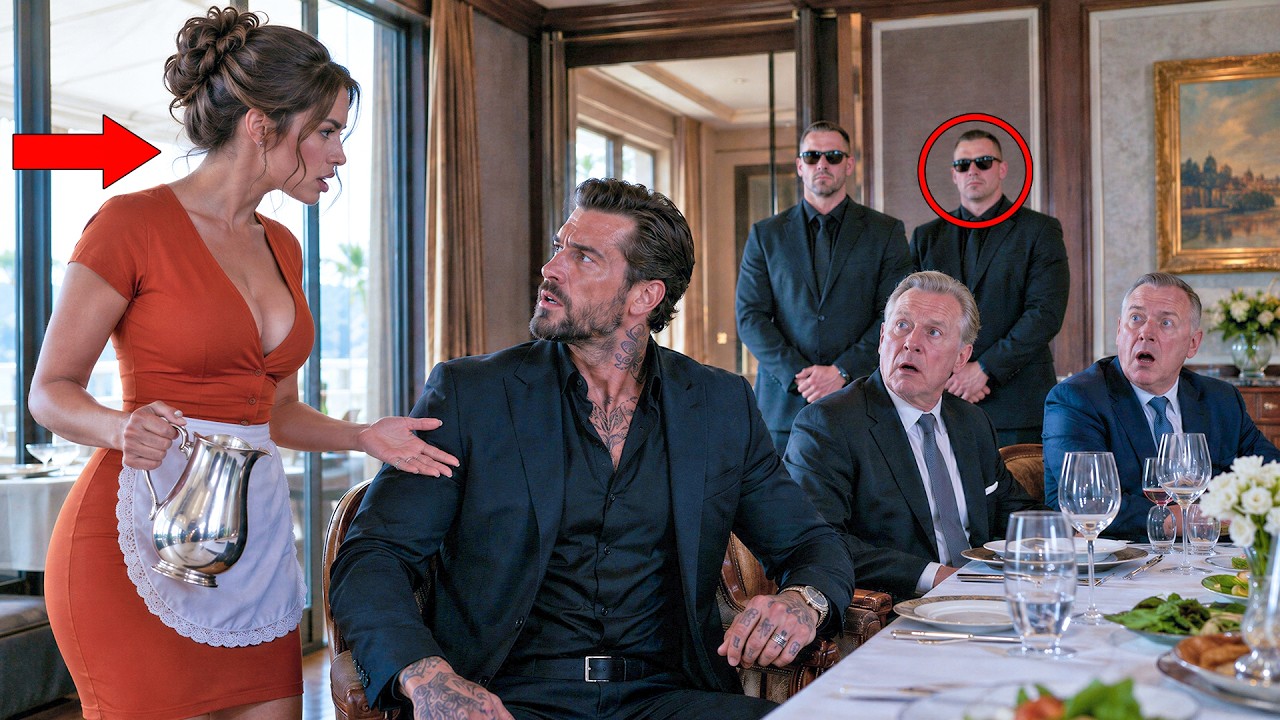
Lana Mercer had been standing for nine hours.
The arches of her feet burned inside black shoes that had stopped being comfortable six months earlier. Her lower back throbbed each time she leaned forward to refill a glass, and the muscles in her face ached from holding the same neutral expression all evening.
The rules for serving in the private room were simple.
Do not cough.
Do not interrupt.
Do not breathe loudly.
Do not react to anything you hear.
Become furniture.
Lana had learned to perform invisibility well.
That Thursday night, six men sat around the long mahogany table beneath a brass chandelier. The restaurant had closed the corridor outside, posted two guards near the kitchen entrance and instructed the staff not to ask questions.
At one end of the table sat Victor Rossi.
He wore a charcoal suit without a tie. Silver had begun to appear at his temples, but there was nothing soft about his face. His eyes were cold, steady and exhausted.
Leo, his right-hand man, stood behind him.
Leo had not sat down once. His hand remained close to the pistol beneath his jacket, and his gaze moved constantly between the doors, the windows and the two large men standing behind the guest on the opposite side of the table.
That guest was Klaus Richter.
Klaus was broad enough to make the dining chair look small. A gold Rolex circled his wrist. His blond hair was cut close to the scalp, and the arrogance in his smile suggested that he had entered the room already certain everyone else had lost.
He had arrived with two bodyguards and a translator named Gavin.
Gavin was thin, pale and sweating so heavily that his wire-framed glasses kept slipping down his nose.
The meeting concerned the southern docks.
Victor controlled them.
Klaus wanted access.
The arrangement sounded simple when spoken in English. Klaus’s organization would receive scheduled use of two shipping lanes. Victor would receive twenty percent of all cargo value and retain authority over security.
If they reached an agreement, Lana had been told to bring champagne.
If the meeting failed, she was to leave through the kitchen and lock the outer door.
No one had explained what would happen after that.
Victor lifted his glass but did not drink.

“Twenty percent,” he said. “My men supervise every shipment. No outside security enters my territory.”
Gavin turned toward Klaus and translated.
Lana was standing behind Klaus’s chair, refilling his water.
She understood every word.
Her grandmother had immigrated from Munich before Lana was born. German had been the language of Sunday dinners, old songs and arguments whispered when adults did not want children to understand.
Later, Lana had spent nearly two years in Berlin.
She spoke the language fluently.
Gavin did not translate Victor’s words accurately.
Instead, he told Klaus, “He is flexible on the percentage. You may bring your own security if the final payment is acceptable.”
Lana’s hand tightened around the water pitcher.
Klaus glanced at Victor and smiled.
Then he spoke in German.
“The Americans are weaker than I was told. He is opening the gate himself.”
Gavin translated, “Mr. Richter appreciates your willingness to negotiate.”
Victor’s expression did not change.
“Twenty percent is not a starting point.”
Gavin turned toward Klaus.
“He says the percentage can be adjusted after the first shipment.”
That was not even close.
Lana moved to the next glass.
Her pulse had begun to beat against her throat.
She told herself it was none of her business.
Men like Victor Rossi did not survive because waitresses protected them.
Men like Klaus Richter did not forgive employees who understood too much.
Lana had enough problems without stepping into theirs.

Her older brother, Danny, owed seventy thousand dollars to Mickey Sullivan, a lender who collected interest with broken fingers and midnight visits.
For two years, Lana had been paying what she could.
Extra shifts.
Double shifts.
Cash tips hidden in envelopes beneath her mattress.
Every month, the amount somehow grew.
She could not afford to lose the job.
She definitely could not afford to die in a private dining room because rich criminals lied to one another.
Victor leaned forward.
“My protection is not optional. Your cargo moves because I allow it to move.”
Gavin translated.
“He says he is willing to provide protection if you pay an additional fee.”
Klaus laughed.
“He thinks he is negotiating,” he said in German. “When the gates open, we replace his men before sunrise.”
Gavin wiped his forehead.
“Mr. Richter believes the agreement will create opportunities for both organizations.”
Victor looked at Klaus for a long time.
The fatigue in his face deepened.
Lana had seen that kind of exhaustion before.
Not in crime bosses.
In hospital corridors.
In people who had spent too long preventing everything around them from collapsing.
Victor did not look like a man eager for war.
He looked like a man trying to preserve control without filling the docks with bodies.
That did not make him good.
But it made the lie more dangerous.
The discussion continued for another twenty minutes.
Every translation shifted the balance further in Klaus’s favor.
Victor believed his conditions were being accepted.
Klaus believed Victor had surrendered them.
Gavin’s voice shook harder with each sentence.
Lana began to suspect that fear, not greed, was controlling him.
Then Klaus raised his glass and spoke in German.
“The weak fool does not know he is already dead. Once he opens the gates, we will slaughter his men. I will keep his head as a trophy.”
Gavin swallowed.
He turned toward Victor.
“Mr. Richter says he looks forward to a long and profitable partnership.”
Victor reached for his glass.
“To profitable partnerships.”
Klaus smiled.
Leo relaxed by less than an inch.
Lana felt sick.
The champagne waited outside in an ice bucket.
If Victor toasted the agreement, the doors would open.
The southern docks would become a trap.
She could remain silent.
That was what she had been trained to do.
Furniture did not warn people.
Furniture did not choose sides.
Furniture survived.
Lana looked at Gavin.
His hand was trembling beneath the table.
Then she looked at Victor.
He was raising his glass toward a man who had just described cutting off his head.
Lana stepped forward.
She lifted the water pitcher and leaned toward Victor’s glass as though topping it off.
Her lips barely moved.
“He is lying.”
Victor’s hand stopped.
The room became silent.
Not gradually.
Instantly.
Leo’s posture changed.
Klaus’s two guards straightened.
Gavin stared at Lana as if she had opened a grave beneath the table.
Victor did not look at her at first.
“What did you say?”
Lana placed the pitcher down.
Every instinct told her to apologize.
Instead, she stood upright.
“He is lying to you.”
Victor turned his head slowly.
The invisible waitress was gone.
For the first time that evening, Lana looked directly into his eyes.
“You speak German?” he asked.
“Yes.”
Klaus said something sharply.
Lana answered him in perfect German.
“Be quiet.”
His expression changed.
Victor rose from his chair.
“Tell me exactly what was said.”
Gavin began shaking his head.
“She misunderstood. The dialect is—”
“It is not a dialect issue,” Lana said. “You changed every major condition.”
Leo moved behind Gavin.
The translator froze.
Lana continued.
“Mr. Rossi said twenty percent and no outside security. Gavin told Klaus the percentage was flexible and that he could bring his own men.”
Victor’s eyes shifted toward Gavin.
Lana pointed toward Klaus.
“He said Americans were weak. He said you were opening the gate for him. He plans to replace your security after the first shipment.”
Klaus pushed his chair back.
His guards reached inside their jackets.
Leo drew his gun first.
Two shots exploded through the room.
Both bodyguards collapsed, each struck in the leg before either could clear a weapon.
The chandelier trembled.
Lana did not scream.
Klaus lunged across the table.
Victor grabbed the heavy silver water carafe and swung it into the side of his head.
The impact sounded dull and final.
Klaus crashed into the table, scattering glasses and silverware.
Leo pressed his pistol against Gavin’s neck.
Victor stood over Klaus, breathing heavily.
“What else?”
Lana’s voice felt distant in her own ears.
“He said when the gates opened, they would kill your men.”
Victor looked down at the German.
“And?”
Lana hesitated.
“He said he would keep your head as a trophy.”
Victor’s face became still.
Then he turned toward Gavin.
“You translated that as a long partnership.”
Gavin’s knees gave way.
Leo caught him by the collar.
“My wife,” Gavin gasped.
Victor stared at him.
“What?”
“They took my wife.”
Gavin’s glasses slid from his face.
“They have had her for five days. Klaus said if I translated one sentence accurately, they would send her back in pieces.”
Klaus groaned on the floor.
Victor crouched beside him.
“Where is she?”
Klaus smiled through blood.
Victor struck him again.
This time, Klaus stopped smiling.
Victor stood.
“Leo, bind all three. Call the cleanup team.”
Leo nodded.
“Use the secondary warehouse,” Victor continued. “Find out where Gavin’s wife is before sunrise.”
He looked toward the two injured guards.
“Keep them alive until they talk.”
The private room transformed in seconds.
Men entered through the side door carrying restraints and black medical bags. The bodyguards were dragged away. Klaus was lifted from the floor and tied to a chair.
Gavin remained kneeling.
Victor looked at Lana.
She stood beside the table holding the edge of her apron, her knuckles white.
He reached inside his jacket and pulled out a thick stack of hundred-dollar bills.
He threw it onto the clean end of the table.
“For the broken glass.”
Lana did not move.
“And the translation,” he added.
“That is too much.”
Victor looked at her as if she had said something irrelevant.
“Take it.”
Lana picked up the money.
Her hands trembled for the first time.
Victor turned away.
“Go outside. A car will be waiting.”
“Why?”
He looked back at her.
“Because you are no longer walking home alone.”
The alley behind The Oak Room smelled of rain, rotting cabbage and hot exhaust.
A black Lincoln Town Car waited beside the service entrance.
A man in a dark coat opened the rear door.
Lana stood beneath the cold rain clutching the stack of money.
She could run.
She did not know where.
Mickey Sullivan knew her address.
Victor Rossi knew her name.
The life she had understood an hour earlier had already disappeared.
She entered the car.
The cabin was soundproof and smelled of leather and peppermint.
The door closed.
For ten minutes, no one joined her.
Lana stared through the tinted window at rain sliding down the glass.
She did not know whether the car would take her home or to a burial ground.
Then the opposite door opened.
Victor climbed in.
There was blood on his right hand.
The skin across his knuckles had split.
He closed the door and sat beside her.
“Where are we going?” he asked.
Lana stared at him.
“I thought you knew.”
“I am asking for your address.”
She gave it to him.
The car moved.
Victor removed a white handkerchief and wrapped it around his hand.
Neither spoke for several blocks.
Then he said, “Mickey Sullivan.”
Lana’s body went cold.
“What about him?”
“Your brother owes him money.”
“How do you know that?”
“I know everyone who lends money in my city.”
Victor took out his phone.
Lana reached toward him without thinking.
“Please don’t hurt Danny.”
Victor looked at her hand.
She pulled it back.
“I am not calling your brother.”
He selected a number.
Mickey answered almost immediately.
“Mr. Rossi.”
“Mickey.”
Victor’s tone was quiet.
“You have an account under Daniel Mercer.”
There was a pause.
“Yes.”
“How much?”
“Seventy thousand, including interest.”
“It is closed.”
Another pause.
“I’m not sure I understand.”
“You understand perfectly.”
“Mr. Rossi, the original loan—”
“The principal is closed. The interest is closed. Every piece of paper with his name on it is destroyed tonight.”
Mickey tried to laugh.
“That is a large favor.”
“It is not a favor.”
Victor’s gaze remained on Lana.
“If you contact Danny Mercer or his sister again, I will nail both your hands to your own desk and let your clients watch you beg.”
Silence came through the phone.
“Understood.”
Victor ended the call.
Lana stared at him.
For two years, debt had shaped every decision she made.
It chose her hours.
Her apartment.
Her shoes.
Her sleep.
Now it was gone after a thirty-second conversation.
She could not breathe.
“Why?” she whispered.
Victor put the phone away.
“I dislike debt.”
“That cannot be the reason.”
“I also dislike distracted assets.”
The word landed hard.
“Assets.”
Victor did not apologize.
“Gavin was controlled through his wife. Klaus found a weakness and used it. Mickey was your weakness.”
“My brother is not a weakness.”
“He is if someone can use him to control you.”
Lana looked out the window.
“So you bought me.”
“No.”
“You erased seventy thousand dollars.”
“I removed interference.”
“That sounds like buying.”
Victor leaned back.
“Would you prefer a lie?”
Lana turned toward him.
He did not soften his expression.
“I could say I acted from gratitude. Gratitude played a role. I could say you saved my life. You did. But neither explanation is complete.”
“Then what is?”
“You stood in a room filled with guns and took control of the table without carrying one.”
Lana said nothing.
“I have dozens of men who know how to pull a trigger,” Victor continued. “Most are useless before the shooting starts.”
He reached for her hand.
Lana stiffened, but he did not grip her tightly.
He turned her palm upward as though examining something delicate.
“I need someone who hears the lie before it becomes blood.”
She looked at their hands.
His was damaged and stained.
Hers smelled faintly of restaurant soap.
“What happens now?”
“Tomorrow at noon, a woman named Polly will collect you.”
“For what?”
“A meeting.”
“With whom?”
“Colombians.”
Lana laughed once, without humor.
“I have another shift tomorrow.”
“Not anymore.”
“I did not resign.”
“I purchased the restaurant before getting into this car.”
Lana stared at him.
“You bought The Oak Room?”
“The owner was eager to sell.”
“You cannot rearrange my life in ten minutes.”
“I already have.”
Anger finally broke through the shock.
“You do not know anything about me.”
“I know you speak German. I know you lived in Berlin. I know you work double shifts to pay a debt that was never yours. I know you recognized a lie while trained men missed it.”
His thumb moved once across her palm.
“And I know you told the truth when silence was safer.”
The car stopped outside Lana’s apartment building.
Its brick facade was stained by years of weather. One hallway light flickered above the entrance.
Victor released her hand.
“Wear black tomorrow.”
“I do not own anything appropriate for meeting Colombians.”
“You will.”
The driver opened the door.
Lana stepped onto the pavement with the money pressed against her chest.
Before the door closed, Victor spoke again.
“Lana.”
She looked back.
“You are not furniture anymore.”
Three weeks later, she stood beside him on the southern docks.
The wind coming off the lake cut through the air like a blade. Diesel fumes mixed with the smell of cold water and rusting metal.
Lana wore a black Max Mara coat, leather gloves and boots that cost more than three months of her old rent.
The clothes had arrived without an invoice.
Inside the box was a note written in Victor’s hand.
Strong foundations matter.
She had read it five times before throwing it away.
Then she had retrieved it from the trash and placed it in her desk drawer.
The docks looked different from beside Victor.
Workers moved faster when he passed.
Guards lowered their voices.
Men who would never have noticed Lana in a restaurant watched her carefully now.
She had attended four meetings in three weeks.
Spanish with the Colombians.
German with an Austrian arms broker.
Enough Russian to recognize when a supplier insulted Victor beneath his breath.
She did not always translate.
Sometimes her role was simply to listen.
Where Victor went, his voice went with him.
Leo called her “the wall.”
Not because she blocked bullets.
Because Victor seemed less exposed when she stood beside him.
That morning, they were meeting Hendrik Vanderviden, a Dutch logistics broker who controlled shipments leaving Rotterdam.
Vanderviden arrived with three guards and a young translator named Thomas.
Thomas worked for Victor.
He had been hired only days earlier and looked as nervous as Gavin had in The Oak Room.
Lana noticed that immediately.
They gathered near a line of shipping containers.
Vanderviden spoke in Dutch.
Thomas translated.
“He says tariffs have increased. He requires a five-percent adjustment.”
Victor looked toward the water.
“No.”
Thomas translated the refusal.
Vanderviden smiled.
He replied in Dutch.
Thomas swallowed.
“He says the market is unstable and there is no other option.”
Victor’s eyes moved toward Lana.
She understood parts of Dutch because of its closeness to German, but not enough to challenge a formal negotiation.
Vanderviden seemed to know that.
Then he turned directly toward Lana and spoke in German.
“The American mule is stubborn. We keep the original price and hide the increase in the fuel surcharge. He will never notice.”
Thomas translated Vanderviden’s official response into English.
“He agrees to maintain the original rate in the interest of a long friendship.”
Victor did not look at Vanderviden.
He looked at Lana.
He asked no question.
He simply waited.
That was the test.
Lana stepped forward.
She answered in German.
“The mule reads every invoice.”
Vanderviden’s smile vanished.
Lana continued.
“If you hide five percent in fuel surcharges, we will sink your cargo beneath the lake.”
She glanced toward the dark water.
“Possibly with you attached.”
The three guards shifted.
Leo moved closer.
Polly, standing behind Lana, opened her coat just enough to reveal a weapon.
Vanderviden raised both hands.
“It was a joke.”
“In that case,” Lana replied, “you need better jokes.”
He looked toward Victor.
“My apologies.”
Victor’s face revealed nothing.
“The original price,” he said.
Vanderviden nodded quickly.
“The original price.”
“No hidden fees.”
“None.”
“And Thomas receives every invoice forty-eight hours before shipment.”
“Yes.”
Victor extended his hand.
Vanderviden shook it.
The meeting ended in less than five minutes.
Inside the Lincoln, Victor poured two glasses of Macallan.
Lana removed her gloves.
Her fingers were still cold.
He handed her a drink.
“The American mule,” he said.
She took the glass.
“I thought it was accurate.”
Victor laughed.
It was the first time she had heard him laugh without cruelty.
The sound changed his face.
“Leo wanted to throw him into the lake.”
“Leo wants to throw everyone into the lake.”
“That is why Leo does not negotiate.”
They drank in silence as the car moved away from the docks.
Lana looked through the tinted window at the rows of containers.
Three weeks earlier, she had been carrying plates through a dining room.
Now men with private armies were apologizing to her.
The change should have frightened her more than it did.
Victor watched her.
“What?”
She turned.
“You are staring.”
“I am thinking.”
“That usually ends badly for someone.”
He set his glass down.
“Everyone lies.”
Lana waited.
“For money. For power. For survival. Most people do not even know when they begin.”
His hand rose to the side of her neck.
The touch was slow enough that she could have moved away.
She did not.
“You are the only person I know who told the truth when doing so could have gotten you killed.”
“I was terrified.”
“Courage without fear is stupidity.”
His thumb rested below her ear.
“You were afraid and spoke anyway.”
Lana looked into his eyes.
The exhaustion she had noticed at The Oak Room was still there.
He carried it everywhere.
Power had not protected him from it.
If anything, power had made it heavier.
“You erased my brother’s debt because you needed me,” she said.
“Yes.”
“You bought me clothes because you wanted me to look like I belonged beside you.”
“Yes.”
“You keep putting me in rooms where one wrong sentence could start a war.”
“Yes.”
“You are not very good at romance.”
Victor’s mouth curved slightly.
“I have never claimed to be.”
“What are you claiming?”
His expression changed.
The humor disappeared.
“That when you stand beside me, I can breathe.”
The words were quieter than she expected.
For a man who controlled ports, warehouses, politicians and armed crews, the admission sounded like surrender.
Victor leaned closer.
His forehead rested against hers.
For several seconds, he did nothing else.
Lana closed her eyes.
She could feel the warmth of his breath and the roughness of his injured knuckles against her neck.
The world she had entered was not clean.
It was made of bulletproof glass, unmarked money and stains that expensive suits could not hide.
It offered no promises of safety.
But neither had her old life.
In her old life, she had been invisible.
She had worked until her body hurt while men like Mickey Sullivan decided how much fear her family owed.
Now she stood in dangerous rooms and made powerful men listen.
Victor did not pretend she was innocent.
He did not pretend he was good.
He saw exactly what she was becoming and gave her the truth without decoration.
Lana opened her eyes.
“What happened to Gavin’s wife?”
“Leo found her.”
“Alive?”
“Yes.”
“And Gavin?”
“Gone with her.”
“You let him leave?”
“He betrayed me under threat.”
Victor’s hand remained at her neck.
“I understand weakness. I do not always punish it.”
Lana studied him.
There were still things about Victor she did not understand.
There were probably things she never would.
But she knew this much.
He remembered the people others forgot.
Sometimes as leverage.
Sometimes as responsibility.
Sometimes as both.
The car turned toward the city.
Victor reached for her again.
This time, Lana moved first.
She closed the remaining distance and kissed him.
There was nothing gentle about the world outside the car, but the kiss itself was controlled, almost careful.
Victor’s hand tightened against her neck.
When they separated, he remained close.
“No more waitressing,” he murmured.
“I liked the tips.”
“I pay better.”
“You are impossible.”
“And yet you are still here.”
Lana looked past him at the dark glass.
The reflection staring back at her was no longer the woman who had stood against the dining-room wall hoping not to be noticed.
The apron was gone.
The panic was quieter.
Her new life came with armed guards, hidden compartments and blood that sometimes appeared on Victor’s cuffs.
She should have wanted something different.
She did not.
At The Oak Room, Lana had believed she was saving Victor from a lie.
Only later did she understand that she had also spoken herself into existence.
One sentence had transformed her from furniture into a voice.
From a frightened waitress into the one person Victor trusted to hear what everyone else missed.
In the months that followed, people across the city learned a new rule.
When Victor Rossi entered a room, Lana Mercer stood beside him.
He controlled the table.
She controlled the truth.
And in a world built on deception, that made her more dangerous than anyone carrying a gun.