USMC Captain Jokingly Asked a Woman Her Call Sign—Until “STICKY SIX” Made Him Freeze
The fork stopped halfway to her mouth when the captain’s shadow crossed the table.
Around her, the mess hall at Marine Corps Air Station Redstone churned with the familiar noise of a weekday lunch—metal trays sliding over rails, boots scraping polished concrete, young Marines speaking too loudly because silence made them remember where they had been.
Outside, a cold November rain pressed against the tall windows in silver sheets. Inside, the air smelled of burnt coffee, disinfectant, wet uniforms, and gravy that had been sitting beneath heat lamps since eleven.
The woman at the corner table wore none of those uniforms.
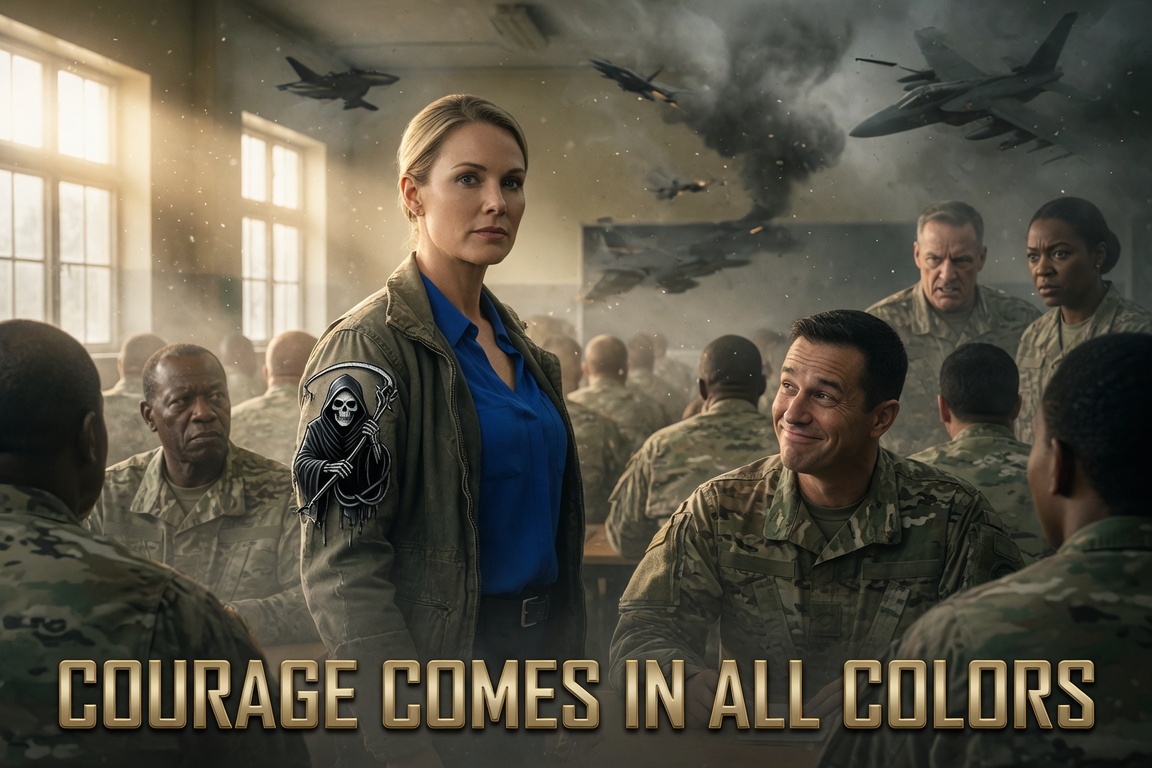
She sat alone in a faded blue shirt beneath a weathered green flight jacket. The jacket had no visible rank, no name tape, and no bright insignia—only the pale outline where several patches had once been removed.
One patch remained.
It was cracked with age, its black stitching worn nearly gray. A six-winged insect clung to a stylized rotor blade, its legs stretched across a red field.
Most of the young Marines nearby had already glanced at it.
None recognized it.
Captain Nolan Vance did.
Or at least he thought he did.
He planted one hand on the back of the empty chair across from her.
“You lost, ma’am?”
The woman finished chewing before she looked up.
She appeared to be in her late forties, perhaps fifty. Dark hair touched with silver was pulled into a low knot at the base of her neck. A thin scar followed the edge of her left eyebrow, disappearing into a line at her temple. There was nothing theatrical about her face.
No challenge.
No apology.
Just attention.
“No,” she said.
Her voice was quiet enough that Vance leaned slightly closer.
“No?”
“No, Captain.”
The use of his rank tightened something behind his eyes.
His four companions stood a few feet away with trays in their hands. Two lieutenants, one staff sergeant, and a contractor from base operations watched with the restrained interest of people who expected a show and did not want to admit it.
Vance looked over the woman’s table.
A bowl of soup.
A cup of black coffee.
A folded newspaper.
No visitor badge.
No dependent ID visible.
No escort.
Mess hall rules had been tightened after a civilian blogger slipped onto the installation three months earlier and posted photographs of restricted equipment online. Since then, Vance had appointed himself guardian of every door, hallway, and dining facility within sight.
It had earned him praise from Colonel Mercer.
It had also taught everyone beneath him to stay out of his way.
“This facility is restricted,” Vance said. “Active-duty personnel, authorized civilian employees, and invited guests.”
The woman lifted her coffee.
“Then I suppose one of those descriptions applies.”
A lieutenant behind Vance lowered his eyes to hide a smile.
Vance heard it anyway.
His fingers curled tighter around the chair.
“Which one?”
The woman took a sip.
“That seems like a question for the person who admitted me.”
“Who admitted you?”
She placed the cup down carefully.
“A Marine at the east security gate.”
“Name?”
“I didn’t ask.”
Vance gave a short laugh.
It was the kind of laugh designed to spread.
It did.
A few Marines at the nearest table looked over. Someone near the beverage station nudged a friend. The room did not become quiet, but its noise shifted, turning toward the corner like iron filings toward a magnet.
Vance pulled out the chair and sat without being invited.
Up close, he was younger than his confidence suggested. Thirty-six, broad-shouldered, clean-cut, with the polished appearance of a man who checked his reflection in darkened windows. His uniform was immaculate. His ribbons sat in perfect lines. His haircut looked as if it had been measured with engineering tools.
“You walked onto a Marine Corps installation,” he said, “entered a restricted dining facility, and you don’t know the name of the person who let you in.”
“That’s correct.”
“And you don’t see the problem.”
“I see several problems.”
One of Vance’s lieutenants shifted his tray from one hand to the other.
Vance leaned forward.
“Let’s hear them.”
“The soup is cold,” she said. “Your coffee tastes like brake fluid. And you’ve been blocking the aisle for forty seconds.”
Someone laughed.
Not loudly.
But loud enough.
Vance’s smile remained in place while the skin beneath it changed.
The woman picked up her spoon.
He put two fingers on the edge of her bowl and slid it six inches away.
The laughter vanished.
At a table near the window, Master Gunnery Sergeant Earl Gaines looked up from his lunch.
He was fifty-four, with the thick forearms and ruined knees of a man who had spent three decades climbing in and out of aircraft never designed for comfort. He stared at the woman’s jacket.
Then he stared harder.
Across from him, a young gunnery sergeant said something Gaines did not hear.
Vance tapped the table.
“Identification.”
The woman’s gaze moved from his hand to his face.
“Captain.”
“Ma’am.”
“Take your hand off my tray.”
There was no threat in her voice.
That was what made it land.
Vance removed his hand, but only because everyone was watching.
He sat back.
“Identification,” he repeated.
The woman reached slowly into the inside pocket of her jacket.
Every nearby head turned.
She removed a slim leather wallet and placed it on the table between them.
Vance opened it.
Inside was a federal identification card with a photograph of the woman, but the upper section was partially obscured by a black security strip. The visible text showed a name.
DR. ELENA WARD.
Below it, in smaller print:
DEPARTMENT OF DEFENSE.
Vance frowned.
“What kind of doctor?”
“The kind who finished medical school.”
Another ripple moved through the room.
His jaw tightened.
“I can read, Doctor. What is your position?”
“It’s listed.”
“It’s redacted.”
“Yes.”
“Why?”
“Because the people who issued it preferred it that way.”
Vance looked at the card again. He could have stopped there. A Department of Defense credential, even partially redacted, was enough to establish that she belonged on the installation.
But stopping would have meant retreating.
And Captain Nolan Vance had built his career on never retreating where anyone could see.
He closed the wallet and kept it in his hand.
“Where did you get the jacket?”
The woman’s eyes changed.
It was almost nothing.
A slight narrowing.
A stillness around the mouth.
“My closet.”
“The patch.”
“What about it?”
Vance turned toward his audience.
“You know how many civilians buy these things online?”
No one answered.
He looked back at her.
“Old flight jackets. Squadron patches. Callsign tabs. They wear them into bars, airports, military towns. Half the time they don’t even know what they mean.”
The woman rested both hands on the table.
“And the other half?”
“They’re pretending to be something they’re not.”
At the window table, Gaines rose so quickly his chair legs scraped the floor.
Vance glanced at him.
“Problem, Master Guns?”
Gaines’s eyes stayed on the patch.
The faded insect.
The rotor blade.
The red field.
For a moment, the old Marine looked as though he had seen a ghost walk in from the rain.
Then he sat down again.
“No, sir.”
But his face had gone pale.
Vance turned back to the woman.
“What did they tell you it stood for when you bought it?”
She studied him.
“Who is ‘they’?”
“The surplus store.”
The muscles along Gaines’s neck tightened.
The woman leaned back.
“You seem very certain I bought it.”
“I’ve spent twelve years around Marine aviation.”
“Twelve.”
“That right.”
She looked at the captain’s wings.
“You fly?”
“AH-1Z Vipers.”
“Attack helicopters.”
“You familiar with them?”
“I’m familiar with helicopters.”
His smile sharpened.
“I’m sure you are.”
Outside, thunder rolled somewhere beyond the flight line.
The mess hall lights flickered once.
The woman looked toward the windows, where the blurred silhouettes of aircraft sat beneath gray skies.
Vance saw the movement.
He mistook it for discomfort.
“Here’s what’s going to happen,” he said. “You’re going to tell me who invited you. Then you’re going to tell me where you got the patch. After that, I’ll decide whether base security escorts you out or turns this over to NCIS.”
The contractor behind him drew a breath through his teeth.
Even the lieutenants stopped enjoying themselves.
The woman’s expression did not change.
“NCIS.”
“Impersonating military personnel is a serious matter.”
“I’m not wearing a uniform.”
“You’re displaying a unit insignia.”
“So are three people at the table behind you.”
Vance glanced over his shoulder.
Three young Marines immediately looked down at their food.
“They earned theirs.”
The woman lowered her eyes to the weathered patch.
“So did I.”
The words settled over the table.
Vance stared at her for a second.
Then he laughed.
This time, no one joined him.
He picked up her identification wallet, turned it between his fingers, and nodded toward the patch.
“All right, Doctor. Let’s say you earned it.”
She said nothing.
“Aircraft?”
“Several.”
“Branch?”
She watched him.
“You’re making this difficult.”
“No, Captain. You’re doing that by yourself.”
A murmur passed through the room.
Vance’s ears reddened.
“Unit?”
The woman’s gaze drifted briefly to Gaines, who was no longer eating.
Then back to Vance.
“You don’t recognize the patch.”
It was not a question.
Vance felt the room tilt against him.
He had seen obscure patches before. Hundreds. Some belonged to squadrons that no longer existed. Some came from joint task forces. Some had been designed for single deployments and produced in batches small enough to become collectors’ items.
He could have admitted he did not know.
But one of his lieutenants was watching.
So was the staff sergeant.
So were nearly sixty Marines.
“Experimental rotary-wing support,” Vance said confidently. “Early Iraq. Private contractor integration.”
Gaines shut his eyes.
The woman looked down at the patch.
“That’s an imaginative answer.”
Vance pushed back from the table.
“What was your call sign?”
There it was.
The question that would expose her.
Around the room, conversations thinned to silence. Trays stopped moving. The rain ticked against the glass.
The woman looked at him for a long moment.
Not angry.
Not afraid.
Tired.
As though she had been asked to open a door she had spent years keeping closed.
“You don’t need that,” she said.
Vance grinned.
“I think I do.”
“No.”
“Then we’re done here.”
He raised one hand toward the entrance.
Two military police officers standing near the door straightened. One was a corporal barely old enough to hide the uncertainty on his face. The other, Sergeant Malik Rhodes, had worked base security long enough to know that a partially redacted Department of Defense credential was not something a captain should wave around in a crowded mess hall.
Rhodes approached slowly.
Vance held out the leather wallet.
“Sergeant, this woman entered a restricted facility without a visible pass and is claiming affiliation with a military aviation unit.”
Rhodes looked at the identification.
His eyebrows rose.
“Sir, this credential appears valid.”
“Appears.”
“It scans through the east gate system.”
Vance turned.
“You checked?”
“Gate control sent a notice twenty minutes ago.”
“What notice?”
Rhodes hesitated.
The woman looked at him.
Rhodes’s eyes met hers for a fraction of a second.
Then he said, “I was instructed not to interfere with the visitor’s movement.”
Vance’s face tightened.
“By whom?”
“That part was above my clearance, sir.”
For the first time, something uncertain crossed Vance’s eyes.
It vanished almost instantly.
“Then call gate control and verify.”
“Sir—”
“Now.”
Rhodes stepped aside and keyed the radio clipped to his vest.
Vance looked down at the woman.
“Last chance. Call sign.”
The woman exhaled through her nose.
Gaines rose again.
This time, he did not sit.
“Captain,” he said.
Vance turned.
Gaines’s voice carried without effort.
“Recommend you leave this alone.”
Vance stared at him.
“Is that an order, Master Gunnery Sergeant?”
“No, sir.”
“Then sit down.”
Gaines did not move.
Thirty-one years in the Marine Corps stood behind his silence.
Vance rose from the chair.
“That was not a suggestion.”
Gaines slowly lowered himself back into his seat, but the look he gave the woman remained fixed.
Not curiosity.
Recognition.
The woman saw it.
A flicker of pain crossed her face so quickly most of the room missed it.
Vance did not.
He mistook that too.
He leaned closer.
“Your call sign.”
The woman touched one finger to the cracked edge of the patch.
Then she looked directly into his eyes.
“Sticky Six.”
For three seconds, nothing happened.
Vance’s smile widened.
He glanced around as though he had won.
“Sticky Six?”
The woman said nothing.
“That’s what you’re going with?”
At the window table, Gaines’s coffee cup slipped from his hand.
It struck the floor and shattered.
The sound cracked through the silence like a pistol shot.
Every head turned.
Gaines was standing again.
His skin had gone gray beneath the fluorescent lights.
“Jesus Christ,” he whispered.
The woman looked at him.
“Hello, Earl.”
His mouth opened.
No sound came out.
Then Sergeant Rhodes’s radio erupted.
“Base Security, Operations Actual.”
Rhodes grabbed the handset.
“Go for Base Security.”
The voice on the radio was clipped, urgent, and suddenly too loud.
“Confirm status of Sticky Six.”
No one moved.
Vance’s face emptied.
Rhodes looked at the woman.
She gave one small nod.
“Sticky Six is secure in North Mess,” he said.
A burst of static answered.
Then:
“Copy. Inform Sticky Six the Commanding General’s aircraft is holding. Joint Rescue Review begins at fourteen hundred. General Talbot requests her presence immediately.”
The room became so still that the hum of the overhead lights sounded enormous.
Vance looked at the weathered patch.
Then at the woman.
Then at the identification wallet still in his hand.
Across the room, Master Gunnery Sergeant Gaines came to attention.
Not casually.
Not ceremonially.
His heels struck the floor with a clean, hard snap.
“Ma’am,” he said, his voice rough, “welcome back.”
Elena Ward stood.
And the captain finally noticed that nearly every senior aviator in the room had risen with her.
But the question on his face was no longer who she was.
It was what she remembered about him.
1
Nine years earlier, Nolan Vance had watched a helicopter burn in a valley west of Sangin.
He had been a first lieutenant then, newly qualified, sharp enough to know the procedures and young enough to believe procedures could control the world.
The aircraft had gone down after taking fire during a casualty evacuation. Vance had been flying escort. Dust swallowed the valley. Radio traffic collapsed beneath overlapping voices. The ground force commander demanded immediate extraction. Operations ordered Vance’s section to hold outside the threat ring.
Then a woman’s voice cut across the frequency.
Calm.
Low.
Unmistakable.
“Sticky Six is inbound.”
Vance had never seen her aircraft clearly.
Only a dark shape descending through brown air where no helicopter should have survived.
She landed beneath fire.
Stayed on the ground for eighty-seven seconds.
Lifted with eleven wounded Marines, two dead, and a crew chief bleeding into his harness.
Later, the official report credited coordinated rescue aviation.
The unofficial story traveled faster.
Sticky Six had returned three times that night.
On the final pass, her aircraft took rounds through the nose, cockpit floor, and transmission housing. She flew thirty-two miles with hydraulic pressure bleeding toward zero and one engine coughing metal into the exhaust.
The pilot disappeared from the theater two weeks later.
Some said she had been killed.
Others said she had been grounded.
A few said Sticky Six was never one person at all, but a rotating call sign used by a classified rescue team.
Vance had believed the last version because it allowed him to avoid remembering the voice.
“You have a decision to make, Lieutenant,” it had told him that night. “Follow me in, or keep circling while Marines die.”
He had followed.
Not because he was brave.
Because he was more afraid of living with himself if he did not.
For years, whenever anyone praised his actions in that valley, Vance accepted the compliment.
He never mentioned who had gone first.
Now, in the mess hall at Redstone, the woman attached to that voice stood six feet away.
She was smaller than he had imagined.
Older.
Human.
That frightened him more than any legend could.
Gaines stepped around the broken coffee cup.
He stopped in front of Elena but did not offer his hand.
For a second, neither spoke.
Then she looked at his right leg.
“You still drag it when you’re tired.”
Gaines’s lower lip trembled once.
“You still notice everything.”
“Not everything.”
His gaze moved to the scar along her eyebrow.
“You look different.”
“So do you.”
“I got handsome.”
“You got wide.”
A sound escaped him—half laugh, half breath.
Around them, the room remained silent.
Vance stood at the edge of the moment holding Elena’s wallet like stolen property.
She turned toward him.
“May I have that back?”
He looked down.
Then handed it over.
His fingers were cold.
“Ma’am, I—”
“Captain Vance.”
Hearing his name from her changed the air again.
He stared.
She slid the wallet into her jacket.
“You remember me,” he said.
“I remember the valley.”
His throat tightened.
Gaines looked from one to the other.
“You two served together?”
“No,” Elena said. “We occupied the same airspace.”
The distinction cut deeper than an insult.
Vance’s companions stepped farther away from him.
Elena gathered her newspaper and coffee. She left the soup untouched.
Then she turned toward Sergeant Rhodes.
“Where’s General Talbot waiting?”
“Flight Operations, ma’am. Vehicle is en route.”
“I’ll walk.”
“In this weather?”
She glanced toward the windows.
“I’ve been wet before.”
She started for the exit.
Gaines followed one step behind.
Vance forced himself to move.
“Doctor Ward.”
She stopped.
Every Marine in the room watched him.
He could apologize.
The words were there.
They rose into his chest, collided with pride, and died before reaching his mouth.
Instead, he said, “You should have identified yourself.”
Elena turned slowly.
Gaines closed his eyes.
The rain battered the windows.
Vance heard how the sentence sounded only after it was too late.
Elena’s face remained composed, but something behind it locked into place.
“I did,” she said. “You decided the answer wasn’t impressive enough.”
She walked away.
The doors opened.
Cold air swept into the room, carrying rain and the distant thunder of rotors.
Captain Vance stood alone beside the table.
Nobody laughed.
2
The command vehicle arrived as Elena crossed the wet concrete between the mess hall and Flight Operations.
She ignored it.
Rain darkened the shoulders of her jacket. Wind pulled loose strands of hair across her cheek. Along the flight line, helicopters crouched under the storm like animals waiting to be released.
Gaines kept pace beside her, though his damaged leg made every third step uneven.
“You knew it was me,” she said.
“Patch gave me the first clue.”
“And the second?”
“You insulted the coffee.”
“It’s bad coffee.”
“You said the same thing in Helmand.”
She stopped beneath the overhang of a maintenance building.
Rain drummed on the metal roof.
Gaines turned toward her.
For a moment, the base disappeared. There was only the gray light, the smell of jet fuel, and two people standing on opposite sides of nine unspoken years.
“You left without telling anybody,” he said.
“I was evacuated.”
“Then you vanished.”
“I was recovering.”
“We sent messages.”
“I know.”
“You read them?”
“Some.”
His face hardened.
“Not mine.”
“No.”
“Why?”
Elena looked beyond him at a helicopter being towed into a hangar.
Its rotor blades flexed in the wind.
“Because you thanked me.”
“You saved my life.”
“That was the problem.”
Gaines stared at her.
She put one hand into the jacket pocket, thumb rubbing the edge of something hidden inside.
“I carried twelve people out of that valley,” she said. “Everyone called it a miracle. Nobody wanted to talk about the aircraft we couldn’t reach.”
Gaines’s anger softened.
“Elena.”
“There were six Marines on that ridge.”
“You didn’t leave them.”
“I flew over them twice.”
“Because your transmission was failing.”
“I heard them on the radio.”
“You had eleven wounded aboard.”
“One of them was already dead.”
“And ten were alive.”
She looked at him.
Rain ran from the roof in a clear curtain between them and the runway.
“I made the right decision,” she said.
Gaines waited.
She swallowed.
“That never made it feel right.”
His shoulders dropped.
At fifty-four, Gaines had learned that grief did not shrink with time. It changed shape. It learned to fit inside uniforms, marriages, promotions, birthday parties, and quiet kitchens at two in the morning.
But it never left.
“I thanked you,” he said, “because my daughter was seven years old when you pulled me out. She’s sixteen now. She drives too fast, hates chemistry, and thinks I’m embarrassing.”
Elena looked down.
“You gave me every year in between.”
Her hand tightened inside the pocket.
“You don’t owe me those years.”
“No,” Gaines said. “But I get to be grateful for them.”
A black SUV rolled to a stop beside the curb.
Brigadier General Thomas Talbot stepped out before the driver could open his door.
He was sixty-two, tall and spare, with deep lines around his eyes and silver hair cut close to his scalp. He carried no umbrella.
“Elena.”
She faced him.
“General.”
“You walked.”
“I noticed.”
Talbot looked toward the mess hall.
Word had already reached him. On a military installation, information often traveled faster than authorization.
“What happened?”
“Lunch.”
Gaines coughed into his fist.
Talbot studied her face.
“Was Vance involved?”
Elena did not answer.
That was answer enough.
The general’s mouth tightened.
He turned to Gaines.
“Master Guns?”
“Sir.”
“Find Captain Vance. Have him report to my conference room at thirteen-thirty.”
Elena stepped forward.
“No.”
Talbot looked at her.
“This is not your decision.”
“If you call him in now, everyone will assume I demanded punishment.”
“Did you?”
“No.”
“Then why protect him?”
“I’m not.”
She looked toward the rain-smeared windows of the mess hall. Several silhouettes remained visible inside.
“I want to know whether that was a bad moment or a pattern.”
Talbot’s expression changed.
He knew that tone.
It had preceded some of the most uncomfortable findings in his career.
“The review team came here to evaluate rescue aviation readiness,” he said.
“And leadership culture determines readiness.”
“This is not your old task force.”
“No. It’s yours.”
Talbot held her gaze.
The wind snapped the flags near headquarters.
Finally, he nodded.
“What do you need?”
“Access to safety reports, retention interviews, flight-hour assignments, and disciplinary records for Marine Aircraft Group Twelve.”
“That’s broad.”
“So is arrogance when rank protects it.”
Gaines looked toward the mess hall again.
“What are you expecting to find?”
Elena zipped her jacket.
“I don’t know yet.”
Talbot opened the SUV door.
“You have forty-five minutes before the joint review begins.”
Elena climbed inside.
As Gaines started to follow, she stopped him.
“Earl.”
He looked back.
“Don’t tell anyone who I am.”
The old Marine glanced toward the mess hall, where the story was already multiplying with every retelling.
“That ship sailed nine years ago.”
“Then let it sail without a passenger list.”
The door closed.
As the SUV pulled away, Gaines stood in the rain and watched it go.
Behind him, Captain Nolan Vance emerged from the mess hall.
His face was composed again.
His stride was controlled.
But in his right hand, crushed so tightly the paper had torn, he held an old printed photograph from a deployment bulletin board.
A helicopter hovered inside a wall of dust.
Beneath it, someone had written two words in black marker.
STICKY SIX.
3
The joint rescue review began at fourteen hundred in a windowless operations theater beneath headquarters.
Three rows of officers faced a wall of screens. Maps of the Pacific, Europe, North Africa, and the Middle East glowed in different colors. Red lines marked aircraft ranges. Yellow circles showed evacuation windows. White numbers tracked weather, fuel, distance, and survival probability.
Elena stood at the front without introduction.
That bothered Vance.
He sat in the second row beside Major Connor Hale, commander of the attack helicopter squadron. Behind them, staff officers opened laptops and adjusted headsets.
Talbot entered last.
“Before we begin,” he said, “Dr. Elena Ward is leading the independent assessment team for the Department of Defense Joint Personnel Recovery Office.”
A shift moved through the room.
Vance stared at the back of Elena’s jacket.
Joint Personnel Recovery.
Not a retired pilot visiting an old friend.
Not a consultant.
The person with authority to evaluate whether units were prepared to recover isolated personnel across hostile territory—and whether commanders could be trusted to make decisions when lives became numbers on a screen.
Elena removed the flight jacket and placed it over a chair.
Underneath, she wore the plain blue shirt Vance had mocked.
No medals.
No insignia.
No visible proof.
She picked up a remote.
The first screen showed a simulated downed-aircrew scenario in mountainous terrain.
“Two aviators,” she said. “One injured. Enemy force moving from the east. Weather closes the valley in forty-three minutes. Available aircraft are listed on your tablets.”
Her voice was calm.
The same voice from the valley.
Vance felt the memory before he could stop it.
Dust.
Gunfire.
A burning aircraft.
Follow me in, or keep circling while Marines die.
Elena continued.
“This is not a tactics test. It is a judgment test. You will recommend a course of action, identify acceptable risk, and explain what you are unwilling to sacrifice.”
Teams began working.
Vance forced his attention to the scenario.
He found the answer quickly. Launch a two-ship escort, hold rescue aircraft outside the threat ring, suppress known enemy positions, and delay recovery until weather provided concealment.
Clean.
Controlled.
Defensible.
Major Hale nodded.
“Conservative, but sound.”
Vance entered the recommendation.
Twenty minutes later, Elena displayed the results.
Four of six teams chose variants of delayed recovery.
One chose immediate launch with unmanned reconnaissance.
The final team—led by a warrant officer and a Navy corpsman—recommended dividing assets, landing a small ground element above the valley, and using weather as a shield rather than waiting for it to close the route.
Elena looked toward Vance’s row.
“Captain, explain your decision.”
He stood.
“Immediate entry exposes four aircrews and multiple aircraft to a threat environment we have not adequately shaped.”
“And the isolated aviators?”
“Remain concealed until suppression is complete.”
“How long?”
“Best estimate, thirty-five minutes.”
“The injured aviator has arterial bleeding.”
“That information was not in the initial brief.”
“It was in the medical appendix.”
Vance glanced at his tablet.
He had not opened the appendix.
“Then the timeline changes.”
“To what?”
He hesitated.
Every face turned toward him.
“Twenty minutes.”
“The weather closes the valley in forty-three.”
“Yes.”
“The enemy arrives in eighteen.”
Vance’s jaw tightened.
“That intelligence was assessed low confidence.”
“The enemy does not care how confident your assessment is.”
A few officers looked down.
Vance felt the room turning again, just as the mess hall had.
“You asked for acceptable risk,” he said.
“I did.”
“I won’t risk four crews for two people.”
Elena held his gaze.
“What if one of the two is your commanding officer?”
“No difference.”
“Your closest friend?”
“No difference.”
“Your crew chief?”
“No difference.”
“Someone who once saved your life?”
The room changed.
Major Hale turned slightly.
Vance felt heat rise beneath his collar.
Elena clicked the remote.
The screen changed to a grainy aerial image of a valley.
A burning helicopter lay on its side. Tracer fire cut through dust. A second aircraft descended into the center of the frame.
Vance stopped breathing.
The image had been taken from his gun camera.
“This,” Elena said, “is what unacceptable risk looks like from a distance.”
No one moved.
She froze the frame as the descending helicopter vanished into dust.
“The rescue aircraft entered with a damaged navigation system, incomplete threat intelligence, and no confirmed landing zone. It extracted eleven casualties.”
She clicked again.
A second image appeared.
Two attack helicopters circled beyond the ridge.
Vance recognized his aircraft.
“Escort held outside the valley for seventy-four seconds after the rescue aircraft committed.”
The silence became physical.
Major Hale stared at Vance.
Elena did not raise her voice.
“Why?”
Vance looked at the screen.
He had asked himself that question for nine years.
The honest answer was simple.
Fear.
Not cowardice in the way films portrayed it. His hands had not shaken. He had not tried to flee.
He had simply wanted more information.
A clearer picture.
One more confirmation.
A safer angle.
Fear had worn the uniform of professionalism, and he had obeyed it.
“We had conflicting orders,” he said.
“That is true.”
“Operations told us to hold.”
“Also true.”
“We were waiting for threat confirmation.”
“True again.”
He looked at her.
“Then what answer are you looking for?”
“Yours.”
He said nothing.
Elena let the silence stretch.
The entire room watched him stand inside it.
Finally, he said, “I made the decision I believed gave us the best chance of protecting the crews under my responsibility.”
Elena studied him.
She knew a defensive statement when she heard one.
So did every commander in the room.
She turned off the screen.
“Take fifteen minutes.”
Chairs shifted.
Conversations started in low voices.
Vance stepped into the corridor before anyone could stop him.
Elena followed several seconds later.
He heard her shoes on the tile and turned.
“You ambushed me.”
She stopped ten feet away.
“No.”
“You used classified footage from my mission.”
“The footage was declassified four years ago.”
“You knew I would be here.”
“Yes.”
“You built the scenario around Sangin.”
“I built it around a common failure in command judgment.”
His fists closed.
“You’re trying to humiliate me.”
Elena’s face tightened.
“You think this is humiliation?”
“You showed that footage in front of my commanding officer.”
“I showed it in a room full of people whose decisions may put young Marines into the same position.”
“You made me the lesson.”
“You made yourself the lesson in the mess hall.”
The words hit hard.
Vance stepped closer.
“You walk in wearing that jacket, hide your position, refuse to identify yourself, then act surprised when someone challenges you.”
“I presented valid identification.”
“You withheld context.”
“Because context should not determine whether you treat someone with dignity.”
He laughed without humor.
“That sounds good in a briefing.”
“It also sounds good in a mess hall.”
A door opened behind them.
Major Hale stepped into the corridor, saw their faces, and stopped.
Vance lowered his voice.
“You don’t know what it takes to command now.”
Elena looked at the silver bars on his collar.
“I know exactly what it costs when the wrong person does.”
Vance’s face hardened.
There it was.
Not anger.
Recognition.
The thing he feared most was not that she would expose a mistake from nine years earlier.
It was that she had already recognized what he had become.
Major Hale cleared his throat.
“Captain, a word.”
Vance looked from him to Elena.
Then followed Hale down the corridor.
Elena remained alone beside the closed theater doors.
She reached into her pocket and removed a small metal tag.
The name stamped into it had been worn nearly smooth.
CPL MATTHEW WARD.
She closed her fingers around it.
Inside the operations theater, someone advanced the next slide.
A casualty list appeared on the screen.
Six names were marked unrecovered.
One of them matched the tag in her hand.
4
Matthew Ward had been Elena’s younger brother.
He was twenty-six when he died on the ridge.
The official report said his reconnaissance team had been cut off after moving to support a disabled convoy. Enemy fire prevented recovery. Weather closed the valley. Aviation assets withdrew.
Operational necessity.
That was the phrase.
It appeared three times in the report.
Elena had been in the air below him.
She had heard his radio call.
Not his voice—his team leader’s.
Six Marines, two critical.
They could see her aircraft through the dust.
She had eleven wounded aboard, fuel below emergency reserve, and warning lights multiplying across the panel.
Her copilot told her they had to leave.
Her crew chief told her the same.
Elena made the decision.
She turned south.
The six Marines on the ridge were overrun nine minutes later.
Matthew’s body came home beneath a flag.
The other five came home beside him.
For years, people called Sticky Six fearless.
Elena knew better.
Fear had been in the cockpit with her.
It had simply wanted different things.
Fear of losing the aircraft.
Fear of killing everyone aboard.
Fear of choosing her brother because he was her brother.
Fear of not choosing him because she wanted to prove she could remain objective.
No investigation found fault.
No commander blamed her.
That was almost worse.
She left active duty eighteen months later.
Medical school came afterward, then trauma research, then personnel recovery policy. She studied how people made decisions under pressure—what they saw, what they missed, how rank distorted information, how pride disguised itself as certainty.
She spent nine years building systems designed to prevent someone else from reaching the same impossible ridge with no good options left.
And now Captain Nolan Vance was standing in the center of one of those systems, teaching young pilots that control mattered more than courage and appearances mattered more than character.
By eighteen hundred, Elena had reviewed forty-two internal documents.
The pattern was not dramatic.
Patterns rarely were.
Vance had no drunk-driving arrest. No assault complaint. No obvious breach of regulations.
Instead, there were small things.
A lieutenant removed from a deployment slot after challenging a maintenance shortcut.
A female crew chief transferred following repeated comments about her “command presence.”
Three junior pilots who reported being discouraged from logging safety concerns because it made the squadron “look timid.”
An enlisted airframe mechanic disciplined for entering a readiness discrepancy after Vance ordered the aircraft listed as mission capable.
Each event had an explanation.
Each explanation was just plausible enough.
Together, they formed a shape.
General Talbot stood behind her chair in a secure records room.
“You see it,” he said.
“Yes.”
“Can you prove it?”
“Not yet.”
Elena opened another file.
A resignation letter from Captain Abigail Cho, one of the squadron’s most experienced pilots.
The letter was brief and professional.
The attached exit interview was not.
Cho described a training exercise six months earlier in which Vance had pressured crews to continue despite deteriorating visibility. One aircraft struck a tree branch during low-level flight. No one was injured.
The incident had been classified as minor damage.
Cho believed it should have triggered a formal safety review.
Vance called it “pilot hesitation dressed up as procedure.”
Talbot read over Elena’s shoulder.
“Why didn’t I see this?”
“It was closed at group level.”
“By whom?”
“Major Hale.”
Talbot looked toward the door.
“Hale is protecting him.”
“Or protecting the squadron.”
“That distinction doesn’t help me.”
“It may help us understand him.”
Talbot paced once across the small room.
“Vance’s father was a Marine aviator.”
“I know.”
“Colonel Richard Vance. Killed in training when Nolan was sixteen.”
“I read the file.”
“The investigation blamed spatial disorientation. Nolan has spent his entire career obsessed with control. Checklists. Readiness. Discipline. He believes hesitation killed his father.”
Elena closed the folder.
“And now he punishes anyone who admits uncertainty.”
Talbot nodded.
“He’s not stupid. He’s not lazy. He’s flown dangerous missions and brought people home.”
“So did I.”
Talbot studied her.
“That is not the same as being whole.”
A knock sounded at the door.
Sergeant Rhodes entered with a tablet.
“General. Doctor.”
“What is it?” Talbot asked.
Rhodes handed the tablet to Elena.
“Security footage from the mess hall.”
She watched the silent video.
Vance approached her table.
Sat.
Moved her soup.
Took her identification.
The visual made the incident worse. Without sound, his confidence looked less like authority and more like a man enjoying an audience.
Rhodes swiped to a second file.
“This was recorded three weeks ago.”
The footage showed a young civilian woman standing outside a maintenance hangar. Vance confronted her, blocked her path, and demanded identification.
“Who is she?” Elena asked.
“Lena Ortiz. Aerospace engineering graduate student. She was on base for a rotor-fatigue research partnership.”
“What happened?”
“She presented credentials. Captain Vance told her the program was restricted and suggested she wait for an escort.”
“Was it restricted?”
“No.”
The video continued.
A male researcher arrived four minutes later.
Vance waved him through without checking his identification.
Talbot’s face went still.
“Why was this never reported?”
“She didn’t file a complaint. But one of the gate cameras captured it.”
Elena rewound the footage.
Watched Vance’s posture.
The angle of his shoulders.
The smile he wore when he thought the woman had no power.
The change when the male researcher appeared.
She set down the tablet.
“It’s a pattern.”
Talbot nodded toward the records.
“Enough to remove him?”
“Enough to investigate.”
“And tomorrow?”
Elena looked at the operations schedule on the wall.
A live rescue demonstration was set for 0700.
Vance would lead the escort section.
Weather was expected to worsen overnight.
“Cancel the demonstration,” she said.
Talbot frowned.
“Why?”
“Because Cho’s report says he pushes in poor visibility.”
“We can order conservative limits.”
“He’ll obey the written limits and pressure everyone beneath them.”
Talbot picked up the phone.
Before he could dial, an alarm sounded in the corridor.
Not a drill tone.
A real one.
The door opened again.
A duty officer rushed in.
“General, civilian aircraft down in the northern training range.”
Talbot stood.
“What aircraft?”
“Medical transport. Four aboard. It declared engine trouble, then disappeared from radar near Black Pine Ridge.”
Elena was already pulling on her jacket.
“Weather?”
“Ceiling eight hundred feet and dropping. Heavy rain. Temperature near freezing.”
“Survivors?”
“Emergency beacon is active.”
Talbot moved toward the operations floor.
“Available rescue assets?”
The duty officer hesitated.
“Search-and-rescue crew is grounded at Carson for maintenance.”
“Army?”
“Fort Derby has a Black Hawk, but launch estimate is fifty minutes.”
Elena looked through the glass toward the flight line.
One Viper section sat fueled beneath the lights.
Captain Vance’s section.
Talbot saw the same thing.
“No,” Elena said.
He looked at her.
She zipped the jacket.
“You just told me to cancel tomorrow’s demonstration.”
“Tomorrow was training.”
“And tonight?”
A radio operator called from the operations floor.
“Beacon signal weakening!”
Rain hammered the roof.
Somewhere in the darkness beyond the runway, four people were waiting inside a broken aircraft.
Talbot looked at Elena.
Then at the aircraft outside.
“Get Vance.”
5
The civilian medical plane had gone down eight miles inside the training range, where Black Pine Ridge rose sharply from forested ravines.
Radar placed the last known position near an old logging road.
The emergency beacon transmitted in irregular bursts.
One passenger was a nine-year-old boy being moved to a pediatric cardiac center.
The other three were the boy’s mother, a flight nurse, and the pilot.
By 18:47, the operations floor had become a storm of voices and screens.
Captain Vance stood at the central table wearing a flight suit. Major Hale was beside him. Weather data rolled across the monitor.
Elena entered with Talbot.
Vance looked at her, then away.
“The ceiling is too low for a standard search,” he said. “We can launch to the southern holding point and wait for an opening.”
“Beacon may fail before then,” Elena said.
Vance’s eyes returned to her.
“I’m aware.”
“Infrared?”
“Rain attenuation is heavy. Terrain masking will degrade signal.”
“Ground teams?”
“Two hours minimum.”
Elena studied the map.
A narrow river cut through the ridge from north to south. The temperature difference between water and land could create a visible thermal line even through the rain.
“Follow the river at low altitude,” she said. “Use the beacon bearing to identify the intersecting ravine.”
Vance shook his head.
“That puts us below the ridgeline in marginal visibility.”
“It does.”
“With unconfirmed wires across two logging corridors.”
“Yes.”
He stared at her.
“You’re recommending the exact kind of entry you criticized this afternoon.”
“I criticized entering without understanding the risk. We understand this one.”
“No, we don’t.”
His voice rose.
Several operators looked over.
Elena stepped closer to the table.
“We know the river. We know the terrain. We know the weather trend. We know the beacon is failing.”
“We do not know the wire locations.”
“Then put a second aircraft high enough to mark obstacles.”
“In this ceiling?”
“Use the western ridge. It has better clearance.”
Vance’s finger stabbed the map.
“And when the weather closes behind us?”
“You decide whether four people on the ground are worth the chance that you may have to land somewhere you didn’t plan.”
His eyes flashed.
“There it is.”
“What?”
“The legend.”
The room quieted.
“You think because you survived Sangin, every impossible approach is courage and every delay is cowardice.”
Major Hale put a hand on Vance’s arm.
“Captain.”
Vance pulled away.
“No, sir. She has been doing this all day.”
Elena did not move.
“Say what you came to say.”
He leaned across the table.
“You got lucky.”
Gaines entered the operations floor just in time to hear it.
His face changed.
Vance continued.
“You broke procedure, ignored orders, damaged an aircraft, and somehow came home. Everyone turned it into a myth because they needed one.”
Elena’s gaze remained fixed on him.
“That’s what you believe?”
“That’s what happened.”
“No,” Gaines said from behind him.
Vance turned.
Gaines walked forward, his limp more visible when he was angry.
“What happened,” the old Marine said, “is she landed while rounds came through the cabin. What happened is her crew chief was hit twice and kept working. What happened is she carried men you would have left waiting for a cleaner briefing.”
Vance’s nostrils flared.
“You weren’t in my cockpit.”
“No. I was bleeding out in hers.”
Talbot stepped between them.
“Enough.”
The emergency beacon disappeared from the screen.
A technician leaned forward.
“Signal lost.”
The room went silent.
Elena looked at the dark marker.
Every second began to feel like the ridge.
A voice on the radio.
A choice.
A clock no one could see.
She turned to Vance.
“You’re aircraft commander.”
His breathing was heavy.
“Yes.”
“The decision is yours.”
He stared at her.
It was the one thing he had not expected.
“You’re not ordering me to launch?”
“No.”
“Why?”
“Because when you’re in that cockpit, my authority will not fly the aircraft for you.”
She pointed toward the map.
“You know the risks. You know the people. Decide.”
Vance looked at the storm beyond the windows.
Then at the marker where the signal had vanished.
He imagined the aircraft crushed among trees.
A child in the dark.
A mother listening to rain strike metal.
His father’s final training report flashed through his mind.
Spatial disorientation.
Controlled flight into terrain.
A good pilot who had believed his instruments until the mountain proved stronger.
For twenty years, Nolan had treated control as the opposite of fear.
Now he understood they had been holding hands the entire time.
He picked up his helmet.
“Major Hale, I recommend launch with two aircraft. Lead follows the river. Wing holds west ridge and marks obstacles. We carry emergency medical kits and cold-weather gear. If visibility drops below limits, we land.”
Hale looked at Talbot.
The general nodded.
“Approved.”
Vance turned toward the door.
Then stopped beside Elena.
“If this goes wrong?”
“It will be your decision.”
He waited.
She met his eyes.
“So will coming home.”
The hangar doors opened.
Wind drove rain across the concrete.
The two attack helicopters spun to life beneath white floodlights, rotors chopping the storm into sheets of spray.
Vance climbed into the lead aircraft.
His copilot, First Lieutenant Dana Mercer, strapped in beside him. She was twenty-eight, sharp-eyed, and one of the pilots whose safety reports had been returned twice for “excessive caution.”
Vance connected his helmet cable.
“Mercer.”
“Sir.”
“If I push beyond limits, you call it.”
She glanced at him.
In two years, he had never said that.
“Understood.”
“No.” He looked directly at her. “I need you to believe I mean it.”
Her expression shifted.
“Then I’ll call it.”
The canopy closed.
Engines rose.
Elena stood behind the operations glass as the helicopters lifted into the rain.
For a few seconds, their lights hovered above the runway.
Then the storm swallowed them.
6
The river appeared on Vance’s display as a broken ribbon of cold black.
Rain hammered the canopy.
The aircraft shuddered in mountain wind. Visibility contracted to the reach of the landing lights, then opened briefly, then vanished again.
“Altitude one-fifty,” Mercer said.
“Copy.”
“Ridge right.”
“Visual.”
“Wires possible in two miles.”
Vance tightened his grip on the controls.
The cockpit filled with instrument glow and the mechanical sound of breathing through oxygen masks.
His wingman climbed toward the western ridge.
“Lead, Two. I have intermittent thermal contrast north-northeast. Could be wreckage.”
“Distance?”
“Three-point-four.”
Vance followed the river.
The beacon remained silent.
At operations, Elena stood behind the radio console with Gaines and Talbot.
The flight path crawled across the map.
A weather officer shook his head.
“Ceiling dropping to five hundred feet.”
Talbot looked at Elena.
She said nothing.
On the aircraft, Mercer leaned toward the windshield.
“Power line!”
Vance saw it too late.
A dark cable cut across the river less than two hundred yards ahead.
He pulled.
The helicopter climbed hard.
Warning tones filled the cockpit.
The cable flashed beneath them.
“Rotor clearance!” Mercer called.
“Clear.”
“Terrain ahead!”
The ridge emerged from darkness.
Vance banked left, following the river bend by instinct more than sight.
For one sickening second, every instrument disagreed with his body.
His inner ear told him they were rolling.
The display showed level.
His father had died inside that contradiction.
Vance felt panic rise.
Not as a scream.
As certainty.
He wanted to seize the aircraft, ignore every other voice, and force the world to obey.
Then Mercer spoke.
“Sir, you’re overcorrecting.”
“I have it.”
“Bank increasing.”
“I said I have it.”
“Captain, release pressure.”
His hands tightened.
The horizon tilted farther.
In operations, the telemetry line jumped.
A warning appeared.
Talbot stepped forward.
Gaines whispered, “Come on.”
Inside the cockpit, Mercer’s voice sharpened.
“Nolan.”
She had never used his first name.
It broke through.
Vance looked at the instruments.
Not his body.
Not the darkness.
The instruments.
He eased pressure.
The bank corrected.
The river returned beneath them.
His breath came in rough bursts.
Mercer kept her hands near the controls.
“You with me?”
“Yes.”
“Say it.”
“I’m with you.”
The aircraft stabilized.
Vance swallowed.
“Thank you.”
Two miles ahead, his wingman called again.
“Lead, Two. Strong thermal source at ravine intersection. Multiple hot spots.”
Vance followed the bearing.
The wreckage appeared suddenly—a white fuselage torn open among trees, one wing missing, nose buried against a slope.
A red emergency light blinked weakly through rain.
“Visual,” Mercer said.
There was no landing zone.
Only trees, mud, and a narrow logging road too small for the helicopter.
Vance circled once.
Fuel ticked downward.
“Operations, Lead. Crash located. No suitable landing zone.”
Elena closed her eyes briefly.
On the map, the aircraft circled the same impossible point.
Talbot keyed the radio.
“Lead, recommend hold until ground team arrival.”
Elena looked at him.
Talbot’s jaw tightened.
He was protecting the crews.
He was also leaving four people in freezing rain for nearly two hours.
Vance’s voice came through.
“Operations, assess survivor condition.”
Thermal imagery appeared on the feed.
Three figures moved near the fuselage.
A fourth heat source remained inside.
Mercer studied the display.
“One stationary. Three mobile.”
Vance scanned the slope.
A rocky outcrop lay above the crash site. Too small for a landing, but perhaps large enough for one skid.
He heard Elena’s voice in memory.
You decide whether four people on the ground are worth the chance that you may have to land somewhere you didn’t plan.
He keyed the radio.
“Operations, Lead. Attempting partial-skid landing on north outcrop.”
Talbot answered immediately.
“Negative. Surface unknown.”
“Understood.”
“Captain, that was a negative.”
Vance looked at Mercer.
She studied the outcrop.
“Left skid only,” she said. “Right side remains light. We’ll need constant power.”
“Can we hold it?”
“For a minute. Maybe two.”
Vance keyed the radio.
“Operations, Lead. I accept the risk.”
Before Talbot could respond, another voice entered the channel.
Elena’s.
“Lead, Sticky Six.”
Vance froze.
The call sign cut through nine years.
“Go ahead.”
“You are not in Sangin.”
He stared at the rain.
“No, ma’am.”
“You have a copilot.”
He looked at Mercer.
“Yes.”
“Use her.”
Mercer’s eyes stayed on him.
Vance nodded.
“Copy.”
He turned the aircraft toward the outcrop.
The left skid touched rock.
The helicopter pitched.
Mercer corrected.
“Hold.”
Vance eased power.
“Holding.”
The right side hung above a sixty-foot drop.
Mercer’s voice remained steady.
“Two feet right. Easy. Easy.”
The aircraft settled into a trembling balance.
Their wingman moved overhead.
A crew chief lowered a rescue bag on a line.
Below, the flight nurse climbed toward the outcrop, one arm around the boy’s mother. The mother carried the child against her chest, wrapped in silver emergency foil.
The boy was conscious.
Barely.
The pilot remained trapped in the wreckage.
Vance watched the mother hand the child to the crew chief.
“One aboard,” Mercer said.
The nurse climbed next.
Then the mother.
“Three aboard.”
Fuel continued falling.
The aircraft shook harder.
“Transmission temperature rising,” Mercer said.
Vance looked toward the wreck.
The pilot’s heat signature had not moved.
“Ground team ninety minutes,” operations warned.
The nurse leaned into the cockpit from the cabin.
“Pilot has leg entrapment. He’s alive.”
Vance looked at the fuel.
Then at the storm.
“Can we hold?”
Mercer checked the instruments.
“Not long.”
“How long?”
“Three minutes before we lose safe reserve.”
Every safe instinct told him to leave.
Three survivors aboard.
One child.
A successful rescue.
Defensible.
Clean.
He could write the report before he landed.
The pilot remained inside the wreckage.
Vance keyed the radio.
“Sticky Six.”
Elena answered.
“Go.”
“What did you hear on the ridge?”
The operations floor went still.
She knew what he was asking.
What had lived beneath every argument between them.
Elena closed her hand around her brother’s tag.
“I heard six Marines ask whether we were coming back.”
Vance stared at the wreckage.
“What did you tell them?”
The answer caught in her throat.
She had never said it aloud.
Not to investigators.
Not to therapists.
Not to Gaines.
“I told them yes.”
Rain hissed across the radio.
Vance closed his eyes.
“And then?”
“I didn’t.”
The words broke something open in the room.
Talbot looked away.
Gaines lowered his head.
Elena forced herself to continue.
“That is why you do not promise what the aircraft cannot give.”
Vance looked at Mercer.
“What can the aircraft give?”
She checked the gauges.
“Two minutes.”
He keyed the radio.
“Copy, Sticky Six.”
Then he turned toward the crew chief.
“Get the pilot.”
The crew chief descended with a saw and extraction strap.
Ninety seconds passed.
Then one hundred and twenty.
The transmission warning changed from amber to red.
Mercer’s voice tightened.
“We are at limit.”
Vance watched the wreckage.
No movement.
“We leave in twenty seconds.”
The crew chief appeared below, dragging the pilot across mud.
“Contact!”
A line dropped.
The pilot rose slowly toward the aircraft, spinning beneath the rotor wash.
“Ten seconds,” Mercer said.
The crew chief clipped in behind him.
“Five.”
The pilot cleared the skid.
“Go!”
Vance lifted.
The left skid scraped rock.
The helicopter yawed violently.
Mercer caught the turn.
Trees filled the windshield.
Vance pulled power.
The aircraft climbed into black rain with every warning light demanding attention.
For thirty seconds, no one spoke.
Then the river appeared beneath them.
Mercer exhaled.
Vance looked at her.
“You called it.”
“You listened.”
He nodded once.
The difference was everything.
At Redstone, the operations floor erupted when the rescue aircraft crossed the perimeter.
Elena did not cheer.
She stood with one hand against the console, eyes closed, listening to the rotors approach.
Not because she feared they would not return.
Because they had.
7
The child survived.
So did his mother, the nurse, and the pilot.
The pilot lost part of his left leg below the knee. Three months later, he sent a photograph to the squadron of himself standing on a temporary prosthetic between parallel bars, grinning beneath a handwritten sign.
STILL HERE.
But that came later.
That night, the rescue aircraft landed under floodlights at 20:16.
Ambulances rushed forward.
Rain struck the runway in silver needles. Ground crews moved through rotor wash, jackets snapping, faces turned away from the storm.
Vance climbed down last.
His flight suit was dark with sweat. His hands trembled now that they were no longer needed.
Mercer removed her helmet beside him.
Neither spoke.
Elena waited beyond the painted safety line.
Vance saw her and stopped.
For a moment, he was the lieutenant in the valley again.
Then he walked toward her.
The hangar doors stood open behind them. Dozens of Marines watched from inside.
He stopped three feet away.
“I thought you were going to order me in,” he said.
“You would have resented me.”
“I resented you anyway.”
“I noticed.”
He looked toward the ambulance carrying the child.
“Why did you let me decide?”
“Because command is not obedience with better parking.”
A faint, exhausted laugh escaped him.
Then disappeared.
His eyes moved to the patch on her jacket.
“I knew the story.”
“You knew the version people tell.”
“I thought you were fearless.”
“No.”
“You went back three times.”
“I was afraid all three.”
“Then why?”
Elena watched the ambulance lights vanish into the rain.
“Because courage is not the absence of fear. It is deciding which fear you can live with afterward.”
Vance looked down.
The words settled between them.
He rubbed one hand over his face.
“In the mess hall…”
Elena waited.
He glanced toward the hangar.
Everyone was still watching.
That was the test.
He could apologize privately and preserve the shape of his authority.
Or he could repair the damage where he had caused it.
Vance turned toward the open hangar.
“Attention on deck.”
The Marines straightened.
He stepped inside.
Elena followed at a distance.
Vance removed his helmet and placed it on a workbench.
Rainwater ran from his hair onto his forehead. For once, he did not look polished.
He looked human.
“This afternoon,” he began, “I confronted a visitor in the North Mess.”
No one moved.
“I was authorized to verify her identity. I was not authorized to mock her, take possession of her credential after it had been validated, or treat her with disrespect because I did not recognize her status.”
His voice tightened.
He forced it steady.
“I did those things.”
Several young Marines lowered their eyes.
The same ones who had laughed.
Vance looked directly at them.
“You followed my example.”
Their faces changed.
“That is not your excuse. It is my failure.”
At the back of the hangar, Major Hale stood beside General Talbot.
Hale’s face was unreadable.
Vance continued.
“Dr. Ward did not earn dignity because she was Sticky Six. She had it before any of us knew her name.”
The room remained silent.
Vance turned toward Elena.
His shoulders dropped—not in defeat, but in surrender to the truth.
“Ma’am, I apologize.”
Elena looked at him.
The moment everyone expected had arrived.
The public reversal.
The legendary pilot.
The arrogant captain brought low before his own Marines.
But Elena did not smile.
She did not make him kneel inside the apology.
She stepped forward.
“Accepted.”
A quiet breath moved through the hangar.
Vance’s face showed relief.
Then Elena added, “The apology does not end the investigation.”
The relief vanished.
Major Hale looked sharply at Talbot.
Elena faced the room.
“Respect is not a performance you offer powerful people after discovering who they are. It is a discipline. Like instrument flight. Like maintenance. Like weapons safety.”
Her gaze moved across the Marines.
“You practice it when no one important appears to be watching.”
Silence held.
Then Lena Ortiz stepped out from behind a group of civilian engineers near the hangar wall.
Vance recognized her immediately.
The graduate student from the security footage.
His face went white.
She carried a folder against her chest.
Behind her stood Captain Abigail Cho.
Then the female crew chief from the transfer record.
Then the mechanic disciplined over the readiness discrepancy.
One by one, people moved forward.
Not dramatically.
Not angrily.
Simply becoming visible.
The pattern had entered the room.
Vance looked at Major Hale.
Hale’s eyes fell.
The captain understood.
The rescue had not erased anything.
Heroism had not canceled character.
No single brave act could purchase immunity from every smaller act of contempt.
General Talbot stepped forward.
“Captain Vance, effective immediately, you are relieved of flight leadership duties pending formal investigation.”
A muscle jumped in Vance’s jaw.
He looked at the Marines who had followed him.
At Mercer.
At the people he had dismissed.
At Elena.
For a second, pride fought to return.
Everyone could see it.
His shoulders stiffened.
His chin lifted.
Then his eyes moved to the ambulance tracks disappearing into the rain.
The fight left him.
“Yes, sir.”
Major Hale was relieved of command two days later for suppressing safety reports and improperly closing personnel complaints.
The investigation lasted eleven weeks.
It found that Vance had not falsified maintenance records directly, but had created pressure that encouraged others to minimize concerns. It documented discriminatory treatment, misuse of authority, and a leadership climate built around public correction and private fear.
He received a formal reprimand.
His promotion recommendation was withdrawn.
He was transferred to a non-command training billet.
For many officers, that would have ended the story.
For Vance, it began the part no one applauded.
He met with every person who had submitted a statement.
Some refused to see him.
He accepted that.
Others sat across from him in quiet rooms and described moments he barely remembered—comments made in passing, assignments withheld, questions treated as disloyalty.
He did not defend himself.
Not after the first meeting.
That one went badly.
By the fourth, he had learned to listen without waiting for a gap in which to explain.
Six months later, he returned to flight status as a copilot under officers junior to him.
He never recovered the promotion timeline he had expected.
He never became a squadron commander.
But three years later, during a training review, a lieutenant challenged his risk assessment in front of twelve people.
Everyone in the room went still.
They knew the old stories.
Vance looked at the lieutenant.
Then he said, “Show me what I missed.”
The lieutenant did.
Vance changed the plan.
No applause followed.
Real change rarely arrives with music.
It shows itself in the moment a person finally chooses not to become who they used to be.
8
Elena stayed at Redstone for four months.
The rescue review produced thirty-seven recommendations.
Most were technical.
Improved beacon integration.
Revised low-visibility procedures.
Expanded joint training.
New criteria for escalating safety concerns outside the chain of command.
The recommendation Elena cared about most fit into a single paragraph.
Leadership evaluations would include anonymous reporting from enlisted personnel, civilian partners, and junior officers—not only supervisors.
Talbot approved it base-wide.
Gaines complained that it created more paperwork.
Then he volunteered to run the first review panel.
On Elena’s last morning, the rain had stopped.
Winter sunlight spread across the flight line, pale and sharp. The mountains stood clean against the horizon, their upper ridges capped with snow.
She sat alone in the North Mess at the same corner table.
The coffee was still bad.
Gaines arrived carrying two cups.
“You’re in my seat,” he said.
“You’ve never had a seat.”
“I’ve had this one for twelve years.”
“You sat by the window.”
“I rotate.”
“You’re lying.”
He sat across from her.
For several minutes, they watched Marines move through the room.
The story of Sticky Six had faded into base memory.
That was how Elena preferred it.
A group of young pilots entered laughing. One of them wore a brand-new flight jacket, patches bright and stiff.
His eyes landed on Elena’s worn patch.
He looked curious.
Then he noticed Gaines’s expression and kept walking.
Elena smiled into her coffee.
“What?” Gaines asked.
“Nothing.”
He placed a small envelope on the table.
“This came for you.”
She opened it.
Inside was a photograph of the rescued boy sitting upright in a hospital bed. A stuffed helicopter rested under one arm.
On the back, his mother had written:
Thank you for sending people who came before the light disappeared.
Elena read the line twice.
Then folded the photograph carefully.
Gaines watched her.
“You all right?”
She looked toward the windows.
A helicopter lifted beyond the glass, sunlight flashing across its canopy.
For years, every rotor sound had returned her to the ridge.
The voices.
The promise.
The six names.
That morning, the sound led somewhere else.
A boy in a hospital bed.
A pilot learning to walk.
A captain listening to his copilot.
Not redemption.
Nothing so simple.
But movement.
“Yes,” she said. “I think I am.”
Gaines nodded toward the metal tag hanging briefly from her pocket.
“You ever going to tell me about him?”
Elena took out the tag and laid it on the table.
CPL MATTHEW WARD.
Gaines read the name.
His face changed.
“Your brother.”
She nodded.
“He was on the ridge.”
Gaines closed his eyes.
“Elena…”
“I chose the people in my aircraft.”
“You chose ten living Marines.”
“I left six.”
“You could not save both.”
“I know.”
The words came differently now.
Not as a verdict.
As fact.
Painful.
Permanent.
Survivable.
Gaines placed his hand over the tag.
For once, he did not thank her.
He understood.
Some wounds did not need gratitude.
They needed witnesses.
Across the mess hall, the doors opened.
Captain Nolan Vance entered carrying a tray.
His uniform was still immaculate, but the edges of him had changed. He scanned the room, saw Elena, and paused.
Then he approached.
“Doctor Ward.”
“Captain.”
“Master Guns.”
Gaines grunted.
Vance looked at the empty chair beside them.
“May I?”
Elena nodded.
He sat.
For a while, the three of them ate without speaking.
No audience gathered.
No one whispered.
The power in the room no longer needed to announce itself.
Finally, Vance looked at the patch.
“I’ve wanted to ask you something.”
Gaines groaned.
Elena raised an eyebrow.
Vance almost smiled.
“Why Sticky Six?”
The legend offered dozens of answers.
Some said it came from the way her helicopter seemed to cling to the air after taking damage.
Others claimed she had once landed with six bullet holes in the transmission housing.
A popular version insisted she had rescued six isolated teams in six days.
Elena shook her head.
“Training flight in Arizona. My crew chief left a box of fruit chews in the sun. They melted across the center console.”
Gaines stared.
“That’s it?”
“Everything stuck to everything.”
Vance laughed.
Not the sharp laugh from the mess hall.
A real one.
Gaines shook his head.
“Nine years. People got tattoos of that patch.”
“They should have asked first.”
Elena lifted her coffee.
Outside, rotors rolled across the base.
Vance looked down at his hands.
“Do you think people can change?”
Elena considered him.
“No.”
His face fell slightly.
Then she continued.
“I think people can choose differently enough times that the old version stops being in charge.”
Vance nodded.
He understood the distinction.
Change was not a declaration.
It was repetition.
The next apology.
The next decision.
The next moment when power offered someone an easier, uglier choice.
Elena put on her jacket and stood.
Gaines rose with her.
Vance did too.
She picked up her newspaper and slipped Matthew’s tag back into her pocket.
At the door, she stopped and looked across the mess hall.
This was where Vance had tried to make an example of her.
In the end, he had.
Just not the one he intended.
He had shown every person in the room how quickly authority becomes weakness when it needs humiliation to feel strong.
And she had shown them something else.
The most dangerous person in the room is not always the loudest, the highest-ranking, or the one with the cleanest uniform.
Sometimes it is the quiet woman eating cold soup beneath a worn-out patch—waiting to see how you treat her before you learn the name that once brought Marines home.
Because respect given only after a powerful identity is revealed was never respect at all.