The security guard looked at my truck as if I had dragged a dead animal onto the lawn.
“Service vehicles go around back,” he said, pointing toward a narrow road beside the hedges.
I glanced at the polished brass sign behind him.
CALDWELL–COLE WEDDING
PRIVATE EVENT
“I’m here for the wedding.”
His eyes traveled over my faded denim jacket, worn boots, and the old Ford F-150 idling beneath me. The truck was twenty-one years old. Its blue paint had faded along the hood, and the passenger door carried a shallow dent from a loading accident in Baltimore.
The guard looked down at his guest list.
“Name?”
“Harrison Cole.”
His finger stopped.
For half a second, surprise crossed his face. Then someone spoke behind him.
“Wait. That’s Brooke’s father?”
The young man approaching us wore a cream-colored suit, Italian loafers, and a watch large enough to guide ships through fog. His dark hair had been arranged with deliberate care, and the smile on his face never reached his eyes.
I recognized him immediately from photographs.
Trent Caldwell.
My daughter’s fiancé.
He studied my truck, then me, and smiled wider.
“Of course,” he said. “Patricia mentioned you might come.”
There was something in the way he said might, as if my presence were an unfortunate weather condition.
Before I could answer, Trent tossed a set of Porsche keys through my open window.
“Park it near the east entrance,” he said. “And be careful with the rims.”
I caught the keys against my chest.
The guard froze.
“I think you’ve mistaken me for someone else,” I said.
Trent glanced at my jacket again. “You’re not with the valet company?”
“No. I’m Harrison Cole.”
His face changed.
Not much, but enough.
The color drained from his cheeks before returning beneath a practiced laugh.
“Brooke’s father. Right. Obviously. I was joking.”
He reached for the keys, but I closed my hand around them.
“Interesting joke.”
“We have a strange sense of humor in this family.” Trent turned to the guard. “Mr. Cole is allowed inside, but keep an eye on him. The west terrace and the main house are restricted to VIP guests.”
The guard looked embarrassed. Trent did not.
I handed back the keys.
“Which category does the bride’s father fall into?”
Trent straightened his cuffs. “That depends on how he behaves.”
Then he walked away.
I remained beside my truck, listening to the orchestra rehearsing beyond the hedges.
For thirty years, I had negotiated with port authorities, union leaders, banks, foreign ministers, and men whose smiles were far colder than Trent Caldwell’s. I had built Cole Maritime from one rusted cargo vessel and a warehouse that flooded every spring. Later came logistics centers, shipping terminals, hotels, and commercial real estate.
Business magazines estimated my net worth at six billion dollars.
Most of them were wrong.
It was closer to nine.
Yet none of that mattered as I stood outside the Hampton estate where my only daughter was preparing to marry a man who had mistaken her father for a valet.
I had not come to expose anyone.
I had come hoping Brooke might still want me in her life.
By sunset, I would understand that those two things had become the same mission.
The estate belonged to Patricia’s cousin, though Patricia spoke about it as if she had inherited the entire coastline. White tents stretched across the lawn. Crystal chandeliers hung from temporary ceilings, and thousands of imported roses surrounded a marble fountain.
A woman carrying a clipboard intercepted me near the reception hall.
“Mr. Cole?”
“Yes.”
She forced a professional smile. “Your table has been changed.”
She led me past the family tables, past the flower-covered stage, and stopped near the swinging doors of the catering kitchen. Table Twenty-Nine had been squeezed between a speaker and a stack of folded chairs.
One place setting.
“Will Brooke be sitting here before the ceremony?” I asked.
The woman avoided my eyes. “The bride has a full schedule.”
Of course she did.
I had barely removed my jacket when I heard two women whispering behind me.
“Those shoes must be twenty years old.”
“Patricia said he repairs engines.”
“He looks like he sleeps in that truck.”
I said nothing.
A person reveals more while insulting someone than while introducing himself.
The reception hall gradually filled with politicians, financiers, real-estate developers, and people famous mainly for being photographed beside famous people. Trent moved among them with impressive confidence. He shook hands, slapped shoulders, and ordered bottles of champagne as if every vineyard in France belonged to him.
Then Patricia appeared.
My former wife had always possessed the ability to enter a room as though someone had just announced royalty. She wore silver silk and diamonds at her throat. At sixty-two, she remained beautiful, although time had hardened her beauty into something sharp.
She stopped beside my table.
“You came.”
“Brooke invited me.”
“I sent the invitation.”
“That explains why it arrived three days ago.”
Her lips tightened.
“This weekend is important to her, Harrison. Please don’t make it about yourself.”
“I drove six hours and sat behind a kitchen door. I’m making a heroic effort not to.”
She lowered her voice.
“Trent’s family believes you own a small repair shop.”
“Do they?”
“I thought it was easier.”
“For whom?”
“For Brooke. She doesn’t need questions about why her father disappeared.”
“I didn’t disappear. You moved her across the country and spent twelve years returning my letters.”
Patricia leaned closer.
“You chose your ships over your family.”
“I chose to keep working after you demanded half the company and told Brooke I had abandoned her.”
“That version is ancient history.”
“No. It is the version you taught our daughter.”
For a moment, the polished mask fell from Patricia’s face. I saw the old resentment underneath it—the resentment of a woman who had married a mechanic and never forgiven him for becoming successful after she had stopped believing in him.
She removed a folded hundred-dollar bill from her purse and slipped it into my jacket pocket.
“What is this?”
“Gas money. Leave before the photographs. Brooke is already nervous.”
“You want the bride’s father to disappear from her wedding?”
“I want you to do one unselfish thing.”
She walked away before I could answer.
A young waiter named Eli emerged from the kitchen carrying an overloaded tray. One glass slipped and shattered near my boots.
His supervisor spun around.
“That comes out of your wages!”
“It was my fault,” I said.
Both men looked at me.
“I bumped the tray.”
The supervisor muttered something and left.
Eli knelt to gather the glass. “You didn’t bump me.”
“No.”
“Then why say you did?”
“Because you look like losing a day’s wages would hurt more than lying hurts me.”
I took Patricia’s hundred-dollar bill from my pocket and pressed it into his palm.
“Keep this.”
His eyes widened. “Sir, I can’t.”
“You can. Just don’t spend it all on imported champagne.”
He laughed despite himself.
Across the room, Trent stood beside a pyramid of crystal glasses. When the event manager presented him with a tablet, he signed without looking.
Then he noticed the total.
His expression lasted perhaps one second.
The corner of his mouth twitched. His fingers tightened around the stylus. He glanced quickly toward Patricia, lowered his voice, and asked the manager something. The manager shook her head. Trent signed anyway.
I had seen that reaction thousands of times.
It was not the annoyance of a rich man confronted by an inflated invoice.
It was panic.
A few minutes later, a voice behind me said, “Dad?”
I turned.
Brooke stood beneath an arch of white roses.
For an instant, she was eight years old again, running across a pier in yellow rain boots while I pretended not to notice her stealing bolts from my toolbox.
Now she was twenty-eight. Her blond hair was pinned above her shoulders, and her pale-blue rehearsal dress made her look painfully like her mother at that age.
“You came,” she whispered.
“I wouldn’t have missed it.”
Her eyes moved over my clothes, then toward the crowd.
“You drove the truck?”
“It still runs.”
“I know. I just thought…”
“That I might rent something expensive?”
She gave an uncomfortable laugh. “Trent’s family notices appearances.”
“So I’ve gathered.”
I picked up the wooden box resting beneath my chair.
“I made this for you.”
It was mahogany from the last section of our first family sailboat. I had shaped it by hand, lined it with blue velvet, and carved small waves along the lid. Inside was a brass compass Brooke had carried as a child.
She opened it, and her expression softened.
“You kept this?”
“You told me it would help you find your way home.”
Her eyes glistened.
Then she saw Trent approaching and quickly closed the lid.
“Maybe I should put it somewhere safe.”
Before she could hide it, Trent took the box from her hands.
“What’s this?”
“A gift from my father.”
Trent turned it over. “You made this?”
“Yes.”
“How rustic.”
He set it on a cocktail table, lifted his whiskey, and deliberately placed the wet glass on the carved lid.
Brooke stared at the spreading ring of moisture.
“Trent…”
“What? It’s wood. Wood dries.”
His friends laughed.
I looked at his hand resting on my daughter’s waist.
“Take your glass off the box.”
The laughter stopped.
Trent’s smile hardened. “Excuse me?”
“You heard me.”
For one dangerous second, his eyes showed me exactly what lived behind the charm.
Then Brooke touched my arm.
“Dad, please. Not tonight.”
That hurt more than Trent’s insult.
I removed the glass myself and wiped the lid with my sleeve.
Trent’s smile returned.
“See? No harm done.”
A man in a black leather jacket appeared at the far end of the room.
He did not belong among the silk dresses and dinner jackets. A scar ran from his left ear to the corner of his mouth. When he looked at Trent, the groom’s face went rigid.
The man tilted his head toward the corridor.
Trent followed him without argument.
I waited five seconds and went after them.
They were speaking behind a service door.
“You said Friday,” the man growled.
“I need forty-eight more hours.”
“You already had forty-eight.”
“The wedding changes everything.”
“It had better. Four million dollars doesn’t disappear because you put on a white suit.”
“I’ll have access after she signs.”
“You promised the trust was clean.”
“It is. Brooke doesn’t know anything.”
A waiter pushed through the corridor, forcing me to step aside. When I looked back, the man in the leather jacket was gone.
Trent returned to the ballroom with his smile restored.
Brooke approached me moments later.
“Please don’t misunderstand what you saw.”
“A man threatening your fiancé?”
“He’s a contractor. Trent withheld payment because the work was bad.”
“That contractor mentioned four million dollars.”
Her eyes flickered.
“You were listening?”
“I was standing ten feet away.”
“Trent has complicated business relationships. You always assume the worst about people he knows.”
“I’ve met him once.”
“And you already dislike him.”
“He threw car keys at me and used my gift as a coaster.”
“You embarrassed him.”
I stared at her.
She looked away first.
“I’m sorry,” she whispered. “I’m under pressure.”
Then she raised her left hand, perhaps to remind herself why she was enduring all of it.
The engagement ring carried a stone nearly four carats in size.
“Trent chose it himself,” she said. “It belonged to a private collection.”
“May I?”
She hesitated, then let me examine it.
I did not need a jeweler.
The stone lacked the sharp internal reflections of a diamond. The setting was plated, not platinum, and the inscription beneath the band had been laser-cut by a commercial machine.
Cubic zirconia.
Maybe eight hundred dollars, including the setting.
“It’s beautiful,” Brooke said.
I released her hand.
“Yes,” I answered. “It’s convincing.”
At dinner, Trent delivered a twenty-minute speech about legacy.
He spoke of the Caldwell family’s century of influence, although I knew his father had declared bankruptcy twice. He praised innovation, boldness, and “the courage to leave obsolete generations behind.”
That last phrase came with a glance toward my table.
Then he raised his glass.
“I’m also proud to announce that Caldwell Capital has secured acquisition rights to Sterling Tower.”
Applause erupted.
I did not clap.
Sterling Tower was a forty-seven-story commercial building overlooking Manhattan’s East River.
I had purchased it eighteen months earlier through a holding company.
No acquisition rights existed.
The property was not for sale.
Trent continued describing renovations, partnerships, and projected returns. The figures sounded impressive because he had taken them directly from an investor report my company had published the previous year.
He was not merely pretending to be wealthy.
He was using my own property to construct his fantasy.
After dinner, he slipped through the garden doors with a small black phone pressed to his ear.
I followed at a distance and stopped behind the hedge.
“You don’t understand,” he hissed. “Once we’re legally married, the marital trust activates.”
A pause.
“No, she hasn’t reviewed the final papers.”
Another pause.
“I used the Social Security number you gave me. The bridge loan is already attached to her interest.”
His voice cracked.
“Just give me until tomorrow night. I pay the four million, you release the marker, and everyone walks away.”
The call ended.
Trent hurled the phone against a stone planter. The plastic casing broke apart.
He stood breathing heavily, unaware that I was twenty feet away.
I returned to my truck and called Marcus Reed, my chief financial officer.
He answered on the second ring.
“Harrison? I thought you were at the wedding.”
“I am. I need a complete review of Caldwell Capital and Trent Caldwell. Assets, liabilities, lawsuits, liens, partners, offshore accounts—everything.”
“How fast?”
“An hour.”
“That fast costs money.”
“Good thing we have some.”
My second call went to Vincent Shaw, a former federal investigator who had run security for Cole Enterprises for eleven years.
“I need you to identify a creditor connected to a four-million-dollar marker. The collector has a scar from his left ear to his mouth and is currently in Southampton.”
Vincent became silent.
“This sounds personal.”
“He’s threatening my daughter without her knowing it.”
“I’ll call you back.”
I did not sleep that night.
At two in the morning, Marcus sent the first report.
Caldwell Capital had no permanent office, no employees, and no verifiable clients. Its business address belonged to a mailbox store in Queens. Trent’s penthouse photographs had been taken inside furnished apartments rented by the hour.
His bank accounts held less than twelve thousand dollars.
His debts exceeded six million.
At three seventeen, Vincent called.
“The man you described works for a syndicate that buys distressed gambling and private-placement debt. Trent borrowed two million eighteen months ago. Interest and penalties doubled it.”
“Can the marker be purchased?”
“Technically.”
“Purchase it.”
Vincent exhaled. “Harrison, these aren’t bankers.”
“Everyone sells when the price is right.”
“And if they refuse?”
“Offer twenty percent above face value.”
“You want to pay almost five million dollars for a debt owed by a man you hate?”
“No. I want to own the chain attached to my daughter.”
At dawn, I walked toward the parking area.
Trent’s black Porsche sat in the front row beneath a sign reading RESERVED FOR THE GROOM. He had spent much of the evening telling guests it was a limited-edition import.
The valet manager remembered my tip and gave me access after I explained that an item belonging to Brooke might have been left inside.
The glove compartment contained no registration.
Beneath the passenger seat, I found a rental agreement from Empire Exotic Experiences. The Porsche had been rented for forty-eight hours. The company charged additional fees for wedding photographs.
Inside the trunk was a cardboard box filled with unopened mail.
The first envelope contained an eviction notice.
Trent owed six months’ rent on a one-bedroom apartment above a laundromat.
The second came from a pawnshop in Brooklyn.
The pink receipt listed one item:
VINTAGE ROUND-CUT DIAMOND, APPROXIMATELY 3.8 CARATS, ENGRAVED SETTING.
Brooke’s grandmother’s ring.
Patricia had given it to Brooke after college. Brooke had once told me she would wear it on her wedding day even if she married in a courthouse.
Trent had pawned it for seventy-eight thousand dollars.
He had replaced it with cubic zirconia and used the money to finance the illusion around us.
By seven, Marcus had located Trent’s conventional creditors. At my instruction, Cole Financial purchased his personal notes, delinquent business loans, and the debt secured through forged trust documents.
At seven forty-two, Vincent confirmed that we owned the four-million-dollar marker.
At eight ten, our attorneys obtained an emergency freeze on every account connected to Caldwell Capital.
At eight twenty-five, federal investigators received evidence of identity theft, wire fraud, and fraudulent lending documents bearing Brooke’s information.
At eight thirty, Patricia found me beside my truck.
“The ice delivery is late,” she said. “The staff needs help.”
“I’m not staff.”
She pointed toward fifty plastic sacks stacked near the catering entrance.
“For once in your life, make yourself useful.”
I looked toward the balcony.
Trent stood above us with his groomsmen. He had recovered his confidence after a night of believing salvation was only a wedding vow away.
“Go on, Harrison,” he shouted. “Show us that famous working-class strength.”
His friends laughed.
I picked up two bags of ice.
They were heavy, but I had spent my youth loading engine parts on docks before machines did the work. I carried them across the lawn.
“Look at him,” Trent called. “Brooke’s father, the pack mule.”
More laughter.
My phone vibrated in my pocket.
MARKER TRANSFER COMPLETE.
I returned for two more bags.
A second message arrived.
ASSET FREEZE APPROVED.
By the tenth trip, sweat had soaked through my shirt. Trent’s friends took photographs. Patricia watched without the slightest embarrassment.
By the twentieth, another message appeared.
FEDERAL WARRANTS UNDER REVIEW.
I kept walking.
People mistake silence for weakness because they cannot imagine discipline.
They do not understand that the quietest man in the room may simply be waiting for every door to lock.
The ceremony began at four.
Brooke walked down the aisle beneath a canopy of roses. For all the lies surrounding her, her smile was real. That was the tragedy of it.
She believed she was approaching safety.
Trent waited at the altar wearing the face of a man who thought he had survived.
Before the vows, an attorney presented documents on a narrow table. Trent had insisted on signing the trust amendments as part of the ceremony, calling it “a symbolic union of two futures.”
My legal team had already flagged them.
Hidden among the pages were authorizations giving Caldwell Capital control over assets belonging solely to Brooke.
When she picked up the pen, I stood.
“Brooke.”
Two hundred heads turned.
Patricia’s face became white with fury.
Brooke looked at me. “Dad, please sit down.”
“Read page seventeen.”
Trent stepped forward.
“This is not the time.”
“It is exactly the time.”
He laughed toward the guests.
“Everyone, forgive the interruption. Harrison has difficulty understanding legal and financial matters.”
Several people smiled awkwardly.
Trent placed a hand on Brooke’s shoulder.
“The documents are routine.”
Brooke stared at me.
“Do you have evidence they aren’t?”
I had evidence in my pocket.
But before I could answer, Patricia seized my arm.
“You will not ruin this wedding.”
Brooke’s face tightened. She looked from me to the waiting guests, the cameras, and the altar that had cost more than most homes.
Then she signed.
The ceremony continued.
I sat down.
That moment broke something inside me, but it also removed my final doubt.
Brooke would never believe the truth in private.
Trent had surrounded her with a world designed to make truth appear embarrassing.
The world itself would have to collapse.
At the evening reception, Trent drank champagne and acted like a newly crowned king. He boasted that Sterling Tower would make him “one of the youngest major landlords in Manhattan.”
Then he began another speech.
“Some people spend their lives confusing hard labor with achievement,” he said. “They keep old trucks, old ideas, old limitations. But success requires rapid evolution.”
His eyes found mine.
“Sometimes evolution means separating yourself from people who refuse to grow.”
Patricia applauded first.
Brooke did not.
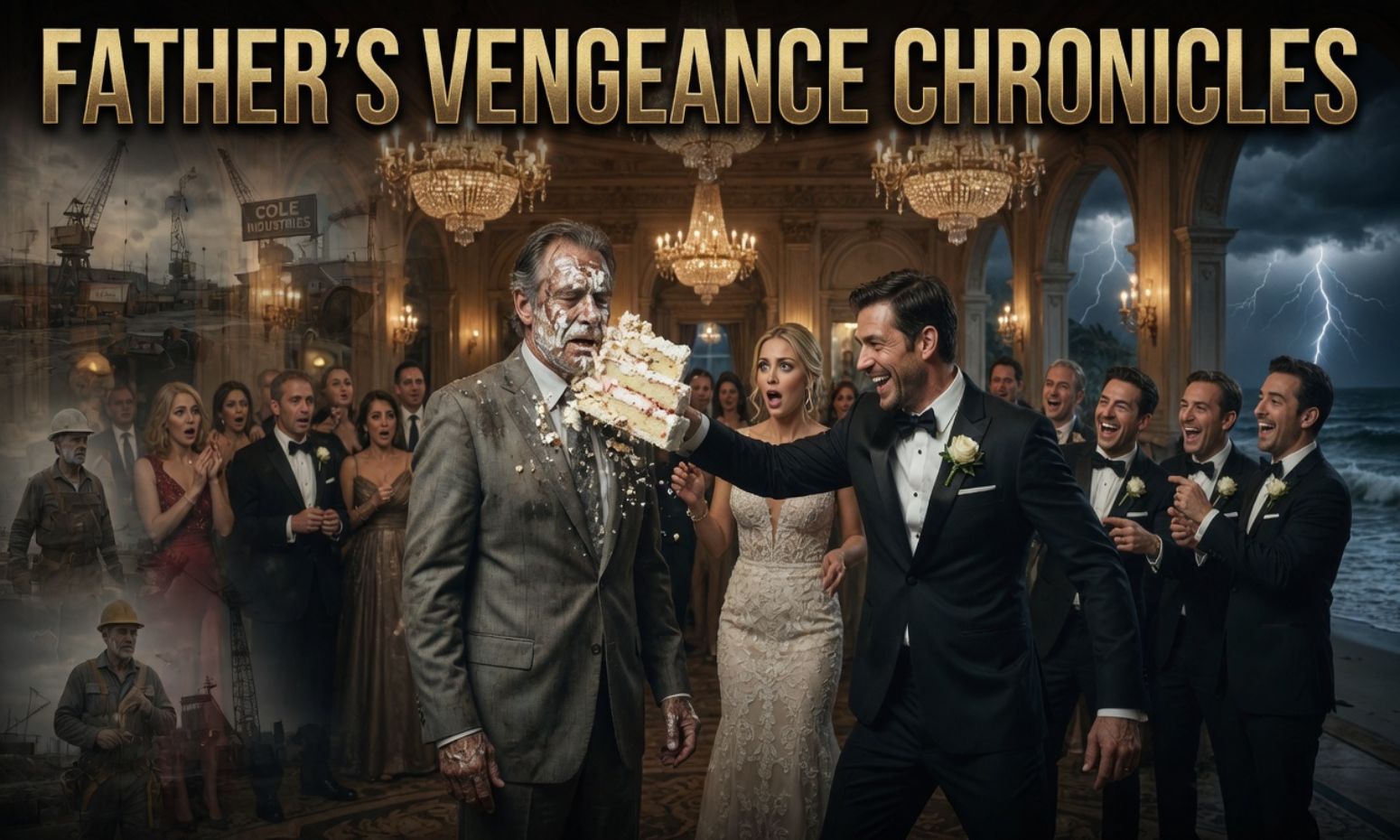
Trent walked toward the wedding cake, cut off a large piece, and placed it on a silver plate.
“I would like to honor my new father-in-law,” he said.
The room became quiet.
He approached my table carrying the cake.
“For teaching Brooke exactly what kind of life she never wanted.”
Then he pushed the plate into my face.
Cream struck my eyes and nose. Cake slid down my collar.
For two seconds, no one moved.
Then Trent laughed.
His friends joined him.
Patricia covered her mouth, but she was smiling behind her hand.
Brooke stood frozen beside the stage.
I removed the plate from my face and placed it on the table.
A chair scraped violently across the floor.
Richard Belmont, a real-estate developer worth nearly three billion dollars, had risen from the head table.
He stared at Trent as though he had just watched someone slap a loaded weapon.
“Do you have any idea who that man is?” Richard demanded.
Trent’s laughter weakened.
“Yes. He’s Brooke’s father.”
“That man owns Cole Maritime.”
Silence spread across the hall.
Richard pointed at me.
“His ships move nearly twelve percent of the commercial freight entering the eastern United States. His logistics division operates in thirty-one countries.”
Trent looked toward Patricia.
She stared at the floor.
Richard continued.
“And Sterling Tower—the building you’ve spent all night claiming you acquired—belongs to him.”
Whispers erupted.
Trent’s face emptied.
“That’s impossible.”
“No,” I said, wiping cream from my eyes. “What’s impossible is acquiring a building that has never been offered for sale.”
I stood and removed my stained jacket.
Trent tried to smile.
“This is some kind of misunderstanding.”
“No. The misunderstanding was mine. I thought my daughter was marrying an arrogant man. It turns out she was marrying a desperate criminal.”
Brooke’s lips parted.
“Dad…”
I placed a folder on the nearest table.
“Caldwell Capital is a shell company. It has no employees, no legitimate assets, and no recorded transactions matching Trent’s claims.”
Trent’s father rose.
“You can’t accuse my son—”
“Sit down, Mr. Caldwell. Your name appears on three of the filings.”
He sat.
I removed the Porsche rental contract.
“The car outside is rented by the hour.”
Then the eviction notice.
“The penthouse does not exist. Trent is being evicted from an apartment above a laundromat because he has not paid rent in six months.”
Guests began taking out their phones.
Trent looked toward the exits.
Vincent appeared beside the main doors with two members of my security team.
I turned to Brooke.
“Take off your ring.”
She covered it instinctively.
“Why?”
“Because it isn’t a diamond.”
Trent stepped between us.
“That is enough.”
I looked directly at him.
“The stone is cubic zirconia. The real diamond—your grandmother’s diamond—was pawned in Brooklyn seven weeks ago.”
I raised the pink receipt.
Brooke stared at it as if she had forgotten how to breathe.
“No.”
“I’m sorry.”
“No, he wouldn’t…”
“Ask him.”
She turned toward Trent.
He said nothing.
“Tell him he’s lying,” she whispered.
Trent’s eyes darted toward the crowd.
“I was going to recover it. It was temporary.”
Brooke looked down at the ring on her hand.
“You stole my grandmother’s ring?”
“I used it to cover wedding expenses.”
“You told me your family paid for the wedding.”
“My funds were temporarily restricted.”
“Because you had no funds,” I said.
Trent’s voice rose. “You stay out of this!”
“I tried. Then I learned you borrowed four million dollars from men who intended to collect through my daughter’s trust.”
The man in the leather jacket stepped out from behind Vincent.
Trent staggered backward.
“You…”
The man tossed a document onto the table.
“Your marker was sold this morning.”
“To whom?” Trent asked.
I answered.
“To me.”
His knees nearly failed.
“You bought my debt?”
“I bought all of it.”
I removed another document.
“Your bank loans. Your delinquent notes. Your fraudulent bridge financing. The four-million-dollar private marker. As of seven forty-two this morning, every dollar you owe is controlled by companies I own.”
Trent’s breathing became shallow.
“You can’t do this.”
“I already did.”
“You don’t understand. If the trust transfer fails—”
“It has failed. The accounts were frozen before the ceremony.”
His eyes widened.
I turned toward Brooke.
“He used your Social Security number to secure loans. He pledged future access to your assets without your knowledge. The papers you signed today were designed to place your inheritance under his control.”
Brooke looked toward the attorney who had presented the documents.
The man was quietly moving toward a side exit.
Vincent’s security officers blocked him.
Trent suddenly seized Brooke’s wrist.
“You knew what you were signing.”
She cried out.
I crossed the distance between us and removed his hand.
“Touch her again,” I said softly, “and prison will become the safest place available to you.”
Sirens sounded outside.
The room changed.
The laughter, whispers, and camera flashes died beneath the approaching noise.
Trent backed away.
“No. This is a family matter.”
The ballroom doors opened.
Four federal agents entered with two local officers.
The lead agent displayed his identification.
“Trent Caldwell, you are under arrest on suspicion of wire fraud, aggravated identity theft, falsification of financial instruments, and conspiracy to commit bank fraud.”
Trent looked at Brooke.
“Tell them this is a misunderstanding.”
She stared at him through tears.
He turned toward Patricia.
“Do something!”
Patricia stepped away from him.
The agents pulled his hands behind his back.
“You set me up!” he shouted at me.
“No. I watched you build the trap. I only made sure it closed.”
As they led him away, his polished shoe caught the edge of a fallen champagne glass. He stumbled, and the room watched the great Trent Caldwell leave his own wedding in handcuffs.
The silence afterward felt heavier than the music ever had.
Patricia recovered first.
She approached me with an expression of wounded dignity.
“Harrison, I wish you had told me what you were planning. We could have handled this privately.”
“We?”
“Brooke is our daughter.”
“She was also your ladder.”
Her face stiffened.
“How dare you?”
“You hid my letters. You told her I was poor, selfish, and ashamed of her because you believed money would make her respect Trent’s world more than mine.”
“I protected her.”
“You trained her to worship appearances.”
“I did what any mother would do.”
“No. You did what you have always done. You loved what wealth could purchase, but never respected what it cost to build.”
She lowered her voice.
“People are watching.”
“That is the only thing you have cared about all weekend.”
Patricia glanced around at the guests gathering coats and whispering into phones. Her social triumph was dissolving in real time.
She reached for my hand.
“We should present a united front.”
I stepped away.
“There is no front left, Patricia.”
Within twenty minutes, the ballroom was nearly empty.
The orchestra stopped playing. Staff removed untouched food. The five-tier cake leaned to one side, its lower section damaged where Trent had torn away the piece he used against me.
Brooke remained near the dance floor.
Still wearing her wedding dress, she looked small beneath the chandeliers.
I walked toward her but stopped several feet away.
“I should have believed you,” she said.
“You were surrounded by people telling you not to.”
“That doesn’t excuse it.”
“No.”
She looked at the wooden box on the gift table. The ring from Trent’s whiskey glass had darkened the carved lid.
“I was ashamed of that gift.”
“I noticed.”
Her mouth trembled.
“You made it from our boat.”
“Yes.”
“I remembered as soon as I opened it. I remembered the compass. I remembered sitting on your shoulders at the marina. But then Trent came over, and all I could think about was whether he would laugh.”
“He did.”
“And I let him.”
Tears rolled down her cheeks.
“I let him humiliate you all weekend. Mom told me you never fought for me after the divorce. She said you sent money because it was easier than being a father.”
“I fought until every fight hurt you more than it hurt her.”
“Why didn’t you tell me you were wealthy?”
“When you were young, the company was struggling. Later, when it succeeded, you already believed I had abandoned you. I wanted to rebuild something real before money entered the conversation.”
“But you could have proven her wrong.”
“With bank statements?”
She lowered her eyes.
“I suppose that would have proven the wrong thing.”
“I also wanted you protected. Wealth attracts people who become whatever you need until they control what you own. Trent is not the first man I’ve met who rented a personality.”
Brooke slowly removed the false ring.
She stared at it one final time, then placed it in my palm.
“I don’t want it.”
I set it on the table.
For a long moment, neither of us spoke.
Then she whispered, “Do you hate me?”
The question nearly broke my heart.
I opened my arms.
She crossed the space between us and collapsed against my chest.
“No,” I said. “I have never hated you.”
“I’m so sorry.”
“I know.”
“What happens now?”
“Now you take off that dress.”
She laughed through her tears.
“And then?”
“We find somewhere that serves breakfast all night.”
“It’s almost midnight.”
“Exactly. No respectable restaurant will let you arrive in a wedding dress covered in champagne.”
She pulled back.
“Are we leaving in your truck?”
“I’m afraid so.”
For the first time that day, she smiled without looking over her shoulder.
We left the estate through the front entrance.
The photographers had disappeared. The rented Porsche remained beneath the lights, waiting for a groom who would not return.
Brooke climbed into my old Ford and ran her fingers over the cracked dashboard.
“You never fixed this?”
“It gives the truck character.”
“It looks terrible.”
“It runs.”
She glanced back at the mansion, where workers were dismantling the arch beneath which she had nearly signed away her future.
Then she fastened her seat belt.
“Let’s go.”
Six months later, Brooke began working at Cole Enterprises.
Not as a vice president.
Not as an executive adviser.
She started in the Baltimore operations office, reviewing manifests and resolving scheduling errors. For the first three weeks, nobody knew she was my daughter. She arrived at six in the morning, wore steel-toed boots, and ate lunch with dispatchers.
At first, she hated it.
Then she learned the name of every driver on her shift.
She discovered that a delayed container could cost a small business its entire season. She learned how contracts were constructed, how fraud hid inside harmless language, and why no document should ever be signed because someone claimed there was no time to read it.
A year later, she helped identify an employee stealing from independent carriers through fake processing fees.
She brought me the evidence herself.
“I checked it three times,” she said.
“So did I.”
“Was I right?”
“You were.”
Her smile reminded me of the little girl holding a brass compass on the deck of our sailboat.
Trent eventually pleaded guilty after investigators uncovered additional victims. He had used forged investments, romantic relationships, and false business ventures to steal millions. The judge sentenced him to fifteen years in federal prison.
The attorney from the wedding received seven.
Trent’s father avoided prison by cooperating, though the Caldwell family’s remaining businesses collapsed under the lawsuits.
Patricia sold her Manhattan apartment and moved to Florida. For months, she told friends she had been another victim of Trent’s deception.
Perhaps she even believed it.
Brooke maintained limited contact with her, but she no longer allowed guilt to make decisions on her behalf.
As for the mahogany box, I repaired the water stain but did not remove it completely.
Brooke keeps it on her desk.
Inside are the brass compass, her grandmother’s recovered diamond, and one folded piece of paper—the hundred-dollar bill Patricia once pushed into my pocket.
Eli, the young waiter, had returned it before I left the estate.
On it, he had written:
A person’s value is revealed by how they treat someone who can do nothing for them.
Brooke says it reminds her of the worst day of her life.
I tell her it was not the worst.
It was simply the day the decorations fell away.
Luxury had made Trent look powerful. A rented car had made him look successful. A false stone had made his promise sparkle. Two hundred wealthy guests had made his lies appear respectable.
But borrowed appearances always come with a deadline.
Eventually, the car must be returned.
The bill must be paid.
The stone must face the light.
And the man mocked for arriving in an old truck may be the only person in the room who owns everything that is real.