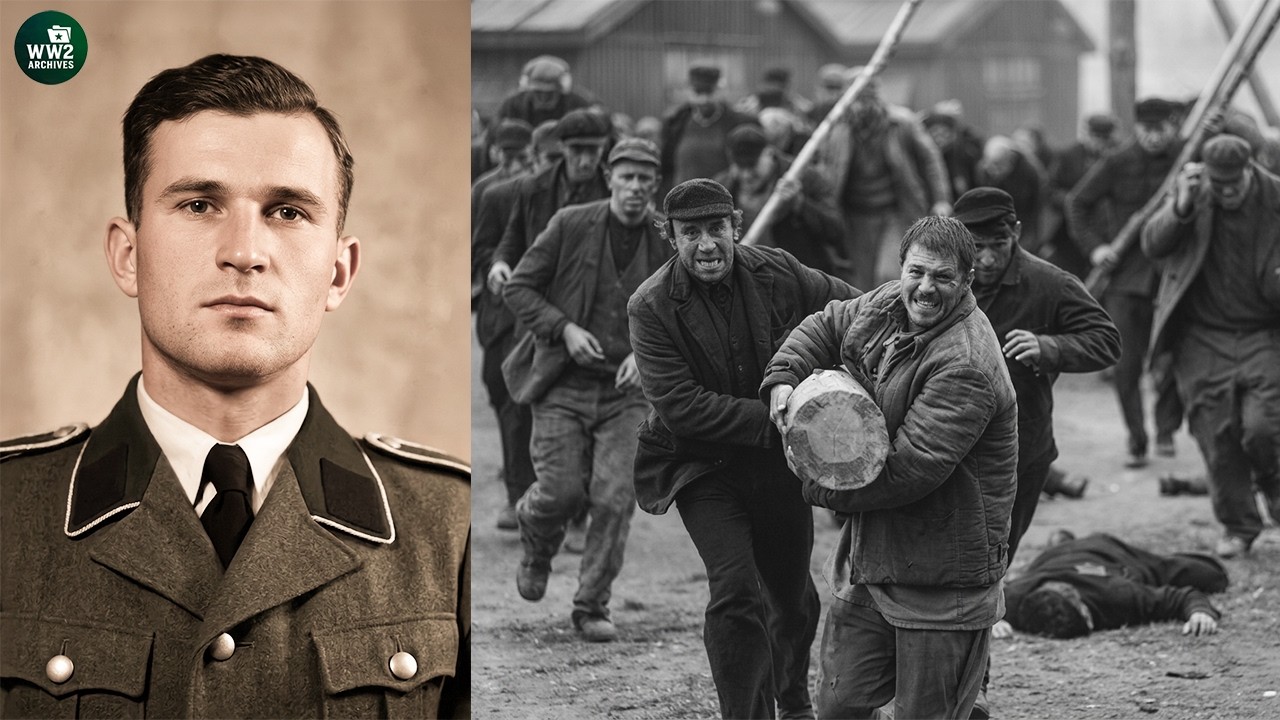
At approximately four o’clock on the afternoon of October 14, 1943, one of the most feared men in Sobibor walked into a prisoner workshop expecting a new coat.
Siegfried Graetschus was not entering as a customer among equals. He was an SS officer and the commander of the camp’s Trawniki-trained guards. The men who had measured, cut, and stitched the garment for him were Jewish prisoners whom he believed could be beaten, replaced, or killed at will.
Graetschus had every reason to feel safe.
Around the camp stood barbed-wire fences, watchtowers, armed guards, and a minefield. For more than a year, trains had arrived carrying Jewish families who were stripped of their belongings and murdered in gas chambers. The SS controlled the weapons, the gates, the food, the schedules, and, as far as they were concerned, life itself.
But that afternoon, behind a curtain inside the workshop, two starving prisoners were waiting with axes.
Their names were Arkady Wajspapir and Yehuda Lerner.
Graetschus stepped inside. The coat was brought forward. He allowed prisoners to place it around his shoulders, enjoying one of the privileges that power had taught him to consider natural.
Then he heard movement behind him.
For one brief second, the room changed.
The prisoners were no longer bending over their work. The men he had treated as inventory were standing upright. Their hands were no longer holding needles or cloth.
Graetschus turned.
The exact expression on his face was never recorded. But the reversal was unmistakable. His shoulders tightened. His attention snapped from the coat to the curtain. The authority that had surrounded him like armor suddenly meant nothing inside that small room.
He understood too late that the appointment was not about clothing.
An axe fell.
Then the prisoners moved quickly, because there was no time to watch a tyrant die.
Outside, Sobibor still appeared to be functioning normally. Guards remained in their towers. Prisoners crossed the yard carrying tools. Orders were shouted. Workshops continued operating.
Yet the Nazi killing center had already begun to collapse from within.
Graetschus had walked into the workshop believing that prisoners existed to serve his vanity.
Instead, his vanity had delivered him into their trap.
YEARS BEFORE SOBIBOR
Biographical records describe Siegfried Graetschus as a farmer by occupation.
There was nothing supernatural about his beginning. He had not been born wearing a uniform. He had not arrived in the world destined to become a mass murderer. He came from the same human world as everyone else—a world of families, work, choices, loyalties, ambitions, and opportunities to say no.
That is precisely what makes his transformation so disturbing.
Graetschus joined the SS in 1935 and the Nazi Party the following year. He entered an organization that rewarded obedience, ideological conformity, and cruelty toward people whom the regime had declared inferior. His advancement did not happen in one dramatic leap.
It happened through decisions.
One oath.
One assignment.
One act of compliance after another.
Before Sobibor, Graetschus worked within the Nazi camp system and the so-called T4 “euthanasia” program, in which people with disabilities were systematically murdered. Photographs preserved by the United States Holocaust Memorial Museum show him at Grafeneck and with other T4 personnel who worked around the killing facilities and cremation operations.
The photographs are terrifying partly because they are so ordinary.
The men are not shown raging in battle. They sit together during breaks. They pose outdoors. They appear relaxed. Some smile.
Behind those casual images was a system that had transformed murder into employment.
Victims arrived. Records were processed. Bodies were removed. Ashes were handled. Staff members ate meals, took photographs, wrote letters home, and returned to work.
Graetschus learned how mass killing could be divided into tasks so that each participant might pretend he was merely performing a duty.
He learned the language of bureaucracy.
He learned that a uniform could silence doubt.
He learned that when everyone around him obeyed, personal responsibility could be made to feel invisible.
But responsibility never disappeared.
Graetschus was not a loose screw in an otherwise respectable machine. He was one of the people who kept the machine moving.
The Nazi system depended on thousands of men who signed forms, guarded doors, repaired engines, scheduled trains, confiscated luggage, watched fences, selected prisoners, and followed instructions. Genocide did not require every participant to be a criminal mastermind.
It required enough ordinary people to surrender their consciences.
By the time Graetschus arrived at Sobibor, killing had become familiar work.
THE CAMP DISGUISED AS A VILLAGE
Sobibor was built in German-occupied Poland as part of Operation Reinhard, the Nazi plan to murder the Jewish population of the General Government.
It was not primarily a detention center. It was a killing center.
From April 1942 until October 1943, German SS personnel and their auxiliaries murdered at least 167,000 people there. Many victims were killed soon after stepping off the trains. Current historical estimates are lower than the figure of 250,000 sometimes repeated in older accounts, but the corrected number does nothing to reduce the scale of the crime.
One hundred and sixty-seven thousand human beings.
Parents carrying children.
Grandparents supporting one another after days in overcrowded railcars.
Teenagers trying not to look afraid.
People clutching keys to homes they would never see again.
People carrying photographs because photographs were among the few possessions that still proved they had once belonged somewhere.
They arrived in a place designed not only to kill them, but to deceive them first.
Sobibor’s SS living area included small houses, decorative fences, and flower boxes. The camp could resemble a quiet country settlement rather than a facility constructed for mass murder.
The deception served a practical purpose.
Panic was dangerous to the killers. Calm victims were easier to control. Families who believed they were being registered, disinfected, or transferred were less likely to resist before the guards had separated them from their belongings and surrounded them with weapons.
The Nazis used neatness as camouflage.
Flowers did not make Sobibor humane.
They made it more efficient.
Even the sounds of the camp were manipulated. Survivor Yehuda Lerner later described how agitated geese were used to help drown out the cries coming from the killing area.
That detail is almost impossible to forget.
Flowers for the eyes.
Geese for the ears.
Lies for the mind.
Behind them, fixed gas chambers powered by engine exhaust were used to murder men, women, and children.
The victims’ possessions were taken to sorting barracks. Clothing was separated. Shoes were collected. Valuables were removed. Hair was cut. Objects that had marked individual lives were reduced to categories.
A child’s coat became material.
A wedding ring became gold.
A family photograph became rubbish.
Some prisoners were temporarily selected for forced labor. They repaired shoes, tailored clothing, sorted possessions, worked in warehouses, maintained buildings, and performed the tasks necessary to keep the camp operating.
Their survival was temporary by design.
They lived surrounded by evidence of what had happened to the people who arrived before them. They touched clothes that were still warm from bodies. They found hidden money, documents, letters, toys, and medicine. They recognized the difference between luggage packed for relocation and luggage abandoned by people who had been murdered.
They knew what Sobibor was.
They also knew what the SS planned to do with witnesses.
 THE MAN WHO COMMANDED THE GUARDS
At Sobibor, Graetschus rose to a position of authority over the Trawniki-trained auxiliaries who guarded the camp.
His power was visible in small gestures.
He could enter a workshop and demand clothing made from confiscated material. He could interrupt a prisoner’s labor. He could strike someone without fearing arrest. He could issue an order that might determine whether a person lived another hour.
The camp trained its personnel to treat domination as normal.
A prisoner stepped aside.
A cap came off.
Eyes lowered.
The officer passed.
To an outside observer, such moments might have looked insignificant compared with the gas chambers. But systems of mass murder are maintained through thousands of such demonstrations. Every humiliation teaches the victim that resistance is impossible. Every unpunished abuse teaches the perpetrator that his power has no boundary.
Graetschus became feared not because he possessed extraordinary strength, but because the entire camp stood behind his violence.
The wire stood behind him.
The rifles stood behind him.
The watchtowers stood behind him.
The German state stood behind him.
That support created the illusion that he was untouchable.
He did not need to imagine how prisoners saw him. Their opinions did not matter within the Nazi worldview. They had been stripped of names, rights, families, food, privacy, and legal personhood.
The SS believed the stripping away was complete.
It was not.
Beneath prison clothing, hunger, injuries, and forced obedience, people continued to observe.
They studied routines.
They remembered which officers arrived on time.
They noticed who was vain.
They saw who coveted expensive boots, leather coats, watches, weapons, and clothing taken from murdered families.
The SS interpreted silence as surrender.
The prisoners used silence to gather information.
 THE RUMOR THAT CHANGED EVERYTHING
By the summer of 1943, the number of transports arriving at Sobibor had declined.
For the forced laborers, fewer trains did not mean safety.
It meant danger.
They had seen what happened when groups of prisoners were no longer needed. They understood the logic of the camp: laborers were kept alive only while their work served the killing operation. Once the operation ended, the witnesses would be eliminated.
The prisoners began hearing rumors that Sobibor would be dismantled.
No one expected to be released.
They expected to be murdered.
The choice became brutally clear.
Remain obedient and die when the SS selected the day.
Attempt escape and perhaps die while deciding the manner of their final act.
A resistance group had already begun forming around Leon Feldhendler, the son of a rabbi and a former leader in the Jewish community of Żółkiewka. Feldhendler understood the camp, its prisoners, and its routines.
What the group lacked was military experience.
That changed in September 1943, when a transport from Minsk brought Jewish Soviet prisoners of war to Sobibor. Among them was Lieutenant Alexander Pechersky, known as Sasha.
The longtime prisoners immediately saw something different in the Soviet soldiers.
The newcomers had been starved, beaten, imprisoned, and marked for death. But they had also fought in an army. They understood command, timing, weapons, coordination, and the need to act even when no safe option existed.
Feldhendler approached Pechersky.
Together, the Polish Jewish underground inside the camp and the Soviet Jewish prisoners began shaping a plan.
The plan was audacious because it depended on the very arrogance that made the SS dangerous.
The prisoners would lure key German officers into different workshops one at a time.
A new coat was ready.
A pair of boots needed fitting.
An expensive item had been found.
A weapon required repair.
Inside the workshops, small teams would kill the officers silently with axes, knives, and tools. The conspirators would seize weapons, cut communications, and prevent the SS leadership from organizing a response.
Then, at the regular evening roll call, the prisoners would gather as usual.
The original hope was to move toward the main gate in an orderly formation, creating enough confusion among the remaining guards to break free before they understood that their German commanders were dead.
It was not a plan created by people who expected miracles.
It was a plan created by people who had counted the towers.
They knew about the machine guns.
They knew about the minefield.
They knew many would be killed.
But they also understood that waiting offered only one outcome.
Pechersky and Feldhendler faced another problem: secrecy.
Approximately six hundred prisoners remained in Sobibor. Telling everyone would increase the risk of betrayal or accidental exposure. Telling too few meant hundreds might not understand what was happening when the revolt began.
The organizers therefore built small circles of trust.
A tailor knew why an officer had been offered an appointment.
A carpenter prepared an axe.
A prisoner assigned near a telephone line knew when it had to be cut.
A worker near the armory watched the guards.
Each participant held only part of the plan.
One frightened word could destroy everything.
THE WEAPONS THEY WERE ALLOWED TO TOUCH
The prisoners did not have an arsenal.
They had work tools.
Axes used in carpentry.
Knives used for cutting material.
Awls, chisels, and objects the SS considered harmless because prisoners were permitted to handle them only while performing assigned labor.
The uprising’s brilliance lay in turning the camp’s own routines against its rulers.
The workshops provided concealment.
The schedule provided coordination.
The officers’ greed provided bait.
The tools provided weapons.
The SS had created an environment in which prisoners repaired their property, tailored their uniforms, polished their boots, and organized stolen goods for them. They had built an entire service system around their own comfort.
That comfort became a vulnerability.
The Nazis believed complete domination had erased the prisoners’ capacity to plan. They mistook malnutrition for helplessness. They mistook forced labor for loyalty. They mistook terror for permanent control.
Most dangerously, they mistook themselves for invincible.
Arkady Wajspapir understood the stakes.
He had served as a sergeant in the Red Army before his capture. At Sobibor, he and the other Soviet prisoners were forced to work while the conspirators prepared the revolt.
Yehuda Lerner was only seventeen.
Age had not protected him from deportation, imprisonment, or the death camp. Now, still a teenager, he was assigned to help eliminate men who commanded the machinery built to murder him.
The two were sent to a tailor’s workshop.
Their targets included Graetschus and a guard.
They carried axes and hid behind a curtain.
Then they waited.
OCTOBER 14, 1943
The revolt began in the afternoon.
The first phase required discipline that is difficult to imagine.
A man might know that an SS officer had already been killed in the building beside him, yet he still had to walk across the yard without running.
A woman might see a conspirator emerge from a workshop, yet she could not cry out or change direction.
A tailor might stand inches from a target while knowing that armed guards were stationed nearby.
Everything depended on normality.
The camp had to continue looking like Sobibor for a little longer.
Johann Niemann, the deputy commandant and the highest-ranking SS officer present, had been invited to a tailor’s shop for a fitting. He arrived at the appointed time, reportedly on horseback, confident that prisoners had prepared something for him.
Inside, he was killed with an axe.
His absence was not immediately noticed.
Other SS men were lured to workshops and storehouses with promises of clothing or valuable items. The prisoners exploited the officers’ greed and vanity, killing them one by one before an alarm could be raised.
Every successful ambush slightly changed the balance of power.
A uniform remained, but the man inside it was gone.
A weapon became available.
A command went unanswered.
A prisoner who had spent months being ordered to lower his eyes now saw an officer lying powerless on a workshop floor.
Yet the danger increased with every minute.
An officer could miss his appointment.
A body could be discovered.
A guard could enter the wrong room.
Someone could lose control.
Someone could talk.
Graetschus was one of the most important targets because he commanded the auxiliary guards. If he remained alive when the escape began, he could organize the towers and restore discipline.
The conspirators needed him isolated.
So they offered him a coat.
For men like Graetschus, stolen clothing was one of the rewards of service. The belongings of murdered people passed through the camp in enormous quantities. SS personnel could select items, demand alterations, and have prisoners fit them perfectly.
A fine coat was not unusual enough to make him suspicious.
It was exactly the sort of privilege he expected.
Wajspapir and Lerner went behind the curtain with their axes.
Minutes passed.
Then more minutes.
Graetschus did not come.
The two prisoners remained motionless in the cramped hiding place. They could not ask what had happened. They could not step outside to look. They could not know whether another part of the operation had failed.
Their bodies were weakened by hunger, but their arms would have to deliver decisive blows.
An hour passed before Graetschus finally appeared.
He entered a room he believed he owned.
The tailors presented the coat.
Graetschus tried it on.
Perhaps he examined the fit across his shoulders. Perhaps he thought about where he would wear it. Perhaps he was already preparing to criticize the stitching or demand another alteration.
The record does not preserve those details.
What it preserves is the trap.
Wajspapir moved from behind the curtain.
Graetschus turned.
For years, uniforms and armed guards had ensured that prisoners stepped away from him. Now one stepped toward him.
The coat remained around Graetschus’s body, but the role it represented had reversed. It was no longer a symbol of his privilege.
It was the bait that had placed him within reach.
His eyes moved toward the raised weapon.
There was no watchtower inside the workshop.
No formation of guards between him and the prisoners.
No time to issue an order.
In that instant, the man who had treated Jewish lives as disposable confronted a truth his ideology had denied: the people before him were not objects, and they had never stopped being human.
The axe came down.
Historical accounts differ over the precise division of the blows between Wajspapir and Lerner, but both men took part in the workshop attack. Wajspapir later described stepping out, moving to block the doorway, turning, and striking Graetschus.
A second target entered and was also attacked.
The two prisoners had accomplished their assignment.
They did not celebrate.
They moved to the next stage.
WHEN THE CAMP REALIZED
By late afternoon, the conspirators had killed much of the German leadership present that day.
But a coordinated operation inside a death camp could not remain hidden forever.
Not every intended target arrived at his appointment. Unexpected movements disrupted the schedule. A body was discovered. Confusion spread before the prisoners could complete the orderly exit they had envisioned.
The roll-call signal was given early.
Prisoners gathered, but the illusion of routine was already breaking apart.
Surviving guards began to understand that something unprecedented was happening. Orders became contradictory. German officers who should have taken command were missing. Shots were heard.
Then the prisoners ran.
Hundreds surged toward the fences.
Some attempted to reach the main gate. Others moved toward the wire. Guards opened fire from the towers. The camp that had operated through controlled lines and forced obedience dissolved into movement, shouting, smoke, gunfire, and desperate decisions.
The minefield still surrounded Sobibor.
The prisoners knew it was there.
They ran anyway.
Some fell to bullets.
Some were killed by mines.
Others pushed through openings created by the people in front of them. They climbed wire, crossed ditches, passed bodies, and entered the forest beyond the camp.
For the first time, the trees surrounding Sobibor did not merely conceal the Nazi crime.
They concealed escaping Jews.
Approximately three hundred prisoners broke out of the killing center. Many were later captured and murdered. Others died while hiding or fighting during the remaining months of the war.
About fifty are known to have survived until liberation.
The number may sound small beside the number murdered at Sobibor.
But that is not how the uprising’s importance should be measured.
The prisoners were not confronting equal forces. They had no outside army waiting at the fence. They had no safe territory to enter. Many did not know the surrounding region. Some could not speak Polish. Antisemitism made approaching strangers dangerous. German search units and collaborators hunted escapees.
The question was never whether every prisoner could survive.
The question was whether people whom the Nazis had marked for silent death could still choose resistance.
On October 14, they answered.
THE MYTH OF NAZI INVINCIBILITY
Sobibor had been built to prove that the SS controlled every possible outcome.
A train arrived.
The doors opened.
The victims stepped down.
Belongings were taken.
Families were separated.
People were murdered.
Their possessions were sorted.
Their bodies were hidden.
Another train arrived.
The repetition created the appearance of unstoppable power.
But power built on terror contains a weakness: it must convince everyone that resistance is useless.
The moment that belief breaks, the system becomes vulnerable.
The Sobibor prisoners did not have to destroy the entire Nazi regime to expose the lie. They only had to demonstrate that SS officers could be deceived, isolated, disarmed, and defeated by the people they despised.
The Nazis had declared Jews incapable of courage.
Jewish prisoners organized a military-style revolt.
The Nazis had reduced prisoners to forced laborers.
Those laborers turned assigned tools into weapons.
The Nazis had stolen clothing from murdered families.
That stolen clothing became bait.
The Nazis had built workshops to serve their comfort.
Those workshops became ambush rooms.
The Nazis had surrounded Sobibor with forest to hide their crimes.
The forest became an escape route.
Everything the camp represented was reversed.
WHAT THE NAZIS DID NEXT
The uprising did not end Nazi brutality at Sobibor with a sudden moral awakening.
It produced retaliation.
Prisoners who remained were murdered. Escapees were hunted. The SS worked to erase the evidence of what had happened at the camp.
Buildings were demolished.
The killing area was plowed over.
Pine trees were planted across the site.
The Nazis attempted to make the ground lie.
They wanted future observers to see forest rather than gas chambers, soil rather than mass graves, silence rather than organized murder.
But the revolt had made complete erasure impossible.
Survivors carried the story beyond the wire.
They remembered the layout.
They remembered names.
They remembered the arrival platform, the workshops, the guards, the gas chambers, the stolen belongings, and the moment the prisoners ran.
They remembered Graetschus walking into the workshop for a coat.
After the uprising, Sobibor ceased operating as a killing center and was dismantled. The SS could destroy barracks, but it could not restore the illusion that its authority had never been challenged.
The camp had been designed as a place from which almost no witness would emerge.
Yet witnesses emerged.
The Nazi plan depended on silence.
Yet testimony survived.
THE MOST DANGEROUS LIE ABOUT MEN LIKE GRAETSCHUS
It is tempting to remember perpetrators such as Siegfried Graetschus as creatures born entirely different from us.
That temptation offers comfort.
A monster belongs to another species. A monster requires no explanation. A monster allows ordinary people to believe that nothing similar could ever involve them.
But Graetschus’s life offers a more demanding warning.
He had an ordinary occupation.
Then he joined an extremist movement.
He accepted its language.
He entered its institutions.
He participated in its crimes.
He allowed repeated exposure to suffering to harden rather than awaken him.
He learned to obey without asking whether an order was lawful, humane, or morally defensible.
He learned to treat categories as more important than individuals.
Jew.
Prisoner.
Disabled.
Enemy.
Unworthy.
Once a person accepts the idea that another group is less human, cruelty can be presented as duty. Theft becomes policy. Imprisonment becomes protection. Murder becomes administration.
The transformation does not always begin beside a gas chamber.
It may begin with a joke that reduces people to stereotypes.
A slogan repeated because everyone else is repeating it.
A lie shared because it flatters one’s tribe.
A neighbor’s rights dismissed because the neighbor is unpopular.
An order followed because refusing might damage a career.
A silence maintained because speaking would be uncomfortable.
Graetschus did not move from a farmer’s field to Sobibor in a single step.
No one does.
The road was constructed from choices.
WHAT WAJSPAPIR AND LERNER PROVED
Arkady Wajspapir and Yehuda Lerner were not powerful in the way Graetschus understood power.
They had no rank recognized by the camp.
No food supply.
No legal protection.
No firearm when they entered the workshop.
Their bodies had been weakened deliberately. Their families had been targeted. Their captors expected them to die without leaving evidence that they had ever resisted.
Yet Graetschus possessed something they could use against him.
Certainty.
He was certain Jewish prisoners feared him too much to act.
Certain that a starving man could not plan.
Certain that a teenager could not become dangerous.
Certain that the uniform would always control the room.
Certain that the coat waiting in the workshop belonged to him simply because he wanted it.
That certainty blinded him.
Wajspapir and Lerner did not need to be physically stronger than the entire SS system. They needed discipline, timing, cooperation, and one moment in which the system’s assumptions placed a commander within reach.
The prisoners’ courage was not the absence of fear.
They knew exactly what would happen if the plan failed.
Courage was remaining behind the curtain anyway.
Courage was holding the axe while an armed camp operated outside.
Courage was waiting through the delay.
Courage was stepping forward when Graetschus entered.
Courage was running toward a mined fence because death chosen in resistance was no longer the same as death assigned by an executioner.
THE COAT AS EVIDENCE
The coat is a small object within the scale of the Holocaust.
It cannot represent 167,000 murdered people. No single object can.
But it reveals something essential about the system.
Graetschus wanted clothing created from a world of theft.
The fabric, leather, tools, or labor available inside Sobibor existed because victims had been robbed. Prisoners were forced to transform stolen material into comfort for the people responsible for their suffering.
To Graetschus, the coat confirmed the hierarchy.
He commanded.
They served.
He chose.
They obeyed.
He would wear something fine.
They would remain in prison clothing until they were killed.
But the prisoners understood the coat differently.
It was a reason for him to arrive alone.
A reason for him to lower his guard.
A reason for him to stand still.
The same object carried two meanings into the room.
For Graetschus, privilege.
For the prisoners, opportunity.
He saw clothing.
They saw an opening in the machinery of death.
That difference decided who walked out.
MEMORY WITHOUT HATRED
Remembering Sobibor is not an invitation to inherit hatred.
Hatred was the ideology that built Sobibor.
The purpose of memory is to recognize the process before it reaches the fence, the train, or the gas chamber.
It is to notice when political movements demand loyalty above conscience.
When leaders describe entire populations as contamination, invasion, disease, or vermin.
When cruelty is marketed as strength.
When people are asked to ignore suffering because the victims belong to the wrong religion, ethnicity, nationality, or political group.
When institutions divide responsibility so widely that everyone claims innocence.
When ordinary professionals say they are only processing paperwork, following procedure, protecting order, enforcing policy, or doing what their superiors required.
Graetschus demonstrates what happens when a person repeatedly chooses belonging over morality.
The Sobibor prisoners demonstrate what remains possible when people choose solidarity under conditions designed to destroy it.
They were divided by language, nationality, age, background, and experience. Some were Polish. Some were Soviet. Some had lived in the camp for months. Others had arrived only weeks earlier.
They did not need to be identical to trust one another.
They needed to recognize a shared human obligation.
The camp depended on isolation.
The revolt depended on cooperation.
That may be Sobibor’s most enduring lesson.
Extremism teaches people to see categories.
Moral courage teaches them to see human beings.
THE LAST REVERSAL
On the morning of October 14, 1943, Graetschus belonged to the group that decided who would live and who would die.
By late afternoon, he was dead in a workshop, defeated by prisoners he had considered powerless.
The watchtowers still stood.
The minefield remained.
The guards still had rifles.
But the balance had changed.
Orders went unanswered because officers had vanished.
Prisoners who had been forced into lines broke formation.
People who had been assigned numbers reclaimed decisions.
The SS could still kill, but it could no longer claim that its victims had accepted the world it created.
That is why the uprising mattered beyond the number who escaped.
It preserved a truth the Nazis tried to bury beneath Sobibor’s soil:
The victims were never what their persecutors said they were.
They were not passive material moving through a killing process.
They were parents, workers, soldiers, tailors, organizers, teenagers, believers, skeptics, friends, and frightened people capable of extraordinary discipline.
They observed.
They planned.
They trusted.
They fought.
Some survived to speak.
And because they spoke, the pine trees planted to conceal Sobibor could not erase it.
The flowers could not beautify it.
The geese could not silence it.
The uniforms could not dignify it.
The bureaucracy could not excuse it.
The name of Siegfried Graetschus remains in history, but not as the invincible commander he imagined himself to be.
He is remembered as evidence of how an ordinary person can become useful to evil by abandoning conscience one decision at a time.
Wajspapir, Lerner, Pechersky, Feldhendler, and their fellow prisoners are remembered for the opposite reason.
Inside a place built to eliminate choice, they chose.
Inside a system built to erase dignity, they acted with dignity.
Inside a camp built to manufacture helplessness, they turned patience, cooperation, and courage into weapons.
Sobibor warns us that the devil’s machinery is rarely built by demons—it is built by obedient human hands, and it begins to break the moment human beings find the courage to say: not through me.