Chapter One: The Signature
The first thing Corine André heard after three weeks in a coma was a woman whispering:
“Don’t let her father know she’s awake.”
The voice came from somewhere beyond the darkness. It sounded close, but Corine couldn’t turn toward it. She couldn’t open her eyes. She couldn’t lift a finger.
She could only feel the plastic tube in her throat and the cold pressure of tape against her cheek.
A machine breathed beside her.
In.
Out.
In.
Out.
Then a second voice answered, lower and older.
“He’ll find out soon enough.”
Corine tried to speak. Pain flashed through her ribs, white and electric. The machine changed rhythm. Footsteps rushed across the floor.
“Corine?” the first woman said. “Corine, squeeze my hand.”
Something warm closed around her fingers.
Corine gathered every piece of herself that still belonged to her and pressed back.
The woman gasped.
The room erupted into motion.
Lights snapped on. Shoes squeaked against linoleum. A monitor began chirping as if it had been waiting twenty-one days to announce her return.
When Corine finally forced her eyes open, the ceiling above her was a blur of fluorescent panels. The air smelled of disinfectant, stale coffee, and the faint metallic scent of rain coming through an open window somewhere down the hall.
A nurse with silver braids leaned over her.
“You’re at St. Matthew’s Hospital in Providence,” she said. “You were in a car accident. You’ve been unconscious for three weeks.”
Three weeks.
The words drifted above Corine, too large to understand.
She looked past the nurse.
No father was standing beside the bed. No stepmother. No brother. No flowers bearing the gold crest of André Glassworks. No cards. No overnight bag from home.
Only an empty chair with a folded blanket on it.
Corine’s gaze moved to the older woman near the window.
She wore a charcoal suit that had been slept in, sensible black shoes, and a raincoat darkened at the shoulders. Her gray hair was pinned loosely at the back of her neck. A leather briefcase rested against her leg.
Corine knew the face, though it had aged since the last time she had seen it.
“Miriam?” Corine tried to say.
The ventilator swallowed the name.
Miriam Shaw stepped closer.
“Yes,” she said. “I’m here.”
The nurse touched Corine’s shoulder.
“We’re going to remove the breathing tube. It will be uncomfortable, but you’re doing very well.”
Corine looked at Miriam again.
Why was her mother’s former attorney in the room?
Why wasn’t her family there?
And why had the nurse said not to let her father know she was awake?
Twenty minutes later, Corine lay propped against two pillows, breathing through a mask. Every breath scraped her throat.
Miriam held a cup of ice chips but did not offer false comfort. She had always been that way. Even when Corine was nine and sobbing at her mother’s funeral, Miriam had not said everything would be all right.
She had simply sat beside her until the adults stopped talking over her.
Corine managed one word.
“Dad?”
Miriam’s eyes moved toward the closed door.
“Your father was here.”
“When?”
“Six days ago.”
Corine waited.
Miriam set the cup down.
“He signed an authorization requesting that the hospital discontinue extraordinary support if there was no measurable neurological improvement by this morning.”
The room seemed to tilt.
Corine stared at her.
Miriam continued carefully.
“At 9:12 a.m., the hospital received a second opinion from a neurologist I retained. At 9:26, I filed an emergency petition establishing that your father did not have legal authority to override the medical directive you signed two years ago.”
Corine’s fingers tightened beneath the blanket.
“What time is it?”
“Ten forty-three.”
Corine looked at the ventilator beside her.
It was no longer breathing for her, but the tubing still hung from the machine like an abandoned leash.
Her father had come within ninety-one minutes of letting her die.
“Where is he?”
“At André Glassworks.”
Miriam’s voice hardened.
“Preparing for a merger announcement.”
Corine closed her eyes.
She saw her father as he had always appeared in public: silver hair swept back, navy suit cut perfectly across his shoulders, one hand resting lightly on a podium while employees leaned forward to hear every word.
Luc André never raised his voice.
He never needed to.
“What about Valerie?” Corine asked.
“Your stepmother has not visited.”
“Julian?”
Miriam paused.
“Your brother sent an assistant to collect your apartment keys.”
Corine’s eyes opened.
“Why?”
“Your father told the building manager you would be transferred to long-term care. Your lease was terminated yesterday.”
The monitor quickened.
“My things?”
“Removed.”
“My mother’s boxes?”
“I don’t know.”
Corine pulled the oxygen mask away.
The nurse reached for it, but Corine shook her head.
“My mother’s boxes were in that apartment.”
Miriam leaned closer.
“Corine, listen to me. Your father has spent twenty years teaching you that every loss in that family began with you.”
A shadow moved beneath the door as someone passed in the hallway.
“But this one didn’t,” Miriam said.
She opened her briefcase and removed a sealed cream-colored envelope.
Across the front, in faded blue ink, was Corine’s full name.
The handwriting belonged to her mother.
Corine stopped breathing.
Miriam placed the envelope on the blanket but kept one hand over it.
“Your mother instructed that this be delivered to you after your twenty-eighth birthday, provided you were mentally competent to receive it.”
Corine stared at the date stamped beneath the seal.
Her twenty-eighth birthday had passed twelve days earlier.
While she was unconscious.
“Why now?” she whispered.
“Because your father filed papers three days ago declaring you permanently incapacitated.”
Miriam lifted her hand from the envelope.
“And because, by doing so, he activated something he has spent nineteen years pretending did not exist.”
Corine looked down at her mother’s handwriting.
Outside the window, rain struck the glass in thin, silver lines.
“What did he activate?”
Miriam’s face became very still.
“Your inheritance.”
Chapter Two: The Empty Apartment
Corine left the hospital eleven days later with a cane, a bruised lung, and a scar beginning at her hairline.
No one from her family came to take her home.
Miriam drove.
Providence passed outside the passenger window in wet shades of brick and slate. Water ran along the curbs. Bare branches tapped against old mill buildings, and the smokestacks near the river disappeared into a ceiling of low clouds.
Corine watched the city like a person returning to a place that had continued without her permission.
Her phone contained thirty-seven missed calls.
None were from her father.
There were messages from clients at the architectural conservation firm where she worked, two from her downstairs neighbor, and one from Julian’s assistant.
The assistant’s message was six seconds long.
“Hi, Corine. We’re all praying for the best. Your father asked me to coordinate the removal of any company-related materials from your residence. No need to respond.”
Company-related materials.
That was what they called her mother’s sketchbooks now.
Corine’s apartment occupied the third floor of a converted textile warehouse overlooking the Woonasquatucket River. She had lived there for six years, filling it slowly with things no one else in the André family wanted: hand-thrown bowls, old tools, chipped photographs, brass drawer pulls from demolished houses.
When Miriam unlocked the door, the apartment echoed.
The rugs were gone.
The bookshelves were empty.
White rectangles marked the walls where framed drawings had hung.
Corine stepped inside, leaning on the cane. Her shoes sounded too loud against the exposed concrete.
In the kitchen, a single coffee mug remained beside the sink.
It said WORLD’S QUIETEST TROUBLEMAKER.
Her mother had given it to her when Corine was eight.
Everything else was gone.
Corine crossed the living room toward the storage closet. The door stood open. Inside, dust outlined the place where six cedar boxes had been stacked.
She turned to Miriam.
“Who authorized this?”
“Your father presented the building manager with the temporary guardianship petition.”
“It wasn’t approved.”
“No. But the manager saw your father’s name and assumed it would be.”
Corine touched the empty shelf.
The cedar boxes had contained Celeste André’s laboratory notebooks, fabric swatches, family photographs, and correspondence from the first years of André Glassworks.
After Celeste died, Luc had ordered the company archives cleared of “personal clutter.” Corine, nine years old and small enough to hide behind a worktable, had watched employees load the boxes onto a handcart.
She had followed the cart to the service elevator and begged the facilities manager not to throw them away.
He had hidden them in his truck instead.
For nineteen years, Corine had kept them safe.
Now her father had taken them.
Miriam placed the sealed envelope on the kitchen counter.
“Open it.”
Corine did not move.
“What’s in it?”
“I don’t know. Your mother required me to give it to you unopened.”
“You said she left an inheritance.”
“She did.”
“Money?”
“Not exactly.”
Corine gave a dry laugh that hurt her ribs.
“Of course not.”
She had spent most of her childhood hearing that Celeste had been brilliant but impractical. Her father praised her mother’s artistic vision in interviews, then blamed her privately for unpaid bills, missed deadlines, and every argument that had occurred before the crash.
After the funeral, Luc had taken control of the company.
After his remarriage, Celeste’s name disappeared from the annual reports.
Eventually, even the building’s founder plaque was replaced.
Corine slid a finger beneath the seal.
Inside was a single sheet of paper and a small brass key taped to the bottom.
The letter was short.
My dearest Corine,
By the time you read this, people may have told you many versions of who I was. Some will be kinder than the truth. Others will be crueler.
Do not spend your life defending a ghost.
Facts leave fingerprints. Follow them.
The key belongs to Box 411 at the Providence Mercantile Trust Building. Miriam will know what to do.
Whatever you find there, remember this: love that demands your silence is not love. It is ownership.
—Mom
Corine read it twice.
Then a third time.
Her mother’s voice lived between the sentences: direct, impatient with sentiment, unwilling to use ten words when six would do.
Miriam touched the brass key.
“The Mercantile building closed its private banking wing twelve years ago. The deposit boxes were transferred to a secure records facility in Pawtucket.”
“Do you know what’s in it?”
“No.”
“Does my father?”
Miriam looked toward the stripped living room.
“I believe he has been trying to find that key for nineteen years.”
A noise came from the hallway.
Both women turned.
Someone had stopped outside the apartment.
A shadow moved beneath the door.
Then the knob turned.
Miriam stepped between Corine and the entrance.
The door opened.
Julian André stood on the threshold holding one of the missing cedar boxes.
He wore a camel overcoat over a dark suit. Rain shone in his black hair. At thirty-three, he had their father’s height and their mother’s eyes, though he rarely looked directly at Corine long enough for her to notice.
His gaze moved from Corine’s cane to the envelope on the counter.
“What did she give you?” he asked.
Corine looked at the box in his arms.
“What did you steal from me?”
Julian’s jaw tightened.
“Dad said you weren’t coming back.”
“So you emptied my home?”
“I didn’t know the apartment would be cleared.”
“You sent your assistant.”
“To collect company documents.”
“They belonged to our mother.”
“They were created on company time.”
Corine stepped toward him.
Her knee buckled.
Julian moved instinctively, but she caught the counter before he could touch her.
The brief flash of concern on his face disappeared.
“You should be in rehab,” he said.
“You should be ashamed.”
He looked away.
Miriam held out her hand.
“Put the box down, Julian.”
“You don’t represent the company.”
“No,” Miriam said. “I represent the person who owns a significant portion of it.”
Silence spread through the apartment.
Julian’s eyes returned to the envelope.
“What are you talking about?”
Miriam smiled without warmth.
“That depends. Did your father tell you the merger vote is invalid?”
The color left Julian’s face.
Chapter Three: The Price of Silence
Luc André invited Corine to lunch two days later.
The invitation arrived by courier on heavy ivory paper.
No phone call.
No apology.
Just a time, a place, and one handwritten sentence beneath the embossed family crest:
We should resolve this privately.
The restaurant occupied the top floor of a hotel facing the Providence River. Its windows rose from floor to ceiling, framing steel bridges and wet rooftops under a hard white sky.
Luc sat at a corner table with Valerie beside him.
He stood when Corine approached.
For one second, his face changed.
His eyes moved over the scar at her hairline, the cane, the stiffness in her left leg. Something like grief entered his expression.
Then the shutters came down.
“You look stronger,” he said.
Corine remained standing.
“You tried to stop the machines keeping me alive.”
Valerie lowered her wineglass.
She was fifty-four, narrow-shouldered and elegant, with pale hair cut at the jaw. She wore a cream suit and the diamond brooch Luc had given her on their tenth anniversary.
The brooch had once belonged to Celeste.
“Corine,” Valerie said, “the doctors gave us very little hope.”
“The doctors gave you a range of possible outcomes.”
Luc gestured toward the chair.
“Sit down.”
Corine did not.
He looked at the tables nearby. Two men in business suits had begun listening without turning their heads.
Luc lowered his voice.
“You suffered severe brain trauma. There was no responsible reason to prolong—”
“My neurologist recorded purposeful eye movement four days before you signed the order.”
Luc’s mouth stopped.
Miriam had found the report buried in the hospital portal.
Corine watched his right thumb rub the side of his index finger. It was a habit he had when recalculating.
Valerie leaned forward.
“No one wanted you to suffer.”
Corine looked at her.
“You terminated my lease.”
“That was an administrative mistake.”
“You removed my belongings.”
“We secured sensitive company records.”
“You announced I would never regain consciousness.”
Luc’s expression hardened.
“Who told you that?”
“The nurse who heard you.”
A server approached with three menus.
Luc dismissed him with a glance.
“Corine, this family has endured enough public spectacle.”
“Then stop creating one.”
Valerie’s fingers tightened around the stem of her glass.
Luc sat back.
For the first time, Corine saw the exhaustion beneath his practiced authority. His skin had a gray cast. A pulse beat quickly beside his temple. His left hand trembled once before he lowered it beneath the table.
He had aged while she wasn’t looking.
But age did not soften what he had done.
Luc opened a leather folder.
Inside was a settlement agreement.
“We will cover every medical expense,” he said. “Your rehabilitation, a private residence, and a lifetime stipend.”
“In exchange for what?”
“You will acknowledge that the materials in your apartment belong to André Glassworks. You will withdraw any objection to the Meridian acquisition. And you will agree not to make public statements concerning your mother’s role in the company.”
Corine stared at him.
There it was.
Not concern.
Not reconciliation.
A transaction.
“How much is my silence worth?”
“Five million dollars.”
Valerie inhaled softly, as though even she had not expected the number.
Corine looked through the window.
Below them, the river moved beneath the bridge in sheets of hammered gray. A tugboat sounded in the distance, low and mournful.
“Why?” she asked.
Luc’s voice became gentler.
“Because you have never understood what it takes to keep six hundred people employed.”
“My mother understood.”
“Your mother was talented. She was also reckless.”
Corine turned back.
“She developed the laminated pigment process that made the company profitable.”
“She developed a formula. I built a business.”
“You removed her name from the company history.”
“I simplified the brand.”
“You demolished her laboratory.”
“It was unsafe.”
“You took her portrait down.”
“It was distracting investors from the future.”
Each answer came smoothly. Luc had rehearsed them for years.
Corine placed both palms on the table.
“Did you tell Julian about the trust?”
His eyes flickered.
Valerie looked at him.
That was answer enough.
Luc closed the folder.
“Miriam Shaw has always resented me.”
“This isn’t about Miriam.”
“She encouraged your mother’s worst instincts.”
“What instincts?”
“To protect herself from her own husband?”
The restaurant seemed to grow quieter.
Luc leaned forward.
“You were nine years old when your mother died. You remember fragments. You have no idea what was happening between us.”
“I remember what you told me.”
“And what was that?”
Corine heard the rain from nineteen years ago.
She saw herself in the back seat of a police car, wearing one red dance shoe and one hospital sock. Luc had crouched in front of her, his shirt collar open, Celeste’s blood drying beneath one of his fingernails.
He had taken Corine by the chin and said:
Your mother would be alive if you hadn’t called her.
Corine’s throat tightened.
“You told me she died because she drove through the storm to pick me up.”
Luc’s eyes went still.
Valerie looked down.
“You did call her,” Luc said.
“I was nine.”
“She left because of that call.”
“You made me carry it for nineteen years.”
“You want the truth?” His voice cracked for the first time. “The truth is that every choice has consequences. Your mother never understood that. Neither do you.”
Corine straightened.
Her knee shook, but she did not reach for the cane.
“My mother left a key.”
Luc’s face emptied.
It happened so quickly that Valerie missed it.
Corine did not.
“What key?” he asked.
She saw the pulse in his temple accelerate.
“A brass one.”
Luc’s gaze moved toward the entrance, as if he expected Miriam to appear.
“Corine,” he said slowly, “whatever Miriam has told you, do not open that box.”
Valerie turned toward him.
“What box?”
Luc ignored her.
He reached across the table.
His hand stopped an inch from Corine’s wrist.
“For once in your life,” he whispered, “listen to me before you destroy something you cannot rebuild.”
Corine looked at his hand.
Then at his face.
“What’s inside?”
Luc withdrew his fingers.
Behind his anger was something Corine had never seen in him before.
Fear.
Chapter Four: Box 411
The records facility in Pawtucket had no sign above its steel door.
It stood between an abandoned dye factory and a tire warehouse, three stories of windowless brick beneath a pale afternoon sky. Wind pushed scraps of paper across the parking lot. Somewhere inside, a ventilation fan groaned without pause.
Miriam signed three forms.
Corine provided fingerprints, her passport, and a copy of Celeste’s death certificate.
A security officer led them down a concrete corridor where the air grew cooler with every step.
Box 411 was not a metal drawer.
It was a black fireproof case the size of a suitcase.
The officer placed it on a table and left the room.
Corine inserted the brass key.
The lock opened with a soft click.
Inside lay five objects.
A reel of microcassette tape.
A stack of notarized documents.
A thin laboratory notebook bound in blue cloth.
A sealed glass vial containing a ribbon of deep cobalt pigment.
And a photograph of Celeste standing in the original André laboratory.
She was thirty-seven in the picture, with dark curls pinned carelessly above her neck. Safety glasses rested on her head. Blue dust marked one cheek. Behind her, sunlight poured through a panel of glass that appeared black from one angle and luminous from another.
Corine touched the photograph.
She had spent years trying to remember her mother’s hands.
The picture brought them back immediately.
Long fingers.
Short nails.
A burn mark near the left thumb.
Miriam opened the notarized documents.
Her eyes moved rapidly across the first page.
Then she sat down.
“What is it?” Corine asked.
Miriam did not answer.
She turned to the final page, checked the seal, and looked back at the first.
“Your mother created the Celeste André Preservation Trust seven weeks before her death.”
“You told me that.”
“I knew there was a trust. I did not know what funded it.”
She pushed the document toward Corine.
The list of assets covered four pages.
Forty-two percent of André Glassworks’ Class B voting shares.
The original chemical formulas for twelve proprietary architectural pigments.
Licensing rights to the company’s laminated light-diffusion process.
Ownership of the land beneath the main factory.
And a collection of design patents, technical journals, and unregistered trade secrets Celeste had developed before the company was incorporated.
Corine read the numbers again.
“They said her shares were sold to pay estate taxes.”
“Ordinary shares were.”
“These aren’t ordinary?”
“No.”
Miriam pointed to a clause.
“Each Class B share carries ten votes. Your mother’s block represents sixty-one percent of the company’s voting power.”
Corine stared at her.
“That’s impossible.”
“It would be impossible if the shares had been canceled.”
“Were they?”
Miriam turned another page.
“No. Your father certified that they were converted during the 2009 restructuring.”
“He told the board they no longer existed.”
“He may have believed no one could prove otherwise.”
Corine looked at the black case.
“Did he know these documents were here?”
“He knew your mother placed something in trust. But according to this acknowledgment, he waived any spousal claim without receiving a full schedule of assets.”
“Why would he sign that?”
Miriam’s mouth tightened.
“Because he was using company property as collateral for a private loan. Your mother agreed not to report him if he signed.”
The room felt suddenly too cold.
“What loan?”
“Twenty-three million dollars.”
“For what?”
“A failed hotel development in Newport.”
Corine remembered that year.
Her father had been absent for weeks at a time. Her parents had argued behind closed doors. Celeste had begun sleeping in the guest room.
Luc had always said the company nearly failed because Celeste refused to control her spending.
The pages said otherwise.
A private development company owned by Luc had been collapsing. He had pledged factory equipment, company receivables, and a portion of employee pensions without board approval.
Celeste discovered the transaction.
She refinanced the debt using personal assets, then created the trust to prevent Luc from ever using her shares again.
“Why didn’t she expose him?” Corine asked.
“Six hundred jobs,” Miriam said quietly. “The same reason he gave you at lunch.”
Corine looked at the blue notebook.
Inside were dates, pigment ratios, production tests, and notes in Celeste’s tight handwriting.
Near the back, technical entries gave way to personal ones.
Luc believes the company cannot survive without him.
I fear he may be right.
I fear even more what he will become if everyone keeps agreeing.
Corine read the final dated entry.
It had been written the afternoon Celeste died.
Meeting L at the bank tonight. He thinks I’m going to Corine’s school. I will pick her up afterward.
Corine read it again.
Her mother had not entered the storm because Corine called.
She had gone to confront Luc.
Her father knew.
He had known every day he let Corine blame herself.
Miriam picked up the microcassette.
“There’s a recorder in the case.”
They placed the tape inside.
Static filled the room.
Then Celeste’s voice emerged, distant but unmistakable.
“October seventeenth, 2007. This recording is made in connection with the Preservation Trust.”
Paper rustled.
“If anything happens to me, the trust must remain sealed until Corine turns twenty-eight. Luc will interpret disclosure as an attack. He will use our daughter’s loyalty against her, and she will surrender what is hers to keep the peace.”
Corine covered her mouth.
The recording continued.
“Corine is observant. That frightens him, because she sees what people do when they believe no one important is watching.”
A long breath.
“I hope, by twenty-eight, she has learned that being loved and being useful are not the same thing.”
The tape clicked.
Celeste’s voice returned, quieter.
“I am going to the bank now. Luc asked me to meet him there before I collect Corine. If he agrees to resign as chief executive, the matter can remain private.”
The recording stopped.
Corine sat without moving.
For nineteen years, her father had built an entire version of the past around a child’s phone call.
Not because the lie was necessary.
Because it was convenient.
Miriam opened the trust agreement again.
“There is one more provision.”
Corine looked up.
“The trust granted André Glassworks a royalty-free license to use your mother’s formulas as long as three conditions were met.”
“What conditions?”
“Her status as cofounder had to remain in all official company histories. The trust beneficiary had to receive annual financial statements. And no controlling transaction could occur without notice to the trustee.”
Corine thought of the missing portrait.
The demolished laboratory.
The merger Luc planned to announce in four days.
“What happens if the conditions are violated?”
“The license terminates automatically.”
“And the formulas?”
“Revert to the trust.”
“Which means?”
Miriam looked at her.
“Without your permission, André Glassworks can no longer legally manufacture the products that generate seventy percent of its revenue.”
Corine heard the ventilation fan groaning behind the walls.
Her father had spent nineteen years erasing Celeste from the company.
In doing so, he had handed the company back to her.
Chapter Five: The Daughter Who Wasn’t Well
Luc moved before Corine did.
By sunrise the next morning, every senior executive at André Glassworks had received an email from the chief legal officer.
It described Corine as “a recovering accident victim experiencing emotional confusion.”
By noon, two business reporters had contacted Miriam asking whether Corine intended to disrupt the Meridian acquisition.
By evening, a photograph of Corine leaving the hospital appeared online beneath the headline:
ESTRANGED HEIRESS CHALLENGES FAMILY COMPANY AFTER BRAIN INJURY
The photograph showed her gripping the cane with both hands, her face pale and unfocused.
No one had photographed Miriam beside her.
No one had mentioned the trust.
Luc called at 8:17 that night.
Corine answered from the floor of Miriam’s study, where trust documents surrounded her in careful stacks.
“Take down the story,” Corine said.
“I didn’t publish it.”
“You gave them the language.”
“I corrected misinformation.”
“You called me confused.”
“You were in a coma.”
“And you were in my apartment.”
Silence.
In the background, Corine heard the soft clink of glass. Her father was likely in his library, standing beneath the portrait of himself painted after the company’s fiftieth anniversary.
“You opened the box,” he said.
“Yes.”
“Then you know your mother was preparing to destroy everything we built.”
“She was trying to stop you from gambling it away.”
“I made one bad investment.”
“You stole from employee pensions.”
“I replaced every dollar.”
“After she refinanced your debt.”
His breath changed.
“Your mother did not understand scale. She saw every risk as a moral failure.”
“And you see every moral failure as a necessary risk.”
A long pause passed between them.
When Luc spoke again, his voice was quieter.
“You think the papers make her innocent?”
“This isn’t a trial.”
“It is for you. It always has been.”
Corine looked toward the rain-dark windows.
“What does that mean?”
“It means you have spent your life needing one of us to be good and the other to be monstrous.”
“No. I spent my life believing you.”
“Your mother was leaving me.”
The words landed softly.
Corine said nothing.
“She had rented an apartment in Boston,” Luc continued. “She planned to take you. She planned to force me out of the company and tell the board about the loan.”
“You should have resigned.”
“I had built that company from four furnaces and a borrowed truck.”
“So had she.”
“She would have broken it into pieces to prove a point.”
“She protected the shares.”
“She protected herself.”
Luc’s voice sharpened.
“You know why I told you about the phone call? Because you kept asking why she was on that road. You asked every night. You stopped eating. You clawed at your own arms until they bled.”
Corine remembered the long sleeves.
She remembered Valerie entering her life six months later with soothing hands and lemon-scented perfume.
“You could have told me the truth.”
“What truth would have helped a nine-year-old? That her mother was leaving? That her parents were at war? That the company everyone depended on might collapse?”
“So you gave me a simpler answer.”
“You needed an answer.”
“You gave me a wound.”
On the other end of the line, Luc said nothing.
For the first time, Corine understood the full architecture of his cruelty.
He had not woken one morning and decided to ruin his daughter.
He had made one cowardly choice in a moment of crisis.
Then another to protect it.
Then another to protect that one.
Eventually, the lie required an entire family to live inside it.
“The merger vote is Friday,” Luc said. “If you interfere, Meridian walks. Our debt becomes callable. Banks freeze the credit lines. Hundreds of people could lose their jobs.”
“You should have considered that before violating the trust.”
“I considered survival.”
“Whose?”
“The company’s.”
“No,” Corine said. “Yours.”
Luc exhaled.
“I am still offering you the settlement.”
“And I’m still alive.”
She ended the call.
Miriam stood in the doorway.
She had heard enough.
“You don’t have to attend the vote,” she said.
“Yes, I do.”
“You are still recovering.”
“So is the truth.”
Miriam watched her for a moment.
“Your father will make this personal.”
“He already did.”
“He may attack your capacity.”
“He already tried.”
“He may bring witnesses.”
Corine pushed herself upright using the edge of the desk.
Her leg trembled.
“So will I.”
The merger vote would take place in André Glassworks’ original furnace hall, before the board, employees, investors, and the press.
Luc had chosen the location because it made him look like a man standing inside his own history.
Corine intended to show everyone whose history it really was.
Chapter Six: The Furnace Hall
Friday morning arrived bright and bitterly cold.
Sunlight struck the old factory windows and shattered across the floor in pale rectangles. The brick walls held the smell of mineral dust, machine oil, and heated metal.
At the far end of the furnace hall, a stage stood beneath a forty-foot banner:
ANDRÉ MERIDIAN: BUILDING THE NEXT CENTURY
Luc’s portrait filled the center.
Below it, in smaller lettering, were the words:
Founded 1974 by Luc André.
Celeste’s name was nowhere.
Corine entered through the employee door wearing a black suit Miriam had altered to accommodate the brace beneath her trousers.
Conversations stopped as she passed.
Some workers looked away.
Others stared openly at the scar above her eyebrow.
A woman from the pigment laboratory pressed a hand to her chest. She had worked with Celeste years ago.
“Miss André,” she whispered.
Corine nodded.
Security blocked the aisle.
“I’m sorry,” the supervisor said. “Your access has been suspended.”
“By whom?”
“Mr. André.”
Miriam stepped forward and presented a court-stamped notice.
The supervisor read the first page.
His face changed.
He moved aside.
Luc stood near the stage speaking to Meridian executives. Valerie was beside him in dark green silk. Julian checked messages near the board table, his shoulders tight beneath his jacket.
When he saw Corine, he froze.
Luc followed his gaze.
For one suspended second, father and daughter looked at each other across the hall.
Then Luc turned back to the Meridian chairman and finished his sentence.
He would not give the room the satisfaction of seeing him rattled.
That discipline had built his legend.
The meeting began at ten.
Luc spoke for twenty-three minutes without notes.
He described growth, stability, sacrifice, and the courage required to guide a family enterprise into the future. Every sentence landed cleanly. Every pause appeared effortless.
Corine understood why people followed him.
He made fear sound like strategy.
He made control sound like protection.
When he finished, the hall rose in applause.
Luc returned to the board table.
“Before we proceed to the vote,” he said, “I must address an unfortunate distraction.”
Every face turned toward Corine.
Luc’s expression softened for the cameras.
“My daughter survived a devastating accident. Our family is grateful beyond words. However, her recovery remains incomplete. Certain advisers have encouraged her to pursue claims she does not fully understand.”
Miriam whispered, “Let him finish.”
Luc placed one hand on the table.
“I ask everyone here to show compassion. Not speculation. Not hostility. Compassion.”
Corine saw heads nodding.
It was elegant.
He had made disagreement with him look like cruelty toward her.
A Meridian director leaned toward another and murmured something behind his hand.
Luc continued.
“The trust being referenced by Ms. Shaw contains outdated intellectual property and a disputed class of shares that corporate counsel determined were canceled nearly two decades ago.”
Miriam’s eyebrow lifted.
That was not what he had said privately.
“Furthermore,” Luc said, “questions regarding my daughter’s legal capacity remain unresolved.”
Julian looked at him.
“Dad,” he said under his breath.
Luc did not turn.
Miriam stood.
“Mr. Chairman, the trustee requests recognition.”
Luc’s chief legal officer shook his head.
“This is a private shareholder meeting.”
“Then you will be interested to learn,” Miriam said, “that the trust I represent holds sixty-one percent of voting control.”
A ripple moved through the hall.
Luc remained seated.
“The trust holds no valid shares.”
Miriam removed a document.
“The Rhode Island Superior Court disagreed at 8:40 this morning.”
The chief legal officer stood so quickly that his chair struck the floor.
Miriam handed copies to each board member.
“The court has issued a temporary injunction prohibiting the merger vote pending adjudication of trust assets, licensing rights, and possible fiduciary concealment.”
Cameras rose.
Luc did not look at the document.
He looked at Corine.
“You did this without speaking to me.”
Corine’s voice carried farther than she expected.
“I spoke to you for nineteen years.”
The hall became silent.
Luc stood.
His left hand trembled against the table.
“You have no idea what you’ve stopped.”
“No,” Corine said. “I know exactly what I stopped.”
She walked toward the stage.
Every step sent pain through her hip, but the cane struck the concrete with a steady rhythm.
Click.
Step.
Click.
Step.
She stopped beneath the banner bearing her father’s face.
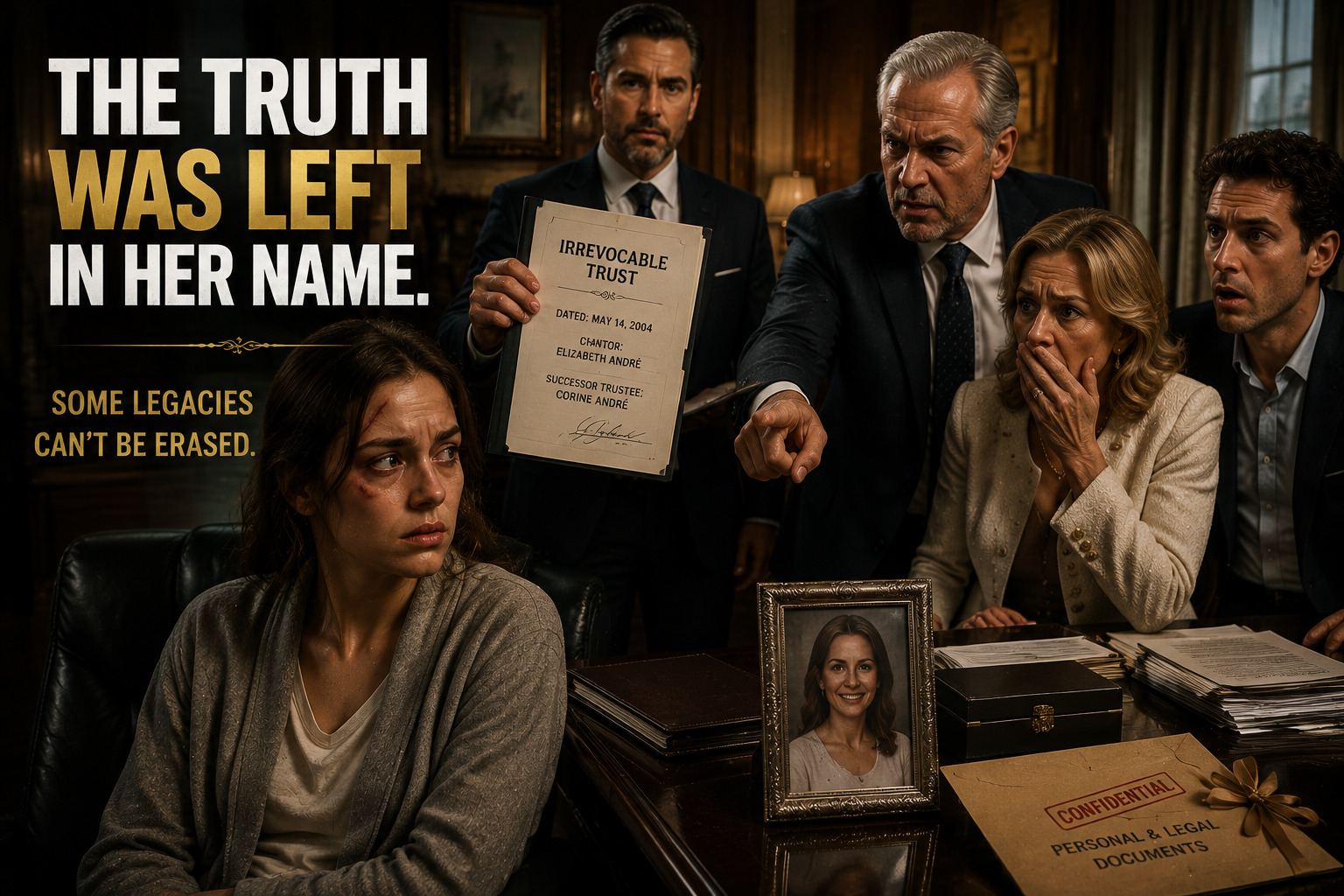
“My mother created the pigment systems this company still sells,” Corine said. “She owned the land beneath this factory. She placed her voting shares and intellectual property in an irrevocable trust before her death.”
Luc turned toward the board.
“This is a performance.”
Miriam connected a small recorder to the sound system.
Celeste’s voice filled the furnace hall.
Luc believes the company cannot survive without him.
Workers lifted their heads.
Julian gripped the edge of the table.
Valerie’s face lost its color.
I fear he may be right.
Luc stared at the speakers.
I fear even more what he will become if everyone keeps agreeing.
The recording ended.
No one moved.
Corine looked at her father.
“Tell them why she created the trust.”
Luc’s jaw tightened.
“The recording is private.”
“Tell them about Newport.”
A reporter near the center aisle raised her phone.
The chief legal officer closed his eyes.
Luc looked toward Julian.
That was the moment Julian understood.
Not the trust.
Not the shares.
The lie beneath the family.
“You said Mom almost bankrupted us,” Julian whispered.
Luc said nothing.
“You said she took money.”
“I protected this company.”
“Did you use the pensions?”
Luc’s gaze shifted toward the employees gathered along the walls.
A furnace operator crossed his arms.
Someone near the back said, “Answer him.”
Luc’s face remained composed, but his body had betrayed him.
His shoulders had drawn inward.
His right thumb rubbed the side of his index finger faster and faster.
Corine had seen that motion across the lunch table.
Recalculating.
Searching for an exit.
There wasn’t one.
Miriam placed the trust agreement on the board table.
“Under Section Fourteen, André Glassworks retained a royalty-free license only while Celeste André remained publicly credited as cofounder.”
She pointed toward the banner.
“The company’s current materials identify Luc André as sole founder.”
Miriam opened another folder.
“Under Section Fifteen, the beneficiary was entitled to annual financial disclosures. Ms. André received none.”
Another page.
“And under Section Sixteen, any attempt to transfer controlling interest without trustee approval terminates the intellectual property license immediately.”
The Meridian chairman removed his glasses.
“What does that mean operationally?”
Miriam looked directly at him.
“It means the formulas, processes, and manufacturing rights your company planned to acquire this morning are not owned by André Glassworks.”
The man turned slowly toward Luc.
“Then what exactly were you selling us?”
Luc’s mouth opened.
No words came.
Corine watched recognition pass over his face.
It began in his eyes.
The hard focus disappeared. His pupils shifted toward the banner, then toward the rows of employees, then toward the board members reading the trust terms.
His hand fell away from the table.
For nineteen years, Luc André had believed Celeste’s trust contained sentimental papers, expired patents, and a daughter too frightened to challenge him.
Now he understood.
The company’s most valuable asset had never been the building, the furnaces, or the André name.
It was the license he had destroyed by erasing hers.
A camera shutter clicked.
Then another.
The sound multiplied across the hall like dry branches snapping.
Valerie stepped away from him.
Only six inches.
But everyone saw it.
Luc looked at Corine.
For the first time in her life, he did not look disappointed in her.
He looked afraid of what she knew she was worth.
Chapter Seven: The Vote That Never Happened
The Meridian acquisition collapsed before noon.
By two o’clock, the board had called an emergency executive session.
Luc was asked to leave the room he had chaired for twenty-nine years.
He refused.
The board secretary repeated the request.
Luc remained seated at the head of the table, one hand resting near the nameplate engraved with his title.
Julian approached him.
“Dad.”
Luc looked up.
Julian’s face had changed since the furnace hall. The obedient certainty was gone. In its place was the stunned expression of a man sorting through every childhood memory and finding fingerprints on all of them.
“You need to go,” Julian said.
“You don’t understand what they’re doing.”
“I understand what you did.”
“I kept this company alive for you.”
Julian glanced toward Corine.
“No. You kept us dependent on your version of it.”
Luc’s eyes hardened.
“You think she’ll protect you?”
Corine answered from the other end of the table.
“This is not about protecting Julian from consequences.”
Julian flinched.
Corine continued.
“He helped remove property from my apartment. He supported the merger without reviewing the trust disclosures. Those actions will be investigated.”
Luc gave a bitter laugh.
“There. You see? She has your mother’s appetite for punishment.”
Corine looked at him.
“My mother hid your crime to save your employees. I’m not sure punishment was her weakness.”
The room went still.
Luc rose.
He gathered no papers.
He straightened his jacket, looked once around the boardroom, and walked out without another word.
The board voted to suspend him as chief executive pending an independent forensic audit.
Julian was placed on administrative leave.
The chief legal officer resigned that evening.
Valerie left the family home the following week, taking three suitcases and none of Celeste’s jewelry. Miriam had sent her a catalog identifying every item owned by the trust.
The company did not collapse.
It came close.
Banks froze two credit facilities. Suppliers demanded assurances. Employees watched the parking lot each morning for news vans.
Corine spent six weeks in rehabilitation while attending board meetings by video.
She learned to climb stairs again.
She learned the company’s balance sheet.
She learned that courage felt less like fire and more like nausea you walked through anyway.
Some directors urged her to sell the trust assets to Meridian at a higher price.
Others wanted her to license the formulas back immediately and disappear from operations.
Corine did neither.
She appointed an interim chief executive from outside the family. She created an employee pension oversight committee. She commissioned an independent valuation of Celeste’s intellectual property and required the company to pay market royalties to the trust.
Half of those royalties funded employee retirement accounts.
The other half funded a new architectural materials research institute in Celeste’s name.
Three months after the vote, Corine entered the old laboratory wing for the first time since childhood.
Luc had not demolished all of it.
Behind a temporary wall, contractors discovered the original test room untouched.
Dust covered the counters. Copper pipes ran along the ceiling. Glass samples leaned in wooden racks where Celeste had left them.
Morning light entered through a cracked skylight.
The cobalt pigment panel from the photograph stood against the far wall.
A worker wiped dust from its surface.
Blue light spilled across the room.
Corine stood inside it.
For years, she had imagined justice as noise: a confession, an apology, a room full of people admitting she had been right.
The real thing was quieter.
It was her mother’s name returning to the building directory.
It was pension money appearing in workers’ accounts.
It was a founder plaque installed at eye level, where children visiting the factory could read both names.
It was the absence of fear when her father’s number appeared on her phone.
Luc called four months after his removal.
Corine answered from Celeste’s restored laboratory.
“I received the audit,” he said.
His voice sounded older.
The audit had found unauthorized loans, misleading board certifications, trust violations, and misuse of corporate funds. Prosecutors declined criminal charges after restitution agreements were reached, but Luc surrendered his shares, his pension package, and the right to serve as an officer or director.
He was not going to prison.
He had lost something he valued more.
Authority.
“You knew the pensions were repaid,” he said.
“Yes.”
“The reports make it sound as though I stole from employees.”
“You used their money without permission.”
“To prevent a larger default.”
“You’re still explaining.”
“What do you expect me to do?”
Corine watched blue light move across the old counter as clouds passed over the skylight.
“Tell the truth without asking it to acquit you.”
Luc breathed into the phone.
For several seconds, neither spoke.
“I went to the hospital every day during the first week,” he said.
Corine closed her eyes.
“The nurses said you were there once.”
“I stayed in the parking garage.”
“Why?”
“I couldn’t enter the room.”
“Because of the trust?”
“No.”
His voice broke around the word.
“Because you looked like your mother after the crash.”
Corine gripped the edge of the counter.
Luc continued.
“The same bruising. The same machine. The same sound when it breathed.”
“Then why did you sign the order?”
A car passed somewhere outside. Tires hissed over wet pavement.
“When the neurologist said you might never wake, I thought…”
He stopped.
“What?”
“I thought I could prevent another nineteen years of watching someone become a reminder of everything I had done wrong.”
Corine stared at the cobalt light.
There it was.
Not love.
Not entirely hatred.
Cowardice wearing the clothes of mercy.
“You weren’t ending my suffering,” she said.
“No.”
His answer was almost inaudible.
“I was ending mine.”
Corine waited for anger to rise.
It did not.
What came instead was a clean, cold understanding.
Her father had spent his life arranging people so he would never have to stand alone with himself.
When Celeste resisted, he called her unstable.
When Corine questioned him, he called her ungrateful.
When Julian obeyed, he called him loyal.
Every label had been a wall built around the same frightened man.
“Are you asking me to forgive you?” Corine said.
“No.”
It was the first honest answer he had ever given her.
“I don’t know what I’m asking.”
Corine looked at the restored founder plaque waiting to be hung.
“You’re asking me to tell you what happens next.”
Luc did not respond.
“I can’t do that for you anymore.”
She ended the call.
Her hand shook afterward.
She let it.
Chapter Eight: Her Mother’s Name
One year after the merger vote, André Glassworks held its annual meeting in the same furnace hall.
The old banner was gone.
In its place hung a single sheet of illuminated cobalt glass.
No portrait.
No slogan.
Just light.
Employees filled the chairs. Retirees sat in the first three rows. Reporters stood along the back wall, but fewer cameras pointed toward Corine now.
The story had moved beyond scandal.
The company had returned to profitability.
Pension funding had reached its highest level in fifteen years.
Three women from the pigment laboratory had been promoted into senior research roles after records showed their work had been credited to executives.
Julian attended quietly.
The investigation found that he had followed Luc’s instructions but had not known about the trust or the original pension transaction. He lost his executive role and spent nine months cooperating with the audit.
Corine later offered him a position managing community restoration projects.
Not chief operating officer.
Not heir.
A job with measurable work and no inherited authority.
He accepted.
Before the meeting began, he approached Corine near the stage.
“You look like her today,” he said.
Corine wore no makeup except a line of dark color around her eyes. Her scar remained visible. Her curls, once straightened for family events, fell naturally to her shoulders.
“I used to hate when people said that.”
“I know.”
“They meant it as a warning.”
Julian looked toward the founder plaque.
“I meant it as an apology.”
Corine studied him.
“For which part?”
“All the parts I haven’t figured out how to say yet.”
She nodded.
“That’s more honest.”
At ten, the board chair stepped to the microphone.
“Before we begin, there is one item of leadership business.”
Corine expected a routine resolution.
Instead, the chair turned toward her.
“For the past year, Ms. André has served as executive trustee, acting chair of the ethics committee, and principal architect of the company’s recovery.”
Applause began near the laboratory employees.
It spread slowly.
The chair continued.
“The board has unanimously voted to appoint Corine André as chief executive officer.”
Corine did not stand immediately.
She looked across the furnace hall.
The people applauding were not cheering because of her surname.
Some had criticized her. Some had doubted her capacity. Some had feared she would dismantle the company to punish her father.
She had answered them with audited numbers, repaired contracts, and decisions that cost the trust money when protecting employees required it.
She rose.
The applause strengthened.
Near the back wall, beside an open service door, stood Luc.
He wore a dark wool coat. His hair was thinner. No one had announced him.
Corine had not invited him.
Their eyes met.
He did not approach the stage.
He did not smile.
He looked toward Celeste’s name on the wall.
Then he lowered his head.
Not dramatically.
Not long enough for the cameras to notice.
Just enough for Corine to see.
A moment of recognition that had arrived twenty years too late.
Luc turned and walked out through the service door.
Corine watched it close behind him.
Then she stepped to the microphone.
“My mother used to say that glass remembers pressure,” she began. “Heat it, bend it, strike it, and the evidence remains inside—even when the surface looks perfect.”
The hall quieted.
“Families remember pressure too. So do companies. Silence does not remove damage. It only hides who has been carrying it.”
Julian lowered his eyes.
Several retired workers nodded.
“For a long time, I believed strength meant surviving whatever people decided to call love. I was wrong.”
Corine placed one hand on the podium.
“Strength is refusing to disappear so someone else can remain comfortable.”
Cobalt light moved across the hall, touching the old brick, the steel beams, and the faces of people who had spent years working beneath a history written by one man.
“My mother’s greatest invention was not a formula,” Corine said. “It was a structure designed to outlive intimidation.”
She looked toward the founder plaque.
“She knew that truth sometimes has to wait. But she also knew it should never be left defenseless.”
When the meeting ended, employees formed a line to speak with her.
Some apologized.
Some shared stories about Celeste.
An elderly furnace technician placed a faded photograph in Corine’s hand. It showed her mother laughing beside a failed glass panel that had cracked down the center.
On the back, Celeste had written:
Failure is information. Shame is optional.
Corine carried the photograph to the restored laboratory.
She placed it beside the blue notebook, the brass key, and the letter that had waited nineteen years for her to wake up.
Outside, the factory furnaces burned against the winter afternoon.
Inside, blue light covered her hands.
Her father had tried to erase her mother.
He had tried to define Corine by guilt, weakness, and dependence.
He had signed papers believing an unconscious daughter could no longer challenge the story he had written for her.
But Corine had opened her eyes.
Then she had opened the box.
And the people who erase your name are often the ones most terrified you will discover what it is worth.