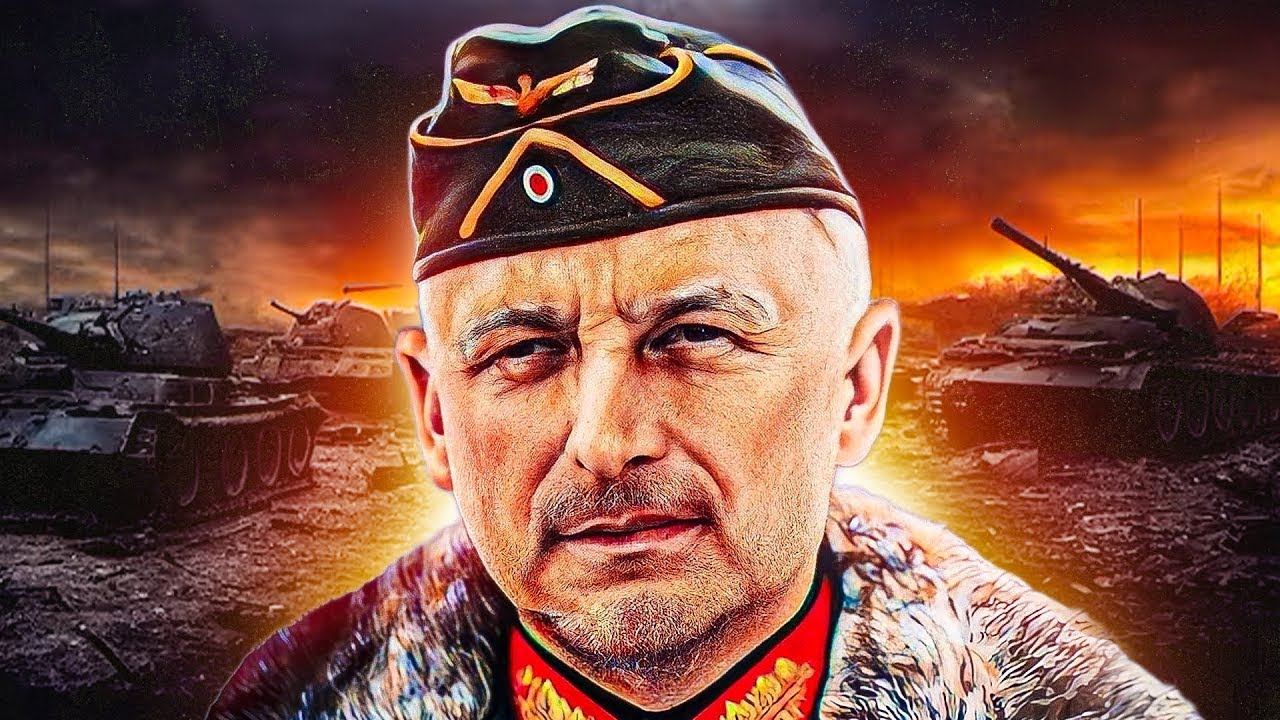
Hitler’s Greatest General? The Rise, Triumph, and Dark Reckoning of Erich von Manstein
In the winter of 1940, one of Germany’s most dangerous military ideas was sitting on a desk that almost nobody wanted to touch.
The generals above Erich von Manstein did not simply dislike his plan.
They thought it was reckless.
France was protected by one of the most powerful armies in Europe. British troops were waiting beside it. The German high command had already designed a safer offensive through Belgium, an approach uncomfortably similar to the old strategy Germany had tried in the First World War.
Manstein looked at the maps and saw a disaster coming.
If Germany attacked where everyone expected Germany to attack, then the Allies would move exactly where Germany expected them to move.
And then the war in the West could become another grinding nightmare.
So the relatively unknown staff officer proposed something that sounded almost absurd.
Send the armored spearheads through the Ardennes.
The Ardennes—the wooded, hilly region many planners considered unsuitable for the rapid concentration of a massive mechanized force.
Cross the Meuse.
Then do not turn toward Paris.
Turn toward the English Channel.
Drive behind the Allied armies rushing north into Belgium and cut them off from France.
It was a plan built around speed, deception and a terrifying assumption:
The enemy would react logically.
And that reaction could be turned into a trap.
Manstein’s superiors resisted the concept. He was eventually transferred away from the headquarters where the Western offensive was being planned.
For most officers, that would have been the end of the story.
Instead, it became the beginning of his legend.
Because within months, German armored formations would burst through the Ardennes, cross the Meuse and race toward the Channel in an operation based substantially on the concept Manstein had pushed.
France, one of the great military powers of Europe, would collapse with breathtaking speed.
And suddenly, the officer whose idea had been considered too dangerous became associated with one of the most astonishing operational victories of the twentieth century. Germany’s official historical institutions describe Manstein as the central advocate of the “Sichelschnitt”—the sickle-cut concept—which sought to split the Allied armies by thrusting armored forces through the southern sector toward the Somme and Channel coast.
But there was something almost prophetic about Manstein’s career.
Again and again, he would see possibilities other commanders missed.
Again and again, he would argue that mobility mattered more than holding ground.
Again and again, Hitler would eventually come to believe that willpower mattered more than Manstein’s calculations.
And eventually, the same military system that elevated him would destroy his army, end his career and place him in a courtroom accused of crimes committed during a war whose operations he had helped direct.
That is why the question “Was Erich von Manstein Hitler’s greatest general?” is more complicated than it first appears.
Because there were really two Manstein stories.
One was about military brilliance.
The other was about what that brilliance was serving.
And the second story changes the first.
He had been born into the world of the Prussian officer corps almost before he could choose anything for himself.
Born Fritz Erich Georg Eduard von Lewinski in Berlin in 1887, he was the tenth child of an artillery general. He was adopted by his mother’s sister and her husband, General Georg von Manstein, whose surname he took.
Military tradition surrounded him.
Biological father: general.
Adoptive father: general.
Other relatives: officers and generals.
Even Paul von Hindenburg, who would later become president of Germany, was connected to the family by marriage.
For Erich von Manstein, the army was not merely a career.
It was the architecture of the world in which he had been raised. British archival biographical records trace his progression from the German cadet system into the 3rd Foot Guards, then through staff appointments during the First World War and into the interwar Reichswehr.
But Manstein was never famous for the theatrical personality associated with some other German commanders.
He did not cultivate the image of a battlefield celebrity.
His talent was colder.
Maps.
Timetables.
Railways.
Reserve formations.
Angles of attack.
The difference between where an enemy appeared strong and where an enemy actually was strong.
He became particularly interested in the relationship between infantry, artillery and armored mobility.
In 1935, while serving in the Army General Staff, Manstein advocated the creation of armored assault artillery that could accompany infantry and destroy strongpoints with direct fire. The idea contributed to the development of Germany’s Sturmgeschütz concept—the turretless assault guns that would later become a major part of German armored warfare. He did not personally engineer the StuG III, as simplified retellings sometimes suggest, but he was an important early advocate of the operational concept behind assault artillery.
It was a revealing idea.
Manstein was not obsessed with weapons for their own sake.
He was obsessed with solving battlefield problems.
Infantry stopped by a bunker?
Give them mobile armored artillery.
Enemy expecting your main attack in Belgium?
Attack somewhere else.
Enemy advancing too quickly?
Do not necessarily stop him.
Sometimes, let him come farther.
That last idea would eventually produce the most famous victory of Manstein’s career.
But first came France.
By late 1939, Germany had invaded Poland.
Britain and France had declared war.
Everyone knew the Western campaign was coming.
The question was how.
The German Army’s initial concept concentrated heavily on an advance through Belgium and the Netherlands. To Manstein, the problem was obvious.
The Allies were expecting it.
The moment German forces entered Belgium, the best Allied formations would hurry north to meet them.
Manstein wanted to use that reaction against them.
His proposal called for powerful armored forces to punch through the Ardennes and across the Meuse, then drive west toward the Channel behind the Allied armies.
It was the military equivalent of opening a door for your opponent—and locking it after he walked through.
The danger was enormous.
The Ardennes road network could become a gigantic traffic jam.
French aircraft could attack the columns.
The Meuse crossings could fail.
A determined counterattack against the German flank could turn triumph into catastrophe.
That was precisely why the plan might work.
Nobody expected Germany to risk so much there.
Manstein pushed the concept repeatedly.
His superiors resisted repeatedly.
Then came one of the strangest turns in the story.
Manstein was transferred to command an army corps.
On paper, he had been moved away from the planning center.
It looked like bureaucratic defeat.
Then circumstances brought him before Hitler.
Manstein explained his idea.
Hitler was captivated by the possibility of a decisive breakthrough.
The concept was incorporated into the revised plan.
The officer who had been pushed aside had, in effect, won.
Then the tanks moved.
May 1940.
German forces entered the Low Countries.
The Allies responded.
British and French formations rushed north.
Exactly as expected.
Meanwhile, armored formations commanded by men such as Heinz Guderian drove through the Ardennes.
Roads filled with vehicles.
Bridges became choke points.
Columns stretched for miles.
Had the Allies understood the scale of what was moving through those forests soon enough, the story might have ended very differently.
They did not.
The Germans reached the Meuse.
At Sedan, defenses cracked.
Then the armored spearheads began moving west.
Commanders on both sides struggled to understand the speed of events.
Telephone reports were obsolete almost as soon as they arrived.
Headquarters looked at maps showing yesterday’s front while German armored columns were already tens of kilometers beyond it.
Then came the moment that turned operational surprise into strategic catastrophe.
German forces reached the Channel.
The Allied armies that had advanced into Belgium suddenly discovered that the front was no longer in front of them.
It was behind them.
The trap had closed.
France did not fall because one man drew one arrow on one map. The campaign depended on many commanders, units, accidents, Allied mistakes and independent decisions in the field.
But the basic operational idea Manstein had championed had worked with devastating effectiveness.
His reputation exploded.
And that reputation would become important later.
Because after France, when Manstein looked at a battlefield and told Hitler that conventional thinking was wrong, it was no longer easy to dismiss him as merely another staff officer.
He had already been right once when almost everyone around him had been cautious.
Soon, he would be asked to prove himself again.
This time in a war unlike anything Europe had yet seen.
On June 22, 1941, Germany invaded the Soviet Union.
The scale was almost unimaginable.
Millions of soldiers.
Thousands of aircraft.
Thousands of armored vehicles.
A front stretching across enormous distances.
Manstein commanded LVI Panzer Corps in the northern sector during the opening phase and demonstrated the same instinct for speed that had defined his planning in France.
But the Soviet Union was not France.
Distances swallowed armies.
Roads vanished into mud.
Vehicles broke down.
Supply columns struggled to catch up.
Soviet formations that appeared destroyed were replaced by new formations.
Cities became fortresses.
Every kilometer east increased the burden behind the advancing German armies.
Then Manstein received command of the Eleventh Army.
Its struggle would take him south, toward Crimea.
The peninsula became the setting for another chapter of his reputation.
Perekop.
Kerch.
Sevastopol.
Fortifications.
Artillery.
Air attacks.
Infantry assaults through terrain that heavily favored defenders.
Sevastopol in particular had been transformed into a massive fortress complex.
Taking it required concentration, patience and overwhelming firepower.
In the summer of 1942, Sevastopol fell.
Soon afterward, Manstein was promoted to field marshal.
His name now belonged to the first rank of German commanders.
France had demonstrated his imagination.
Crimea demonstrated that he could also manage a difficult siege and combined-arms operation.
From Berlin, the victories looked impressive.
On maps, arrows were still moving east.
Hitler’s empire appeared enormous.
But underneath the apparent triumph, the German war effort was becoming dangerously stretched.
And that year Hitler made a decision that would lead to catastrophe.
The German offensive in southern Russia divided its ambitions.
One objective pointed toward the oil fields of the Caucasus.
Another pointed toward a city on the Volga.
Stalingrad.
The name itself made the city politically irresistible.
Hitler wanted it.
Stalin could not afford to surrender it.
And armies began feeding themselves into the ruins.
By November 1942, German Sixth Army was deep inside Stalingrad.
Then the Soviets attacked—not primarily into the strongest German positions inside the city, but against the weaker Axis armies guarding its flanks.
The breakthrough came fast.
Soviet pincers drove around Stalingrad.
They met behind it.
Roughly a quarter of a million Axis troops were trapped inside the pocket.
Germany suddenly faced a disaster unlike anything it had yet experienced in the East.
And the man summoned to repair it was Erich von Manstein.
Hitler created Army Group Don and placed Manstein in command.
The task sounded simple when described in a headquarters:
Save Stalingrad.
On the map, it looked possible.
Reality was worse.
The Sixth Army was encircled.
Soviet forces were expanding their grip.
German reserves were limited.
The Luftwaffe could not reliably supply the surrounded army by air.
Winter was closing in.
Food was disappearing.
Fuel was disappearing.
Men were freezing.
Every day reduced the strength of the force Manstein was supposed to rescue.
Operation Winter Storm began in December.
German armored forces pushed toward the pocket.
For a moment, the impossible seemed almost within reach.
The distance narrowed.
Inside Stalingrad, soldiers heard rumors that rescue was coming.
Outside, Manstein understood the brutal mathematics.
A relief force did not merely need to reach Sixth Army.
Sixth Army needed enough fuel, mobility and freedom to move toward it.
But Hitler had forbidden withdrawal from Stalingrad.
The city was to be held.
The political symbol had become more important than operational flexibility.
The contradiction was fatal.
A rescue operation requires movement from both sides.
Hitler wanted rescue without retreat.
Manstein could argue.
He could propose.
He could maneuver what forces remained under his authority.
He could not transform an impossible order into fuel, trucks and divisions.
The Soviets increased pressure elsewhere.
The relief effort stopped.
The gap remained.
Weeks later, the Sixth Army surrendered.
Stalingrad became one of the great turning points of the war.
For Manstein, it also revealed the central conflict that would dominate the rest of his command.
He believed armies existed to destroy enemy forces and preserve their own ability to fight.
Hitler increasingly treated territory as something that must be held because surrendering it represented weakness.
Manstein wanted elastic defense.
Hitler wanted lines on maps to remain where he had drawn them.
One man thought in terms of maneuver.
The other increasingly thought in terms of will.
And now the Soviet armies were coming west.
Fast.
The situation after Stalingrad was close to catastrophic.
German and Axis formations across southern Russia were exhausted or broken.
The Soviets had momentum.
Their commanders could see the possibility of something larger than merely retaking territory.
If they drove deep enough, they might cut off German forces across the south.
Cities fell.
German formations retreated.
Soviet tank columns pushed forward.
To many officers, the solution seemed obvious.
Stop them.
Hold a line.
Protect every major city.
Manstein saw something else.
He saw an enemy becoming vulnerable precisely because it was winning.
Soviet formations were advancing rapidly.
Their supply lines were lengthening.
Units were separating.
Fuel had to travel farther.
Replacements had to travel farther.
The farther the Soviet spearheads advanced, the more dangerous their position could become—provided the Germans resisted the temptation to attack too early.
This was where Manstein’s philosophy became terrifyingly simple.
Give ground.
Let the opponent believe the retreat is a collapse.
Wait.
Then strike the extended flank.
Hitler hated surrendering territory.
Manstein argued that territory was not the real prize.
The enemy army was.
The tension became extreme.
Kharkov was threatened.
Hitler demanded that important positions be held.
SS commander Paul Hausser eventually withdrew his forces from Kharkov rather than allow them to be surrounded, directly contradicting Hitler’s expectations.
To Hitler, the loss was humiliating.
To Manstein, it created space.
And then came the counterstroke.
February 1943.
German armored formations shifted.
Instead of throwing themselves directly against the strongest point of the Soviet advance, Manstein concentrated against exposed spearheads.
The Soviets had expected pursuit.
They encountered a counterattack.
German panzer formations hit from the south.
Soviet units that had been advancing west suddenly faced attacks against their flanks and supply routes.
Maps that had seemed to show German collapse began changing again.
The hunters had outrun their support.
Now they were being hunted.
One Soviet formation after another came under pressure.
German forces retook ground.
The advance toward the Dnieper was disrupted.
Then Kharkov itself returned to German hands in March.
The front, which weeks earlier had appeared on the verge of disintegration, stabilized.
Military studies continue to cite Manstein’s February–March 1943 counteroffensive as a classic example of operational maneuver under severe pressure.
For the men in German headquarters, the transformation must have seemed extraordinary.
Stalingrad had fallen.
The south had appeared open.
The Red Army had been advancing.
Then Manstein had turned retreat into an ambush.
If the story ended there, the legend would almost write itself.
The brilliant aristocratic field marshal.
The officer who understood movement better than Hitler.
The strategist who saved an army group when everyone else saw disaster.
The man who could lose cities and still win battles.
But the most important plot twist in Manstein’s story was not waiting on another battlefield.
It was already happening behind the front.
And it destroys the comfortable version of his legend.
For decades after the war, many readers encountered a particular image of the German Army.
Professional soldiers.
Traditional officers.
Military men doing their duty.
Hitler and the SS committing crimes somewhere else.
The army, in this version, fought battles.
The Nazis committed atrocities.
Manstein’s postwar image fitted this narrative extremely well.
He had disagreed with Hitler.
He had been dismissed by Hitler.
He was unquestionably talented.
His memoir Lost Victories emphasized military opportunities squandered by Hitler’s interference.
It was an attractive story.
There was just one enormous problem.
The Eastern Front was never merely a conventional war happening beside Nazi racial policy.
It was one of the principal places where that policy was carried out.
Behind the advancing German armies came the Einsatzgruppen—mobile killing units whose operations murdered vast numbers of civilians, particularly Jews, through mass shootings.
Einsatzgruppe D operated in southern Ukraine and Crimea.
Its commander, Otto Ohlendorf, later testified about the scale of those killings.
The United States Holocaust Memorial Museum records that Einsatzgruppen murdered well over one million civilians in the occupied Soviet territories and specifically notes the role of German military structures in supporting and participating in persecution and mass murder. Its material identifies orders from army commanders including Manstein in this wider criminal context.
And Manstein’s own command entered the historical record.
A November 20, 1941 order issued under his authority described the war in ideological terms and spoke of the supposed necessity of punishing “Jewry” as a bearer of Bolshevism. The document later became evidence in his postwar proceedings and survives in archival collections connected to his trial.
That changes the emotional geometry of the story.
Because now the question is no longer simply:
How brilliant was Manstein?
It becomes:
What does brilliance mean when it is being used inside a war of conquest and annihilation?
There is a temptation in military history to isolate the map.
Red arrows.
Blue arrows.
Encirclements.
Breakthroughs.
Distances.
Divisions.
Casualty ratios.
It makes war look almost mathematical.
But maps do not show every grave.
A commander can execute a sophisticated maneuver while civilians are being murdered behind his front.
A general can disagree bitterly with Hitler about where a tank army should retreat without rejecting the criminal nature of the regime’s war.
Opposition to Hitler’s military decisions was not necessarily opposition to Hitler’s system.
That distinction matters enormously in Manstein’s case.
And it leads directly to the second half of his downfall.
After Kharkov, Germany never regained the strategic initiative in the East in any durable sense.
The next great confrontation came around Kursk.
A vast Soviet salient projected into the German lines.
Hitler approved Operation Citadel, an attempt to pinch it off from north and south.
Manstein’s forces would attack from below.
But delays gave the Soviets time.
Minefields deepened.
Anti-tank defenses multiplied.
Reserves accumulated.
The Germans attacked in July 1943.
They made progress in the south.
But this was no France in 1940.
The Soviets had learned.
Their defensive system absorbed punishment and kept functioning.
At the same time, Soviet offensives elsewhere forced Germany to confront the larger strategic truth:
Even a local German success could no longer repair the widening imbalance of the war.
Factories in the Soviet Union were producing immense quantities of weapons.
Allied aid flowed east.
American and British power grew in the West.
Germany was fighting an expanding coalition while its own manpower and resources shrank.
No operational genius could permanently solve that equation.
Manstein could still maneuver.
He could still conduct withdrawals.
He could still inflict losses.
But now each retreat brought him into the same argument with Hitler.
Manstein: pull back before the enemy traps us.
Hitler: hold.
Manstein: shorten the line.
Hitler: hold.
Manstein: preserve the army.
Hitler: hold.
The debate was not merely personal.
It represented two different conceptions of command.
Manstein believed a commander had to exchange space for time when necessary.
Hitler increasingly believed that abandoning ground encouraged collapse.
There were occasions when Hitler had reasons to fear uncontrolled retreats.
But the growing rigidity of his stand-fast orders repeatedly limited the ability of commanders to escape dangerous positions before Soviet breakthroughs became crises.
By early 1944, Manstein was commanding Army Group South through a sequence of Soviet offensives.
The Red Army was no longer the staggering force Germany had attacked in 1941.
It had become a gigantic, increasingly sophisticated military machine capable of masking concentrations, coordinating offensives across huge fronts and replacing staggering losses.
German units were being pushed toward the prewar borders.
Manstein wanted greater freedom to withdraw and maneuver.
Hitler resisted.
Their meetings became battles without gunfire.
Imagine the room.
Maps covering tables.
Officers standing silently.
Colored lines showing armies moving west.
Hitler demanding that positions be held.
Manstein explaining that a position held too long could become a grave.
Nobody in the room needed to raise his voice to understand what was happening.
The field marshal who had once offered Hitler a plan for one of Germany’s greatest victories was now telling him that survival required retreat.
And Hitler did not want to hear it.
On March 30, 1944, Manstein received the Oak Leaves with Swords to his Knight’s Cross.
It looked like an honor.
It was also a farewell.
The next day, he was relieved of command.
The German biographical record notes that their disagreement over defensive priorities had become so fundamental that Hitler removed Manstein on March 31, 1944.
Picture the recognition in that moment.
Years earlier, Manstein’s ideas had helped shape the victory in France.
He had conquered Crimea.
He had become a field marshal.
He had reconstructed a collapsing front after Stalingrad.
Now the same leader who had rewarded him was sending him away because he would not stop insisting that armies could not be saved by orders alone.
For Manstein, the war at the front was effectively over.
For Germany, the worst was still coming.
A year later, the Reich was collapsing.
Soviet troops entered Berlin.
Hitler killed himself.
Germany surrendered.
The uniforms, medals and headquarters maps suddenly belonged to a defeated state whose crimes were being exposed on a scale that shocked the world.
Manstein surrendered to British forces in May 1945.
At first, his future was uncertain.
There was no question that he had been one of Germany’s most important commanders.
The question was what responsibility a commander carried for crimes committed in areas under his authority, for criminal orders transmitted through his command, and for the treatment of civilians and prisoners.
Four years after the war, Manstein entered a British military courtroom in Hamburg.
This was a different battlefield.
No armored reserves.
No flanking maneuver.
No terrain to surrender in exchange for time.
Only documents.
Orders.
Witnesses.
Signatures.
Reports.
The trial ran from August to December 1949. British National Archives records preserve material from the proceedings and describe charges relating to alleged war crimes committed in Poland and the Soviet Union while Manstein served in senior command positions.
His defense became internationally controversial.
Prominent British figures contributed to a fund for his legal costs.
The Cold War had already begun.
Yesterday’s Soviet ally was becoming the West’s geopolitical adversary.
Western governments were increasingly interested in understanding German military experience against the Red Army.
The political atmosphere surrounding former German generals was changing.
But the courtroom was dealing with actions from a different moment.
The prosecution brought forward the realities of occupation.
Prisoners.
Civilians.
Commissars.
Deportations.
Killings.
The machinery of a war in which conventional operations and criminal policies had overlapped.
This is where the popular image of Manstein as simply “the general who opposed Hitler” becomes inadequate.
He certainly clashed with Hitler.
But primarily over the conduct of military operations.
That fact does not erase the documented orders and practices associated with his commands.
In December 1949, the court convicted him on multiple charges and sentenced him to eighteen years in prison, later reduced to twelve. Archival biographical records state that he was convicted on nine of seventeen charges and was released in 1953.
The general who had once trapped armies now sat behind walls.
And then came yet another reversal.
He did not disappear into history.
West Germany was being rebuilt.
The Cold War was hardening.
The possibility of a new West German army became increasingly important to NATO strategy.
Who understood the Soviet Army better than the officers who had fought it?
Former Wehrmacht commanders suddenly possessed knowledge that Western planners valued.
After his release, Manstein became part of the military conversation surrounding West Germany’s defense establishment. British archival records note that he later served as an organizational adviser in connection with the new Bundeswehr.
At the same time, his reputation as a military commander grew.
His memoir appeared.
The title itself was powerful:
Lost Victories.
Those two words contained an argument.
Germany had lost, yes.
But perhaps opportunities had been wasted.
Perhaps generals had understood what to do.
Perhaps Hitler had ruined their chances.
It was a seductive framework because it converted defeat into a series of hypothetical victories.
If only the tanks had been released.
If only the retreat had been authorized.
If only Hitler had listened.
If only.
And some of those military arguments had merit.
Hitler did make disastrous operational and strategic interventions.
Manstein was often more capable than the dictator whose orders constrained him.
German officers frequently did understand battlefield realities better than Hitler.
But the memoir-era legend encouraged another idea:
That professional military brilliance could be cleanly separated from the regime for which it fought.
That is the final twist.
The myth of Manstein became almost as historically important as Manstein himself.
Because his career offered exactly the kind of story postwar audiences wanted to believe.
A genius defeated by a fool.
A professional soldier sabotaged by a dictator.
A master of maneuver whose “lost victories” might have changed history.
Yet once the records behind the front are placed beside the arrows on the map, the story becomes harder.
Much harder.
So was Erich von Manstein Germany’s greatest general of the Second World War?
If the question is strictly about operational skill, his case is formidable.
He possessed an unusual ability to recognize opportunities inside apparently unfavorable situations.
The concept he championed for France exploited Allied expectations rather than merely attacking Allied strength.
His advocacy of assault artillery anticipated the value of mobile direct-fire support for infantry.
His campaigns in Crimea demonstrated competence in complex operations.
His counterstroke after Stalingrad remains one of the clearest examples of using an opponent’s momentum against him.
Even contemporary and later military analysts who were deeply critical of Nazi Germany acknowledged his formidable operational abilities.
But here is the uncomfortable part.
A great battlefield commander is not automatically a great strategist.
And military genius is not moral exoneration.
Manstein could solve operational problems.
He could not solve Germany’s fundamental strategic problem because Germany’s fundamental strategic problem was bigger than any battlefield.
By 1943, the Reich was fighting the Soviet Union, the British Empire and the United States simultaneously.
Its enemies possessed immense industrial and manpower advantages.
Its occupation policies generated resistance and brutality rather than durable political support.
Its war in the East was inseparable from racial ideology and mass murder.
No clever counterstroke around Kharkov could reverse all of that.
No perfectly timed withdrawal could manufacture another million soldiers.
No armored maneuver could bomb American factories out of existence.
No general could transform Hitler’s political project into a sustainable strategy.
And Manstein himself was not standing outside that system observing it with clean hands.
That is what makes his story disturbing.
His intelligence was real.
So was the regime he served.
His conflicts with Hitler were real.
So were the criminal policies operating within the theater he commanded.
His military achievements were real.
So were the victims whose existence disappears when the Eastern Front is reduced to arrows on a map.
The contradiction cannot be solved by pretending one side did not exist.
Perhaps the most revealing moment in Manstein’s entire career was not Sedan.
Not Sevastopol.
Not Stalingrad.
Not Kharkov.
Not even the day Hitler dismissed him.
It may have been the moment after the war when the world began trying to decide which version of Erich von Manstein it wanted to remember.
The tactical genius?
The aristocratic professional?
The frustrated subordinate of Hitler?
The convicted commander?
The Cold War adviser?
The memoirist explaining victories that might have been?
All of them were the same man.
That is why his story refuses a comfortable ending.
If we call him incompetent, the historical evidence does not support it.
If we turn him into a heroic military genius betrayed only by Hitler, the historical evidence does not support that either.
His career demands something more difficult:
The ability to recognize brilliance without worshipping it.
To study military skill without sanitizing the cause it served.
To understand that a man can be extraordinarily good at answering the question “How do I win this battle?” while failing—or refusing—to confront the far larger question:
“What exactly am I helping to win?”
By the time Manstein died in 1973, the tanks had rusted, the armies he commanded had disappeared and the borders of Europe had been redrawn.
But the argument about him survived.
Military academies could study the maneuver.
Historians could study the command structure.
Courts had studied the orders.
Survivors remembered what military maps never showed.
And generations afterward, people still ask whether he was Hitler’s greatest general.
Maybe that question itself tells us something.
Because Hitler had many generals capable of moving divisions.
What he desperately needed—and never truly possessed—was a strategy capable of making his war winnable.
Manstein could sometimes see three moves ahead of the enemy.
He could sometimes see three moves ahead of Hitler.
But even one of the most gifted operational commanders Germany produced could not maneuver his way out of a war built on impossible ambitions, catastrophic decisions and criminal foundations.
And that may be the most important lesson hidden inside his famous “lost victories”:
A brilliant commander can change the course of a battle. He cannot make a disastrous cause wise—and no amount of military genius can erase what happened behind the lines while those victories were being won.