The cup split open the moment Tessa Malone threw it down on the granite counter. Oat milk spread across the surface in a thin, deliberate puddle, and the entire Harlow Financial Lobby Cafe went still. Not the dramatic kind of still. The careful freeze that happens when someone becomes a storm in a room full of people trying to stay dry.
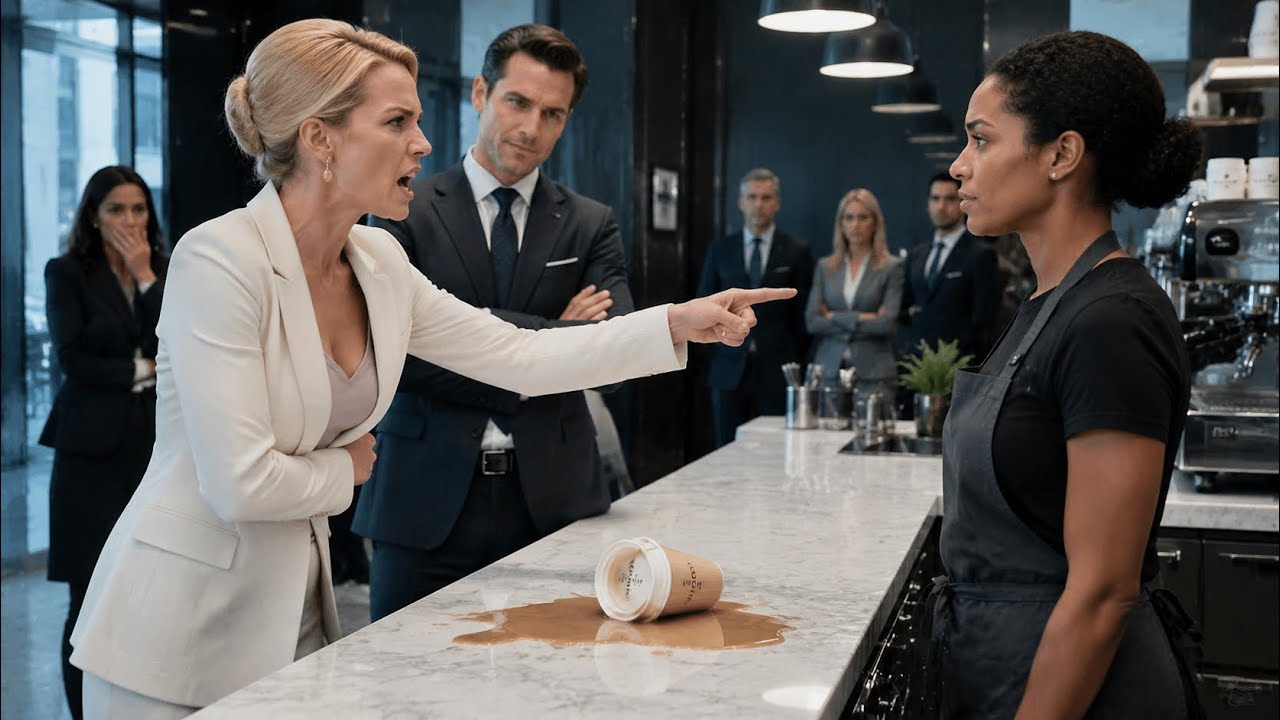
Jade set down her cleaning cloth and looked at the cup. Flat white, oat milk, no sugar, at exactly the right temperature. She had made it correctly, and she knew it. Tessa knew it too.
“I said make it again,” Tessa said. “The texture is wrong. I don’t pay $12 for something that tastes like a gas station made it. ”
Behind her, Colton Briggs, vice president of business development and the man everyone expected to become the next executive director, watched with the half-smile of someone who had never once been embarrassed by anything his girlfriend did in public.
Because embarrassment requires caring what other people feel. “You should stand straighter,” Tessa said, leaning into the counter. “Posture affects quality. I can always tell when someone doesn’t care about their work.
”
Jade said nothing. She pulled the shot, steamed the milk, watched the foam form with the patience of someone who learned long ago that silence is not the same thing as surrender. “She’s very particular,” Colton said, not to Jade, just loud enough. “It’s not personal.
”
Jade set the new cup on the counter. Tessa took one slow sip, tilted her head like she was doing the world a favor by allowing it to continue. “Fine. See?
That’s all it takes. ”
Then she walked toward Colton and the room quietly exhaled. Near the end of the counter, Aiden stood frozen with a stack of paper cups he had completely forgotten he was holding. He was three months into his first job out of college.
He still flinched when people raised their voices. He caught Jade’s eye for a second and she gave him nothing. No anger. No reassurance.
Just stillness. What Aiden didn’t know, what none of them knew, was that the woman behind that counter had walked into the Harlow Financial Building nineteen days ago carrying a barista certification, a carefully constructed employment history, and a single deliberate purpose. Jade Monroe was the founder and chief executive officer of the Harlow Group. She had built the firm from a one-room consulting practice into five business verticals across nine countries.
The company was three weeks away from its largest structural shift in a decade: a landmark expansion into Pacific infrastructure that would define the next generation of the firm’s identity. That expansion required appointing a new executive director. And Jade had learned something twice in her career that she never forgot. Titles tell you what a person can do.
Character tells you who they actually are. Those are not the same thing. The lobby cafe served every floor of the building. Senior executives passed through it five or six times a day.
It was the one place in the building where rank was supposed to become invisible. Supposed to. Jade spent nineteen days learning the rhythm of the room. Watching who thanked the staff and who looked through them.
Who held the door. Who left cups on the counter instead of walking four steps to the return bin. Who laughed when somebody else was uncomfortable. She filled fourteen pages of a small notebook she kept in her apron pocket.
The hidden cameras had been placed before she started, professionally installed at the ceiling corners of the service area. The only other person in the building who knew was the board chairman, Gerald Park. Colton Briggs appeared in those fourteen pages nine times in nineteen days. Not for anything dramatic.
For texture. The way he stacked cups at the wrong end of the counter, always just far enough to be someone else’s problem. The way his voice changed depending on who he was talking to. The way he went warm and generous when board members were present and went flat and absent everywhere else.
Tessa had come three times. The first visit was unpleasant. The second was worse. Today was different.
Jade had been anticipating it. The afternoon rush thinned and Tessa came back alone. She walked in with the specific energy of someone who had been waiting for a smaller audience. Not because she wanted privacy, but because she wanted a stage she could control.
She stepped past a junior associate named Priya, who had been waiting quietly at the counter for ninety seconds. Didn’t acknowledge her. Didn’t slow down. “Same as this morning,” she said to Jade.
“And make sure it’s actually right this time. ”
Priya blinked, moved sideways, said nothing. “You know what I’ve noticed about you? ” Tessa set her bag on the counter.
“You have the look of someone who thinks this job is beneath them. ”
Jade said nothing. “I’ve managed people like that. They think being quiet makes them seem deep.
It doesn’t. It makes them seem like a problem. ” She tilted her head. “Where did you go to school?
”
“I studied,” Jade said. “And this is where that got you. ” Tessa smiled like she was offering something generous. “There’s nothing wrong with that.
Not everyone has the capacity for serious work. This is honest work, as long as you’re grateful for it. ”
Near the window, Priya had stopped scrolling her phone. She was staring at nothing, listening to everything.
Jade set the finished drink on the counter. “I want regular milk,” Tessa said. “You ordered oat. I’m changing it.
”
She paused. Deliberate. Quiet. “Is that a problem?
”
Jade held her gaze for exactly one beat. Then she took the cup back. “You’re replaceable, you know,” Tessa said conversationally, like she was commenting on the weather. “Everyone in a job like this is.
I’m not being mean. I’m being honest. People in service work develop an inflated sense of their own importance. Someone needs to tell them.
”
From behind her, near the service door, Roy stopped moving. Roy had worked in the building for twelve years. He had mopped these floors through three company ownerships, two renovations, and one pipe burst that flooded the east corridor at 2:00 a. m.
on a Tuesday. He was sixty-one, and he moved with the quiet efficiency of someone who had learned to be invisible to the people who didn’t know how to look. He set down his cart and looked at Tessa. “Ma’am, there’s no call for that kind of talk.
”
Tessa turned slowly, the way someone turns toward a sound they haven’t decided whether to take seriously. “I’m sorry? ”
“She’s doing her job. Speak to her properly.
”
The cafe went completely still. Even the milk steamer seemed to quiet. Tessa’s expression shifted into something colder than anger. The kind of cold that comes from someone who has never been corrected by someone they believe to be below them.
“I don’t need etiquette lessons from the janitor. ”
Roy looked at her for one more second. Then he nodded once, picked up his cart, and moved on. Not defeated, just finished.
The movement of a man who had said what was true and required nothing from the response. Jade placed the new drink on the counter. Tessa took it and walked out. Jade turned to the sink, ran cold water over her wrists, breathed once.
Behind her, Priya stepped quietly to the counter. “I’m sorry,” Priya said. “That was wrong. She had no right.
”
Jade looked at her for a moment. “What can I get you? ”
Priya blinked, gave her order, and Jade made it. But she had already reached into her apron pocket, pulled out the small notebook, and added two names.
Three days before the announcement, Colton came back with Tessa. Something had shifted between them. Jade recognized it immediately. The way two people move when one has been promised something and they’re both already living inside the version of life where it’s been delivered.
Colton was working the room. He shook hands with a department head near the door. He laughed too loudly at something Aiden said while picking up his order. The kind of laugh that costs nothing and means less.
He was rehearsing warmth, practicing likeability. They ordered. Jade made the drinks. The exchange was unremarkable until Tessa, mid-sentence, gestured with her cup and caught the corner of a countertop display, knocking it sideways.
Cups and branded coasters scattered across the floor. Tessa looked at the mess, then looked at Jade. “You’ll want to get that. ”
Not an apology.
Not a request. Just a reorganization of the facts of the world, delivered without heat because no heat was needed. Colton glanced at the floor, looked away. Jade came around the counter with a cloth.
As she crouched to collect the items, Tessa’s voice came from somewhere above her. “See, Colton? No drama. That’s all I want from people.
Just do the job without the attitude. ”
Aiden, restocking cups at the far end, had gone completely still. Priya had closed her laptop. Roy had stopped his cart in the doorway and was watching.
Jade stood up slowly, items collected, face composed. She looked at the counter and not at Tessa. “I’ve seen enough,” she said quietly, to herself mostly, not to the room. But Aiden heard it, and for a reason he couldn’t explain, the words made something cold move across the back of his neck.
The email went out at 7:00 a. m. the following morning. All senior staff, directors, and board members.
Mandatory all-hands meeting. Main conference room. Friday, 11:00 a. m.
No agenda listed. Only a note at the bottom: Attendance is required. Coordinated by the office of the chairman. Colton read it in his car and called Gerald immediately.
“Is this the announcement? ”
“Come to the conference room at 11:00,” Gerald said. “You’ll have your answers. ”
Colton hung up smiling.
He texted Tessa two words: It’s Friday. She sent back a champagne emoji. In her office on the twenty-ninth floor, a floor that no one in the cafe had ever connected to the woman who made their coffee, Jade Monroe closed Gerald’s confirmation email and looked out over the city for a long moment. Then she went to her closet, found the barista apron she’d folded and brought home the night before, and set it over the back of her chair.
She wasn’t finished with it yet. The conference room on the thirty-eighth floor was built to make visitors feel the distance between where they sat and where decisions were made. By 10:55, every seat was filled. Department heads.
Senior directors. The board’s inner circle. Junior managers and associates packed along the side walls, summoned by a secondary email that had surprised nearly all of them. Aiden stood near the door, pressing his tablet against his chest, trying to understand why he was there.
Priya sat near the center, spine straight, hands in her lap. Roy had been personally walked to the room by Gerald’s assistant and seated in the second row. No one seemed to know what to make of that. Several people looked at him and then looked away quickly, unsure which response was correct.
Colton arrived at 10:58. Charcoal suit. The good one. The one he wore when he needed to look like the answer to a question before it was even asked.
Tessa was not in the room. She was outside in the lobby, having talked her way to the waiting area near the conference room entrance. She had dressed for an announcement. She had imagined this moment.
She was ready to be in the room when it happened. At exactly 11:00 a. m. , the side door opened.
The room didn’t register her immediately. She walked in from the narrow staff entrance near the presentation wall, not the main double doors. And she was still wearing it. The apron.
Coffee-stained at the left side where something had splashed across it two days ago. Her posture identical to what it had always been. Her expression the same. But the room rearranged itself.
Not all at once, but like a current moving through water. Face by face, the recognition traveled. And behind it came something heavier, something closer to dread, as people began the rapid private work of replaying everything they had said and done in the past three weeks. A senior director who had been in the cafe that Tuesday inhaled sharply.
A woman near the back covered her mouth. Aiden felt the floor shift beneath him. Colton’s face moved through four expressions in under three seconds. Confusion.
Then an almost-laugh. Then something uncertain. Then the slow nauseating arrival of understanding. Gerald stepped forward.
“Good morning. Before we begin, I’d like to make an introduction. For those of you who don’t recognize her by sight, and it appears that many of you don’t, allow me to present the founder and chief executive officer of the Harlow Group. ” He turned toward her.
“Jade Monroe. ”
Silence. Not polite silence. The silence of a room in which multiple people were simultaneously doing the same math and arriving at the same terrible answer.
Jade moved to the podium without hurrying. She set the small notebook on the surface. The same one from her apron pocket, worn at the corners. She looked at the room.
“I spent nineteen days in this building’s lobby cafe,” she said. “I made coffee. I wiped counters. I restocked supplies.
And I watched. ”
She pressed the remote. The screens behind her came to life. The footage was clean, timestamped, professionally captured from the corners of the service area.
The angles were precise enough to capture faces clearly, to carry voices without distortion, to document everything with the same quiet efficiency that the people on screen had believed nobody of consequence was applying. The first clip loaded without introduction. Tessa’s voice came through the room speakers with perfect clarity: “I don’t pay $12 for something that tastes like a gas station made it. ”
The room watched.
Nobody moved. The clip of the afternoon visit. Tessa’s patient, pleasant delivery: “You’re replaceable, you know. Everyone in a job like this is.
”
The clip of the spilled display. The scattered cups. Tessa looking down at Jade crouched on the floor: “No drama. That’s all I want from people.
”
And then the clip of Roy. Quiet, unhurried, setting down his cart. “Ma’am, there’s no call for that kind of talk. ”
Someone in the back of the room exhaled loudly enough for three people to hear.
Jade let the footage run until it reached the moment she had said “I’ve seen enough,” and then she stopped it. She let the room hold it for exactly five seconds. “I did not come into that cafe looking for failures,” she said. “I came looking for character.
Those are not the same search, and the difference between them matters more than anything else I could have reviewed in this office. ”
She looked at Colton directly for the first time since walking in. He had not moved, not shifted, not reached for his phone. He had the stillness of someone who understood at last that any movement would be expensive.
“The executive director of this company needs to understand one thing above everything else. The measure of your leadership is not your quarterly results. It is not your presentation skills. It is not the confidence you perform in rooms that have windows and name placards.
” She paused. “The measure is what you do with people you believe don’t matter. What you do when you think no one important is watching. ”
She closed the notebook.
“Colton Briggs’ employment with this company is terminated effective today. His division will move to interim leadership pending a full conduct review. That review will also examine the culture of his entire floor, which the footage suggests has been a problem for significantly longer than nineteen days. ”
Colton stood up.
“Jade, I didn’t—”
He stopped. He didn’t have the rest of the sentence. “You have nothing to add,” she said, not unkindly, just factually. He sat back down.
The restructuring moved forward with precision. Two project leads who had treated service staff with consistent respect received immediate promotions. A junior manager who had once, without knowing who Jade was, quietly apologized to her after a difficult exchange with another customer was offered a senior development track beginning the following quarter. Then Jade looked toward the second row.
“Roy has worked in this building for twelve years. In nineteen days, he was the only person in that cafe who had any standing to intervene in a public humiliation and actually used it. Without protection. Without an audience performing back at him.
Without any reason to expect it to go well for him. ” She paused. “He simply thought it was wrong and said so. ”
The room was quiet.
“Roy has been enrolled in Harlow’s management development program beginning next month, with a full salary adjustment effective immediately. ”
Roy looked at his hands for a moment. Then he looked up. His expression wasn’t surprise.
It was something older than surprise. The quiet acknowledgement of a man who had known for a long time that he was worth more than the work he’d been assigned and had simply been waiting for a room that could see it. The conference room emptied slowly. People moved with the careful deliberateness of those recalibrating long-held assumptions about how the world sorted itself.
Some stopped to speak to Gerald in low voices near the door. Others left without a word, staring straight ahead. Aiden stood near the exit for nearly a full minute before his legs agreed to carry him out. Priya left without making eye contact with anyone.
Colton left through the side exit. Jade did not watch him go. Outside, in the lobby adjacent to the conference room, Tessa had been standing near the glass doors when the footage started playing on the screens visible through the window. A member of the board’s security team had quietly asked her to leave the premises before the meeting formally closed.
She did not make a scene in the lobby. Whatever she had imagined Friday would look like, she had not built the right picture. And when reality collapses, you need a picture to fall back on. She had none.
The room had nearly emptied when Aiden came back through the door. He stood at the edge of the space, tablet still in hand, and looked at Jade with an expression carrying several feelings that hadn’t yet negotiated which one would speak first. “Can I ask you something? ”
Jade was picking up the notebook from the podium.
She looked at him. “Go ahead. ”
“Why do it like this? You have access to every performance record in this company.
You could have hired outside reviewers. You could have reviewed complaint histories, pulled exit interviews from the last three years. Why did you actually go down there and make the coffee? ”
Jade looked at the apron still draped over the podium.
“Because records tell me what people accomplish. I needed to know what they are. Those aren’t the same question. ” She picked up the apron, folded it once, set it down.
“People behave differently when they know power is in the room. They remember to say thank you. They hold doors. They choose better words.
That version of them is not worthless, but it’s not what I came to see. ” She looked at him. “I needed to see what they did with people they thought didn’t count. ”
Aiden was quiet for a moment.
“And me? I didn’t do anything. I watched. I offered someone napkins once.
”
“You also looked like it cost you something. Every single time. ” She studied him carefully. “There’s a version of that story where it doesn’t matter, but you’re twenty-two.
You’re new. The real price of speaking up in that environment for someone in your position was not abstract. I watched you make the wrong choice and feel it. That means something.
It means when you have enough standing to protect you, you’ll choose differently. ”
He nodded slowly. Then, because he couldn’t stop himself: “I recognized you. Second week.
I’d seen your photo in the company newsletter. ”
“I know. ”
He blinked. “You knew?
”
“You avoided eye contact with me for two days after. Then you went back to normal. ”
He laughed once. A short, disbelieving breath.
He shook his head, thanked her, and left. The room was empty. Jade stood alone with the afternoon light coming through the tall windows. The same light that reached the cafe thirty-eight floors below.
Same building. Same sun. Different altitude. She thought about Roy moving through these floors for twelve years.
Quiet. Consistent. Doing the work without noise. Waiting for a room that could see the shape of a person without needing a title to tell them what to look for.
She thought about what it costs an organization to waste that for twelve years. She picked up her notebook and walked toward the door. The apron she left folded on the table. She didn’t need it anymore.
It had done exactly the work it was hired to do.