The network executives gathered in the dimly lit screening room, their faces illuminated only by the flickering images on the screen, and they knew immediately they had a problem. The $600,000 pilot for what would become one of the most iconic science fiction series in television history was too dark, too bleak, and too terrifying for the families they hoped would tune in every week. The footage was technically brilliant, featuring sweeping matte paintings and elaborate mechanical miniatures, but it lacked the warmth and humor that network standards demanded.
The decision was swift and absolute. The pilot was sealed in a vault, and the entire production was ordered back to the sound stages for a complete overhaul that would fundamentally alter the course of mid-century television.
 The original 1965 pilot, titled No Place to Hide, presented a starkly different vision of space exploration than the one that eventually captivated millions of households every week. Designed strictly as a serious, hard-edged survival drama, the story followed the crew of the Gemini 12, a sleek, saucer-shaped vessel carrying a pioneer family on a daring mission to colonize a distant planet in the Alpha Centauri system. When a rogue meteor shower strikes the ship mid-flight, the controls lock up, throwing the astronauts violently off course and stranding them on a hostile, uncharted, alien world filled with extreme sub-zero weather and towering Cyclops giants.
On paper, it was a thrilling, straight-laced space adventure that treated the cosmos with absolute gravity and scientific earnestness.
But when network executives sat down in the private screening room to review the $600,000 reel, they felt an unsettling, undeniable void. The pilot was undeniably dark, heavy on technical jargon, and emotionally distant from the audience. More importantly, the version delivered to the network was completely missing the two pivotal figures that would come to define its pop culture identity.
There was no scheming, manipulative villain, and there was no environmental control robot to interact with the crew. Without a central antagonist to drive internal human conflict or a metallic foil to bring humor, warmth, and heart to the narrative, the network feared the series would prove far too bleak, dry, and terrifying for primetime family viewing.
Rather than airing the expensive footage or scrapping the entire multi-million dollar investment, network executives made a drastic, non-negotiable demand. They ordered producer Irwin Allen to pull his cast back onto the sound stages, completely overhaul the premise, and introduce both a covert saboteur and a mechanical companion to balance the family dynamic. The original pilot was quietly pulled from broadcast schedules, sealed in a metal vault, and kept strictly out of public sight until decades later.
The expensive sets were altered, new actors were brought in, and large portions of No Place to Hide were painstakingly re-edited, chopped up, and blended with newly filmed scenes to create a far lighter, campier series premiere.
The vaulting of the original pilot stands as a fascinating, pivotal turning point in television history. Had the network aired that $600,000 reel as originally filmed, viewers would have received a grounded, gritty space survival epic focused purely on human endurance against an unforgiving universe. Instead, studio heads chose to lock away the original vision, opting to pivot toward a lighter, character-driven format that fundamentally altered the course of mid-century science fiction television.
The decision would prove financially successful, but it also created a legacy of lost footage that fans and historians would spend decades trying to recover.
The network’s problems did not end with the vaulted pilot. By its third season, the series had largely abandoned its tense survivalist roots in favor of extravagant, colorful space fantasies. The Robinson family was no longer just fighting for survival on an alien world.
They were encountering space Vikings, cosmic gladiators, intergalactic carnivals, and eccentric planetary warlords. But when the 14th episode of the third season rolled off the production line, its execution pushed network standards far beyond what several regional broadcast executives were willing to transmit into local living rooms. Titled Castles in Space, the episode dropped the crew into a high-stakes standoff on a freezing, desolate planet.
The plot centered on an ice princess frozen in suspended animation who is accidentally thawed out by Dr. Smith. She is pursued by a ruthless, silver-skinned bounty hunter named Chavo.
On paper, the story promised a classic, swashbuckling space adventure with frozen fortresses, laser shootouts, and high drama. But when the master tapes reached network screening rooms, the portrayal on screen ignited an immediate quiet panic among program directors. The source of the firestorm was the depiction of Chavo, the episode’s main antagonist.
Played by character actor Alberto Monte in heavy makeup and exaggerated costuming, Chavo was written as a bizarre, heavily caricatured bandito figure.
The character spoke in an exaggerated accent, brandished a weapon like a wild west outlaw, and displayed traits that mirrored deeply insensitive ethnic stereotypes. In a particularly absurd plot point, Chavo even gets the robot drunk on tequila to extract information. Across the country, several local station managers, particularly in major metropolitan television markets, viewed the character portrayal as egregiously inappropriate and culturally regressive, even by the relaxed standards of mid-century network television.
When broadcast day arrived, the pushback was swift. Rather than airing the episode across their regional networks, several prominent TV affiliates quietly altered their primetime schedules.
In multiple major markets, stations blacked out the broadcast entirely, substituting syndicated movies, sports reruns, or local news programming in its place. Viewers who tuned in expecting to see the Robinson family found their screens blacked out or replaced without warning. The network received a wave of complaints from viewer advocacy groups and local station directors demanding higher standards for primetime network broadcasts.
The controversy forced studio executives to reassess how far they could push character caricatures in primetime slots. While the episode was included in original network logs, it was quietly flagged during post network syndication runs.
For years afterward, when local channels bought rerun packages for afternoon television slots, Castles in Space was frequently pulled from the broadcast rotation or skipped over entirely by local station programmers who feared renewed backlash from local audiences. The tapes were quietly shelved, becoming a prime example of how studio missteps and cultural insensitivity could turn a mainstream family show into a target of quiet network censorship. If a single offensive character portrayal could trigger regional blackouts on live television, what would happen when an entire $600,000 pilot episode proved too dark and disturbing for network executives to air?
The answer was clear, and it involved a complete restructuring of the show’s core identity.
When studio executives ordered Irwin Allen to overhaul the vaulted pilot, they knew the show needed a catalyst, a force of friction to drive the narrative forward on a weekly basis. Enter Dr. Zachary Smith, played by veteran character actor Jonathan Harris.
Introduced in the newly filmed premiere, The Reluctant Stowaway, Smith was originally written as a cold-blooded, calculating foreign operative tasked with sabotaging the mission from within. He was intended to be a sinister, ruthless villain whose covert actions would trap the crew in deep space before he met a swift, tragic end within the first few episodes. But what ended up on screen was a complete subversion of the studio’s original vision.
 In the original script and initial takes, Dr. Smith was devoid of warmth or comedic charm. He was a lethal agent of a hostile foreign power who programmed the onboard environmental control robot to destroy the ship’s guidance systems shortly after launch.
In a twist of fate, Smith’s own treachery backfired, trapping him aboard the departing vessel as it blasted off into the cosmos. On set, however, Jonathan Harris quickly recognized a fatal flaw in the material. As written, a purely evil, static villain who constantly plotted killing and sabotage had a very short shelf life on a family television program.
Harris knew that if his character remained a cold-hearted killer, the crew would eventually have no choice but to maroon him, throw him out of an airlock, or write him out of the show entirely.
Determined to save his job and redefine the character, Harris began taking subtle, unauthorized creative liberties during filming. Between takes and during rehearsals, he introduced a dramatic shift in performance style. He abandoned the low, menacing tone of a Cold War spy in favor of a theatrical, cowardly, and pompously articulate persona.
He began improvising now iconic alliterative insults directed at the robot, transforming tense, life-threatening scenes into moments of dark comedic relief. When producers saw the footage in daily rushes, they realized Harris had unlocked a completely unexpected dynamic. Rather than a terrifying monster, Dr.
Smith had become a delightfully pathetic, self-serving coward that audiences could not take their eyes off of.
This unscripted transformation presented studio executives with a massive dilemma. The network had ordered a serious sci-fi survival show with a dangerous antagonist, but the filmed footage contained a villain who was rapidly morphing into a comedic anti-hero. Recognizing that Harris’s performance was magnetic, producers ordered emergency re-edits of The Reluctant Stowaway.
Darker, more threatening dialogue was systematically dubbed over or cut out entirely. Scenes depicting Smith as an irredeemable, cold-blooded killer were scrubbed from the broadcast master, softening his actions so that his presence aboard the ship remained palatable to primetime network censors and young viewers.
The radical restructuring of the premiere fundamentally altered the course of the series. By softening the original darker cut of Dr. Smith, the show stepped away from high-stakes military espionage and embraced the theatrical, character-driven melodrama that defined its run.
The cold-blooded KGB-style saboteur was buried forever in the cutting room floor, replaced by the cowardly, scheming doctor who would ultimately hijack the entire focus of the show. With its iconic villain secured and its trajectory altered forever, the show launched into a primetime television phenomenon that would define science fiction for generations.
To understand the sheer magnitude of the phenomenon that swept across American living rooms in September 1965, one must look at the broader landscape of network television during the height of the space race. NASA’s real-world Gemini missions were capturing global headlines and public fascination with space travel was reaching a fever pitch. Producer Irwin Allen, already dubbed the master of disaster for his cinematic thrillers, recognized that the home audience was starving for high-stakes cosmic adventure.
When Lost in Space debuted on CBS, it was not merely another program joining the fall lineup. It was a bold, expensive gamble that revolutionized how science fiction was produced, marketed, and consumed on primetime network television.
When the show hit the airwaves, its visual presentation set a staggering new standard for broadcast television. The series boasted incredible production values for its era, including intricate miniature models built by Hollywood veteran L. B.
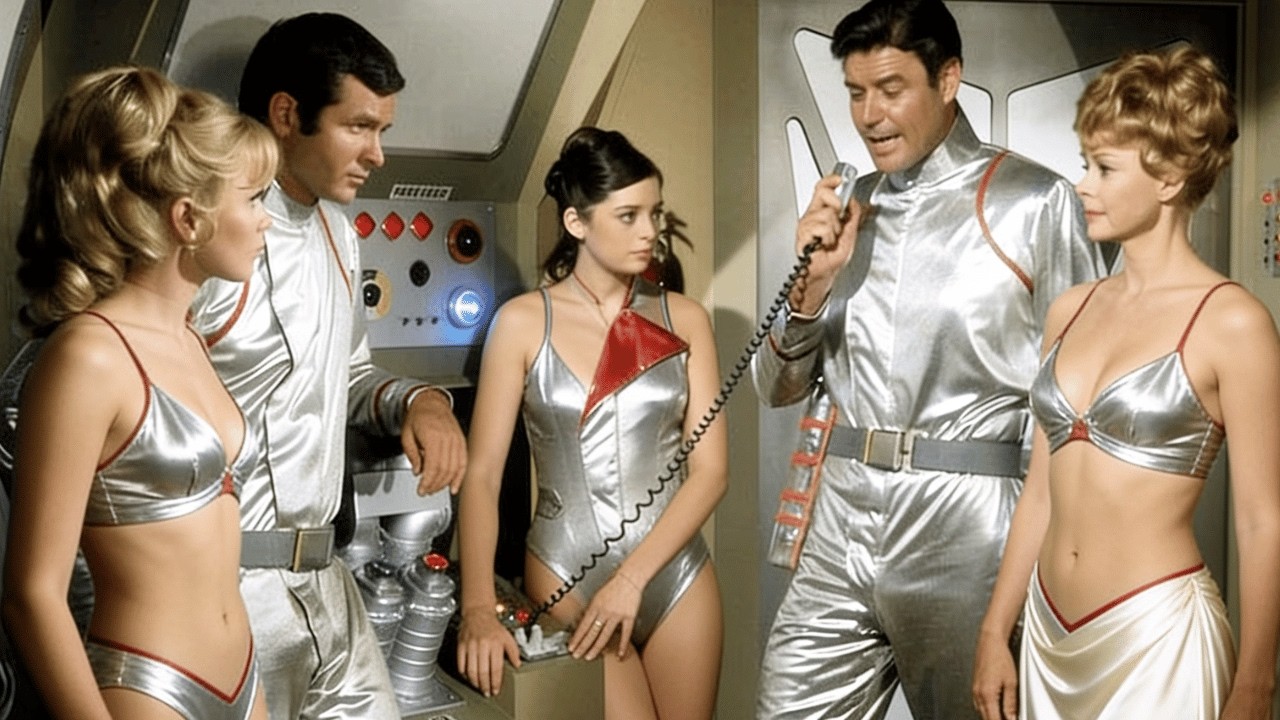
Abbott, sweeping pyrotechnic displays, and elaborate sound stage environments designed to mimic alien worlds. The iconic Jupiter 2 spacecraft, a two-deck saucer-shaped vessel complete with glowing control panels, hydraulic elevators, and cryosleep pods cost tens of thousands of dollars to construct and gave the production a grand cinematic weight. During its first season, filmed in crisp atmospheric black and white, the series maintained a tense, dramatic edge.
Audiences tuned in by the millions every Wednesday night to watch the Robinson family battle unforgiving extraterrestrial environments, cosmic storms, and hostile alien flora. The ratings were an instant triumph for CBS, crushing competing network programs, and proving that primetime audiences would eagerly tune in for serialized space exploration every week. However, the show’s greatest test arrived in early 1966 with the sudden explosion of ABC’s Batman TV series.
The pop art, campy superhero sensation surged in the ratings, forcing every major network to rethink its midweek strategies. Irwin Allen and CBS responded with a radical pivot of their own.
Starting in season 2, Lost in Space made a triumphant leap into brilliant saturated Technicolor. The transition to color fundamentally changed everything. The stark, shadows and dust aesthetics of the first season gave way to vibrant neon hues, colorful alien costumes, and increasingly bizarre outlandish storylines.
The show shifted away from hard survival drama and fully leaned into theatrical, family-friendly space opera. Instead of facing grounded environmental hazards, the Robinson crew was now encountering space pirates, galactic leprechauns, intergalactic circuses, and metallic gladiators across the galaxy. Central to this rating victory was the electrifying chemistry between three key cast members.
Jonathan Harris as the pompous Dr. Smith, young Bill Mumy as the brilliant prodigy Will Robinson, and stuntman Bob May inside the heavy blinking suit of the B-9 environmental control robot created a dynamic that captivated audiences. What began as a traditional ensemble show about a family unit gradually transformed into a weekly showcase for this iconic trio.
The warm protective relationship between young Will and the robot contrasted against Dr. Smith’s endless schemes, cowardly outbursts, and legendary alliterative insults like you bubbleheaded booby became the undeniable emotional core of the series. Behind the scenes, filming was a grueling endeavor.
 The actors worked long hours under scorching sound stage lights while wearing heavy metallic spacesuits crafted from dense synthetic fabrics. Stuntman Bob May spent countless hours squeezed inside the mechanical robot suit maneuvering the clumsy prop over artificial terrain while enduring intense heat and minimal ventilation. Despite these harsh filming conditions, the cast maintained a remarkably tight-knit bond operating like a true family both on and off the camera sets.
By blending cutting-edge visual effects, vibrant color cinematography, and a unique mix of high-camp humor and genuine family heart, Lost in Space dominated primetime ratings throughout the mid-60s.
The show proved that science fiction could be a massive commercial powerhouse paving the way for decades of space-bound television epics that followed in its wake. The show’s massive success cemented Irwin Allen’s status as a visionary producer demonstrating that television audiences were ready to embrace the wonders and perils of outer space as a permanent fixture of popular culture. When Lost in Space concluded its three-season, 83-episode run in the spring of 1968, television critics were quick to write its obituary.
Serious entertainment journalists in major newspapers routinely dismissed the show as a victim of its own absurdity.
To the critical establishment of the late 60s, Irwin Allen’s decision to pivot away from hard science fiction toward theatrical, colorful camp was seen as a creative decline. Reviewers lamented that a show that began with dark, high-stakes survival stories had devolved into a weekly circus of talking carrots, celestial pirates, and theatrical space warlords. They argued that the series had traded genuine suspense for cheap laughs and extravagant visual gimmicks designed solely to entertain young children.
Yet, those critics fundamentally misunderstood the true secret of the show’s enduring success. While television reviewers were busy dissecting narrative realism, millions of families were gathering around their living room television sets every week to share a singular, joy-filled experience.
What the critics labeled as cheap camp, the audience embraced as imaginative, escapist entertainment. The series struck a rare cultural balance. It offered colorful, high-concept monsters for children, clever theatrical banter for adults, and a warm, underlying message of familial loyalty that resonated across age groups.
No matter how dangerous or absurd the alien world became, the Robinson family faced every crisis together, proving that love, courage, and unity could overcome any hazard in the cosmos. When the series entered syndicated rerun packages in the early 70s, its popularity did not fade. It exploded.
Freed from the rigid weekly scheduling of network broadcasts, Lost in Space aired every weekday afternoon in regional television markets across America and around the globe. A completely new generation of children coming home from school discovered the adventures of Will Robinson, Dr. Smith, and the robot.
The show’s bright Technicolor palette, iconic character dynamics, and memorable catchphrases like Danger, Will Robinson became permanently etched into the global pop culture lexicon. This massive syndicated resurgence transformed Lost in Space from a mid-60s television project into a multi-generational cultural phenomenon.
The show proved that sci-fi television possessed immense, long-term commercial value, laying crucial foundational groundwork for the explosion of major media franchises that followed in its wake. Without the commercial success and groundbreaking visual effects work of Irwin Allen’s production team, the television landscape that birthed modern space epics would have looked vastly different. The show’s legacy was further cemented by its remarkable adaptability across media formats.
Decades after the original series went off the air, the franchise expanded into a high-budget 1998 feature film, comic book series, collectible toy lines, and a critically acclaimed modernized Netflix series that introduced the Robinson family to a 21st century audience.
Crucially, these new iterations paid direct homage to the original 1965 series, often featuring cameo appearances from surviving cast members who were celebrated as royalty by generations of devoted fans. Long before Lost in Space ever made it to the television screen, producer Irwin Allen found himself locked in a high-stakes legal feud that nearly crushed the show before a single frame of film was shot. In December 1962, nearly three full years before the Robinson family debuted on CBS, a comic book publisher named Western Publishing, through its Gold Key imprint, launched a sci-fi series titled Space Family Robinson.
The comic followed a family of space travelers, the Robinsons, space scientist Craig, his wife June, and their children Tim and Tam, whose ship, the Space Hydro Mansion, drifted off course into the vast unknown after a cosmic accident. When CBS announced in late 1964 that it had greenlit Irwin Allen’s new series about a family named Robinson lost in the cosmos, Western Publishing’s legal department immediately slapped the studio with claims of copyright infringement and intellectual property theft. The similarities were undeniable.
Both featured a heroic family adrift in space, both shared the same iconic surname, and both leaned into high-concept extraterrestrial hazards.
For a network preparing to invest millions in primetime sci-fi, a high-profile copyright lawsuit threatened to derail the entire launch. Behind closed doors, network lawyers scrambled to negotiate a settlement before Western Publishing could file for a full judicial injunction that would freeze production. Rather than battling it out in a costly public courtroom war, CBS and Western Publishing struck a quiet out-of-court agreement.
CBS paid an undisclosed licensing fee to Western Publishing for the rights to use the character name and core premise. In return, Western Publishing was granted the legal right to append a subtle subtitle to their comic book covers.
Beginning with issue number 15 in 1965, the comic was rebranded as Space Family Robinson: Lost in Space. This secret legal pact saved the show from being buried under an injunction, but it remained one of Hollywood’s best-kept secrets during the show’s original run. Irwin Allen rarely acknowledged the comic’s existence in press interviews, maintaining publicly that the show was entirely his own original vision inspired by Daniel Defoe’s 18th century novel The Swiss Family Robinson.
Had the legal negotiations failed in early 1965, the Robinson family might have had their names forcibly changed or worse, the show would have been legally locked away before ever reaching an antenna.
While studio executives were navigating legal battles and ratings rivalries against ABC’s Batman, Irwin Allen unlocked another massive revenue stream that permanently altered how television networks monetize sci-fi shows. The playground demographic became a target for unprecedented merchandising. In the mid-60s, primetime television programs rarely capitalized on toy sales in a systematic way.
 However, Allen recognized that children were not just watching Lost in Space, they were obsessed with its gadgets, lasers, and mechanical monsters. The result was an unprecedented wave of licensed Lost in Space merchandise that flooded retail shelves across America.
Leading the charge was the Remco Toy Company, which released a line of motorized plastic B-9 robots, laser pistols, and miniature Jupiter 2 spacecraft. Children across the country scrambled to own the battery-operated robot, complete with a translucent dome and flashing lights, turning a television prop into one of the most sought-after holiday gifts of 1966. Beyond action figures and robots, the show dominated the back-to-school season with its iconic metal lunchboxes.
The 1967 dome-top lunchbox, manufactured by King-Seeley/Thermos and featuring full-color artwork of the Robinson family battling a giant one-eyed cyclops, became a massive cultural staple.
Today, that original lunchbox remains one of the most expensive and highly prized vintage collectibles in television history, often fetching thousands of dollars among retro collectors. The merchandising craze extended far beyond toy stores. Topps produced a popular 55-card bubble gum trading card set featuring vivid, dramatic stills from season 1, while Marx Toys released elaborate playsets complete with plastic alien landscapes, silver spacesuits, and miniature buggies.
This retail boom proved to studio executives that a television show’s financial value was no longer limited to commercial advertising spots during a broadcast window.
By turning the Jupiter 2 into a playground empire, Irwin Allen helped lay the modern blueprint for media franchising. Long before Star Wars revolutionized movie merchandising in 1977, Lost in Space proved that sci-fi universe building could generate millions of dollars off the screen, establishing a marketing strategy that defines Hollywood to this day. To understand how Lost in Space captured the hearts of millions, you have to look beyond the glowing miniature spaceships and colorful studio sets to the ensemble cast that brought the Jupiter 2 crew to life.
While millions of viewers tuned in every week to watch the Robinson family navigate extraterrestrial perils, the lives of the actors offscreen were filled with high dramatic shifts, career transformations, and a lifelong bond that persisted long after the camera lights went dark.
At the head of the family was Guy Williams, who portrayed the courageous mission commander, Dr. John Robinson. Already a major television star following his iconic title role in Disney’s Zorro, Williams brought heroic authority and undeniable star power to the production.
However, as the focus of the series gradually shifted toward the comedic antics of Dr. Smith and young Will Robinson, Williams grew increasingly frustrated with his diminished screen time. Following the cancellation of the series in 1968, Williams chose to retire from full-time acting altogether.
He relocated to Buenos Aires, Argentina, where his legacy as Zorro had made him a beloved national hero, living quietly away from Hollywood until his passing in 1989.
Opposite Williams was June Lockhart, who played the intelligent and compassionate matriarch, Dr. Maureen Robinson. Lockhart was already a celebrated Tony Award winner and household name from her long-running starring role in Lassie.
She brought warmth, stability, and genuine warmth to the set, serving as an anchor for the younger cast members. Following her time on the Jupiter 2, Lockhart continued a vibrant, decades-long acting career in television and film, appearing in popular daytime dramas, feature films, and voice roles, while remaining a passionate advocate for real-world space exploration and NASA education initiatives.
The show’s absolute breakout force was veteran character actor Jonathan Harris as the cowardly Dr. Zachary Smith. Originally hired for a limited run as a cold villain, Harris brilliantly reinvented his character into a pompous, theatrical anti-hero whose endless catchphrases and cowardly schemes stole almost every scene.
Off-camera, Harris was a sophisticated, deeply knowledgeable lover of the arts, who formed a heartwarming, fatherly mentorship with his young co-star, Bill Mumy. Harris worked extensively as a prolific voice actor for animated films and video games later in life before passing away in 2002.
Playing the brilliant child prodigy, Will Robinson, Bill Mumy was already one of Hollywood’s most accomplished child actors before stepping aboard the Jupiter 2. His natural charisma and genuine curiosity gave the series its emotional beating heart. Following the show, Mumy transitioned into a remarkably versatile career as a successful musician, voice actor, comic book writer, and sci-fi icon.
Famously starring as Lennier in the acclaimed 90s series Babylon 5. Mumy has consistently remained a proud champion of the show’s legacy, frequently writing books and reflecting on his lifelong friendship with Jonathan Harris.
Rounding out the core cast were Mark Goddard as the hot-headed pilot Major Don West, Marta Kristen as the adventurous eldest daughter Judy Robinson, and Angela Cartwright as the sensitive, artistic Penny Robinson. Goddard delivered sharp heroic tension against Harris’s scheming doctor, later going on to earn a master’s degree in education and working as a dedicated special education teacher for decades before his passing in 2023. Kristen and Cartwright, the latter already famous for her role as Brigitta in The Sound of Music, both built diverse artistic careers spanning photography, design, writing, and continued acting roles.
The physical presence and voice behind the show’s most iconic non-human character were split between two men. Stuntman Bob May, who operated inside the sweltering heavy B-9 robot suit, and radio announcer Dick Tufeld, whose booming vocal delivery gave life to iconic lines like Danger, Will Robinson. Together, this tight-knit ensemble formed an enduring bond that extended far beyond the sound stage, proving that the heart of the show was the genuine affection they shared both on and off the screen.
Looking back across more than half a century of television history, the battle between 60s critics and the viewing audience has a clear winner.
While the harsh reviews of the era have long been forgotten, the Jupiter 2 remains an immortal icon of American imagination. The show’s journey from its vaulted $600,000 pilot and regional affiliate blackouts to its triumphant reign as a syndicated classic stands as a powerful testament to the magic of vintage television. Lost in Space proved that when you blend bold imagination, vibrant storytelling, and a heart centered on family, you create a timeless adventure that can navigate any storm in the universe and shine bright for generations to come.
The three banned episodes, Castles in Space, the original vaulted pilot No Place to Hide, and the heavily re-edited The Reluctant Stowaway, represent the hidden history of a show that survived censorship, legal battles, and creative upheaval to become a beloved cultural touchstone.