The security guard reached for her badge and unclipped it from her chest. Eleven years of night shifts, of holding dying children’s hands, of driving home at seven in the morning too exhausted to change out of her scrubs—all of it folded into his palm. Keziah Malone stood in the hallway of Riverside Children’s Medical Center in her teal scrubs, the ones with the ink stain on the right cuff from a pen that had exploded in her pocket three months ago. Her stethoscope still hung around her neck.
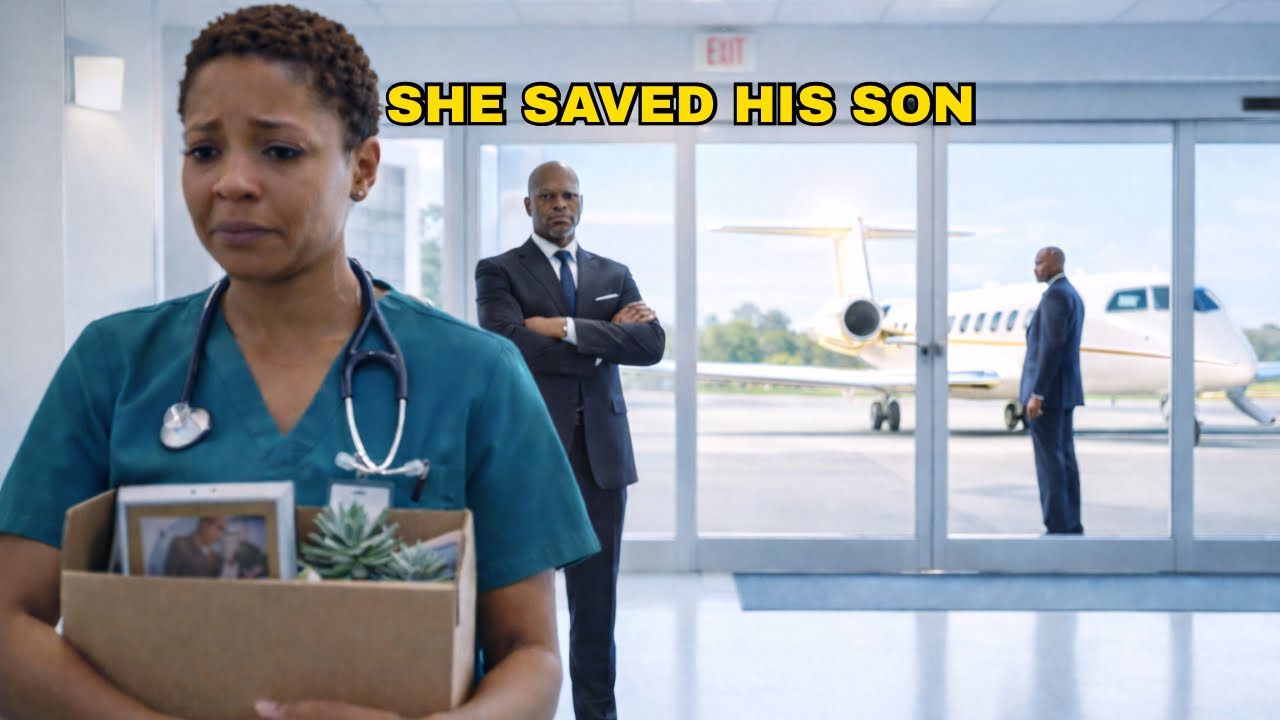
Her name was gone from her chest. Behind the guard, Preston Holt stood with a manila folder and a face like a closed door. He was the hospital administrator, tall and angular, with the kind of eyes that calculated everything and felt nothing. His voice was flat as pavement.
“Ms. Malone, your employment at Riverside Children’s Medical Center is terminated effective immediately. You violated three separate protocols. You administered unauthorized treatment.
You used hospital resources without approval. And you directly disobeyed a transfer order from administration. ”
“I saved a child’s life,” Keziah said. “You overstepped your authority.
”
“He was six years old, Mr. Holt. He was dying. ”
“And he was not your patient to save.
”
The words hit her like a slap. She looked down the hallway toward room 811. The door was closed. Behind it, a six-year-old boy was sleeping, breathing, alive because of what she had done seven hours ago.
Forty feet from that door, pressed flat against the wall like he was trying to vanish into it, a man was watching. He wore the dark green coveralls of the janitorial staff. His name tag said Janitorial Services in letters so small you had to squint. His name was Darius Wynn.
He was the night janitor on the eighth floor. He was also the boy’s father. And he was watching every single second. Keziah didn’t look at him.
She couldn’t. If she looked at the father of the child she had just been fired for saving, she would break. She turned back to Preston. “Eleven years,” she said.
“You’re throwing me away for doing my job. ”
“Your job,” Preston said, stepping closer, “is to follow orders, not play hero. ”
He turned and walked down the hallway. The security guard handed Keziah a cardboard box—the kind they give you when they don’t want you coming back.
She took it. She walked past room 811. She didn’t stop. She didn’t look in.
But her hand reached out and her fingers brushed the door just barely as she passed. Inside that room, a six-year-old boy named Theo Wynn was breathing because of her. And that was enough. But this story doesn’t start there.
It starts fifteen hours earlier, in the rain at the back entrance of a hospital that was about to become the most important building in four people’s lives. It was 10:12 p. m. on a Wednesday when Darius Wynn carried his son through the emergency entrance of Riverside Children’s Medical Center.
The rain was coming down hard—not Atlanta drizzle but Atlanta fury, the kind that bends trees and floods parking decks. Darius was soaked, his green coveralls black with water. He wasn’t thinking about the rain. He was thinking about the boy in his arms.
Theo was six years old, small for his age, with his father’s deep brown skin and eyes that were usually wide and full of questions. Tonight, those eyes were closed. His breathing was shallow, too fast, wrong. He had been sick for four days.
Darius had done everything he knew—cool cloths, children’s medicine from the corner pharmacy, prayers whispered over the boy’s bed at three in the morning. But the fever wouldn’t break. Tonight, Theo had stopped eating. Then he stopped talking.
Then he started shaking. Darius had no car. He picked up his son, wrapped him in a blanket, and ran five blocks through the storm. The emergency room was chaos.
A highway accident had brought in six people two hours earlier. Every bed was full. The triage desk was backed up three deep. Darius stood in the middle of it all, holding his son, and said the only words he could find: “Please, my son.
He can’t breathe right. Please help. ”
The triage nurse looked at him. She saw the coveralls.
She saw the rain. She saw no insurance card, no ID band, no paperwork. She hesitated. Then she called for a bed.
A doctor came within minutes. He listened to Theo’s chest and frowned. “Pneumonia, both lungs advanced. He needs four antibiotics, imaging, and ICU monitoring.
” He looked at the chart. “No insurance? ”
“No,” Darius said. The doctor paused.
“I’ll get him started on fluids and a first round of antibiotics, but you’ll need to speak with admissions. ”
What nobody told Darius was that thirty minutes later, a flag would appear on Theo’s chart in the hospital system. A red flag. Two words: No coverage.
And that flag would land on the desk of a man who cared about numbers more than children. Keziah Malone had been a nurse at Riverside for eleven years. She started at twenty-two, straight out of nursing school. By twenty-seven, she was the lead night nurse on the eighth floor.
She was thirty-three now, slim but steady, the kind of person who looks like they’d bend in a strong wind but never does. Her parents had come from Addis Ababa before she was born. They had taught her two things: work harder than everyone in the room, and never walk past someone who needs help. She had never walked past anyone.
At 11:30 p. m. , the call came from the ER. A six-year-old boy with pneumonia in both lungs was being transferred to the eighth floor.
Keziah prepped the bed in room 811 herself. She set the IV line. She adjusted the monitors. She dimmed the lights so they wouldn’t be harsh on a scared child’s eyes.
When the orderlies wheeled Theo in, the boy was barely conscious. His eyes fluttered open. He saw Keziah’s face. He saw her smile.
And his small hand reached out from under the blanket and grabbed the hem of her scrub top. He didn’t let go for twenty-five minutes. Darius walked behind the stretcher, still wet, still shaking—not from cold, but from fear. “I am his father,” he said.
“Darius. His name is Theo. ”
Keziah looked at him. She saw the coveralls, the rough hands, the terror in those deep-set eyes.
And she saw something else—the look of a man who would die for his child without thinking twice. “Mr. Wynn,” Keziah said gently, “Theo is going to be okay. I’m going to take care of him.
I promise. ”
Keziah worked through the night. She checked Theo’s oxygen every fifteen minutes. She adjusted his IV when his small veins struggled.
She held his hand when he cried in his sleep. She hummed something soft and low—a melody her mother used to sing when the world felt too big. By 3:00 a. m.
, the fever dropped. By 4:30, his breathing steadied. By 5:45, his eyes opened. He looked at Keziah and whispered one word: “Thirsty.
”
She smiled so wide her face hurt. She got him water in a small cup with a straw and held it while he drank. Darius was asleep in the chair beside the bed, his mop propped against the wall. Keziah draped a blanket over his shoulders without waking him.
She didn’t know who he was. She didn’t ask. She saw a father. That was enough.
Preston Holt arrived at 7:30 a. m. , same spot, same door, same briefcase. He had been hospital administrator for three years.
His whole career was built on one principle: a hospital that loses money closes, and a closed hospital saves nobody. It was a reasonable principle. It was also the kind of principle that made it easy to stop seeing patients as people. At 8:20 a.
m. , his assistant placed the overnight admissions log on his desk. Fourteen patients. His eyes stopped on one entry: Wynn, Theodore, age 6, bilateral pneumonia, insurance: none, payment source: unverified, admitted 11:41 p.
m. , floor 8, room 811. Preston picked up his phone. Five minutes later, he was speaking to the day shift charge nurse.
Room 811—the Wynn boy—who authorized extended treatment? “Nurse Malone administered care based on the ER doctor’s initial orders. No separate authorization from an attending physician on record. ”
So she treated an uninsured patient with no attending sign-off and no financial clearance?
“The child was critical, Mr. Holt. ”
He drafted a transfer order. Theo Wynn would be moved to Grady Memorial, the county hospital, effective immediately.
Grady was good. Grady was public. Grady handled uninsured patients. Grady was also fifty-one minutes away by ambulance.
Moving a six-year-old with bilateral pneumonia mid-treatment was not risk-free. Preston didn’t think about the risk. He thought about the $11,000. Keziah’s shift ended at 7:00 a.
m. She hadn’t left. She told herself she was finishing her charting. But the truth was, she couldn’t walk away from room 811 until she knew Theo was stable.
At 9:22 a. m. , the day shift charge nurse came to her with the transfer order. Keziah read it twice.
“He’s on his second round of IV antibiotics. His oxygen just stabilized three hours ago. You cannot move him mid-treatment. ”
“That’s what the order says.
”
“The order is wrong. ”
The charge nurse looked at her. “Keziah, it came from Preston’s desk. ”
“I know who it came from.
I also know the boy’s lungs are barely holding. A fifty-minute ambulance ride could crash his oxygen. ” She paused. “There’s no attending on his chart.
That’s the problem. He fell through the system. ”
“Then I’m going to find one. ”
Dr.
Adeze Obi was the only pediatric specialist on call that morning. She was known for exactly one thing: she did not play politics. Keziah found her in the doctor’s lounge with green tea and a stack of charts. “Dr.
Obi, I need you to look at room 811. Six-year-old boy, bilateral pneumonia, mid-treatment. Administration wants to transfer him to Grady. No attending on record, no insurance.
”
Dr. Obi put down her tea. “Show me. ”
They walked to room 811 together.
Theo was awake, sitting up against the white sheets, IV line trailing from his hand. Darius sat beside him, holding his other hand. Dr. Obi examined the boy, listened to his lungs, checked his charts, checked his oxygen saturation.
Then she turned to Keziah. “This child is not stable for transfer. Moving him now carries serious risk. ” She pulled out her pen.
“I’m signing his chart as attending physician and ordering continued treatment. ”
She signed. Keziah felt her chest unlock. “Thank you.
”
“Don’t thank me. I’m just doing what anyone with a license and a conscience would do. ”
Fifteen minutes later, Dr. Obi’s phone rang.
Preston Holt. “Dr. Obi, I see you’ve added yourself to the chart for room 811. ”
“Yes.
”
“That patient has no financial clearance. I issued a transfer order. ”
“And I’ve countermanded it on medical grounds. The child is not stable for transport.
”
“Doctor, this is an administrative decision. ”
“Mr. Holt, the day you have a medical degree, you can make medical decisions. Until then, my patient stays.
”
She hung up. Preston sat at his desk for a full minute without moving. Then he opened his email and typed one line to HR: “Pull the employment file for Keziah Malone, pediatric unit, night shift. ”
Nobody ever wondered why a man with hands like his was pushing a mop.
Darius Wynn had worked as the night janitor on the eighth floor for two years. He arrived at 10:00 p. m. He left at 6:00 a.
m. He mopped the halls, emptied the trash, cleaned the bathrooms, restocked the paper towel dispensers. He did it all in silence, with his head down, and nobody ever looked at him twice. What they didn’t know could fill a library.
Darius Wynn had been born in Vine City, Atlanta. By twenty-four, he had started a logistics and warehousing company out of a rented garage in East Point. By twenty-seven, he owned four warehouses. By thirty-one, when Wynn Logistics was operating in eleven states with contracts tied to two major national retailers and a federal supply chain partnership, he was worth just under $800 million.
Then his wife died. Nadia, twenty-nine years old, a brain aneurysm—no warning, no chance. She was there on a Tuesday morning and gone before noon. Something broke in Darius that day.
Not the kind of break that heals with time. The kind that reshapes everything permanently. He handed day-to-day operations to his operations director. He took Theo, then three years old, and he walked away from the building with the glass walls and the corner office.
He wanted to disappear. He wanted to feel what it felt like to be nobody, to have nothing, to see exactly how the world treated a man in coveralls who held a mop. He found out. The world treated that man like furniture, like a shadow, like something you step around on your way somewhere important.
But there were exceptions. There was the cafeteria worker who always saved him a warm plate after midnight. There was the security guard who called him by his first name every single night and actually meant it. And there was the nurse on the eighth floor.
The one who said, “Good evening, Mr. Wynn” every single night. Not because she had to, but because she saw him. Keziah.
She was the only person in that hospital who called him by his name. For two years, he had watched her work. He watched her hold children’s hands during blood draws. He watched her stay past her shift to sit with a crying parent.
He watched her sing softly to sick kids in a voice that somehow made the machines seem quieter. And when Theo’s fever turned dangerous, when the world narrowed to one terrified prayer, there was never a question where Darius would go. He went to the place where Keziah worked, because she was the only person in this city he trusted with his son’s life. Now, sitting in room 811, holding Theo’s hand while the boy slept, Darius had heard everything.
He’d heard the charge nurse talking about the transfer order. He’d heard Keziah refuse. He’d heard Preston Holt’s name spoken like a verdict. And he’d heard the whispers in the hallway when people thought no one was listening: “She’s done.
Holt is going to fire her. ”
Darius looked at his son. Theo’s chest rose and fell. Steady.
Even. Alive. Then Darius looked at the mop propped against the wall. The green coveralls.
The name badge that made him invisible. He thought about the money sitting in accounts in Atlanta and Chicago and London. He thought about the phone in his locker—not the cracked old phone in his coverall pocket, but the other one, in the matte black case, with four contacts saved in it that could move mountains by morning. Then he heard footsteps in the hallway.
Hard shoes. Fast. Heading toward room 811. Preston Holt pushed open the door at 1:17 p.
m. Behind him stood the day shift charge nurse and a security guard. Keziah was changing Theo’s IV bag. She turned when the door opened.
She saw Preston. She saw the guard. She knew. “Miss Malone, step into the hallway.
”
“I’m in the middle of—”
“Now. ”
Keziah set down the IV bag. She looked at Theo, who was watching her with wide, scared eyes. She touched his forehead.
“I’ll be right back, sweetheart. ”
She stepped into the hallway. Preston didn’t pause. “Miss Malone, effective immediately, your employment at Riverside Children’s Medical Center is terminated.
Unauthorized administration of treatment without attending sign-off. Unauthorized use of hospital pharmaceutical resources. Direct insubordination of an administrative transfer order. ”
“You’re firing me for saving a dying child.
”
Preston’s jaw tightened. “I’m terminating you for violating hospital protocol. ”
“Theo Wynn would be dead right now if I had followed your protocol. He would have crashed in the back of an ambulance because you wanted to save $11,000.
”
“That is not your determination to make. ”
“Then whose is it? Because you’re not a doctor. You’re not even a nurse.
You don’t sit with kids at three in the morning when they can’t breathe. You sit in an office moving numbers on a spreadsheet and call it health care. ”
The veins in Preston’s neck stood out against his collar. “Your badge.
”
Keziah walked out carrying a cardboard box. A framed photo of her parents. A mug the eighth floor kids had given her two Christmases ago. A small succulent that had survived eleven years.
And her stethoscope, the one she had bought with her first paycheck. She sat in her car—a ten-year-old Honda Accord with a cracked side mirror—put her hands on the wheel, and cried. Not the quiet kind. The kind that comes from your stomach, that bends you forward and won’t stop until there’s nothing left.
She cried for eleven years of night shifts, for every child she’d held and every parent she’d steadied. She cried until there was nothing left. Then she started the car and drove home. In the janitor’s closet on the eighth floor, Darius opened his locker.
He reached past the clean coveralls, past the lunch bag, past the cracked old phone, to the very back, behind a folded towel. He pulled out the phone in the matte black case. He powered it on. Four contacts.
He pressed the first one. It rang once. “Darius. ” The voice on the other end was careful, alert—like a man who had been waiting for a call he never expected to come.
“What’s wrong? ”
“Trey, I need you to listen. ”
Trey Wynn, Darius’s younger brother, was forty-two years old, the current CEO of Wynn Logistics, managing operations across eleven states and $800 million in assets. He excused himself from a meeting the moment he heard his brother’s voice.
“I’m listening. ”
“I need the jet at DeKalb-Peachtree Airport tonight. And I need you to find out who owns Riverside Children’s Medical Center. The full corporate structure.
Every board member. Every stakeholder. ”
Silence. “Darius.
”
“My son was dying. A nurse stayed and saved him. They fired her for it. And the man who fired her runs this hospital like it’s a warehouse.
”
Three seconds of silence. “How much are you willing to spend? ”
“Whatever it takes to put someone new in that chair by Friday. ”
“And the nurse?
”
Darius looked at the mop in the corner. The coveralls on the hook. The name badge that had made him invisible for two years. “The nurse,” he said quietly, “is the only person in this building who ever called me by my name.
”
He hung up. Then he went back to room 811. He sat down beside his son and held the boy’s hand. Theo opened his eyes.
“Dad. ”
“I’m here. ”
“Is the nice nurse coming back? ”
Darius looked at the door.
He thought about the sound of Keziah’s footsteps disappearing down the hallway—the sound of someone walking away from the place they had given everything to. “Yes,” he said quietly. “She’s coming back. ”
Keziah didn’t sleep that night.
She lay in her apartment in East Atlanta, staring at the orange lines the street light threw across her ceiling, trying to imagine what she would do tomorrow. Eleven years. No job. Four months of savings.
A nursing license that might now carry a mark on it if Preston pushed the violations to the state board. At thirty-three, she might be starting over from nothing. Her phone buzzed at 6:22 a. m.
Unknown number. “Miss Malone, please don’t go anywhere this morning. Someone is coming to you. A friend.
”
She stared at it. Almost deleted it. But something—some feeling she couldn’t name—made her put the phone down and wait. At 7:50 a.
m. , a black Suburban pulled into her parking lot. The driver stepped out in a dark suit. He walked to her door and knocked.
“Miss Malone. ”
“Yes. ”
“My name is Marcus. I’ve been asked to bring you to DeKalb-Peachtree Airport.
Someone would like to speak with you. ”
“Who? ”
“The father of the boy you saved. ”
Keziah’s knees went soft.
She got dressed, putting on the nicest thing she owned—a deep blue blouse, black slacks, and the only heels she hadn’t worn since her cousin’s graduation. She got in the car. They drove north through Atlanta, past the neighborhoods she had driven through a thousand times on her way home from night shifts. The city looked different in the morning light.
Sharper. Like it was showing her something she’d never noticed before. They turned into a private gate, passed the security checkpoint, and drove onto the tarmac. And there it was.
A Gulfstream G700, white with a thin gold stripe down the fuselage. The morning sun hit it and the metal gleamed like it was made of light. It was the most beautiful thing Keziah had ever seen. Standing at the bottom of the stairs, in a suit she had never seen him wear, was Darius Wynn.
Still tall. Still angular. Still those deep-set eyes and the gray at his temples. But he was standing differently.
Shoulders back. Chin level. Hands at his sides, open and still. He wore a navy suit, perfectly tailored, and a white shirt with no tie.
His shoes were polished to a mirror finish. He didn’t look like a janitor. He looked like someone who built things. Beside him stood three people—a woman with a legal pad, a man with a briefcase and an earpiece, and a younger man holding a tablet.
Keziah stepped out of the Suburban. Her heels clicked on the tarmac. She looked at Darius and didn’t understand what she was seeing. “Mr.
Wynn,” she said. He walked forward, stopped three feet from her, and looked at her with those bottomless eyes. “Miss Malone. ”
“Keziah.
”
“I need to tell you something I should have told you two years ago. ”
The wind went still. “My name is Darius Wynn. I am the founder and majority owner of Wynn Logistics.
We operate in eleven states. I have built supply chains that move more product in a single week than most companies see in a year. I am worth more money than I know how to spend. ”
Keziah’s lips parted.
No sound came out. “For the past two years, I have mopped the floors of Riverside Children’s Medical Center. I wore coveralls. I emptied trash cans.
I cleaned bathrooms. I did it because I needed to understand what the world looks like when you have nothing. I needed to remember what my parents knew—that the only wealth that matters is how people treat you when they think you can’t do anything for them. ”
He took one step closer.
“For two years, you were the only person in that hospital who said my name. Not ‘hey. ’ Not ‘janitor. ’ Not nothing.
You said, ‘Good evening, Mr. Wynn. ’ Every single night. Not because you had to.
Because you saw me. ”
Keziah’s eyes were filling. “And when my son was dying, when the whole world narrowed down to one room and one prayer, you stayed. You held his hand.
You sang to him. And you risked everything you had built to keep him alive when a man in a suit told you to let him go. ”
His voice cracked. Just barely.
Just enough. “I can never repay you for my son’s life. But I can do this. ”
He turned to the woman with the legal pad.
Breanna. She stepped forward. “Ms. Malone, as of 5:30 this morning, Mr.
Wynn has acquired a controlling interest in Riverside Children’s Medical Center through a purchase of its parent company’s health care division. The acquisition includes full operational authority. ”
Keziah grabbed the side of the Suburban. Her legs weren’t working.
“The hospital’s board has been reconstituted,” Breanna continued. “Preston Holt’s contract has been terminated. A new administrator will be appointed within the week. ”
Keziah looked at Darius.
“You bought the hospital. ”
“I bought the hospital. Because they fired me? ”
“Because they tried to let my son die.
And the only person who stood in the way was a nurse who makes $54,000 a year and drives a Honda with a cracked mirror. ”
Keziah’s hand went to her mouth. The tears came—not the painful kind from yesterday, but the kind that come when the world suddenly makes sense in a way you never expected. “There’s one more thing,” Darius said.
He reached into his jacket and pulled out a small white card. Keziah took it. She read it: Keziah Malone, RN, Director of Nursing, Pediatric Services, Riverside Children’s Medical Center. “The position was just created,” Darius said.
“It reports directly to the new board. No administrator can override your medical decisions. Ever. ”
Keziah looked at the card.
She looked at Darius. She looked at the jet. She looked at the sky. Then she started laughing—the kind of laugh that comes out when you’ve been holding so much for so long that letting go is the only thing left to do.
Darius smiled, warm, full of something that looked like sunlight after four days of clouds. “Mr. Wynn,” Keziah said through her tears, “your son asked me last night if the nice nurse was coming back. What did you tell him?
”
“I didn’t. I didn’t know the answer. ”
She pressed the card against her chest. “But now I do.
”
Preston Holt was at his desk at 7:30 a. m. , same spot, same door, same briefcase. His assistant knocked at 7:36.
“Mr. Holt, there’s a call from the board. ”
He picked up the phone. The call lasted eighty-seven seconds.
When it ended, Preston sat very still. The color left his face. His jaw went slack. His flat eyes blinked four times fast, like a machine receiving information it wasn’t built to process.
The hospital had been sold overnight. His position had been eliminated. He had thirty minutes to collect his personal belongings and leave the building. He stood up.
He looked at his mug with the hospital logo. He looked at his leather briefcase. He looked out the window at the parking lot below, where a black Suburban was idling near the entrance. He left the mug.
He took the briefcase. He walked out of Riverside Children’s Medical Center for the last time. Nobody said goodbye. Six weeks later, a small ceremony was held on the eighth floor.
The pediatric wing was being renamed. A new plaque was being mounted beside the elevator: The Theo Wynn Pediatric Wing. Because every child deserves someone who stays. Keziah stood in front of it with tears on her face and her old stethoscope—the one she had bought with her first paycheck—around her neck.
Beside her stood Dr. Adeze Obi, newly named chief of pediatric medicine. Behind them stood Darius, in a simple gray suit, holding Theo’s hand. The boy was healthy, full cheeks, bright eyes, wearing a small blazer that was slightly too big and kept tugging at the sleeves.
The staff lined the hallway. Nurses, doctors, orderlies, the cafeteria worker who saved warm plates after midnight, the security guard who called everyone by their first name. All of them clapping. Theo tugged on Darius’s hand.
“Dad, is this our hospital? ”
Darius looked at Keziah. She looked back at him. Something passed between them—not words, not a promise, but an understanding.
The kind that only comes when two people have both been invisible and have both been seen by each other. “No,” Darius said to his son. “This is her hospital. ”
Darius Wynn could have saved his son a thousand different ways.
He had the money. He had the power. One call and there would have been a team of specialists there within the hour. But he didn’t call because he needed to know.
He needed to see who would help when there was nothing to gain. Who would stay when staying cost everything. Keziah Malone didn’t save Theo because she knew who his father was. She didn’t refuse the transfer because she was calculating a reward.
She did it because a six-year-old boy grabbed her scrub top and wouldn’t let go. She did it because that’s who she is. And fate saw the whole thing. It didn’t rush.
It didn’t shout. It just waited. And when the time was right, it landed on a tarmac in Atlanta in the morning light, in the shape of a private jet that brought a janitor’s truth into the open. The proud walk out alone.
The ones who stay—fate holds on to them.