The fluorescent lights hummed over the empty aisles, and none of the staff noticed the old man who shuffled through the front door. His coat was two sizes too big, gray and stained at the collar. His boots were scuffed past saving. His face was buried under a heavy, tangled beard, his shoulders folded inward like a man the world had already finished with.
But Garrett Owens owned every single thing inside that building. Three years ago, he’d walked these same floors in a tailored suit, shaking hands and cutting ribbons. His face had been on magazine covers. His company, a national retail chain with over 200 locations, had been called one of the greatest American business success stories of the decade.
Then the emails started arriving in his inbox. Anonymous messages from customers describing how they’d been treated in his stores—mocked, dismissed, made to feel invisible. One message from an elderly man in Ohio had stayed with him for six months: “They looked at me like I was something they needed to clean off their shoe. ”
Garrett ordered internal reviews, investigations, retraining programs.
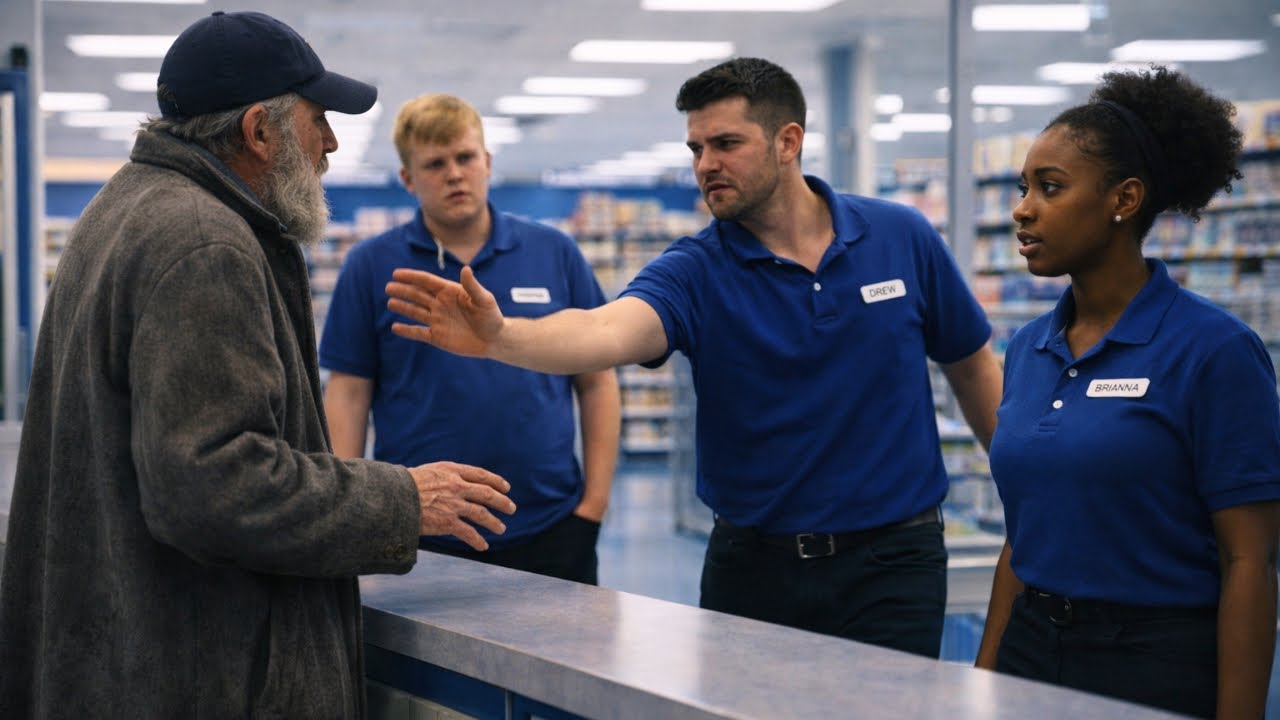
Nothing changed. So tonight, one hour before closing, he walked into location 47 in his old coat and his fake beard with shaking hands and downcast eyes to find out the truth himself. The store was quiet. Two workers stood behind the main service counter—a young man named Drew and another named Tofer, both leaning against the back shelf, phones half-raised, clearly waiting for the shift to end.
At the far end of the counter stood a girl working alone. Her name tag said Briana. She was maybe 22, with tired circles under her eyes that spoke of double shifts and too much coffee. But her posture was straight, and she was actually doing her job—reorganizing a display case, focused, moving with quiet purpose.
Garrett shuffled toward the counter. Drew noticed him first, letting his eyes move from his phone to the old man’s coat. He said nothing, just leaned slightly toward Tofer and tilted his head. Something ugly crossed Tofer’s face, quick but visible.
Garrett’s voice came out thin and rough when he reached the counter. “Excuse me, could I trouble you for a cup of water? My throat’s been real dry. ”
Drew and Tofer didn’t move.
But Briana looked up from the display case without hesitation. “Of course,” she said, and turned toward the back. Behind her, Tofer let out a short breath—not quite a laugh, but not far from one. Drew picked up his phone again.
Briana brought the water in a proper cup, filled to the top, and set it on the counter carefully so it wouldn’t tip. “Take your time,” she said. Garrett reached for the cup. His hands were shaking.
That part wasn’t fake anymore. Behind Briana, Drew spoke in a low voice meant for Tofer alone, but not low enough. “How long is this going to take? ”
Tofer snorted.
“Should’ve just said we were out. ”
Garrett caught every syllable. He set the cup down carefully and said, in his weakest voice, “Thank you, miss. That was very kind.
”
This was the next part of the test. “I don’t suppose,” he started slowly, “there’s any small thing I could help with—sweeping, carrying boxes, anything. I haven’t eaten since morning, and I was hoping maybe…”
Drew cut across the store floor, moving now, his voice sharp and low. “Hey.
Hey, man—I’m going to have to ask you to move along. You’re blocking the counter, and we’ve got actual customers coming in. ”
There were no other customers. The store was empty.
Garrett looked at the floor and started to turn. “He’s fine. ” Briana’s voice was quiet, but it stopped the room cold. Drew looked at her.
“Bri. ”
“He’s fine,” she said again, not louder, just clearer. “He asked a question. That’s not blocking anything.
”
A beat of silence. Drew walked back, but something in his face had hardened. Then Briana looked at the old man—at his hands, his coat, his eyes—as if making a decision the rules on the backroom bulletin board hadn’t covered. “There’s a small stockroom around back,” she said quietly.
“Some boxes came in today that need to be broken down. If you can manage that, I can put something together for you to eat. ”
Garrett nodded. “I can manage it.
”
He worked for twenty minutes, genuinely aching by the end, breaking down the heavy boxes one by one and stacking them flat. When he came back out, the job was done right. Briana was waiting with a paper bag—a sandwich and a bottle of juice, not scraps, not things about to expire, but something she had gone to the food section and selected herself. “You earned it,” she said simply.
Behind her, Tofer had drifted closer. “You know you can get written up for this, right? ” he said, low. “Store items without a purchase receipt.
Manager finds out, and it’s your job. ”
Briana didn’t answer him. She kept her eyes on Garrett and held the bag steady until he took it. His hands were no longer shaking—not from performance, not from age, but from something in his chest that had gone very, very quiet.
She knows the risk, he thought. She knows exactly what it could cost her, and she’s doing it anyway. He turned toward the door. He took four steps, then stopped.
He had run this kind of test before, twice at other locations years ago. It had always felt controlled, strategic, professional. But now he stood near the exit of a fluorescent-lit store at 9:40 at night, holding a paper bag that a twenty-something woman had packed for him knowing it could get her fired—and something in his chest was doing something he hadn’t budgeted for. He thought about his own mother.
She’d worked third shift in a store like this one, sore feet, never complained. She’d once given her lunch to a man outside who said he was hungry and had gone the rest of that shift on black coffee and crackers from her purse. He hadn’t thought about her in years. He reached up slowly, pulled off his cap, then with both hands peeled away the beard.
The sound Tofer made wasn’t words—just air, like something had hit him in the stomach. Drew dropped his phone. Briana went completely still. Garrett Owens turned around and faced the three of them with a clean, sharp face and calm eyes.
He stood straight. His voice was low and even, carrying across the entire empty store. “My name is Garrett Owens. I own this company.
”
Nobody spoke. Drew’s face went the color of dry concrete. Tofer took a small step backward, his mouth opening and shutting with nothing coming out. Briana hadn’t moved, her eyes locked on Garrett’s face—not with guilt, but with a stunned, searching expression.
Garrett looked at her. Then he looked at the other two. He let the quiet sit for a long time. “I came in tonight,” he said finally, “because I’ve been getting messages from customers for two years telling me how they feel when they walk out of my stores.
” He paused. “Tonight I felt it myself. ”
Drew opened his mouth. Garrett held up one hand.
“Don’t,” he said, not loud, but with absolute finality. “There is nothing you can say right now that changes what I saw, what I heard. ” He looked at Drew. “You told a man in need to move along.
There were no other customers. There was no reason. ” He looked at Tofer. “You warned a young woman that doing the right thing was going to cost her job.
And you hoped that would stop her. ”
Neither of them looked up from the floor. “It didn’t stop her. ” He turned back to Briana.
She was watching him, her expression close to tears but held back through pure stubbornness. “You gave me water,” he said. “You defended me when you didn’t have to. You gave me work because you understood that dignity matters more than policy.
And you packed that bag knowing exactly what it could cost you. You were willing to lose your job to do the right thing for a stranger. ” He stepped closer. “That’s not something I can ignore.
”
He told Drew and Tofer they would be on a mandatory performance review effective immediately. He told them, simply and without cruelty, that the behavior he’d witnessed tonight was not what he had built his company to represent. Then he turned to Briana. “I’m creating a district oversight position,” he said.
“It’s a role I’ve needed to fill for two years and haven’t found the right person for. I want someone who already knows what it looks like when a location is failing its customers. Someone who won’t look the other way. Someone who can’t be warned off doing the right thing.
”
Briana blinked. “You’d be moving up five levels,” Garrett said. “Salary, benefits, and a direct line to my office. You’d oversee six locations in this region.
” He looked at her carefully. “I know you don’t know me. I know this is sudden. But I watched you tonight for ninety minutes, and I think I know enough.
”
Her voice came out small when she finally spoke, but steady. “I wasn’t doing it to get anything. ”
“I know,” Garrett said. “That’s why I’m offering it.
”
She accepted—but not right away. She asked one question, quiet and serious, about whether the people she’d be overseeing would be treated fairly even when they were struggling, whether they’d have a real chance to improve. Garrett looked at her for a moment. Then he said yes, and he meant it.
Drew and Tofer stood near the back of the store while the two of them exchanged contact information. Neither of them spoke. The lights didn’t know anything had changed, but something had. Later that night, alone in his car in the parking lot, Garrett sat for a few minutes before starting the engine.
He held the paper bag. He hadn’t put it down since she’d handed it to him because it was the first time in a long time that someone had handed him something with no idea who he was, no angle, no performance—just a sandwich and some juice, and a woman who decided a person in need was worth the risk. He thought about his mother again, about the crackers and black coffee and the man outside who’d gotten her lunch. She never found out what happened to that man.
She never knew if he’d been okay. She’d done it anyway. “Some things,” she used to say, “you do because they’re right. Not because anyone’s watching.
”
Garrett set the bag on the passenger seat, started the car, and drove home through the quiet dark. And somewhere on the highway, alone at midnight, the most powerful man in the building started crying. Not from sadness, not from guilt, but from something rarer—the sudden, unexpected, overwhelming relief of finding out the world still had people like Briana in it. He’d walked into that store to test his employees.
He hadn’t expected to walk out changed himself.