Annelise’s voice cut through the polished silence of the Keller & Co. lobby like a crack on marble. Her heels clicked across the floor as she crossed her arms and looked down at the young woman before her. “So,” Annelise said wearily, placing a hand on her chin.
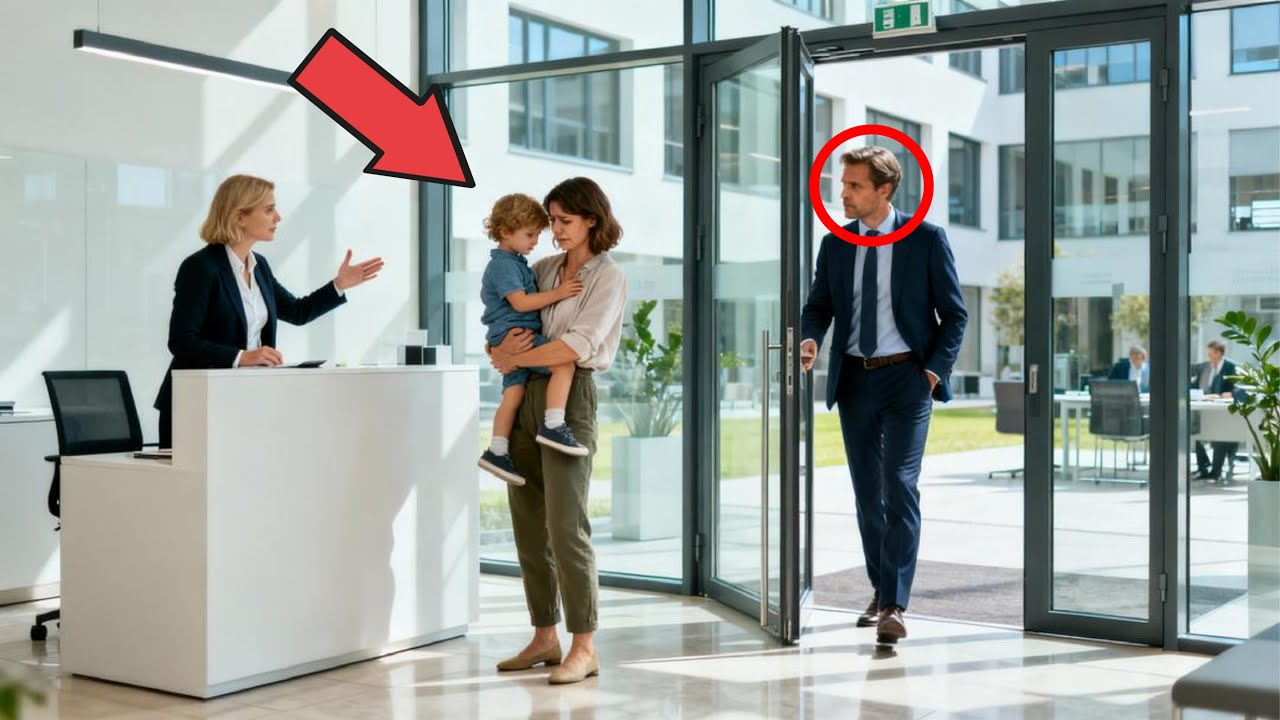
“You brought a child to a job interview. ”
Sophia Berger clutched a simple folder to her chest, trying to keep her voice steady. “I had no choice. I couldn’t leave her alone.
”
Her daughter Mara stood beside her, three years old, blonde curls bouncing around her round face, tiny shoes scuffing across the floor. She wore a little blue dress that Sophia had pulled from a donation bin the day before and washed by hand. Her big curious eyes wandered through the glass atrium, completely unaware of the tense atmosphere. Annelise snorted and turned to the receptionist.
“We’re evaluating professionalism here, not organizing playdates. ”
“I understand,” Sophia murmured quietly. “But I’m here. I prepared.
I brought everything you asked for. ”
“Clearly you didn’t prepare well enough,” Annelise cut in sharply. “This is an interview at an international corporation, Mrs. Berger, not a kindergarten.
”
Sophia flinched at the words but remained standing. Mara looked up at her mother. Her small hand sought Sophia’s fingers. Sophia squeezed gently and forced a smile to calm her child, while her cheeks burned with shame.
Annelise nodded to a security guard nearby. “Could you please take care of—”
A soft gasp interrupted her. Mara had accidentally knocked a paper cup off the edge of the reception counter. Water spilled across the marble floor.
Sophia knelt immediately, pulled tissues from her bag, and frantically dabbed at the water. “I’m so sorry. Please, it wasn’t intentional. ”
No one moved.
No one spoke. Only the distant clatter of keyboards at the front desk filled the silence. Sophia knelt there, scrubbing the floor, while her daughter watched. Her old gray pumps were scratched, her hands trembling.
The air around her was heavy with judgment. Then the elevator chimed. A man stepped out in a dark gray suit—tall, composed, unmistakably powerful. He moved like someone used to being watched.
The receptionist straightened instantly. Even Annelise froze. Markus Keller, CEO of Keller & Co. A name that regularly appeared in business magazines and Forbes profiles.
At thirty-six, he had built an empire, yet few employees had ever seen him up close. He wasn’t supposed to be here. And yet there he stood, pausing mid-step, brow slightly furrowed as he took in the scene: a woman on her knees wiping up spilled water, a child at her side, a manager full of contempt, and a room full of people pretending to see nothing. His voice was calm, deep, unbothered.
“Why don’t you tell me why you’re here, madam? ”
Sophia looked up, startled. “Berger,” she said. “Sophia Berger.
”
He nodded and gestured to the seating area. “Let’s sit. ”
Annelise blinked. “Mr.
Keller, this candidate brought a child. ”
“I can see that,” Markus replied smoothly. “And I also see that she’s on time and has all her documents. So let’s hear what she has to say.
”
Sophia’s eyes widened. She opened her mouth, but no sound came out. Annelise looked as if she had swallowed a lemon. Markus’s expression didn’t change.
He pulled out a chair for Sophia and sat down himself, elbows on his knees, eyes at her level. Mara, sensing the shift, climbed quietly onto her mother’s lap. “Take your time,” Markus said gently. “Start wherever it makes sense for you.
”
Sophia swallowed the lump in her throat. Her hands unconsciously smoothed Mara’s dress as she reached for her résumé. “I applied for the position in administration. I saw the listing online and thought maybe it could be a new beginning.
”
Markus nodded slowly. “Why now? ”
Sophia lowered her gaze to her daughter. “Because I can’t afford to wait anymore.
”
For the first time that morning, something other than judgment hung in the air. Tension, yes—but also curiosity, maybe even hope. Annelise stood behind the chairs, arms crossed, lips thin. Her disapproval weighed heavily in the room.
Markus ignored her completely. He leaned forward, his voice calm but firm. “Let’s start with your story, Mrs. Berger.
”
Sophia took a deep breath. Mara sat still on her lap, playing with a corner of her mother’s jacket. “I lost my husband two years ago,” she said softly. “A car accident.
A drunk driver ran a red light. ”
Markus didn’t blink. “I’m sorry. ”
Sophia nodded almost imperceptibly, the way people nod when they’ve already cried all their tears.
“I was twenty-three. I had just started a part-time training program in office organization. I thought it would help us move forward. Then everything fell apart.
”
“Family? ” Markus asked quietly. “None nearby,” she said. “My parents died when I was a teenager.
My husband’s family cut contact after the funeral. Since then, I’ve raised Mara alone. ”
Mara lifted her head at her name. Sophia gave her a gentle kiss on the forehead and continued.
“I’ve worked everywhere I could. Coffee shops, retail, evening cleaning jobs. I applied to Keller & Co. because I heard they have internal training programs.
I thought if I could just get through the door… ”
Markus glanced at the résumé in his hand. Simple, concise, but neat. Honest.
“And you’re still completing your training? ”
Sophia nodded. “Online courses late at night, when she’s asleep. ”
Markus looked briefly at Mara, who was now quietly swinging her feet in rhythm, calm and well-behaved, as if she knew her mother needed the silence.
Then he returned his gaze to Sophia. “And today? Why did you bring her? ”
“I couldn’t afford childcare this week.
Last Friday, I lost my apartment. We’re staying in a small motel until I find something stable. I didn’t want to leave her there alone, not even for an hour. ”
She straightened her shoulders—a tiny act of defiance.
“I know it’s unprofessional, but I also knew this was my chance. So we got ready, practiced questions, and came here. ”
Annelise interjected from behind. “We could reschedule without the child.
”
But Markus raised his hand and cut her off. “She came prepared. We’ll finish now. ”
Annelise blinked in surprise.
Markus turned back to Sophia. “Would you be willing to do a two-week trial period in office assistance? Entry level. You’d report directly to me.
”
Sophia’s breath caught. She blinked once, unsure she had heard correctly. “Yes,” she said hastily. “Absolutely.
Yes. ”
“I’ll have HR prepare the paperwork by the end of the day. ”
Sophia’s eyes glistened. “Thank you.
Thank you so much. ”
Mara cheered softly, not fully understanding but clapping her hands enthusiastically. Annelise looked dumbfounded. Markus simply stood, buttoned his jacket.
“You can start Monday. We have a small on-site daycare. We’ll make sure Mara gets a spot. ”
He nodded politely.
“Welcome to Keller & Co. , Mrs. Berger. ”
Sophia stood, daughter in her arms, folder in the other hand.
For a moment, she just stood there, overwhelmed. There had been no pity between them—only respect. As she turned to leave, Markus leaned down slightly to Mara and said softly, “You did great today. ”
Mara smiled and pulled a crumpled sticker from her pocket—a heart.
She held it out to him. Without hesitation, he took it. And in that moment, without any grand gesture, something shifted. This was no longer just an interview.
It was a beginning. Markus Keller was a man of systems. His mornings began at 5:30—black coffee, twenty minutes of workout, emails until six, driver at 6:45, and by 7:15 he sat in his glass office overlooking the pulse of Manhattan. CEO of one of the fastest-growing companies in the city.
He had everything a man in his mid-thirties was supposed to have: a penthouse straight out of a luxury magazine, a wardrobe that changed with the season, articles describing him as a visionary, a disruptor, the next Elon Musk. And yet he ate dinner alone. The apartment echoed when it rained. He never spoke about the fire that had taken his little sister when he was twelve.
She had been seven—Lilli, bright-eyed, always drawing butterflies. He never forgave himself for not reaching her in time. Since then, silence was his sanctuary, work his shield. Emotions were folded and put away as neatly as one of his pressed shirts.
But something had shifted since Sophia Berger had walked into his company with frayed sleeves, a child in one hand, dignity in the other. She started the following Monday. Nervous, of course, but punctual, polite. She asked smart questions, stayed late to finish training modules, and never used Mara as an excuse—even when the girl caught a cold midweek.
Markus watched from a distance, not because he had to, but because he wanted to. One afternoon, leaving a meeting, he stopped at the end of the hallway. Through the glass door of the break room, he saw Sophia sitting at a small table, her tray untouched. Across from her sat Harris, one of the janitors, usually avoided by the office chatter.
Sophia slid half of her sandwich toward him. She had cut it exactly in half. “I have too much,” she said with a warm smile. She hadn’t.
She looked hungry herself, and yet she offered it. Markus said nothing—he only watched. Something tightened in his chest. The next day, a different scene.
He was leaving the office late when he heard voices in the hallway—sharp, impatient. “You can’t keep leaving early, Sophia. We’re picking up your slack,” a female colleague snapped. “This isn’t a daycare.
”
“I was five minutes late picking her up,” Sophia replied quietly but firmly. “Yesterday I stayed late and finished all the reports. That’s not the issue. ”
“That’s not the point.
”
Markus rounded the corner and saw her standing at her desk, shoulders tense, lips pressed together. Mara wasn’t there, but her presence seemed to linger in the air, heavy with unspoken judgment. Sophia noticed him and straightened immediately—not pleading, just ready to hold her ground. Markus looked at the other employee and said calmly, “You can go.
”
When they were alone, Markus stepped closer. “Everything alright? ”
Sophia hesitated. “Yes, Mr.
Keller. ”
He looked at her for a moment. “Take tomorrow off. ”
She blinked.
“I don’t want to cause trouble. ”
“You’re not. You’ve earned it. ”
He didn’t wait for thanks—just nodded and left.
But in the elevator down to the garage, his thoughts were louder than usual. He remembered Sophia’s expression—not defeated, but composed. He remembered the sticker Mara had given him. He hadn’t removed it.
It was still in his planner, and for the first time in years, something stirred in him—warm, unfamiliar, like the first breath of spring against a window still holding winter. It was a Sunday afternoon, one of those days when New York insisted summer had already arrived. Central Park hummed—guitar strings, distant laughter, the rhythmic patter of joggers. Normally Markus didn’t stroll through the park—too public, too unpredictable.
Today he had his driver drop him off early. He told himself he needed air. The truth was harder to admit. Near the pond, he stopped.
A little girl in a yellow hoodie and glittery sneakers crouched beside a bench, trying to pull a plastic bottle from the grass. Next to her, a woman he recognized—Sophia. She knelt down, freed the bottle, and handed it to the child. “Okay, Mara, where does this go?
”
Mara looked around, spotted a trash can, and trotted over as if she’d received an official mission. She tossed the bottle in, turned around, and beamed. Markus stayed under a tree, out of sight. “But Mama,” Mara asked, tugging at Sophia’s sleeve, “why are we cleaning up if it’s not our trash?
”
Sophia brushed a leaf from her curls. “Because we don’t wait for the world to be kind, sweetheart. We make it kind. ”
Markus’s chest tightened.
He had built a company, a name, a fortune. But had he ever taught anyone something that honest? He stepped out of the shadows. “Looks like I found the city’s new cleaning crew.
”
Sophia turned, surprised. Mara lit up. “Mr. Markus!
”
He gave a slight bow. “Miss Mara. ”
Sophia smiled warmly but uncertainly—jeans, a worn jacket, cheeks reddened by the wind. “I didn’t expect to see you here.
”
“Neither did I,” he said. “But I’m glad for a break. Have you had lunch? ”
Mara perked up.
“Pizza! ”
Sophia started to decline, but Markus was already pulling out his phone. “There’s a wood-fired place nearby. They have outdoor seating.
”
She looked at Mara, then at him. His smile wasn’t rehearsed, wasn’t business—just human. “Okay,” she said. “Let’s go.
”
Under a striped umbrella, Mara colored on the kids’ menu while Sophia picked at her salad. Markus had taken off his jacket and rolled up his sleeves. For the first time, he looked like someone who wasn’t playing a role. “You’re already teaching her ethics,” he observed.
Sophia laughed softly. “Only when trash is involved. ”
“The answer you gave her,” he said, shaking his head. “That was beautiful.
”
She shrugged. “I just want her to know that kindness isn’t something you wait for or have to earn. ”
“Were you raised that way? ”
“No,” she said honestly.
“I was raised hoping kindness might pass by if you got lucky. ” She dabbed her mouth with a napkin. “After my husband died, I thought grief would be the worst part. It wasn’t.
The worst part was surviving daily while pretending I had it all together, while my life was packed in moving boxes. I thought if I worked more, smiled more, asked for less, it would work out. But life doesn’t reward effort—it rewards image. ”
He leaned forward.
“I disagree. ”
She raised an eyebrow. “The world doesn’t always care. But I do.
I care about substance. ”
Their eyes met. Mara interrupted, holding up a drawing. “I drew us a house!
”
Markus grinned. “A masterpiece. ”
Later, they walked through the park. The sky shifted, a cool breeze arriving.
Mara sneezed. Sophia reached into her bag, but Markus had already taken off his jacket and wrapped it around Mara’s shoulders before anyone could protest. “That wasn’t necessary,” Sophia said quietly. “Yes, it was,” he replied.
“She’s cold. ”
“She’s fine. Really. ”
He shook his head.
“A good leader notices who’s shivering in silence. ”
Sophia stopped. Something in her chest tightened, then loosened. She looked at him—not the CEO, not the man from the magazines, but the person who had just made sure her daughter felt safe.
And for the first time, she didn’t see power or wealth. She saw warmth, presence, someone who noticed the small things and stayed when it mattered. Maybe, she thought, maybe we’re not so different after all. The elevator ride to HR felt endless.
Sophia held a thin envelope with her name written on it in marker. Annelise had sent the invitation that morning—no explanation, just 10 a. m. , HR Conference Room B.
Sophia knew what it meant. Inside, the blinds were closed. Annelise sat stiffly at the table beside Mr. Mertens from legal.
An open file lay before them. Sophia didn’t need to see the contents—she already knew them from the internet. Photos of her and Markus in Central Park. Mara on his shoulders.
Another of him draping his jacket over her daughter. The headline from an anonymous forum echoed in her head: “Single mother hooks the golden ticket—or does she just know how to play the game? ”
She had read the comments. “Boss’s pet.
” “No wonder she got promoted. ” And now she sat here, judged not for her work but for something she had never sought. Annelise cleared her throat. “Mrs.
Berger, there are concerns about your relationship with Mr. Keller. ”
“I’m sure there are,” Sophia replied quietly. Mertens leaned forward.
“This isn’t about gossip. It’s about perception, liability, protecting the company. ”
Annelise slid the envelope forward. “This is a voluntary resignation.
No drama, no mark on your record. ”
Sophia stared at the paper. Two months ago, she had no job and was sleeping with her daughter on a sagging couch. She hadn’t flirted, hadn’t schemed.
She had just worked and accepted gratitude. And now that gratitude was being used against her. She thought of Mara, of the nights she stayed late to catch up, of the mornings she skipped breakfast so her daughter could eat. Her fingers traced the edge of the envelope.
“May I have a moment? ” she asked. Annelise nodded. “Of course.
But the sooner, the better for everyone. ”
Just as Sophia reached for the pen, the door opened. Every head turned. Markus Keller walked in.
No tie. Sleeves rolled up. Expression unreadable. “Mr.
Keller, this is a confidential HR meeting,” Annelise began. “Then open it,” he said calmly. He stood at Sophia’s side, facing Annelise and Mertens. “I’ve seen the posts, the photos, the insinuations.
” He looked at Sophia. “Your promotion was approved by me, based on performance, integrity, ethics. ”
Mertens cleared his throat. “Nevertheless, there are concerns about external perception.
”
“Then let’s clarify something,” Markus replied, his voice sharper now. “Questioning her integrity means questioning mine. ”
Silence. He turned to Sophia.
“You don’t have to sign that. You’ve done nothing wrong. ”
Sophia looked at him—really looked. He hadn’t come to fix the problem.
He had come to stand beside her. Not as a rescuer, but as someone who believed in her. “Why are you doing this? ” she whispered.
He answered without hesitation. “Because you matter. Because the people who work the hardest shouldn’t be the ones left most vulnerable. ”
Annelise exhaled audibly.
“But the external perception—”
“Then we change the lens,” Markus said. He picked up the envelope, tore it in two, and dropped the pieces into the wastebasket. Then, softer: “You’re dismissed, Mrs. Berger.
From this meeting, not from the company. ”
Sophia blinked, overwhelmed. “Thank you. ”
“You’ve earned it,” Markus said.
As they walked out together, the office hummed with rumors, but Sophia walked taller. Not because Markus had defended her, but because someone finally believed in her. In the elevator, she turned to him. “You know people will talk even more now.
”
Markus smiled. “Let them. I’m not afraid of noise. ”
She held his gaze.
“Neither am I. ”
The doors closed. They stepped side by side into something that was just beginning. For three days, Sophia avoided the top floor.
She took early lunch breaks, stayed late, steered clear of the glass elevators near Markus’s office on the west wing. It wasn’t just about the gossip—it was the feeling of being exposed, seen not for her mistakes but for a defense she hadn’t asked for. And his belief in her—real, unshakeable belief—felt heavy, almost too heavy to carry. Late one night in her rented studio on a sagging couch, Mara asleep in her arms, Sophia’s phone lit up.
“You are more than they say. You are exactly what this company needs. Don’t disappear. ”
Markus.
She read it three times. Didn’t respond. Just stared out at the city skyline and whispered, “Why does this make everything harder? ”
Two days later, a calendar invite from his assistant.
No title, just “Rooftop. 6:15 p. m. ”
Sophia wanted to cancel.
But at 6:12, she stood in the stairwell, heart racing, hand on the door handle. Upstairs was quiet—the wind cool but gentle. Manhattan lay golden before her, indifferent to the setting sun. Markus stood at the edge, jacket off, sleeves rolled, silhouette against the sky.
He didn’t turn when she stepped out. “Thank you for coming,” he said. Sophia walked closer, arms crossed. “You didn’t have to stand up for me.
”
Markus glanced at her. “Yes, I did. ”
A silence spread—not awkward, but full. Finally, he spoke.
“When I was twelve, my little sister died in a fire. ”
Sophia’s breath caught. “She was seven. I was supposed to watch her, but I was angry at my parents, snuck out for fifteen minutes to meet a friend.
Fifteen minutes, nothing more. ” His voice nearly broke. “Fifteen minutes. She built a pillow fort in the living room, knocked over a lamp.
The fire spread faster than anyone could react. They told me she probably never woke up. ”
His eyes were rimmed red but dry. “Since then, I’ve built a hundred things, but I’ve never stopped trying to create something that makes me feel worthy of still being here.
”
Sophia stepped closer. “You don’t owe anyone redemption, Markus. ”
“I know. But the need remains.
” His voice softened. “When I saw you with your daughter, standing there while everyone judged you, and you still held your head high—it reminded me what this was supposed to be about. ” He turned fully toward her. “You saved someone.
Not just your daughter. Not just yourself. You reminded me why I started this company, why it has to mean something. ”
Sophia’s eyes filled, but she didn’t let the tears fall.
Slowly, she stepped forward, and without another word, she took his hand. Warm, firm, steady. They said nothing—they didn’t need to. For the first time, both felt a quiet hum of something they couldn’t yet name: not being alone anymore.
The city roared below them, but it felt distant. Up here, there were no job titles, no rumors, no mistakes too big to heal. Just two people—both broken, both brave enough to stay. The rain was pouring when Sophia stood at the window of her tiny one-room apartment.
A bucket caught drips from the leaking roof. The power had been out for over an hour. The air was damp. Mara lay beside her on the couch, wrapped in a blanket.
“Mama, I’m cold,” she whispered. Sophia pulled her close, kissed her forehead. She reached for her phone. Her thumb hesitated over a name.
Markus. She paused, then typed: “Power outage. Roof leaking. Mara’s cold.
I’m sorry—I didn’t know who else to call. ”
The reply came in less than a minute: “I’m on my way. ”
Fifteen minutes later, Markus’s SUV pulled up. Sophia came out, Mara in her arms under an umbrella, rain plastering strands of hair to her forehead.
Mara was wrapped in Sophia’s jacket, arms tight around her mother’s neck. Markus jumped out, took the umbrella from her without a word, shielded them, and gently lifted Mara into his arms. “You’re soaked,” he said quietly. “I’m fine,” Sophia replied, voice trembling.
“Not from the cold. ”
He didn’t argue. His penthouse was warm, softly lit. Marble kitchen counters, art on the walls, floor-to-ceiling windows reflecting the storm.
Sophia stood uncertainly in the doorway, dripping wet. “I’ll get towels,” Markus said, already moving. Mara giggled when he brought her a fluffy bathrobe that reached past her knees. Ten minutes later, Sophia stood barefoot in his kitchen in one of Markus’s oversized shirts and dry leggings he’d provided.
She stirred pasta on the stove while Mara played quietly on the rug. “You didn’t have to cook,” Markus said, now in a gray hoodie and joggers. “You drove through a storm to get us,” she replied. “Dinner is the least I can do.
”
He leaned against the counter, arms crossed, watching her as if she already belonged there. “Smells better than anything my chef ever made. ”
Sophia laughed softly. “That’s because it’s real food.
”
Later, the three of them sat on the couch watching an old cartoon Mara had chosen. The girl fell asleep halfway through, curled up against Markus’s side, one hand clutching his sleeve. He looked at her, then at Sophia, who sat beside him with her knees drawn up. “She’s asleep,” he whispered.
Sophia smiled. “She always picks the movie and then misses the ending. ”
A long silence followed, filled only by the soft theme music and the rain softening outside. Then Sophia spoke, almost inaudibly: “I’m scared.
”
Markus didn’t move. “Scared of hoping too much,” she continued, voice trembling. “I’ve learned to live without a lot. But the hardest part is imagining more.
A home—a real one. A future where Mara doesn’t watch me struggle every day. A life where someone stays. ”
He turned to her.
Her eyes glistened in the dim light. She looked away quickly. “I shouldn’t have said that. ”
“Sophia,” he interrupted gently.
She looked at him. “Then let me carry that hope for you. For both of you. Until you’re ready to hold it yourself.
”
Silence. Then a breath, a heartbeat. Sophia’s shoulders relaxed. A wall inside her cracked for the first time.
Mara murmured in her sleep, still clutching Markus’s arm. He smiled down at her, then his gaze met Sophia’s again. No grand gestures, no explanations—only truth.
Something real.