The first Swedish fascist party appeared in 1924, quiet and almost unnoticed. While Europe drifted toward extremism, a small group of men in Sweden decided that their country needed saving too. They called themselves the Swedish National Socialist Freedom Federation. Over the next few years, the movement twisted and turned, split and reformed, until it finally settled into a new shape in 1930 as the new Swedish National Socialist Party, led by a man named Birger Furugård.
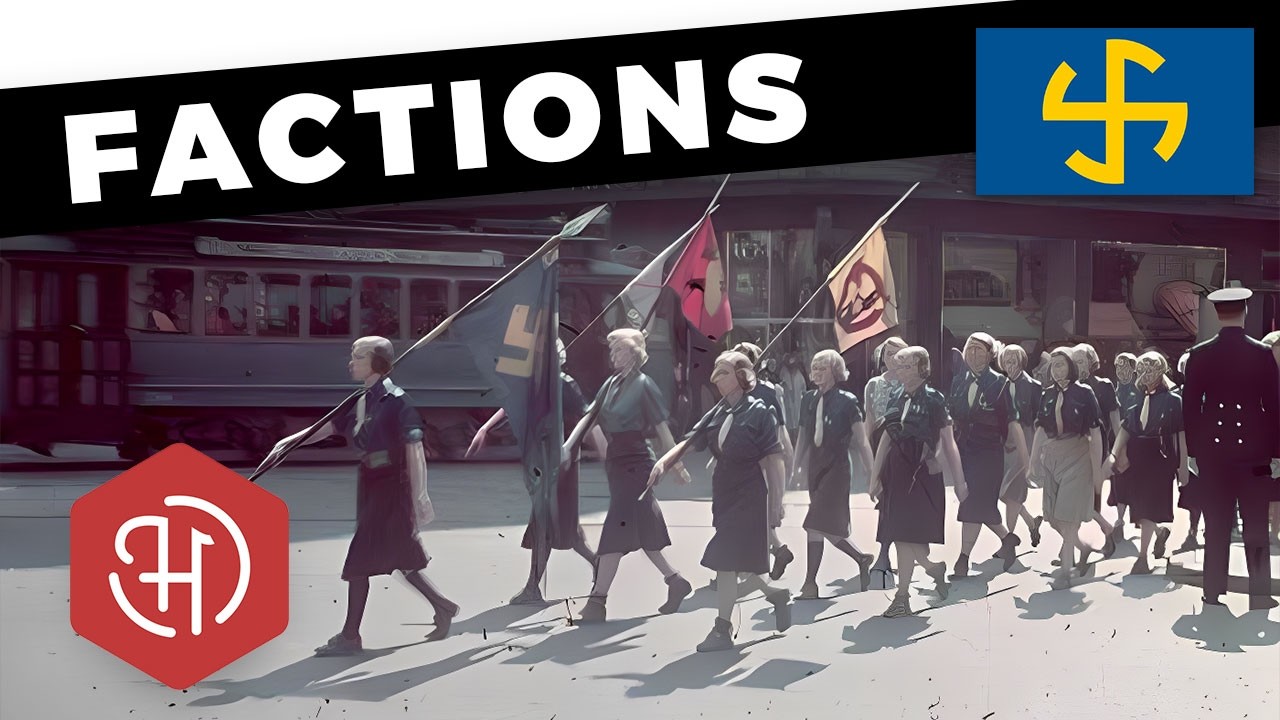
A year later, they changed the name again, narrowing it to the Swedish National Socialist Party. Small groups everywhere kept joining them. One was the Swediska Fascist People’s Party, formed originally in1926, which soon became Sweden’s Fascist Combat Organization, modeled directly on the blackshirt militias of Mussolini’s Italy. But as the late 1920s wore on, Sweden’s fascists began looking less toward Rome and more toward Munich.
Germany felt closer, culturally and geographically. That shift made sense to almost everyone, but not to everyone. There was a political scientist named Per Engdahl who rejected German-style Nazism completely. He wanted Italian-style fascism instead, something more intellectual, more focused on ideas than on elections.
He kept pushing his vision for decades. He would become one of the few fascist figures in Sweden who still had any influence long after the war ended. The main party’s unity did not survive long. In January 1933, Sven Olof Lindholm broke away from Furugård’s party with a group of younger, more energetic followers.
They called themselves the National Socialist Labor Party. It was a clear split. The original party leaned toward the nationalism, while Lindholm’s group leaned toward the socialism, representing theleft-right division inside Swedish Nazism. And the fragmentation did not stop there.
Later that same year, Colonel Martin Ekström founded yet another group, the National Socialist Bloc. Wealthy industrialists backed him. It was the upper-class Nazi Party. They staged a dramatic launch rally in Stockholm, but Ekström lacked the charisma to turn drama into momentum.
The party managed to win some local seats, but its grand ambitions never went anywhere. Swedish fascism was never one movement. It was a collection of rival factions, endlessly splitting over personality and ideology, each convinced it was the true path. After the Split of 1933, Furugård’s party limped forward, drained of its youngest leaders.
Yet it still claimed eight thousand membersby1934. Lindholm’s party, meanwhile, claimed twelve thousand. In local elections that year, Furugård’s party wonroughly sixteen thousand eight hundred votes. There was still a loyal core holding on, despite the chaos.
But the national elections two years later were devastating. Furugård’s party formed a coalition with Ekström’s upper-class bloc. Together, they scraped together just three thousand twenty-five votes. Lindholm’s party, running separately, won seventeen thousand four hundred eighty-three votes.
Suddenly, Lindholm was the undisputed leaderof Swedish fascism, and even that number was tiny. At their peak, Swedish fascist parties won just zero point seven percent of the vote. They never won one single seat in parliament. They won some local seats here and there, but at the national level, they barely registered.
Within mainstream politics, they were nothing. But elections don’t measure everything. Individual sympathizers could influencer society from inside quiet institutions. Still, the numbers told a clear story if anyone bothered to read them.
Swedish voters were not interested. Furugård’s party eventually gave up, disbanding and encouraging its members to join Lindholm’s group instead. Ekström’s bloc faded into nothing. Only Lindholm’s party, the National Socialist Labor Party, still hadsome life in it.
And it was surprisingly organized for a doomed movement. It had women’s groups. Youth groups. A uniformed militia.
A trade union. Its own printing house. Its ideology started out withastrong socialist bend, talking about improving workers’ rights and nationalizing certain industries. But by the late nineteen thirties, it swung rightward, putting the nationalist side front and center.
Its style closely copied Germany’s NSDAP, but it insisted it was adapting the program to Swedish conditions. It preached Nordic racial superiority. In1938, it rebranded as the Swedish Socialist Coalition. It dropped the swastikas.
It even replaced the Nazi salute with a less extreme gesture. They were trying to look more acceptable, cleaner, more respectable. And then the war came. During World War II, the renamed Swedish Socialist Union stayed low profile.
Young members were being drafted. Police was watching. Political scrutiny grew. They refused to contest elections, quietly supporting Sweden’s official neutrality while cheerleading volunteer service against communism.
On April twentieth, nineteen forty, Lindholm wrote openly about his disappointment with Germany. Germany, he said, appeared to be trying to conquer their Nordic neighbor. That bothered him. He was even more disappointed with the Norwegian National Unification Party, which he thought he had understood as a kindred party, but which ended up putting German interests above its own birth nation’s interests.
The Swedish Socialists wanted no part of that. But they also hated communism more than anything in the world. When Finland found itself at war, the party urged its members not to push Sweden into formal participation. Joining the war formally, they believed, could compromise Swedish sovereignty.
Instead, they pushed the idea of individuals volunteering on their own terms. And many did go. Over a thousand Swedes fought alongside Finnish troops in the Continuation War. Several hundred more served in the ranks of the German Waffen SS.
The party itself stayed home, safe, watching. It had another dream, one it had carried since1933. It wanteda Swedish-led Nordic military bloc. A greater Nordic alliance, with Sweden at its head.
In the beginning, that vision had included the Baltic states. But as Germany absorbed Austria and then Czechoslovakia, the party intensified its calls fora regional power base around the Baltic Sea. Germany’s expansion served as both inspiration and warning. Later, between nineteen forty and nineteen forty-two, when a German victory seemed all but certain, they quietly shelved that Nordic talk.
It would have been tactically foolish to push itin. But by nineteen forty-three, as the tide turned, the concept returned to their official program. The Baltic states were no longer mentioned. They had already been swallowed into the German Reich.
The dream ofa Nordic Federation was theirs again, though. It wasn’t just a practical military idea. It was a fantasy of resurrecting the Swedish Empire from the seventeenth century, dressed up inmodern military theory, a way to keep Nordic freedom alive through collective strength. Other Swedish fascist and right-wing groups shared the same dream.
It was never achieved. It never even came close to being achieved. There was one other party worth mentioning. The Swedish National Federation.
It stood apart from the other fascist factions. It was anti-democratic, ultra-nationalist, and it was huge. In the mid-nineteen thirties, it had roughly forty thousand member, making it larger than all the other fascist groups in Sweden combined. It had started out way back in nineteen fifteen, as an autonomous youth wing of the Swedish Conservative Party.
Around nineteen thirty-four, internal disputes over ideology and leadership finally blew up, and the group broke definitively with the Conservatives. It became an independent political party, ready to run for parliament. Things started well. Three sitting Conservative members of Parliament defected to join them, immediately lending the party a visibility its rivals could only envy.
But the momentum did not hold. In the nineteen thirty-six elections, they lost every single one of those parliamentary seats. The party collapsed into utter irrelevance afterhat. The old fascist movements staggered on after the war, though.
Sweden was spared the horrors of occupation. Its cities stood intact. Its institutions held. Its fascist movements entereda long, slow period of fragmentation and marginalization, fading into history’s margins.
The most prominent survivor of those immediate postwar years was the new Swedish movement, formed by the same Per Engdahl who had rejected German Nazism back inthe late nineteen twenties. His movement survived. And unexpectedly, it counted among its circle a young man named Ingvar Kamprad. Kamprad was for a time friend of Engdahl.
He would later found something far more lasting than any political party. He would be remembered around the world, under a different name. IKEA. While the fascists fought each other, split, rebranded, and faded, Sweden’s largest global legacy from that shadowy era didn’t come from a charismatic leader on a podiumor a man in uniform marching through Stockholm.
It came from a quiet furniture salesman who once drifted through the same circles and later built a flat-pack empire instead. The parties died. The uniforms were packed away. The speeches stopped.
Only the memory remained, tucked deep inside a strange and uncomfortable corner of Swedish history.