The sea had once reached the base of the hill. Geologists proved it by drilling deep into the earth and pulling up ancient seashells, showing that the city now miles inland had been a coastal settlement during the Bronze Age. The river, carrying sediment from the mountains, had slowly filled the bay over thousands of years. This was a landscape that matched Homer’s descriptions of Troy.
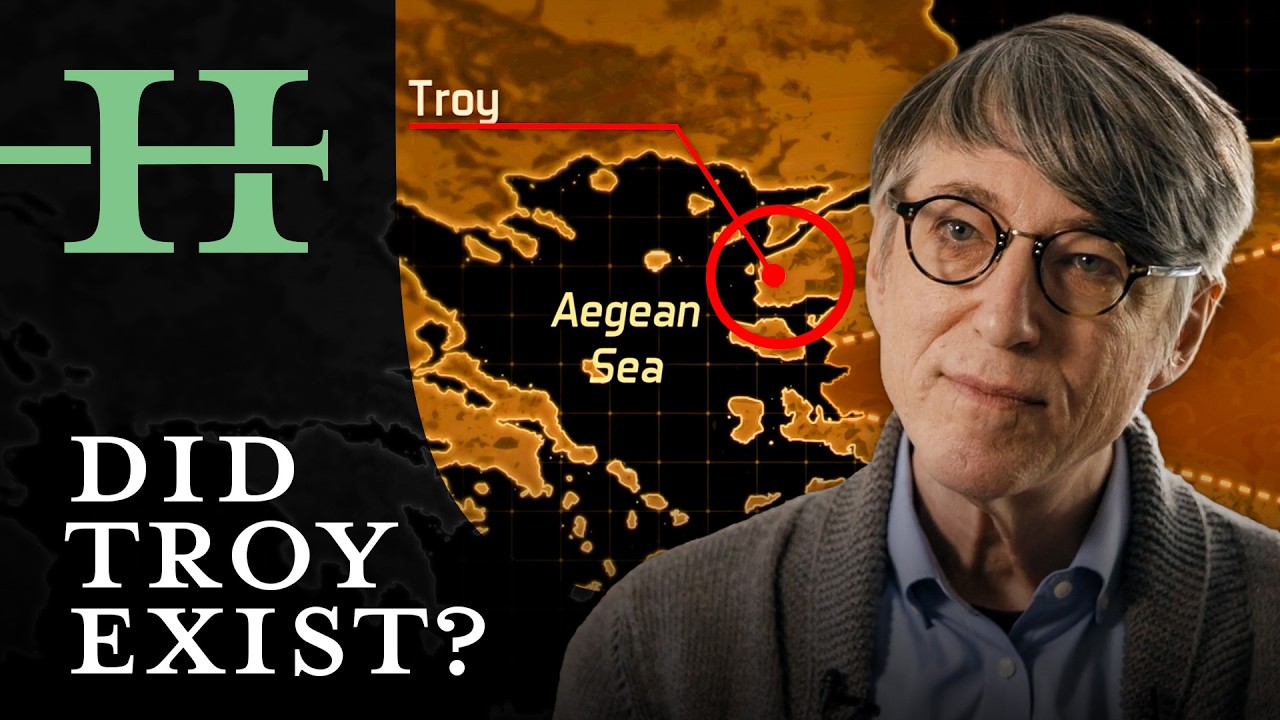
The mystery, however, was whether the ruins themselves were the lost city. The answer began to emerge from a hill called Hisarlik, on the Turkish coastline, where archaeologists had spent a century and a half slicing into the earth to uncover its secrets. The hunt began with a maverick millionaire named Heinrich Schliemann. In 1870, he tore a massive trench into the heart of the mound, digging through layer after layer of ruins in search of the city of King Priam.
He treated the Iliad like a tourist guide, pointing to spots and claiming that Helen had watched battles from them. It was an approach that horrified later archaeologists. In 1873, Schliemann made an astonishing discovery. Buried in the earth, he found goblets, intricate necklaces, and bracelets made of gold and silver.
He photographed his wife wearing the treasures and declared them the riches of King Priam, proof that he had found Homer’s Troy. He was wrong. The layer he had dug into dated to over a thousand years before the Trojan War could have taken place. In his haste to reach what he dreamed of finding, he had thrown away the very level he was searching for.
Later archaeology revealed that the site consisted of at least nine distinct layers of occupation, one city built on top of another, spanning over three thousand years. Wilhelm Dörpfeld, a German architect, made sense of Schliemann’s chaotic excavations and produced meticulous drawings that archaeologists still rely on today. He, and later Carl Blegen, who brought modern methodology to the site in the 1930s, worked to date each layer. Blegen found traces of soot on the stones of a building called Pillar House, evidence of a fire that was later dated to around 1200 BC, the time Homer’s war supposedly took place.
Despite this, huge questions remained. The citadel at Hisarlik was too small to match Homer’s descriptions of a city with thousands of inhabitants. It could only have held a few hundred people. The mystery deepened when archaeologists discovered that the city at Hisarlik had been surrounded by a far greater network of ruins.
During the 1990s, a team using magnetic scanning found a large lower city at the foot of the hill, ten times larger than the citadel. It was filled with tightly packed houses, warehouses, and wells. The Trojans, it seemed, had been prepared for a long siege. Archaeologists found a network of tunnels that brought water from underground springs into the city and huge storage jars, called pithoi, buried up to their necks in the ground, used as Bronze Age refrigerators.
They were ready to survive years of attack, protected by a vast defensive system of a deep trench and embankments, the first line of defense against chariots and soldiers. The key to identifying the site as Troy lay in its name. Roman statues, dedicated to the site by emperors like Hadrian and Augustus, who believed they were descendants of Trojan survivors, referred to the city as Ilium. This was the Latin translation of the Greek name Ilion, another name Homer used for Troy.
Emperor Hadrian himself had visited the city in 124 AD as a kind of pilgrimage, proof that the Romans considered this the legendary site. New avenues of investigation emerged. Scientists dated a total eclipse of the sun mentioned by Homer, calculating that it was visible from the region on April 16th, 1178 BC. This suggested the war, if it happened, occurred during the 13th or 12th century BC.
The Hittite records from the era mentioned a city called Wilusa, ruled by a king named Alaksandu. The city’s name was derived from an archaic version of Ilios, and Alaksandu was another name for Paris, the Trojan prince. The records even described tunnels under the city where water flowed, matching the network found at Troy. Archaeologists found a bronze seal dating to the period, the only written evidence found at the site, linking it to a people called the Hittites.
The investigation into whether the Trojan War truly happened remains open. Carl Blegen discovered slingshot ammunition found carefully arranged in piles at the foot of the citadel walls, suggesting warriors had been stationed there but had abandoned their positions so quickly that they left their weapons behind. Some believe these stones were left by a survivor of the attack. There is no conclusive proof of a single war, but archaeologists agree that the site was the scene of epic battles before it was abandoned, and that there is likely a kernel of historical truth at the heart of Homer’s story.
In Greece, another excavation near the ancient city of Corinth was trying to find evidence of Tenea, a lost city said to have been founded by the last Trojans taken prisoner by the Greeks. The Roman conquerors, who believed themselves descended from Trojan survivors, spared this city when they destroyed the surrounding region. Secrets are still being uncovered, and the hunt for the truth about the Trojan War continues.


