At four in the morning on August 25, 1941, while the world watched the great battles of Europe, Iran was invaded from two sides. British forces crossed the Shatt al-Arab River into the southwest, British and Australian troops pushed in from the west, and Soviet armies rolled down from the Caucasus and Central Asia. Within a week, the country had fallen. The operation was called Operation Countenance, and for the Iranians it came as a complete surprise.
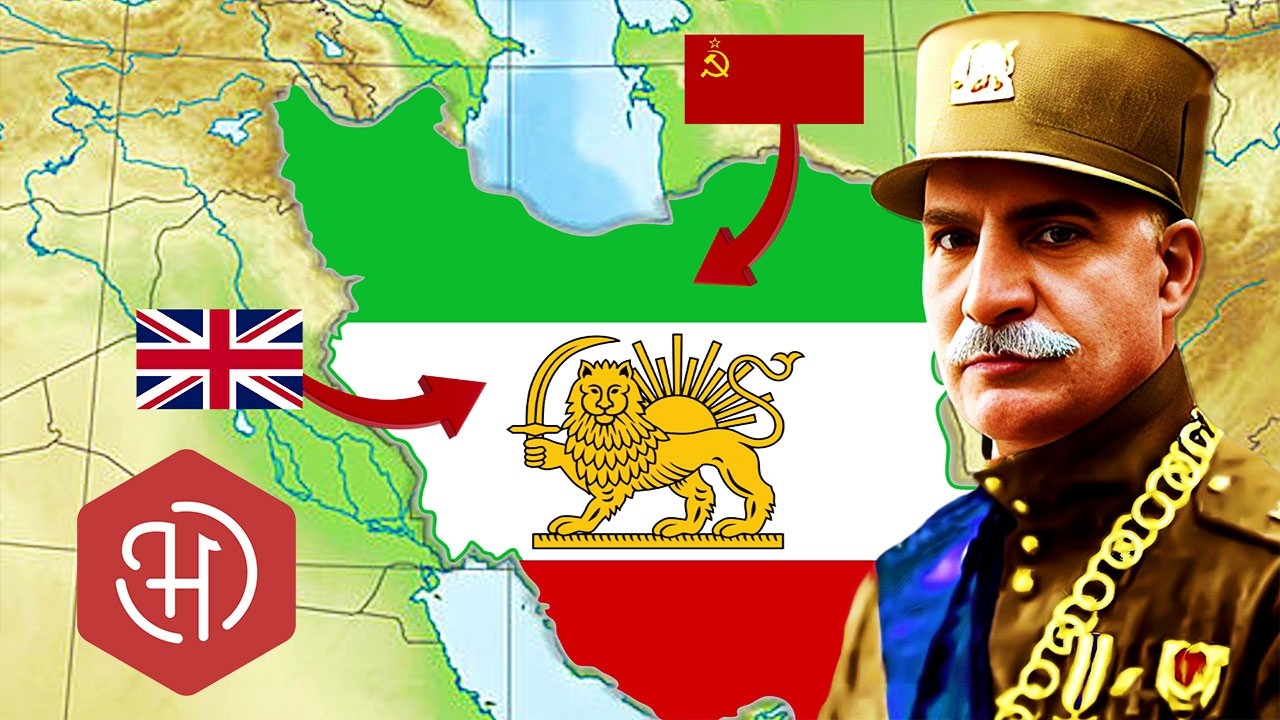
Their army could not mount serious resistance, and the allies met near Kazvin, northwest of Tehran, where they literally shook hands. Iran had officially stayed neutral in the Second World War. That neutrality did not protect it. The ruler, Shah Reza Pahlavi, was forced to abdicate, and his young son Mohammad Reza was placed on the throne in his place.
The British took control of the oil-rich southwest, the Soviets occupied the north, and both powers made use of the strategically vital Trans-Iranian Railway. The invasion did not happen by accident. In the summer of 1941, the Soviet Union, Great Britain, and soon the United States were fighting alongside each other against Nazi Germany. From their point of view, occupying Iran was necessary to keep Germany out.
Before the war, Iran had developed close ties with the Nazis, especially economically. Shah Reza Pahlavi had wanted German trade and technical expertise for his modernization programs. Under his rule, bridges, roads, railways, factories, and communication networks were built. The most prestigious project of all was the Trans-Iranian Railway.
When the war began, hundreds of German engineers, advisers, and technicians were working in the country, and Germany had become Iran’s largest trading partner. The Shah felt far more comfortable cooperating with Germany than with Britain or the Soviet Union. He deeply distrusted those two powers. Germany had never behaved imperially toward Iran or tried to seize its territory.
The same could not be said for Russia and Great Britain. Since the nineteenth century, both powers had taken large parts of the weakened Persian state. Iran was independent on paper, but in reality its sovereignty was often limited. The Treaty of Turkmanchai in 1828 had forced Persia to give up large territories to Russia, including present-day Armenia and Azerbaijan.
In 1907, Russia and Britain secretly divided Iran into two spheres of influence. That foreign interference caused widespread anger. Between 1905 and 1911, the Constitutional Revolution established Iran’s first parliament. But foreign influence remained strong.
British officials undermined the new political developments, and Russian troops eventually crushed the revolution. When the Russian Empire collapsed in 1917, the new Soviet government abandoned its sphere of influence and even revealed the secret 1907 agreement. This earned the Soviets considerable sympathy in Iran. But by the 1930s and 1940s, they were interfering again, even if their influence was never as dominant as Britain’s.
British involvement in Iran went back to the mid-nineteenth century. British companies were granted monopolies, including the tobacco trade. When large oil fields were discovered in the early twentieth century, Britain tightened its grasp. Politicians were bribed, prime ministers were influenced, and through the Anglo-Persian Oil Company, Britain extracted huge profits from Iranian oil.
In the 1920s, Britain even helped Reza Pahlavi seize power and eventually become Shah. Officially, Iran was a constitutional monarchy where power was shared among the Shah, the prime minister, and the parliament. In reality, Reza Pahlavi ruled more and more as an authoritarian. As his modernization program advanced, he tried to reduce British influence while becoming harsher toward his own population.
His popularity dropped. He was inspired by the nationalist ideologies of fascist and militaristic regimes in Germany, Italy, and Japan. Minorities were suppressed, parliament was sidelined, and socialists and communists were persecuted. Some foreign ministers were imprisoned, and several died under suspicious circumstances.
In 1935, Reza Pahlavi officially renamed the country Iran instead of Persia. The name meant “land of the Aryans,” and the choice was connected to the so-called Aryan connection. But this did not mean all Iranians supported Nazi Germany. Only part of the elite felt sympathy toward the Nazis, and that support was not necessarily based on antisemitism.
Many Iranians simply saw Germany as a counterweight to British influence. This sympathy existed even before Nazism rose to power—during the First World War, some Iranians had already backed Germany. As the Second World War progressed, Britain, the United States, and the Soviet Union grew increasingly worried about German influence in Iran. By the summer of 1941, the situation reached a breaking point.
The British demanded that the Shah expel all Germans from the country. When he refused, the Allies launched Operation Countenance. The invasion had other goals too. One of the most important was securing the so-called Persian Corridor, a route through Iran that allowed Britain and the United States to transport enormous quantities of military equipment and supplies to the Soviet Union.
Iran also lay directly between key British territories, including India, Iraq, and Egypt. And Iranian oil was extremely valuable to the Allied war effort. It absolutely could not be allowed to fall into German hands. After the invasion, Iran was forced to cut all ties with Nazi Germany and expel all German citizens.
To reassure the Iranians that the occupation was only temporary, Britain and the Soviet Union declared in 1942 that they respected Iran’s independence and territorial integrity, promising to withdraw their troops no later than six months after the end of the war. That promise was repeated in 1943 during the famous Tehran Conference, where Joseph Stalin, Franklin D. Roosevelt, and Winston Churchill met for the first time to discuss the war against Nazi Germany. But after the war, things turned out differently.
Germany was defeated, and tensions between the Soviet Union and the Western powers quickly surfaced. It soon became clear the Soviets were not planning to leave Iran. They demanded greater freedom for the Iranian Communist Party and prevented Iranian troops from entering the region of Azerbaijan in the northwest. Stalin believed he could easily keep Iran within the Soviet sphere.
He assumed Britain had been severely weakened by the war and that the United States would retreat into isolationism, as it had after the First World War. In March 1946, Western countries began withdrawing their troops from Iran as promised. The Soviet Union barely did. Stalin justified his delays by referring to old agreements and by supporting separatist movements inside Iran.
In November 1945, pro-communist Iranians in the region of Iranian Azerbaijan proclaimed the Azerbaijan People’s Government, attempting to break away. Shortly after, in January 1946, Iranian Kurdish nationalists proclaimed the Kurdish Republic of Mahabad. Iranian troops tried to restore control, but Soviet forces blocked them. The new American president, Harry S.
Truman, repeatedly warned Stalin to honor his promise. Meanwhile, the United States and Britain increased military support for the Iranian government and applied strong diplomatic pressure through the United Nations Security Council. Eventually, in the spring of 1946, Soviet troops finally withdrew. This happened only after Iran offered the Soviets a lucrative oil deal.
Stalin hoped it would allow the Soviet Union to maintain influence in Iran’s oil industry, particularly in the north. Once the Soviets were gone, Iran crushed the separatist governments in Azerbaijan and Mahabad. Stalin’s success was short-lived. In 1947, the Iranian parliament overwhelmingly rejected the proposed oil agreement with the Soviet Union.
Iran felt supported by the United States, which had promised to help the country if the Soviets invaded again. In 1949, the Iranian Communist Party was banned, as it was widely seen as a tool of Moscow and a source of unwanted foreign interference. In the end, Stalin emerged as a major loser of this struggle. The British kept their position in the Iranian oil industry, and the United States gained increasing influence in the country.
Some historians consider this crisis over Iran the first real conflict of the Cold War. The tensions between Washington and Moscow over Iran marked one of the earliest moments the two future superpowers confronted each other directly. Those tensions lasted for years. In 2016, newly released archival documents revealed that the British and Americans had prepared plans to sabotage the Iranian oil industry if the Soviet Union ever attempted to invade again.
For Iran itself, the Second World War was above all a traumatic experience. For decades, the country had sought full independence. Yet despite its neutrality, it was once again occupied by foreign armies. The presence of foreign troops and the heavy demands of the British and Soviets placed enormous strain on the Iranian economy.
As a result, a severe famine struck the country in 1942 and 1943. The exact number of victims remains unknown, but estimates suggest around four million deaths, or possibly more. Another famine had already occurred during and after the First World War, with estimates ranging from two to ten million victims. Despite these hardships, the occupation produced unexpected changes.
The parliament gained more political freedom, and the power of the Shah weakened. The new Shah, Mohammad Reza Pahlavi, was young and inexperienced, and he constantly feared he might be forced to abdicate just like his father. During this period, Iranian political and social life flourished. New political parties emerged, newspapers appeared, and numerous social organizations were founded.
At the beginning of the 1950s, a new political figure rose to prominence: Mohammad Mossadegh. He was a nationalist with liberal ideas and had held several political positions since the 1920s. In April 1951, parliament elected him prime minister. He once again tried to strengthen Iran’s independence, and his most important step was the nationalization of the Iranian oil industry.
But that decision would have enormous consequences. In 1953, the United States organized a coup against Mossadegh. He was removed from power, and the Shah’s authority was strengthened. That development would indirectly contribute to the Iranian Revolution of the late 1970s.
Iran, however, was not the only country invaded by the British during the Second World War. Iraq experienced a similar fate.