The words cut through the low hum of the room, sharp and deliberate. Richard Reed didn’t bother lowering his voice. “Are you still playing doctor in the military? I suppose someone has to hand out the band-aids.
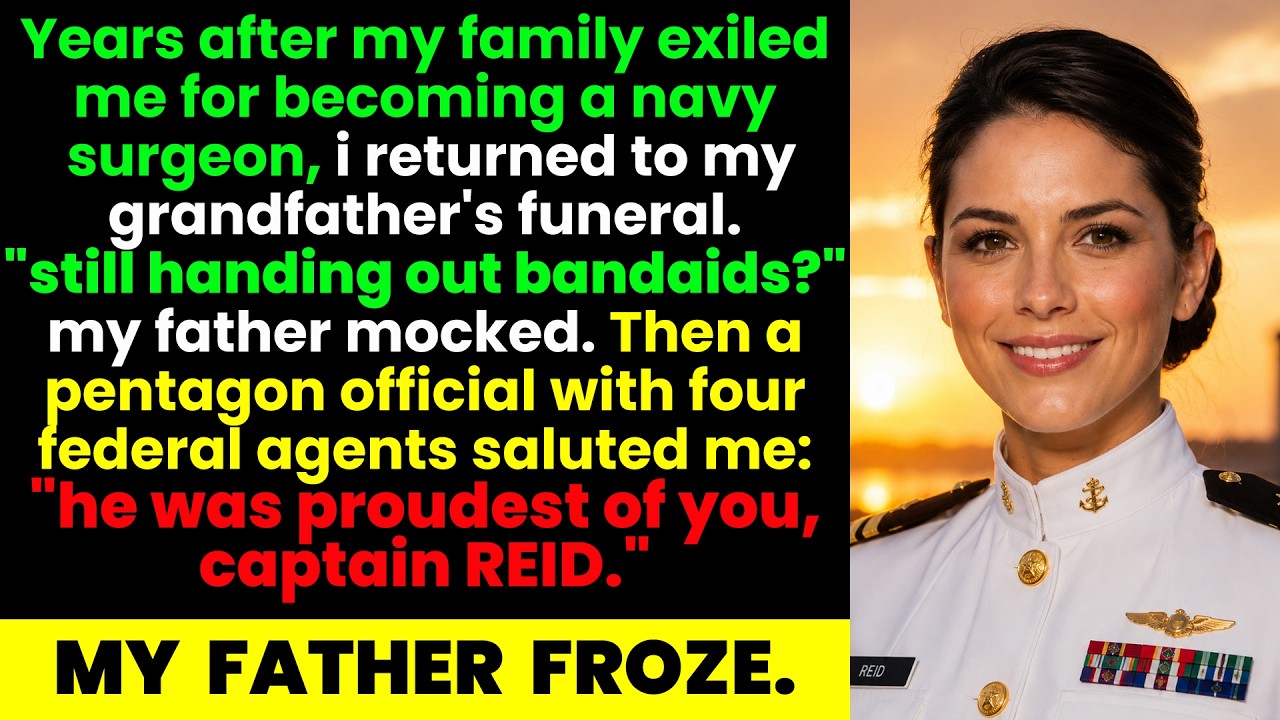
” He stood in the center of the expansive living room, rolling a heavy crystal glass of bourbon between his palms. I didn’t blink. I didn’t shift my weight. I simply stood at parade rest, my hands clasped loosely behind my back.
The heavy wool of my navy dress blues felt rigid in the climate-controlled air of the estate. This was supposed to be my grandfather’s funeral. General Raymond Reed, a man who commanded armies and bled for this country. Instead, within hours of him being put in the ground, his sprawling Virginia mansion had been transformed into a Wall Street trading floor for defense contractors.
Richard, my father, flashed a practiced plastic smile at a passing senator, turning his back to me completely. Dismissal. Total and absolute. A second later, Linda, my stepmother, drifted past.
She wore a black designer dress that probably cost more than a junior enlisted sailor made in six months. Her eyes slid right past my shoulder, the polite ignoring. She looked at me the same way she looked at a scuff mark on the baseboards. An inconvenience she chose not to acknowledge.
I kept my mouth shut. I let my eyes do the work. The military hardwires you to scan a room. You don’t just look at people.
You assess them. You look for the exits. You look for the threats. The room smelled heavy.
An expensive, suffocating mix of Tom Ford cologne and the stale burnt odor of Cuban cigars. I scanned the men in the dark tailored suits laughing in the corners. The vultures. Washington elites, lobbyists, and weapons manufacturers.
None of them knew how to pack a chest wound. None of them knew what burning diesel and charred flesh smelled like. But right now, over plates of smoked salmon and expensive scotch, they were pricing out the lives of nineteen-year-old kids, turning American blood into profit margins. I looked back at Richard.
He was laughing, but I saw the beads of sweat forming at his hairline. I watched the rapid shallow rise and fall of the chest of the lobbyist standing next to him. They were stressed, desperate for the next contract. I took a slow breath in through my nose, counted to four, held it for seven, exhaled for eight.
I forced my heart rate down. Cold control. Then came the heavy dragging footsteps on the Persian rug. Daniel, my younger brother, walked with the loose-limbed swagger of a man who had never been punched in the mouth.
He had a trust fund, a sports car, and a severe alcohol problem he called social drinking. He stopped two feet in front of me. The smell of day-old liquor and mints radiated off his breath. He shoved one hand deep into his tailored slacks.
With the other, he pointed a manicured finger directly at the stack of colorful ribbons pinned to my chest. “So, what are you now anyway? A lieutenant captain? ” He spat the words, a sneer plastered across his face.
I locked my jaw. I looked at the dark circles under his eyes, the slight tremor in his hand. Weakness. “Navy captain,” I said.
Two words. Flat, hard, and sharp. Daniel froze for a fraction of a second. He hated that tone.
The tone that didn’t ask for permission. He rolled his eyes hard and let out a wet snort. “Right. In the medical corps, playing dress-up soldier.
Must be real tough work. ” He tilted his glass. A splash of amber liquid and a half-melted ice cube hit the floor, splattering directly against the polished toe of my black uniform boot. I didn’t flinch.
I didn’t look down. I just stared a hole straight through his skull. Across the room, the domestic staff began pulling out the high-backed leather chairs around the long mahogany dining table. The catering crew was serving dinner.
I watched the guests take their places. Richard, Linda, Daniel, the senators, the contractors. I counted the chairs. Nine.
There was no chair for me. There was no place card with the name Reed that didn’t belong to the inner circle of the business. I was pushed out, exiled to the perimeter. I stepped back, letting my shoulder blades press against the cold plaster of the wall near the hallway arch.
The shadow of the room. A glorified bouncer at my own grandfather’s wake. I slipped my right hand into my trouser pocket. I rubbed my thumb over the side of my index finger.
The skin there was thick, dead, and calloused. An ugly yellowish ridge of scar tissue. You don’t get a callous like that from holding a pen or signing checks. You get it from pulling nylon combat tourniquets so hard they bite through your gloves.
You get it from trying to stop a hemorrhage in the dark while the ground shakes. I had stood my ground in a canvas medical tent in Kandahar. I had operated for forty hours straight with mortar shells screaming over the roof, shaking dirt into open chest cavities. I didn’t break then, but standing here in this quiet chandelier-lit room, my lungs felt tight.
The suffocation of being entirely invisible to the people who shared my blood. Daniel wasn’t finished. He slid into his leather chair at the table, picking up a fresh drink. He looked across the room, locking eyes with me.
He saw me standing against the wall, isolated, quiet. He mistook my silence for submission. He opened his mouth, his lips curled into a vicious little smirk, drawing in a breath to deliver another alcohol-soaked punchline for his audience of defense contractors. He never got the words out.
The heavy oak double doors at the front entrance blew open. The sound cracked like a rifle shot through the quiet hum of the room. A pair of hard leather heels slammed against the hardwood floor in the foyer. A heavy rhythmic marching step that did not belong in a civilian house.
The clinking of silverware stopped. Richard’s glass froze halfway to his mouth. Daniel snapped his jaw shut. The temperature in the room plummeted.
Something else had just walked through that door. Four men stepped through the entryway. They did not look like the defense contractors or the Washington lobbyists currently stuffing their faces with smoked salmon. They wore dark tailored suits, but the cut of the fabric hid the distinct bulge of shoulder holsters.
They moved with mechanical efficiency, fanning out, their eyes scanning the room with cold clinical detachment. Federal agents. The real deal. They didn’t speak.
They didn’t have to. They simply cleared a path. Then Thomas Whitaker walked through the door. The deputy secretary of defense.
He was a massive man built like a cinder block with close-cropped gray hair and a face that looked like it had been carved out of granite. He didn’t walk. He marched. Every step was deliberate, carrying the immense crushing gravity of the Pentagon.
The shift in the room was violent. The arrogant, relaxed posture of the billionaires and politicians vanished. Spines snapped straight. Throats were cleared nervously.
Richard reacted first. Panic flashed across his face. This was a man who measured his self-worth in government contracts, and the second-in-command of the entire United States military had just walked into his living room unannounced. Richard practically threw his glass of bourbon onto a side table.
The amber liquid sloshed over the rim, staining the polished wood. He didn’t care. He frantically smoothed the lapels of his suit, wiping his slick, sweaty palms on his trousers. He pasted on a wide, hungry smile, the smile of a salesman about to close the deal of his life.
He stepped directly into Whitaker’s path, thrusting his right hand out. “Mr. Secretary,” Richard said, his voice loud, carrying a desperate chord of fake warmth. “What an absolute honor!
I am Richard Reed. We are so—”
Whitaker did not break his stride. He did not look at Richard’s face. He did not look at Richard’s outstretched hand.
He simply walked past him. He treated my father the same way you treat a telephone pole on the sidewalk. You don’t acknowledge it. You just step around it.
Richard froze. His hand hung suspended in the empty air. The fake smile cracked, sliding off his face like wet mud. The public humiliation was absolute.
A physical gut punch delivered without a single word. Around the dining table, the other contractors looked away, suddenly finding their shoes extremely interesting. Whitaker kept moving straight toward the back wall, straight toward the corner where they had exiled me. He stopped exactly two feet in front of me.
The silence in the room was so heavy it felt like water pressure in my ears. I didn’t move. I kept my back straight, my hands clasped loosely behind my back. Whitaker looked at me, his hard eyes locked onto mine.
He didn’t offer a handshake. He didn’t offer a polite civilian greeting. He pulled his right foot in. The hard leather heel of his shoe struck the floorboard with a sharp, violent crack.
His right arm snapped up. The motion was a blur of dark fabric. His fingers were perfectly straight. His thumb tucked tight along the edge of his index finger.
The tip of that finger stopped exactly at the outer corner of his right eyebrow, cutting a flawless forty-five-degree angle through the air. A high-level textbook military salute. My body reacted before my brain processed the command. Muscle memory forged in blood and dirt kicked in.
My heels slammed together. My spine locked, bone straight. My right hand snapped up to the brim of my cover in a mirror image of his gesture. We stood there, two soldiers completely ignoring the room full of millionaires, politicians, and bloodsuckers holding their breath around us.
Out of the corner of my eye, I saw Daniel. He actually took a physical step backward, stumbling slightly against the edge of the dining table. His mouth hung open in dumb, slack-jawed shock. The glass of liquor he had used to mock me a minute ago was trembling in his hand.
Richard looked like he had swallowed crushed glass. The muscles in his jaw were locked tight. His face had gone pale, all the blood draining out of his cheeks. Whitaker dropped his arm, cutting the salute sharply down to his side.
I dropped mine. “Captain Reed,” Whitaker said. His voice was a low, heavy rumble that carried into every corner of the dead-silent room. “Sir,” I replied, flat, controlled.
Whitaker held my gaze. He didn’t look back at my family. He didn’t need to. “The men you pulled back from the dead in Kandahar,” he said, his words slow and deliberate.
“They still say your name. ” He leaned forward just a fraction of an inch. He raised his voice just enough to make sure the words bounced off the walls and hit Richard right in the chest. “General Reed was proudest of you out of this whole damn family.
”
It was a death sentence. An execution carried out in plain clothes. He didn’t yell. He didn’t curse.
He just dropped the absolute unfiltered truth onto the hardwood floor and forced them to choke on it. The power dynamic in the room didn’t just shift. It was ripped out of Richard’s greedy hands and placed entirely into my calloused ones. I didn’t smile.
I didn’t look at Daniel to gloat. Gloating is for amateurs. It’s for people who need external validation to know they matter. I already knew what I was worth.
“Thank you, sir,” I said. I stepped away from the wall. I didn’t look at my father or my stepmother. I walked past the dining table, past the empty space where my chair should have been, and headed straight out into the quiet hallway.
The air was cooler out here. It didn’t smell like cheap perfume and desperation. Three seconds later, I heard the frantic squeak of leather shoes on the hardwood. Richard.
He practically threw himself through the archway. His face flushed a dark angry red. The veins in his neck stood out like thick cords. The polished CEO mask was entirely gone, replaced by raw, naked panic.
He needed to know how I had bypassed his entire social ladder. “Kira,” he hissed, his voice tight, glancing nervously back over his shoulder to make sure the guests couldn’t hear him. “How the hell do you know Thomas Whitaker? ”
I stopped.
I didn’t turn around to face him completely. I just looked back over my shoulder, staring at his sweat-slicked forehead. “You meet them on someone’s worst day,” I said. My voice was as sharp as a scalpel.
Before Richard could open his mouth to demand an actual answer, heavy footsteps echoed behind him. Whitaker stepped into the hallway. Richard immediately shut his mouth and took a quick step back, shrinking against the wallpaper. Whitaker ignored him again.
He walked up to me and reached into his coat pocket. He pulled something out and pressed it firmly into the palm of my right hand. “The general wanted you to have this,” Whitaker said quietly. “Not the estate, not the money, just this.
”
He gave me a single stiff nod, turned on his heel, and walked out the front door, his security detail trailing right behind him like shadows. I stood alone in the hallway, leaving Richard breathing heavily against the wall. I looked down at my hand. Sitting in the center of my palm was a battered, scratched silver Zippo lighter.
The metal was freezing cold. The casing was dented on the left side, scarred by years of hard use. I closed my fingers around it. The heavy solid weight of it grounded me.
I pushed my thumb against the lid. It popped open with that distinct hollow metallic clink. I dragged my thumb down hard against the flint wheel. The mechanism caught.
A bright spark bit into the air. But the flame didn’t stay small. The spark flashed. Blind searing white light exploded behind my eyes.
The smell of Tom Ford cologne vanished instantly, replaced by the thick, suffocating stench of burning diesel and raw copper blood. The quiet hallway shattered into a deafening roar. I wasn’t in Virginia anymore. The spark from the Zippo flared bright white, and suddenly the mahogany-paneled hallway of the Virginia estate burned away.
The low hum of central air conditioning vanished, replaced by a deafening mechanical roar. My ears popped. The ground beneath my boots jerked upward, vibrating hard enough to rattle my teeth. Kandahar, 2018.
The heat hit me first, thick, wet, and suffocating. The air inside the forward surgical tent sat at one hundred and twelve degrees. Sweat ran down my forehead, stinging my eyes, pooling in the heavy rubber edge of my surgical mask. I didn’t wipe it.
My hands were slick with it. Not just sweat. Blood. Thick, dark, and hot.
I stood over a collapsible metal operating table. The canvas walls of the tent shook violently as another mortar shell slammed into the earth a quarter mile out. Dust rained down from the ceiling light, speckling the sterile drapes covering the chest of the soldier in front of me. Forty-three hours.
I had been awake cutting and sewing for forty-three hours straight. There was no time to sit, no time to eat, no time for fear. Just the brutal mechanical rhythm of keeping people breathing when their bodies were trying to give up. The tent reeked of a toxic, stomach-turning cocktail of industrial bleach, raw copper, and the undeniable stench of open bowels.
My fingers clamped hard around a heavy steel scalpel. I dragged the blade down, making a fast, deep incision to expose a piece of shrapnel wedged tight against a collarbone. The metal clinked against the clamp. “More suction,” I ordered.
My voice sounded thin and raspy, like dry sandpaper. My mind slipped backward, a cruel glitch in focus. Just six hours before this body was put on my table, I had stood outside in the dark, sucking down lungfuls of dust and exhaust fumes. I had the SAT phone pressed hard against my ear, trying to block out the noise of a Blackhawk spooling up on the tarmac.
The connection was garbage. A heavy rhythmic static hissed through the speaker, but Tom’s voice cut through it just fine. Flat, even, completely detached. “I didn’t even think you were still alive over there, Kira.
”
I leaned against a concrete barrier, closing my eyes. “Tom, we took incoming all morning. The comms were down. I couldn’t call.
”
“It doesn’t matter anymore. ” A long pause, just the static buzzing in my ear. “I signed the papers. ”
The words didn’t register at first.
My brain was too tired, too wired on adrenaline and cheap instant coffee. “What papers? ” I asked. “The divorce papers, Kira.
It’s done. I’m done. ”
The call lasted exactly three minutes. A beep sounded loud and sharp, signaling the dropped connection.
I pulled the heavy plastic receiver away from my ear. I stared at the dark, empty desert line. I didn’t cry. I didn’t scream.
I just stood there in the wind. I lifted my left hand. My fingers were stiff and swollen from the heat. I grabbed the plain gold band on my ring finger, twisted it hard, and pulled it off.
The metal was caked in fine brown dust. I unzipped the top pocket of my scrubs and dropped the ring inside. It landed with a dull thud against my chest. I turned around, walked to the scrub sink, pumped iodine soap onto my forearms, and went back to work.
In the military, you don’t get the luxury of grieving your own life. You just keep cutting. The memory snapped. The blast of a nearby siren dragged me violently back to the operating table.
The tent flaps tore open. Two medics rushed in carrying a stretcher. They were shouting, their voices hoarse and desperate, overlapping each other. “Incoming!
Severe trauma! Watch your backs! ”
I stepped away from my table, letting the backup surgeon take over. I stripped my bloody gloves off, throwing them onto the concrete floor, and snapped a fresh pair on.
They slammed the stretcher down onto the empty bay next to me. Private first class Tyler Mercer. Nineteen years old. He didn’t look like a soldier.
He looked like a kid who should be working a summer job at a hardware store in Ohio. His face was chalk white. His lips were entirely bloodless. “Status!
” I yelled, pushing a medic aside to get to his legs. “Blast shrapnel tore through the right thigh, severed the femoral artery. ” Mercer was thrashing, his eyes wide, blind with panic. He was bleeding out fast.
Dark arterial blood pulsed out of the massive jagged wound on his leg in heavy rhythmic spurts, soaking through the canvas stretcher and pooling onto the floor around my boots. “Get a tourniquet now,” I barked. A medic slapped a brand-new vacuum-sealed trauma kit into my hand. I ripped the plastic open with my teeth.
I pulled the black nylon strap out, looping it high and tight around Mercer’s thigh just above the massive tear in his flesh. I grabbed the heavy plastic windlass rod. I twisted it hard. The nylon bit deep into his muscle.
“Hold him down,” I ordered. I put my entire weight into the twist, cranking it another half turn to crush the artery against his femur and shut the blood flow off. Crack. The sound was sharp, brittle, and sickening.
The thick plastic locking clip snapped in half. The tension on the strap released instantly. The rod spun backward, hitting my wrist. The nylon loosened.
The blood erupted. It didn’t just leak. It sprayed, soaking the front of my scrubs, covering my hands in a hot, slick mess. “No!
God damn it! No! ” I roared. I threw the broken pieces of the plastic lock onto the floor.
I dropped to my knees, driving both of my bare, bloody hands directly into the open wound. I found the severed end of the femoral artery with my thumbs and pushed down with every ounce of strength I had left in my body. “Clamp! Give me a damn hemostat!
” I screamed without looking up. Mercer stopped thrashing. His body went terrifyingly still. His head lolled to the side, his eyes fixing on the ceiling.
“Stay with me, Mercer. Do not close your eyes. You hear me? Keep them open.
” He didn’t blink. The monitor behind me started screaming a long continuous high-pitched tone. I kept pushing. My shoulders burned, my hands cramped, locking up from the pressure.
I poured my entire body weight into his leg, trying to act as a human tourniquet. “I need a clamp,” I yelled again, my voice cracking. A hand grabbed my shoulder. Heavy, firm.
“Doc, let it go. ”
I looked up. The senior medic was standing over me, shaking his head slowly. “Time of death,” he said quietly, looking at his watch.
“14:43. ”
I stared down at my hands. They were buried in the torn flesh of a nineteen-year-old kid. My fingers were freezing cold.
The blood on my skin was already starting to cool. Forty-three minutes. That was all it took. I looked at the floor.
Lying in the puddle of Mercer’s blood were the two broken halves of the black plastic locking clip. A cheap, defective piece of equipment. The roaring of the tent faded. The smell of copper and bleach thinned out.
The freezing cold of my hands remained, but the blood was gone. I blinked. I was standing in the quiet, air-conditioned hallway of my grandfather’s Virginia estate. The heavy silver Zippo lighter was still clutched tightly in my right hand.
The metal felt rough against my calloused thumb. The profound, bone-deep exhaustion settled back into my spine. My chest felt hollow. A sharp metallic click broke the silence.
At the end of the hallway, the heavy oak doors to my grandfather’s private study unlocked. The family lawyer, a thin man in a gray suit, pushed the doors open. He looked down the hall, his face entirely unreadable. “If everyone could gather inside, please,” the lawyer called out, his voice echoing slightly in the vast house.
“We will begin the reading of the will. ”
I slipped the Zippo into my pocket. I locked the memory of Kandahar back into the dark, silent box in my head. I walked toward the study, my face a blank mask of discipline.
I stepped into the room entirely unaware that the biggest explosive device of my life had already been armed, and the pin was about to be pulled right here on American soil. The air inside General Raymond Reed’s private study was thick and suffocating. It smelled like old pinewood, expensive leather polish, and the stale, sour linger of half-smoked cigars. The room felt less like a place of business and more like a sealed tomb.
Richard sat right in the center of it all. He occupied the massive high-backed leather chair behind the general’s desk, his fingers interlaced tight across his stomach. He was already playing the part of the new patriarch, claiming the throne before the dirt on the grave had even settled. Daniel stood in the far corner of the room, his legs crossed at the ankles, swirling a fresh glass of amber liquor.
A lazy, arrogant smirk rested on his face. I did not take a seat. I stood near the heavy oak doors, my spine locked straight, refusing the only empty chair left in the room. Mr.
Vance, the family lawyer, sat at the edge of the desk. He was a thin, graying man who moved with the mechanical stiffness of a clockwork toy. He cleared his throat, turning over the heavy cream-colored pages of the last will and testament. “We have reached the final clause,” Vance said.
His voice was flat, carrying absolutely zero emotion. “Regarding the Reed Veterans Foundation. ”
Richard leaned forward slightly. The leather chair squeaked under his weight.
He smelled the money. Vance looked down at the paper. “I leave absolute controlling interest and full executive direction of the Reed Veterans Foundation to my granddaughter, Captain Kira Reed. ”
The words dropped into the quiet room like a live stun grenade.
Daniel snapped first. He pushed off the wooden bookshelf so hard his drink sloshed over the rim, staining the expensive Persian rug. “What? ” Daniel spat, his face twisting into an ugly red knot.
“That fund is a money wash—I mean, it belongs to the family company. ”
Richard locked his jaw. The veins in his neck pushed hard against his white collar. He stood up abruptly, slapping both palms down flat on the pine desk.
The wood groaned under the sudden violent weight. “Out of the question,” Richard said. His voice was loud, vibrating with a sudden naked panic. “She knows absolutely nothing about the defense business.
That foundation holds major equity. It is a corporate asset. You cannot hand it over to a woman who spends her days handing out gauze. ”
Vance did not flinch.
He did not look intimidated. He slowly reached out and closed the heavy leather binder. The metal rings snapped shut with a sharp, cold clack. “It is not a corporate asset, sir,” Vance replied, his tone chillingly polite.
“And it belongs exactly where the general decided it belongs. ”
Vance stood up. He walked right past Richard’s desk. He did not ask for permission.
He stopped directly in front of me and reached into his inner jacket pocket. He pulled out a thick envelope. It was sealed on the back with a heavy drop of dark red wax. “He asked me to give this to you in private, Captain,” Vance said quietly.
I took the envelope. I turned around and walked out of the study, pulling the heavy oak doors shut behind me. The brass latch clicked into place, locking the screaming match inside. The hallway was completely silent.
The only sound was my own slow, measured breathing. I looked down at the envelope. I ran my calloused thumb over the red wax. I pressed down hard.
The seal broke with a dry, crisp tear. I pulled out a single sheet of heavy paper. The handwriting was shaky, written by an old man who knew he was running out of time. “Kira, I was a coward.
I stayed quiet to protect the family name. I thought I could fix it quietly from the inside. I was wrong. I am sorry.
”
My eyes moved down to the next paragraph. “Your father, Richard, signed the final approval. He bribed procurement officials at the Pentagon to push the defective RDS40 plastic tourniquets to the front lines in Kandahar. He knew the locking clips were brittle.
He knew they would fail under heavy pressure. He did it to widen his profit margin by three cents a unit. I’ve already handed the financial evidence over to the Department of Defense. ”
My pupils dilated.
The air in the hallway completely vanished. A sudden violent wave of physical nausea rose up in the back of my throat. It tasted like copper and battery acid. My fingers dug so hard into the paper that the edges crumpled.
The memory exploded inside my brain. The sharp, brittle crack of the plastic locking clip snapping in half under my hands. The sudden horrifying release of tension on the nylon strap. The hot, dark blood spraying across the front of my surgical scrubs.
The dead weight of Private Tyler Mercer on the canvas operating table. Nineteen years old. He did not die because of enemy mortar fire. He did not die because I failed to hold the artery.
He died because my father wanted a bigger year-end bonus. The blood that soaked into the desert sand in Kandahar did not belong to the war. It belonged to Richard Reed. He had put a price tag on a young American life and he had sold it for pennies.
My father had turned my operating table into a slaughterhouse. My breathing stopped completely. The shock burned away. The profound suffocating grief burned away.
Every single trace of human empathy I had left for the people inside that study evaporated, leaving nothing behind but pure freezing ice. The brass handle of the study door turned. The heavy hinges creaked. Richard poked his head out into the hallway.
His face was pale. The heavy sweat had returned to his forehead, shining under the overhead lights. He looked at the paper in my hands. His eyes narrowed, sharp and probing, like a rat cornered in a dark alley.
“What did your grandfather write to you? ” Richard asked. He forced his mouth into a stiff, terrifyingly fake smile. I did not scream.
I did not throw a punch. I did not say a single word to him. I slowly folded the thick paper in half. I ran my thumb along the crease, making it sharp.
Then I folded it in quarters. I reached up and slid the letter into the breast pocket of my uniform, right over my heart. I raised my head. I looked directly into Richard’s eyes.
I was no longer looking at my father. I was looking at a hostile target. I walked back into the living room. The heavy oak doors shut behind me, completely silent this time.
The atmosphere in the room was completely different now. The tension from Whitaker’s brief appearance had faded. The defense contractors and politicians were back to doing what they did best: drinking expensive alcohol and patting each other on the back. Richard was standing near the fireplace.
He held a fresh glass of bourbon high in the air, a wide, charismatic smile plastered across his face. He was about to deliver a toast. Probably something empty about family legacy and patriotism. I didn’t let him start.
“How much does a nylon tourniquet cost, Richard? ” My voice wasn’t loud. I didn’t yell, but the tone was absolute zero. It cut through the low hum of conversation like a razor blade.
The room went dead silent. Dozens of heads turned in my direction. Richard lowered his glass, his thick eyebrows pulled together, forming a deep crease above his nose. He forced a short, dismissive laugh, trying to play to the crowd.
“Kira, I think you’ve had too much to drink. Maybe you should head upstairs. ”
I didn’t stop. I walked straight toward him.
The heavy rubber soles of my uniform boots made absolutely no noise on the thick Persian rug, but I could see the panic starting to crack his public mask. I stopped exactly three feet away from him. Close enough to smell the mint on his breath. Close enough to see the sudden rapid pulse beating in the side of his neck.
“Private first class Tyler Mercer,” I said. Flat, clinical. “Nineteen years old. Died on my operating table from massive blood loss.
” Richard’s face tightened. The fake smile vanished. “The plastic locking clip on his tourniquet snapped in half. Batch code RDS40.
Signed for and authorized by Reed Defense Solutions. ” I locked my eyes onto his. “Authorized by you. ”
The blood drained out of Richard’s face.
He looked like a man who had just stepped off a ledge and was waiting to hit the concrete. “You’re crazy! ” Daniel yelled. He shoved past two lobbyists, smelling like cheap cologne and bad decisions.
His face was bright red, flushed with alcohol and sudden violent anger. “Are you out of your mind? ” Daniel spat, closing the distance between us. “You’re going to stand here in front of these people and slander our own company, slander this family.
” He reached out his hand, snapping forward to grab the collar of my dress blues. He never made contact. I shifted my weight back half a step, bringing my left forearm up in a short, sharp block. I knocked his hand away effortlessly.
The sudden deflection threw him completely off balance. He stumbled forward, catching himself awkwardly against the edge of a heavy armchair. I didn’t raise my fists. I didn’t need to.
I just looked down at him. “You always knew exactly what this family was, Daniel,” I said. My voice was dangerously quiet. “But you hid behind the liquor and that loud mouth because you have never had the guts to do a single hard thing in your entire life.
”
Daniel froze. His jaw worked silently, opening and closing like a fish on the deck of a boat, but no sound came out. The humiliation completely paralyzed him. Around us, the crowd of millionaires physically backed away.
The Washington elites, the power brokers, they recognized a sinking ship when they saw one. And right now, the Reed family was taking on water fast. They scrambled backward, creating a wide, empty circle around the three of us. Richard stared at me, his chest heaving.
The panic in his eyes morphed into pure cornered desperation. “You are destroying this family,” Richard hissed through his teeth. His voice a ragged whisper meant only for me. “No,” I replied, my face completely blank.
“I just decided to stop covering for it. ”
Footsteps echoed from the hallway. Hard, rhythmic. Thomas Whitaker stepped back into the living room.
He was not alone this time. Two men wearing dark blue windbreakers followed right behind him. The bold yellow letters on the backs of their jackets caught the harsh glare of the chandelier. FBI.
The silence in the room became toxic. You could hear the faint high-pitched whine of the refrigerator running in the kitchen two rooms away. Whitaker walked past the shrinking crowd of contractors. He stopped right next to me, his massive frame casting a long shadow over Richard.
“Richard Reed,” Whitaker said, his voice heavy, carrying the full crushing weight of the federal government. “I highly suggest you exercise your right to remain silent. As of five minutes ago, the Department of Defense has frozen all financial assets tied to Reed Defense Solutions. The bureau is currently executing search warrants on your corporate offices.
”
Richard’s mouth fell open. He looked at Whitaker, then at the federal agents, his eyes darting frantically around the room. “This is a political hit job! ” Richard shouted, his voice cracking, completely losing control.
“You have no proof. You have absolutely nothing on me. ”
Whitaker didn’t blink. He just stared down at my father with the cold, dead eyes of a man who had seen worse men try to lie their way out of hell.
“No, Richard,” Whitaker said flatly. “This is just math. ”
One of the agents stepped forward. He reached for Richard’s arm.
Daniel panicked. He lunged off the armchair, throwing a wild, sloppy punch at the second federal agent. The agent didn’t even flinch. He sidestepped the punch, grabbed Daniel by the back of the neck, and slammed him face-first down onto the hardwood floor.
The sound of Daniel’s nose breaking cracked loudly across the room. He let out a muffled, pathetic groan. His cheek smashed flat against the oak planks. The agent dropped his knee hard into Daniel’s spine, pinning him down.
The metallic ratcheting sound of heavy steel handcuffs locking into place echoed sharply. Click, click, click. Richard didn’t fight. He just stood there completely frozen.
The heavy crystal glass slipped out of his sweaty, trembling fingers. It hit the marble tile framing the fireplace and shattered. Amber bourbon splashed across the pristine white stone, glittering like broken glass in the light. An agent grabbed Richard by the bicep, spinning him around roughly to secure his wrists behind his back.
The high-society crowd scattered. The lobbyists, the politicians, the men who had been shaking Richard’s hand ten minutes ago now pressed themselves against the walls, desperately trying to avoid getting caught in the blast radius of a federal indictment. They treated the Reed family like a highly contagious disease. I took a slow step backward.
I watched the agents haul Daniel off the floor by his arms. Blood ran down his chin, dripping onto the lapel of his expensive suit. I watched them march Richard toward the front door. His head hung low, his shoulders completely slumped.
The arrogant defense contractor was gone. All that was left was an old, desperate man in handcuffs. I didn’t smile. I didn’t feel a rush of victory.
I didn’t feel anything at all. The objective was neutralized. The threat was eliminated. I turned around, leaving the shattered glass and the ruined legacy behind on the floor.
I walked toward the back door of the estate, stepping out into the cool, dark Virginia night without looking over my shoulder a single time. Six months later, the wind cutting across Arlington National Cemetery was sharp, freezing, and completely indifferent. Row after row of identical white marble headstones stretched out across the rolling green hills, standing in perfect silent formation under a pale gray sky. It was the kind of cold discipline that didn’t end when the heart finally stopped beating.
I stood alone in front of General Raymond Reed’s grave. I held a small, cheap bouquet of white chrysanthemums wrapped in brown paper. I didn’t wear my navy dress blues today. No ribbons, no medals.
Just a heavy canvas jacket, a plain gray shirt, and worn denim jeans. The corporate defense empire Richard built on top of this old man’s legacy was gone. Smashed to pieces by federal indictments, asset freezes, and ruthless Pentagon audits. Richard was currently sitting in a concrete holding cell, waiting for a federal judge to hand down a sentence that would ensure he died behind bars.
Daniel was broke, cut off from the trust funds, his sports cars repossessed, forced to live out of a roadside motel, while the lawyers picked the bones of the company clean. I stepped off the paved walkway. My boots crunched against the frost-covered grass. I dropped the white flowers at the base of the headstone.
I took my hands out of my jacket pockets. I reached out, pressing my bare, calloused fingertips against the freezing white marble. The stone bit into my skin. “You messed everything up, old man,” I muttered.
My voice was quiet, caught by the wind, and carried away over the endless rows of the dead. “You stayed quiet when you should have screamed. ”
I let my hand drop to my side. I stared at his name carved into the rock.
But I forgive you. I didn’t say it for him. He was dead. I said it for me.
I felt the heavy suffocating weight I had been carrying in my chest for years finally crack open. The thick defensive armor I wore just to survive my own bloodline hit the dirt. I didn’t hate them anymore. I didn’t feel anything for them.
They were just strangers. I turned my back on the grave and walked back down the path. I didn’t look over my shoulder. I was done with ghosts.
Two days later, the military terminal at Baltimore/Washington International Airport smelled exactly the same as it did a decade ago. Industrial floor wax, stale black coffee, and the thick, unmistakable stench of jet fuel seeping in through the heavy glass doors leading out to the tarmac. I sat on a hard plastic chair near gate B. My olive drab duffel bag sat on the scuffed linoleum floor between my boots.
I held a Styrofoam cup of cheap black coffee in my right hand, letting the heat bleed through the thin material and seep into my skin. The terminal was loud, a steady, chaotic hum of combat boots, rolling luggage, and PA announcements. Troops moving out. Families saying goodbye.
I watched the crowd with the idle, sweeping gaze of a soldier. A young woman in green combat fatigues broke away from a group of soldiers standing near the vending machines. She was young, maybe twenty-two tops. She wore the caduceus insignia of a combat medic on her collar.
She walked toward my row of seats. Her pace slowed down the closer she got. She looked nervous. She stopped three feet away from my chair.
Her eyes were locked onto the black Velcro name tape stitched over the right side of my chest. Reed. She swallowed hard, her throat bobbing. “Excuse me, Captain.
”
I took a slow sip of the bitter coffee, letting it burn the back of my throat. I lowered the cup. “Yeah. ”
She shifted her weight from one combat boot to the other.
“Were you deployed to Kandahar in the summer of 2018? ”
I looked at her face. The memory of the canvas tent, the shaking ground, and the smell of blood flashed in the back of my mind. But it didn’t drag me under this time.
It was just a fact. A piece of history. “I was,” I said. The young medic took a shaky breath.
“My brother, Specialist Ben Keller. He took a heavy round to the chest outside the wire. They medevacked him to the forward surgical team. ” She looked down at my hands holding the coffee cup.
“They said a female Navy surgeon pulled the bullet out of his lung and kept him breathing. ”
I stared at her. The name clicked perfectly into place. A chest tube.
A shattered third rib. Two pints of O-negative blood squeezed in by hand because the pressure bags had ruptured. I remembered the heavy, ragged sound of his breathing finally stabilizing on the metal operating table. “I remember Keller,” I said quietly.
I looked the young medic directly in the eyes. “How is he doing? ”
Her eyes immediately filled with tears. She didn’t wipe them away.
She just let them sit there on the brim of her lower lashes. “He’s alive. He came home. He got married last year.
” She sniffled, her voice thick with emotion. “He has a little girl now. ”
The words hit me right in the center of my chest. Not like a bullet.
Like a deep, solid breath of clean air. It was a piece of math that Richard Reed could never understand. The absolute, unquantifiable value of a single human life. I set my coffee cup down on the empty plastic chair next to me.
I stood up, rising to my full height. The young medic took a half step backward. She squared her shoulders. She snapped her heels together, the rubber soles of her boots squeaking against the linoleum.
She raised her right hand, bringing her fingertips sharply to the edge of her cover. It wasn’t a mandatory salute. It wasn’t about rank or protocol or military regulation. It was pure, unfiltered respect.
A silent thank you from a sister for giving her a family to go home to. For the first time in a very long time, I actually smiled. A real, genuine smile that reached my eyes. I snapped to attention.
I brought my hand up, returning the salute with a sharp, crisp motion. “Take good care of your people, medic,” I said. “Yes, ma’am,” she replied. She dropped her hand, gave me one last firm nod, and turned around to walk back to her unit.
I stood there for a second, listening to the muffled, vibrating roar of a C-17 Globemaster spooling its massive engines on the tarmac outside. I reached down and grabbed the heavy canvas straps of my duffel bag. I hoisted it up, throwing it over my shoulder. The weight of the gear pressed down hard on my collarbone, but my steps felt lighter than they had in a decade.
I didn’t need a seat at a mahogany dining table. I didn’t need the validation of a father who priced human blood in pennies. Family isn’t just about the genetics you share. It’s about the blood you are willing to give.
It’s the people you pull out of the dark when the rest of the world turns its back. The overhead intercom crackled to life, calling my flight number for immediate boarding. I adjusted the strap on my shoulder.
I turned my back to the terminal and walked straight toward the gate.


