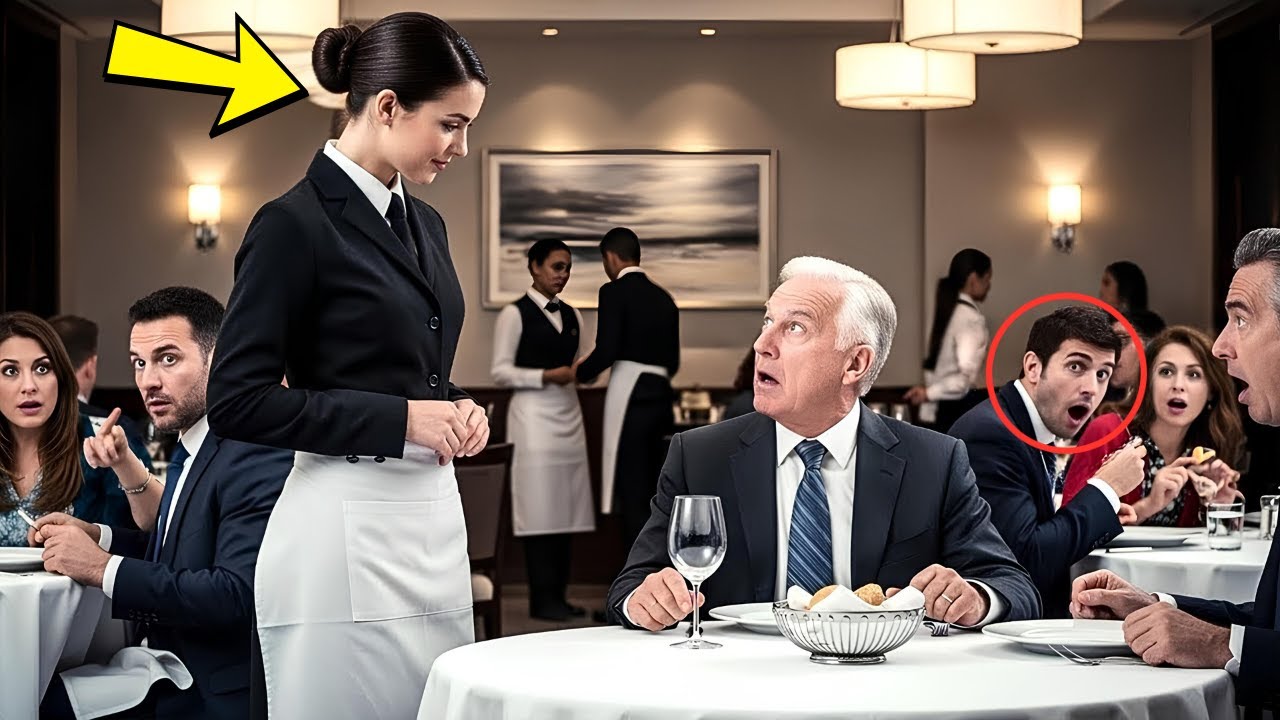
“You cannot even afford a law school intern, you parasite. ” Daniel spat the words across the heavy oak table. The sound echoed off the gray, peeling walls of the Cook County Courthouse. The air inside the room was thick and stale, smelling of burnt folders, coffee, wet wool, and cheap floor wax.

My younger brother leaned back in his wooden chair, the wood groaning under his weight. His gut spilled over a cracked leather belt. He wore a cheap, shiny polyester suit that trapped his sweat and radiated nervous heat. He looked exactly like what he was—a middle-aged failure masking his deep cowardice with loud, aggressive noises.
Sitting right next to him was our father, Arthur, eighty-six years old. His spine was bent, his knuckles swollen and white, his hands covered in the thick, permanent calluses of a retired steel worker. He leaned heavily on his aluminum cane and nodded slowly, agreeing with every vile word pouring out of his son’s mouth. I stood on the opposite side of the room, silent.
I wore Tom’s old beige coat, the cuffs frayed, the fabric worn thin at the elbows. It hung loose over my rigid shoulders. I did not flinch. I did not raise my voice.
I locked my vision on the dark, heavy bags under Daniel’s eyes, watched the thick blue vein pulsing in his neck, and counted his breaths—shallow, rapid, irregular. He was terrified beneath the bluster. The insult slid past my eardrums like dry wind whistling over the hot steel barrel of a rifle. Harmless.
Meaningless. Judge Holloway shifted on his elevated bench, pushing his heavy horn-rimmed glasses up the bridge of his nose. He flipped through a stack of brown cardboard files, then looked down at me. It was a look of pure, concentrated pity—the exact kind of look a powerful man gives to a weak, helpless widow who is in way over her head.
Daniel saw the judge’s expression and fed on it like a starving animal. He stood up abruptly, his chair scraping violently against the concrete floor. He pointed a thick, trembling sausage-like finger directly at my chest. “She manipulated her!
” Daniel yelled, his voice cracking with poorly rehearsed emotion. “She waited until Mom’s mind was gone. Then she swooped in and tried to steal the house. I was the one here.
I scrubbed the toilets. I fixed the leaking roof. I took care of this family while she was off doing God knows what. ”
I kept my heart rate steady—sixty beats per minute.
I looked away from his pointing finger and scanned the perimeter of the room. Two exits. Solid oak doors with heavy brass push bars. No windows on the ground floor.
A secondary bailout route existed through the judge’s private chambers if absolutely necessary. It was a hardwired habit. I remembered a pitch-black night crossing a live minefield on the outskirts of Fallujah. The rules of survival never changed, whether you were standing in the desert dirt or on the polished floor of a courthouse.
The loudest men in the room are always the first ones to break into a million pieces when the pressure drops. Richard Talbot stood up. He was Daniel’s lawyer. He wore a silk tie and a custom-fitted Italian wool suit that cost more than my first car.
Smug arrogance radiated from his pores. He adjusted his expensive cufflinks and repeated Daniel’s absurd accusations, his voice a slow, deliberate, condescending draw. He spoke to me as if I were a slow, uneducated child, stripping away my identity with every single syllable. Four decades.
Forty years of wearing a military uniform. I spent my youth sleeping on rigid metal cots and eating cold, tasteless rations. I sent tens of thousands of dollars in combat hazard pay back to this exact zip code. I paid off the massive bank loans for Daniel’s garbage business ventures, the ones that always went bankrupt within six months.
I bought the expensive prescription blood pressure medications for our mother. I kept the heating on in their house while I was freezing thousands of miles away in the dark. But none of that mattered. None of it ever mattered.
At the family dinner table on Thanksgiving, Arthur always carved the turkey. He always put the thickest, most tender cut of breast meat on Daniel’s plate. He gave the scraps to everyone else. Daniel was the golden boy—the son who stayed home, the man of the house.
They weaponized my sense of duty. They took my absence—an absence strictly required by the United States government—and twisted it into a weapon. They used my deployment orders to brand me a traitor, a cold, bad daughter who abandoned her aging mother. The worst kind of betrayal does not come from enemy fire.
It does not come from angry strangers in a foreign land. It comes from the people sitting at your own dinner table. It stabs right through your spine, driven deep by the hands of those who share your exact blood. The courtroom fell into a heavy, suffocating silence.
The old iron radiator in the corner clanked, metal grinding harshly on metal. Talbot picked up a thick piece of legal paper and slid it across the polished wood of the plaintiff’s table. He tapped his gold-capped fountain pen right next to the blank signature line. “Sign the waiver, Mrs.
Meyers,” Talbot said, his tone dripping with fake sympathy. “Relinquish your claim to the estate today. Walk away. Save yourself the exorbitant legal fees you clearly cannot afford to pay.
”
Daniel let out a short, wet, ugly laugh. He slumped back into his chair, crossing his thick arms over his chest. He looked victorious. He thought he had won.
I closed my eyes. One second. I reached up to my collar and slowly unbuttoned the top button of the frayed beige coat. Then the next.
I slipped the heavy, worn fabric off my shoulders and placed it on the table. I folded the coat once, twice, forming a precise, sharp-edged square. I pressed the seams down flat with the palms of my hands. Not a single millimeter of fabric hung over the edge of the wood.
The weak civilian shell was officially gone. I took a deep breath and stepped forward half a step. The hard leather toe of my shoe touched the white chalk line painted on the floor—the line dividing the public gallery from the judge’s bench. The battle had begun.
I did not look at Daniel. I ignored him completely, treating him exactly like a useless speck of dust floating across the glass of a sniper scope. He was entirely irrelevant to the mission. My eyes, cold and sharp as a fresh razor blade, swept across the sterile room.
I locked my target dead center on the smug face of Richard Talbot. Richard Talbot tapped his gold-capped fountain pen against the heavy oak table. Tap. Tap.
Tap. The sound cut through the stale, suffocating air. He pushed the thick legal document closer to the edge of the table, pointing the expensive pen directly at the blank signature line. He expected me to take it.
He expected me to fold. I did not move my hands. I squared my shoulders. I lifted my chin just a fraction of an inch.
I blocked the harsh fluorescent light buzzing directly above us, my shadow falling forward and stretching across the table, covering the waiver and plunging Talbot’s manicured hands into darkness. I looked at the sharp lapel of his tailored suit, at the small, expensive law school pin attached to the expensive wool fabric. I bypassed the shiny exterior. I looked right through the man.
I opened my mouth and kept my voice low, flat, stripped of all human emotion. “Who signed off on your security clearance? ”
The words dropped onto the table, heavy like a block of solid concrete smashing into a glass pane. It was a question that did not belong in a civilian estate hearing.
It was a question that made zero sense inside the peeling walls of a Cook County court. But it carried a deadly weight. Talbot froze. The rhythmic tapping of the gold pen stopped instantly.
His arm locked rigid in midair. The smug, condescending smile vanished from his face. His pupils dilated. He recognized the terminology immediately.
A dry clicking sound echoed from the back of his throat as he swallowed hard. Daniel slammed his thick hand down on the wooden table. The sudden noise made the old wood rattle. “What is this?
” Daniel barked. His face flushed a deep, ugly red. Sweat gathered in the deep creases of his forehead. “Sign the damn paper, Your Honor.
Make her sign the paper. She’s stalling. ”
Daniel sounded like a dog barking at a passing freight train. Loud.
Clueless. Completely unaware of the crushing weight bearing down on the steel tracks. Judge Holloway frowned deep into his wrinkles. He leaned forward over the elevated bench and looked down at the plaintiff’s table.
“Mr. Talbot,” the judge said, his voice laced with irritation. “Control your client. Proceed with the waiver.
”
But Talbot did not move. He did not speak. The blood drained completely from the lawyer’s face, his skin turning the color of wet cement. He looked exactly like a man who had just taken a blind step into a live anti-tank minefield and heard the sharp metallic click under his leather boot.
He finally looked up at me. He really looked at me—past the frayed beige coat. He evaluated my posture. He noticed the exact calculated distance between my boots planted firmly on the floorboards.
He saw the stillness, the unnatural predatory stillness of a trained professional. I did not break eye contact with Talbot. I did not blink. “Defense Logistics Agency,” I said, my voice a steady, rhythmic drumbeat.
“Contract audit file number 74-Bravo-Niner. October of 1994. Your firm submitted a bid for federal contractor representation. The lead auditor on your file was Special Agent Thomas Vance.
”
Talbot started to shake. A fine, rapid tremor developed in his fingers. The gold pen slipped from his grip, clattered loudly onto the wooden table, rolled away, and fell off the edge, hitting the concrete floor. “What the hell is going on?
” Daniel yelled. He gripped the edge of the table, his knuckles turning white under the immense strain. “What language is she even speaking? Mom is dead.
This is about the house. Stop talking nonsense and sign the paper. ”
Daniel was losing his mind, losing control of the room. I applied the protocol of polite ignorance—a fundamental tactical maneuver.
You do not grant a weak, panicking adversary a single ounce of your attention. You treat them like a fly buzzing against a reinforced glass window. Annoying, but entirely irrelevant to the primary mission. I did not look at my brother.
I did not acknowledge his existence. I kept the crosshairs locked dead center on Richard Talbot. The silence in the courtroom grew thick, suffocating. The disconnect between the two men at the plaintiff’s table was brutal.
Talbot, the expensive lawyer, understood exactly who he was dealing with. Daniel, my own blood, had absolutely no idea. The realization hit me like a physical blow to the ribs. For forty years, my brother and my father gladly took my hazard paychecks.
They took my money to pay off their bad debts. Yet they never once asked what I actually did in the military. They assumed I pushed paper. They assumed I was a glorified secretary.
They were completely blind to the reality of my life. Their ignorance was profound. Now, it was fatal. Cold sweat beaded along the hairline of Richard Talbot.
The collar of his custom silk shirt suddenly looked entirely too tight around his neck. He struggled to pull air into his lungs. He stumbled backward, his expensive leather shoes scraping clumsily against the floorboards. He turned his pale face toward the judge.
“Your Honor,” Talbot stammered, his voice thin and shaky. “I require—I must request a brief recess. Five minutes, please. ”
Judge Holloway narrowed his eyes behind his horn-rimmed glasses.
“We just started, counselor. Is there a problem? ”
“Five minutes, Your Honor,” Talbot pleaded. He did not wait for official permission.
Talbot grabbed Daniel by the sleeve of his cheap polyester suit and yanked him hard. Daniel stumbled out of his chair, protesting loudly, his heavy boots scuffing the floor. Talbot dragged my brother into the far corner of the courtroom near the heavy oak doors. I could not hear their exact words, but I saw the frantic, erratic hand gestures.
I saw Talbot hissing through his teeth. I saw the absolute terror radiating from his entire body. Behind them, Arthur shifted uncomfortably in his seat. My eighty-six-year-old father gripped his aluminum cane with both hands.
His pale, cloudy eyes darted back and forth between the panicking lawyer and his golden boy son. The old man could sense the sudden collapse of their defense line. His aging brain simply could not process the reason why. He looked across the room at me.
His expression was a mixture of deep confusion and raw fear. The civilian system was breaking down. I took one step backward and returned to a resting stance. I rolled my shoulders back once to relieve the physical tension.
I looked down at the floor near my boots and reached down. My fingers curled around the thick, reinforced leather handle of my black briefcase. The leather was worn. The heavy brass locks were deeply scratched from years of rough transport in the bellies of military cargo planes.
I gripped the handle tight and lifted the heavy briefcase. I placed it squarely onto the center of the wooden table. The dull, heavy thud echoed through the silent courtroom. The five-minute recess felt like an hour.
The heavy oak doors of the courtroom finally swung open, the rusty hinges squealing. Richard Talbot walked back toward the plaintiff’s table. He did not strut this time. He dragged his feet, his expensive Italian leather shoes scuffing harshly against the worn floorboards.
He looked like a man walking a final mile on death row. His silk tie was suddenly crooked. His breathing was shallow. Daniel followed right behind him.
My brother’s chest was puffed out, his cheap polyester suit straining at the plastic buttons. He was completely blind to the tactical shift in the room. He thought the recess was just a legal trick. He thought he was still winning.
I stood in the exact same spot. I had not moved a single inch. “Court is back in session,” Judge Holloway announced, sounding annoyed. He wanted to get this petty family dispute over with.
“Mr. Talbot, you asked for a recess to clarify the defendant’s federal ties. Proceed. ”
Talbot stood behind his table.
He opened his mouth. No sound came out. His throat was completely dry. Daniel let out a loud, ugly snort.
He leaned over the table, glaring at me. “She doesn’t have any federal ties,” Daniel mocked, crossing his thick arms over his gut. “She’s stalling. Make her sign the paper.
”
I ignored his voice. I reached down to the floor. My fingers found the heavy brass zipper of the black leather briefcase. I gripped the cold metal and pulled it hard to the right.
Zzzzip. The sharp metallic sound cut through the stale air. It was loud. Final.
I reached past the thin, useless civilian tax forms. I grabbed the real file—a thick, heavy manila envelope, two inches of dense compressed paper bound tight with bright red tamper-evidence security tape. I pulled it out. The weight of it felt familiar in my hand.
I placed it flat on the wooden table and pushed it forward. The bailiff stepped up, took the heavy envelope, walked it up the wooden steps, and handed it directly to Judge Holloway. The front of the envelope faced the gallery for just a second. It was long enough.
Stamped in the dead center, pressed deep into the heavy brown paper, was the official seal of the United States Department of Defense—the raised eagle. Right below the eagle were thick, heavy bars of solid black ink. Redacted text. Classified federal protocols completely blacked out to protect national security.
This was not a civilian mortgage document. This was a weapon. Judge Holloway picked up a dull brass letter opener from his desk. He jammed the metal tip under the red security tape.
Shhh. He sliced the seal open. He pulled a thick stack of cardstock paper out of the envelope. He pushed his horn-rimmed glasses up the bridge of his nose.
He read the first paragraph. He stopped breathing for a full two seconds. I watched his face. I watched the condescending pity melt away.
I watched the mild annoyance vanish from his eyes. His jaw muscles tightened. The loose, wrinkled skin under his chin pulled taut. He flipped to the second page, his eyes scanning the black ink.
Then the third page. He was not looking at a helpless, grieving widow anymore. He was looking at a ghost. He was looking at forty years of cold, calculated military logistics.
He was looking at the woman who calculated the exact tonnage of fuel, ammunition, and human blood required to keep an entire theater of war operational. He slowly lowered the file and placed it carefully on his desk. He looked down at me. The entire power dynamic of the room snapped.
He sat up straighter. He cleared his throat to remove the dryness. “Mrs. Meyers,” Holloway started.
He paused immediately. He caught his own mistake. He corrected his inflection. The tone was no longer a judge speaking to a civilian.
It was a man recognizing a higher authority. “Colonel Meyers, you are currently an active-duty officer. You hold a top-tier federal security clearance—defense logistics intelligence. ”
The title hung in the air.
Heavy. Undeniable. I kept my hands flat at my sides. “Yes, Your Honor.
”
Daniel slammed his thick hand flat onto the table. Smack. The sound echoed loudly. “So what?
” Daniel yelled. His face flushed a dark, angry purple. “Who the hell cares? She does paperwork.
She pushes paper for the government. Big deal. We’re here about my mother’s house. We’re here about the money she stole.
”
Daniel always diminished other people. It was the only way he could tolerate his own pathetic reflection in the mirror. He expected his expensive lawyer to launch an attack. He looked at Talbot, waiting for the legal strike.
But Talbot did not move forward. Talbot looked physically sick. He gripped the edge of the wooden table, his knuckles bone white. He was trying to keep his hands from shaking in front of the judge.
“Your Honor,” Talbot said, his voice a thin, pathetic croak. He swallowed hard. “My firm—my previous law firm—was audited by Colonel Meyers’ division, 1994, Federal Contractor Compliance. ”
Talbot turned his head.
He could not look me in the eyes. He stared at the floor. “I recognize the authority of the defendant’s office,” Talbot whispered. “I concede her federal standing.
”
Then it happened. The physical desertion. Talbot took his right foot and stepped backward, then his left. He took two full steps away from Daniel.
It was a calculated physical movement to sever all ties. He broke the shield. He abandoned his client right in front of the judge. The extortion wall crumbled into dust.
Daniel looked at his lawyer. The angry purple color drained from his face. Confusion instantly morphed into raw animal panic. He was completely exposed—a man who had spent his entire life hiding behind our mother’s skirt and then behind an expensive suit, suddenly finding himself standing completely alone in the middle of a battlefield.
He reverted to his base instincts. He attacked blindly. “She stole the money! ” Daniel screamed.
Spittle flew from his lips, landing on the polished wood. He pointed a shaking, fat finger right at my face. “She manipulated an old woman with dementia. She drained the bank accounts.
I fixed the roof. I scrubbed the toilets. I was here. She bought her way in and brainwashed Mom!
”
Behind him in the wooden gallery chairs, Arthur shifted his weight. My eighty-six-year-old father gripped his aluminum cane with both of his calloused, arthritic hands. He lifted the metal cane into the air and slammed the rubber tip down onto the floorboards. Thud.
“Listen to the boy,” Arthur croaked. His voice was raspy, ruined by decades of breathing in toxic steel mill dust. “He’s telling the truth. He was the one who stayed home.
”
I looked at Arthur—my father, a man who demanded absolute respect his entire life but never bothered to earn a single ounce of it. A man who sat at the head of the table every Thanksgiving and gave the thickest cut of meat to the son who constantly stole from him. I looked at the deep wrinkles around his eyes. I did not feel angry.
Anger requires a massive amount of energy. Anger is a tactical disadvantage. I just felt tired—a deep, bone-crushing fatigue that settled into the marrow of my spine. I broke eye contact with the old man.
I did not need to defend my military record to men who had never worn combat boots. I did not need to explain the weight of a casualty report to men who only cared about property taxes. The civilian identity was dead. The military identity was established.
The room was mine. Now it was time to neutralize the primary target. I reached back down to the floor. My fingers found the heavy brass zipper of the second compartment of the black leather bag.
I pulled it open. The metal teeth separated with a harsh grinding noise. I reached inside and pulled out a stack of paper. It was not classified military intelligence.
It was civilian math. Hard, cold, undeniable math. Daniel was sweating. The dark patches under the arms of his cheap polyester suit were spreading rapidly.
He gripped the edge of the table and doubled down on his original lie. It was the only weapon he had left. “She manipulated Mom! ” Daniel shouted, his voice echoing off the peeling gray walls.
“She waited until Mom lost her mind. She used her money. She tricked an old woman with severe dementia. ”
I did not raise my voice.
I did not get angry. I looked directly at his flushed, panicked face. I locked the target. I pulled the trigger.
“Exactly when did Mom lose her cognitive functions, Daniel? ” I asked. The question was flat, monotone. Daniel blinked.
He thought he saw an opening. He thought he could win the argument. “Early this year,” he said quickly. “January.
The doctor said she was completely gone by January. You knew that. You took advantage of her. ”
He stepped right into the trap.
The heavy steel jaws snapped shut around his ankle. I lifted the thick stack of papers and slammed them down onto the solid oak table. Smack. The sound was like a gunshot in the silent courtroom.
“These are three separate mortgage refinance agreements,” I said, my voice cutting through the air like a surgical blade. “They are dated June, August, and October of last year, totaling two hundred fifteen thousand dollars. They were taken out against the house. The cash was deposited directly into your personal business account.
”
Daniel stopped breathing. The angry red color drained out of his face, turning the color of old ash. “They all carry Mom’s signature,” I continued. I did not blink.
I did not look away. “So, Daniel, you have a choice to make right now in front of this judge. If Mom was competent last year, you are committing perjury today by claiming she had dementia. If she had dementia last year, you committed federal bank fraud by forcing a mentally compromised senior citizen to sign legal financial documents.
”
The silence in the room was absolute. It was thick, suffocating. Richard Talbot, the expensive lawyer, stood completely frozen. He looked like a stone statue.
He refused to intervene. He refused to speak. He knew a sinking ship when he saw one. Behind Daniel, Arthur shifted heavily in his wooden chair.
The aluminum cane clattered against the floor. The eighty-six-year-old retired steel worker frowned, his thick, calloused hands trembling. “Refinance? ” Arthur muttered, his voice a dry, raspy wheeze.
He looked at the back of Daniel’s head. “What does she mean, refinance? The house was paid off in ’82. What are you doing with the house, Danny?
”
Daniel spun around in a panic. He held his thick hands up, palms facing his father. “It’s nothing, Pop,” Daniel stammered. Sweat dripped down his nose.
“It was just a short-term business loan. Don’t listen to her. She’s lying. ”
It was a clumsy, pathetic lie.
It smelled like fear. I did not give him room to breathe. I picked up the next file and pushed it forward across the table toward Judge Holloway. The judge took the file and opened it.
His eyes narrowed behind his thick glasses. “County property tax records,” I said, “covering the last four consecutive years. ”
Judge Holloway looked at the documents, then at the attached bank receipts. “These taxes were paid in full,” the judge said, his voice grave.
“Every single payment was wired directly from an account belonging to Colonel Greta Meyers. ”
Daniel wiped his wet forehead with the back of his sleeve. He turned back toward me and bared his teeth like a cornered rat. “You did that to suck up to her!
” Daniel yelled, his voice cracking. “You threw your dirty military money around to buy Mom’s affection. You wanted to look like the savior while you were abandoning us. ”
I looked at him.
I felt nothing but cold, sterile disgust. “No, Daniel,” I said, my voice a block of solid ice. “I paid the taxes because Cook County was preparing to issue a final notice of foreclosure. ”
The word hit the room like a physical shock wave.
Foreclosure. Arthur stopped moving. He stopped breathing. The color completely vanished from his wrinkled face.
His jaw dropped open. He looked at me, then at Daniel, his cloudy eyes wide with pure, unfiltered horror. “What? ” Arthur gasped.
The word barely made it out of his throat. “Foreclosure? The county? They were going to take the house?
”
He did not know. Daniel had hidden all the final notices. Daniel had intercepted the mail. Daniel had buried the truth under a mountain of lies.
I looked straight into my father’s eyes. I watched the arrogant patriarchal wall he had built over fifty years crack and shatter into pieces. “Sixteen thousand dollars, Dad,” I said, my tone steady. “You were sixteen thousand dollars in debt to the county.
I used two years of combat hazard pay—money I earned sleeping in dirt bunkers while mortars dropped outside. I wired it directly to the county clerk. I paid it off quietly. I did it to save your pride.
I did it so you would not die on the street. ”
The truth lay bare on the floor, ugly and raw. Arthur stared at Daniel. The old man realized the brutal reality.
He was not here in this courtroom fighting for justice alongside his loyal son. He was a blind, manipulated victim. He was a prop. The son who got the best cut of meat every single Thanksgiving was the exact same son who had secretly sold the roof over their heads.
Arthur let out a low, agonizing groan. He slumped forward, his heavy shoulders collapsing. The aluminum cane slipped from his fingers and hit the ground with a loud metallic ring. The man of the house was broken, destroyed by his own flesh and blood.
Daniel backed away from the table. His shoes squeaked against the cheap floor wax. He hit the wooden railing separating the gallery from the court, the impact rattling the old wood. He had nowhere left to run.
He opened his mouth to speak, but only a dry, rasping sound came out. The math had executed him. The numbers had stripped him naked in front of the one man he needed to impress. I did not smile.
I did not feel a sense of victory. I just felt the heavy, dragging weight of the past forty years pulling at my bones. I watched my father bury his face in his large, scarred hands and weep silently for the illusion he had protected his entire life. Judge Holloway did not say a word.
He did not offer any comfort. He watched the destruction of the family dynamic with a grim, hard expression. He reached his hand into the thick stack of documents I had given him. He bypassed the heavy mortgage papers.
He bypassed the bank fraud evidence. He bypassed the tax receipts. His fingers closed around the final item sitting at the very bottom of the pile. He pulled it out.
It was a small, rectangular object—a sealed envelope. The paper was old, yellowed, and slightly stained at the edges. It carried a single federal registered mail stamp. The judge held it up in the harsh fluorescent light.
Daniel stared at the yellow paper, his eyes widening in absolute terror. He knew exactly what it was. The air in the courtroom stopped moving completely. Daniel stared at the yellow envelope in the judge’s hand.
He recognized the neat cursive handwriting on the front. He recognized the federal registered mail stamp. It was the absolute last thing he ever expected to see inside a Cook County courthouse. “Object!
” Daniel screamed. He slammed both hands flat onto the heavy oak table. The sudden noise made the bailiff jump. “I object!
You can’t use that! She forged it! Mom was crazy! Throw it out!
”
Daniel sounded like an animal caught in a steel jaw trap—desperate, bleeding, panicked. Richard Talbot, the expensive lawyer who had spent the last hour trying to destroy me, finally reached his breaking point. He turned toward my brother. His face was a mask of cold professional fury.
“Sit down, Daniel,” Talbot snapped, his voice a harsh whip crack. “Sit down and shut your mouth before you put both of us in a federal penitentiary. ”
Daniel froze. The sharp command from the man he paid to protect him broke his remaining nerve.
He slowly sank back into his wooden chair, his thick shoulders slumping forward. He looked sick. Judge Holloway did not look up from the envelope. He picked up his dull brass letter opener and slid the metal tip under the flap.
Rrrrip. The sound of the dry, aged paper tearing open was incredibly loud in the silent room. The judge pulled out a single sheet of lined notebook paper. He adjusted his heavy horn-rimmed glasses and cleared his throat.
The tone of his voice dropped. It became solemn, heavy. He was no longer a judge reading a legal brief. He was a man delivering a final message from the grave.
“To the honorable court,” Holloway began, reading my mother’s exact words. “I am writing this letter while I am still of sound mind. I am sending it via certified mail to my daughter Greta, with strict instructions to only open it if my son Daniel attempts to execute my estate. ”
Arthur let out a sharp, choked gasp.
He grabbed the edge of the wooden railing with his thick, calloused hands, his knuckles bone white. “I have known for fourteen months that Daniel has been stealing from me,” the judge continued reading. “I found the bank statements hidden in the garage. I saw the refinance papers he forced me to sign when I was medicated for my hip surgery.
He told me it was a routine insurance form. He lied. ”
Daniel put his head down on the table and buried his face in his arms. He could not look at the judge.
He could not look at his father. “I tried to tell Arthur,” the letter read. The judge paused for a fraction of a second. “But my husband is a coward.
Arthur hates conflict. He hates admitting failure. He chose to look the other way. He chose to protect his son rather than protect our home.
He allowed Daniel to rob us blind because it was easier than facing the truth. ”
The words hit Arthur like a physical hammer blow. My father—a man who had worked in the brutal heat of a steel mill for thirty-five years, a man who demanded absolute respect at the dinner table, a man who always took the biggest cut of meat—was completely gutted. The illusion of his strong patriarchal control was dead.
He was not a protector. He was an enabler. His own wife had died knowing he was too weak to stop their son from destroying them. Arthur let out a broken, wet sob.
It was an ugly sound—the sound of an eighty-six-year-old man realizing his entire legacy was a pathetic lie. Tears spilled over his bottom eyelids and tracked down through the deep, dirty wrinkles of his face. Daniel lifted his head off the table. His face was streaked with sweat and snot.
He looked at me, his eyes wide and crazy. “You think you’re so perfect! ” Daniel yelled, his voice ragged. “You come back here with your fancy military titles.
You walk around like a hero. What about me? I was stuck here. I was the one changing her adult diapers.
I was the one cutting the grass. I deserved that money. You abandoned us! ”
I did not move.
I did not raise my voice. I looked at the pathetic, sweating man in the cheap suit. “You did not earn anything, Daniel,” I said, my voice completely flat. “You robbed them.
”
Judge Holloway raised his hand, demanding silence. He looked down at the last paragraph of the letter. His expression softened. The hard lines around his mouth relaxed.
He looked directly at me. “Greta has always been distant,” Holloway read, his voice dropping to a near whisper. “She missed Thanksgiving. She missed birthdays.
She missed my anniversaries. Arthur and Daniel called her cold. They called her ungrateful. ”
I looked down at the table, at the fraying cuffs of my dead husband’s coat folded perfectly on the wood.
“But I know the truth,” the letter continued. “Greta was distant because her job required absolute silence. She was not abandoning us. She was standing on a wall somewhere in the dark.
She was missing our holidays so that other American families could eat their dinners in peace. She paid our taxes so we would not sleep on the street. She carried the weight of the world, and we repaid her with resentment. ”
I felt a sudden, sharp tightness in my chest.
Survivor’s guilt. It is a heavy, suffocating blanket. I remembered the long, freezing nights in the tactical operations center. I remembered the static of the radio.
I remembered signing the logistics orders that sent nineteen-year-old kids into combat zones they would never walk out of. My family was angry because I missed a turkey dinner. They had absolutely no idea what real loss looked like. They had no idea what it felt like to write a letter to a dead soldier’s mother.
My mother knew. Even at the end, as her mind was failing, she saw the ghost I was carrying. “Do not let Daniel take the house,” the judge read the final sentence. “Give it to Greta.
She is the only one who actually earned it. ”
Holloway slowly folded the yellow paper and placed it carefully back onto the bench. The silence in the room was absolute. Richard Talbot cleared his throat.
He stood up and buttoned his expensive suit jacket. He looked at the judge. “Your Honor,” Talbot said, his voice completely devoid of emotion. He was back in survival mode.
“For the record, my firm was retained strictly for estate processing. We had zero prior knowledge of any federal bank fraud, elder abuse, or forged mortgage documents. I am formally withdrawing as legal counsel for Daniel Meyers. Effective immediately.
”
Talbot picked up his leather briefcase. He turned his back on my brother. He walked down the center aisle and pushed through the heavy oak doors. He did not look back.
The enemy front line was completely decimated. Arthur sat in the gallery, openly weeping now. He pressed his calloused hands hard over his face, his shoulders shaking violently. The aluminum cane lay forgotten on the floor.
Judge Holloway took off his horn-rimmed glasses and rubbed the bridge of his nose. He looked exhausted. He looked down at the plaintiff’s table, then shifted his gaze directly to me. “Colonel Meyers,” Holloway said quietly.
“Based on the federal evidence presented—including the fraudulent refinance documents and the property tax evasion—I have a legal obligation to ask you a question. ”
I stood perfectly still. My heels were locked together. “Do you wish to press maximum federal criminal charges against your brother?
”
The question hung in the stale, suffocating courtroom air. I looked at Daniel. He was trembling—a middle-aged man in a cheap, sweat-stained suit, shaking like a terrified child. His knuckles gripped the edge of the oak table so hard the skin looked like it might tear.
He was waiting for the execution. In the military, the objective is simple. Locate the enemy. Isolate the enemy.
Destroy the enemy. I had him zeroed in. I had the weapon loaded. One word from me and he would spend the next decade in a federal penitentiary for bank fraud and elder abuse.
But I looked at his bloodshot eyes. I did not see an enemy combatant. I just saw a weak, jealous man who had spent his entire life trying to fill shoes that were way too big for him. I was tired of destroying things.
I was tired of casualty reports. “No, Your Honor,” I said. My voice was quiet but firm. “My mother wanted the truth on the federal record.
She did not want him in a cage. Let him go. ”
Daniel let out a sharp, ragged breath. He slumped back in his chair, the wood groaning loudly.
He stared at me. He could not process the mercy. “Why? ” Daniel whispered.
His voice was completely broken. I reached down and picked up Tom’s old beige coat from the table. “Because I am just tired, Danny. ”
Three weeks later.
The bitter winter wind howled off the Chesapeake Bay, rattling the loose single-pane windows of my small kitchen. The house smelled of strong black coffee and burning pinewood from the cast-iron stove in the corner. Tires crunched hard on the frozen gravel of the driveway. I looked out the frosted glass over the sink.
An old, rusted Ford pickup truck was parked near the porch. Arthur stepped out. My eighty-six-year-old father moved slow, leaning heavily on his aluminum cane. In his free hand, he clutched a brown paper grocery bag—a cheap, transparent excuse to show up unannounced.
I opened the front door. The freezing wind bit immediately into my face. Arthur walked inside. He did not look around.
He went straight to the wooden kitchen table and sat down heavily. He placed the grocery bag on the worn Formica surface—a carton of whole milk, a loaf of cheap white bread. I poured him a mug of black coffee from the pot and set it down directly in front of him. He wrapped his thick, calloused hands around the hot ceramic.
His knuckles were swollen tight with arthritis. He stared down into the dark liquid for a long time. The harsh, stubborn patriarch of the Meyers family was gone. “I was angry when you enlisted,” Arthur said, his voice a low, raspy gravel.
“You were just a girl. You packed your bags and walked out the door. You went off to do things I could not even understand. ”
He stopped.
He took a slow, labored breath. The radiator clicked in the background. “I thought if you left, you would realize how small we were. I thought you would forget us.
”
The truth finally hit the table. Forty years of absolute coldness. Forty years of giving the thickest cut of Thanksgiving turkey to the son who stayed home. It was never about pride.
It was never about duty. It was about fear. The terrifying fear of an old steel worker realizing his daughter had outgrown his small, rusted world. “I never forgot you, Dad,” I said.
Arthur squeezed his eyes shut. A single tear escaped, cutting a clean, wet line through the deep dirt and wrinkles on his cheek. The front door creaked open again. Heavy boots stepped onto the hardwood floor.
Daniel walked into the kitchen. He was not wearing the cheap polyester suit. He wore faded Carhartt work pants and a heavy flannel shirt. He looked smaller, stripped of his fake armor.
He stood awkwardly near the door frame. He looked at Arthur, then at me. “I parked down the road,” Daniel mumbled. He rubbed the back of his neck with a thick, dirty hand.
“Saw Pop’s truck. ”
I pulled out a third wooden chair. I pointed at it. Daniel walked over and sat down.
He kept his hands in his lap. He stared hard at the scuff marks on the toes of his work boots. “You were always bigger than me,” Daniel said, his voice tight in his throat. He was forcing the words out like pulling teeth.
“Even when we were kids. Then you went off and got all those medals. People in town would ask about you. They would call you a hero.
Every time they said your name, I just felt stupid. I felt like nothing. ”
He looked up. His eyes were red and raw from the biting cold outside.
“I took the money because I wanted to feel like I was the one in charge. I wanted to be the man of the house for once. But I just ruined it. ”
I looked at my brother.
The heavy resentment I had carried for decades suddenly felt incredibly light. The invisible rucksack I had been dragging across the desert for forty years finally slipped off my shoulders. It evaporated into the warm kitchen air. “The house is still standing, Danny,” I said quietly.
Arthur shifted in his chair. The old man placed both hands flat on the wooden table. He pushed down hard. His elbows locked.
His knees popped loudly. Bone ground painfully against bone. He forced his curved spine to straighten. He stood up.
He breathed heavily through his nose. He did not look at Daniel. He turned his entire body. He faced me directly.
Arthur lifted his right arm. It was a slow, agonizing movement. His shoulder joint cracked in the quiet room. His swollen, arthritic fingers pressed tightly together.
He brought his stiff hand up to his right eyebrow. He executed a perfect, rigid military salute. It was not a mockery. It was not a joke.
It was absolute, unwavering respect. It was the highest honor a proud, stubborn, blue-collar man could possibly give. He was acknowledging the rank. He was acknowledging the blood, the sweat, and the decades of silent sacrifice.
“I should have done that forty years ago,” Colonel Arthur whispered. His voice broke. My chest seized. My throat locked tight.
For the first time since the mortars fell in Fallujah, a single hot tear broke loose. It ran down my face and dropped onto the collar of my shirt. Daniel stood up. He walked around the table.
He wrapped his thick arms around my shoulders and pulled me into a tight, crushing hug. He buried his face in my neck and cried. The war was over.
I was finally home.