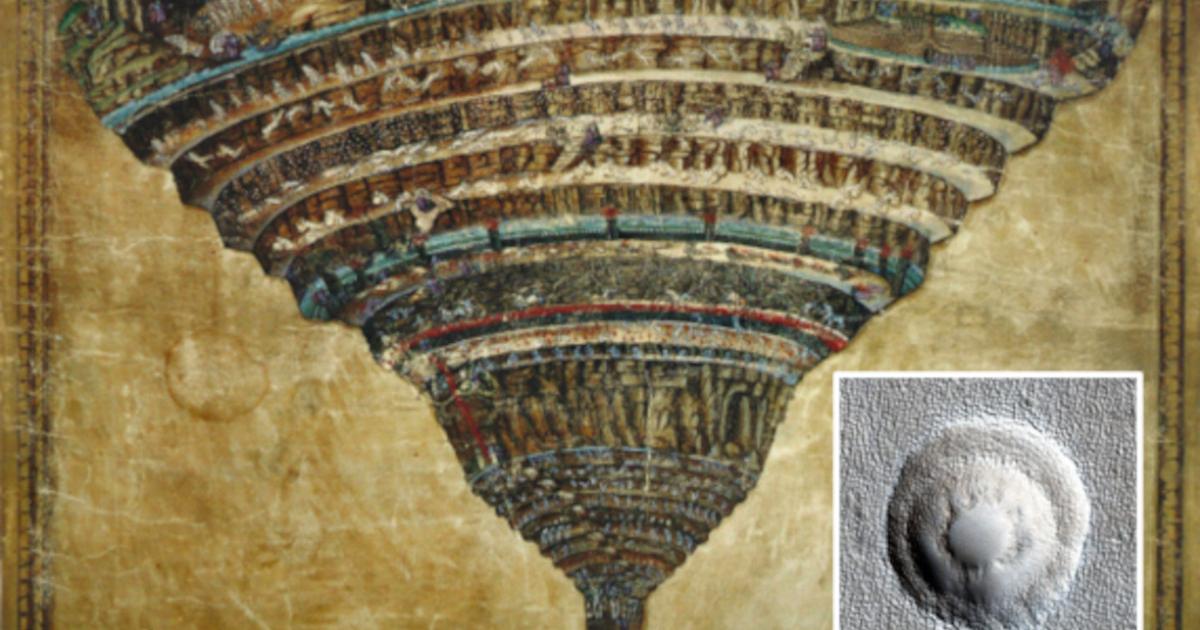
 A provocative new study presented at the 2026 European Geosciences Union (EGU) General Assembly in Vienna is drawing attention from both literary scholars and planetary scientists after proposing an unexpected connection between Dante Alighieri’s Inferno and modern impact crater science.
The research, led by Dr. Iain Stewart of the University of Plymouth, argues that the structure of Hell described in Dante’s 14th-century masterpiece closely resembles the geological morphology of a large planetary impact crater — a concept that would not be formally understood by science for another five centuries.
Presented during the EGU meeting in April 2026, the study explores whether Dante’s extraordinary spatial imagination and deep engagement with medieval natural philosophy may have led him to create a surprisingly accurate model of planetary impact geometry long before the rise of modern geology.
The Shape of Hell and the Science of Impact Craters
In Inferno, the first part of Dante’s Divine Comedy, Hell is described as a vast inverted cone descending beneath the Earth through nine concentric circles toward a frozen center.
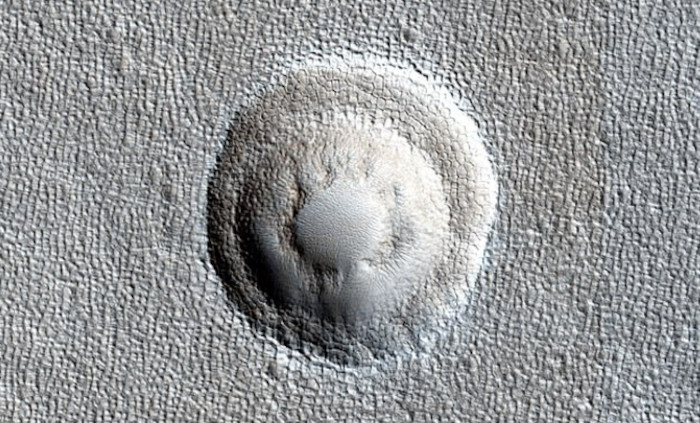
According to the researchers, this structure bears striking similarities to what planetary scientists today classify as a “complex impact crater” — a geological formation produced when a massive asteroid strikes a planetary surface with extreme force.
Unlike smaller bowl-shaped craters, complex impact craters contain terraced inner walls, central uplifts, layered depressions, and broad basins formed when rock behaves temporarily like fluid under intense pressure. The study argues that Dante’s layered depiction of Hell mirrors many of these features with surprising accuracy.
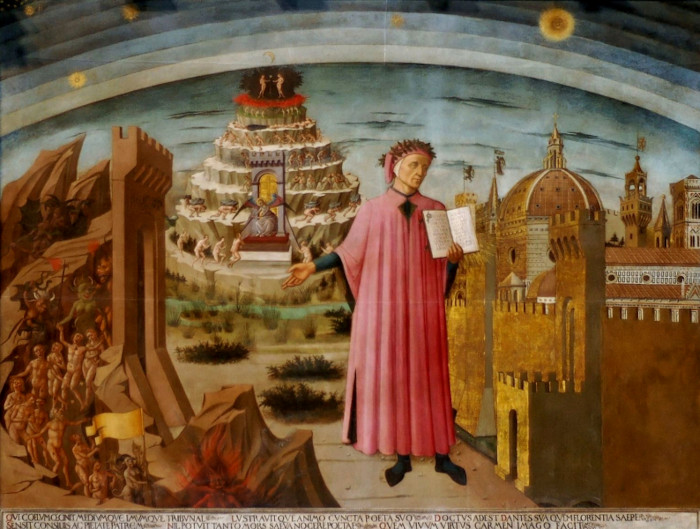
Researchers emphasize that Dante was heavily influenced by the classical philosophy of Aristotle and medieval Islamic scholars who preserved and expanded ancient scientific knowledge. While there is no suggestion that Dante possessed direct geological understanding in the modern sense, the study proposes that his philosophical worldview may have allowed him to intuitively construct a physically realistic planetary structure.
 The Chicxulub Comparison
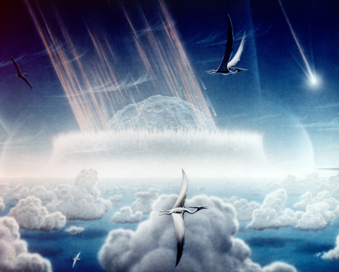
The study draws particular comparisons with the famous Chicxulub crater, the enormous impact structure buried beneath the Gulf of Mexico that was created approximately 66 million years ago by the asteroid linked to the extinction of the dinosaurs.
Chicxulub remains one of the best-studied impact craters on Earth and features terraced walls, a central uplift ring, and a massive basin structure — characteristics researchers say align closely with Dante’s description of Hell.
The authors are careful not to claim that Dante somehow knew about Chicxulub itself. Instead, they argue that the geometry found in Inferno reflects a remarkable intuitive understanding of how catastrophic planetary impacts shape geological structures.
The scale described by Dante is also noteworthy. In the poem, Hell is depicted as immense — roughly comparable in size to the Mediterranean basin — a dimension researchers say could theoretically correspond to a very large terrestrial impact feature, although they acknowledge this may simply be coincidence.
Science Hidden in Ancient Literature?
The study fits into a growing academic field sometimes referred to as “archaeo-geophysics,” where scholars investigate whether ancient myths, monuments, and literary works preserve observations of real astronomical or geological phenomena.
Previous research has explored whether sites such as Göbekli Tepe contain evidence of ancient comet observations, while myths from numerous cultures have been interpreted as possible memories of catastrophic natural events.
Dr. Stewart’s presentation argues that Dante’s work may belong within this broader tradition — not as a scientific document in the modern sense, but as an example of how pre-modern thinkers sometimes arrived at surprisingly accurate descriptions of natural phenomena through philosophy, observation, and imagination.
 A Fascinating but Speculative Theory
Despite the excitement surrounding the presentation, researchers stress that the hypothesis remains speculative. The work has not yet undergone peer review or been formally published in a scientific journal.
Still, the study has generated considerable interest because it bridges literature, philosophy, and planetary science in an unusual way. Whether coincidence or genuine intuitive insight, the parallels between Dante’s underworld and modern crater morphology have opened a new conversation about the relationship between art and scientific understanding in the medieval world.
More than 700 years after Dante completed The Divine Comedy, scholars are still discovering unexpected layers within one of history’s most influential literary works — and this latest interpretation suggests the poet’s vision may have reached far beyond theology alone.