What began as an ordinary morning hike in southwestern Norway has become one of the country’s most remarkable archaeological discoveries in recent years. A local hiker walking through the popular Dalsnuten trail area near Sandnes noticed something shimmering beneath the roots of a fallen tree — a discovery that would later astonish experts across Northern Europe.
Using a stick to investigate a mound of disturbed earth, the hiker uncovered an intricately decorated gold fitting from a sword scabbard dating back roughly 1,500 years to the early sixth century AD.
Archaeologists from the University of Stavanger later confirmed the artifact as one of only 17 known examples of its kind ever discovered in Northern Europe — and the first ever found in Rogaland county.
“This is the kind of discovery archaeologists dream about,” said archaeologist Håkon Reiersen of the University of Stavanger’s Museum of Archaeology. According to researchers, the odds of stumbling across such an artifact by chance are extraordinarily small.
An Exquisite Example of Ancient Goldsmithing
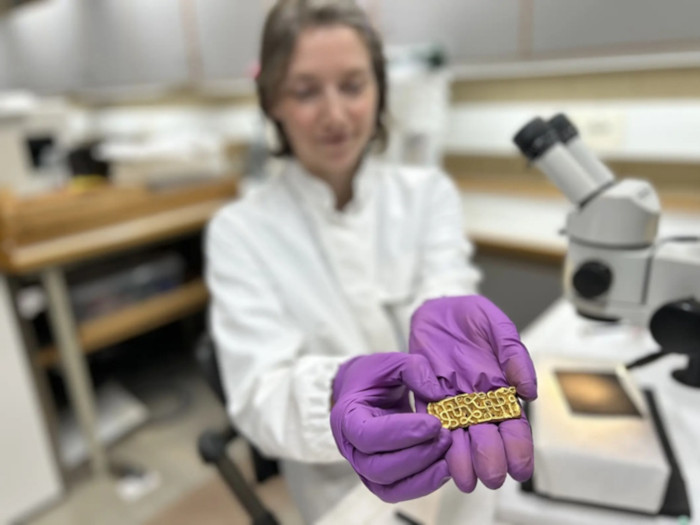
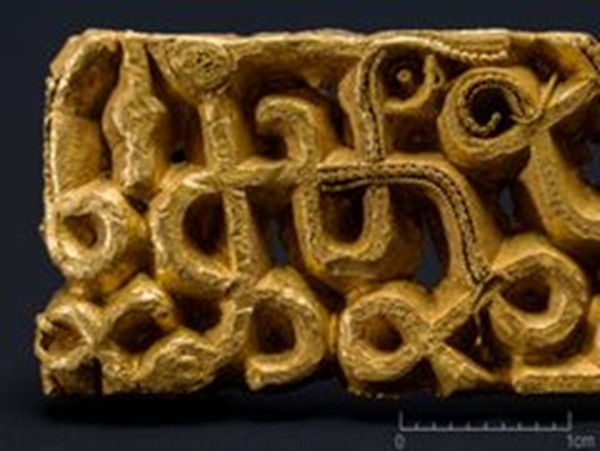
Though modest in size — measuring only around six centimeters wide and weighing just 33 grams — the artifact represents some of the finest metal craftsmanship of the Migration Period in Scandinavia.
Experts describe the object as a gold fitting that once decorated the scabbard of a prestigious sword, likely belonging to an elite warrior or regional chieftain.
Retired archaeology professor Siv Kristoffersen explained that traces of delicate filigree work remain visible on the surface. The decoration was created using extremely fine triple-stranded gold threads carefully layered into intricate patterns, a technique requiring exceptional skill.
The ornament’s design also contains hidden imagery. What first appears to be abstract swirling decoration actually reveals two animal-like figures facing one another. Researchers believe the motif may depict hybrid creatures combining human and animal characteristics, a symbolic style commonly associated with “Animal Style I,” an artistic tradition that spread across northern and western Europe during the Migration Period.
Unlike many similar ceremonial artifacts discovered elsewhere in Scandinavia, this fitting shows significant signs of wear. Archaeologists believe this suggests the sword was regularly carried and displayed, likely serving as a visible symbol of authority and power.
 A Region Linked to Ancient Warrior Elites
The discovery site lies close to Hove, an ancient farm complex in the Austrått district long associated with elite power in prehistoric Norway.
Archaeologists say the region has already produced numerous high-status artifacts over the years, including gold objects, silver neck rings, and even a massive Roman bronze cauldron dating back to around 300 AD.
The newly discovered scabbard fitting strengthens growing evidence that the Jæren region of Rogaland was once one of the most important centers of political and military influence in early Scandinavia.
Reiersen believes the gold fitting may have been intentionally buried as part of a ritual sacrifice during a period of extreme crisis in the sixth century.
“Whoever owned this sword was likely a local ruler with a loyal warrior retinue,” he explained. “Sacrificing objects like this may have been a way to demonstrate status while seeking favor or protection from the gods.”
 The Shadow of the Sixth-Century Catastrophe
The period in which the artifact was buried coincides with one of the darkest environmental disasters in recorded history.
In 536 AD, a massive volcanic eruption is believed to have thrown enormous quantities of ash into the atmosphere, triggering years of global cooling, crop failures, and famine across much of the Northern Hemisphere.
Some historians and archaeologists have linked this event to the Norse myth of Fimbulwinter — the legendary great winter said to precede Ragnarök in Norse mythology.
At the same time, outbreaks of plague swept across Europe, creating a prolonged era of instability and demographic collapse.
Experts believe many valuable gold objects buried throughout Scandinavia during this period may have been ritual offerings intended to appease divine forces during a time of fear and uncertainty.
The newly discovered sword fitting will eventually go on display at the University of Stavanger Archaeological Museum after conservation and further scientific analysis are completed.
Researchers hope the artifact will provide new insight into the warrior elites, belief systems, and political power structures that shaped Scandinavia centuries before the Viking Age reached its height.