The Face of an Ancient Egyptian Woman Reborn After 2,000 Years
In a quiet laboratory filled with scanners, 3D printers, and forensic instruments, a face long lost to history slowly re-emerged from the shadows of time.
She was a young Egyptian woman who lived more than two thousand years ago. Today, she is known as Meritamun, meaning “beloved of the god Amun”—a name that echoes through the religious and cultural world of ancient Egypt.
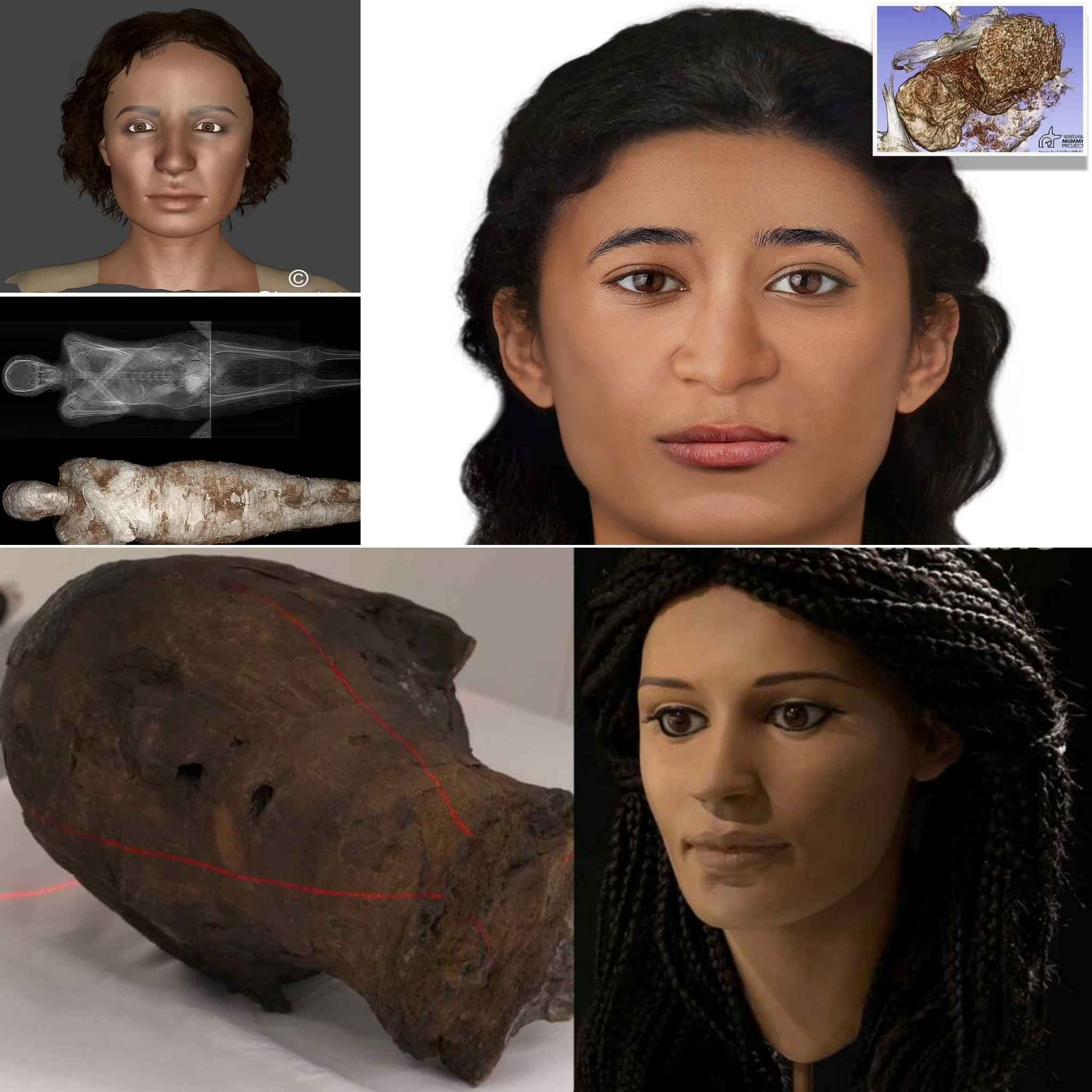
Her remains, preserved through centuries in a fragile state, became the focus of a remarkable scientific project that blended archaeology, forensic anthropology, and cutting-edge digital reconstruction. What emerged was not just a scientific model, but a deeply human glimpse into a life that once walked the banks of the Nile.
A Mummy Forgotten in Storage
Unlike the famous royal mummies displayed in Egyptian museums, Meritamun’s remains were not part of a grand public exhibition.
Instead, her mummy had spent decades in storage at the University of Melbourne, largely forgotten in a basement collection of anatomical specimens. She had originally been brought to Australia in the early 20th century by the English anthropologist Frederic Wood Jones, who collected Egyptian remains during archaeological surveys conducted before major flooding projects along the Nile.
It is believed she was excavated around 1907–1908 in southern Egypt, during a period when many ancient sites were being explored and documented before modern infrastructure reshaped the landscape.
For decades, she remained in academic storage—silent, wrapped, and largely unstudied.
Until modern technology gave her a voice again.
Reconstructing a Face from Bone
The breakthrough came through a collaboration between the University of Melbourne and the Victorian Institute of Forensic Medicine.
Researchers began by scanning the skull using high-resolution CT imaging, allowing them to see through layers of preserved tissue and damage without physically unwrapping or disturbing the remains. This non-invasive approach preserved the integrity of the mummy while revealing detailed internal structures of the skull.
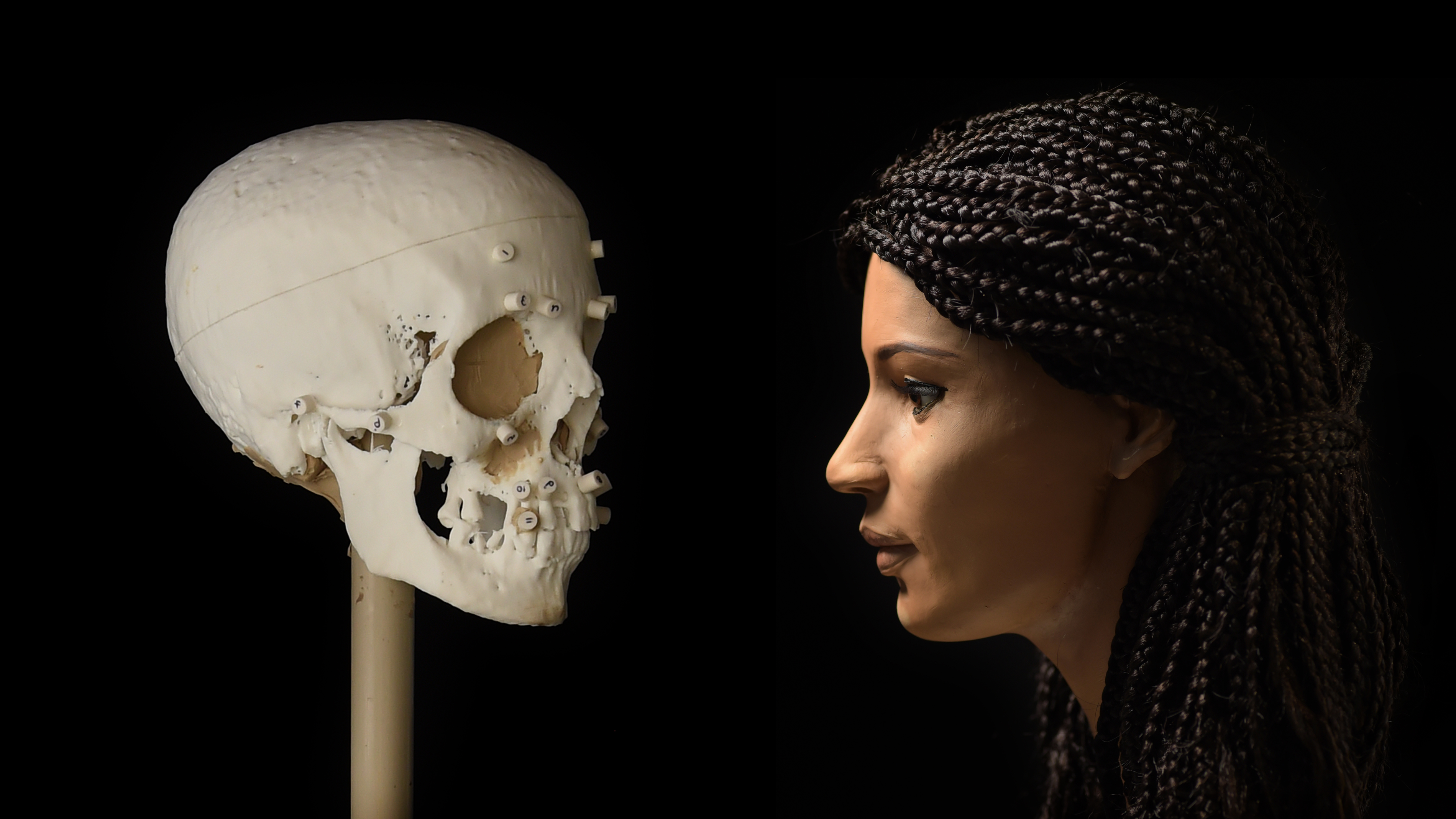
From these scans, scientists created a precise digital 3D model of her cranium.
The model was then brought into the physical world through 3D printing, a process that took more than 140 hours to complete. The result was a tangible replica of her skull—one that could be studied, measured, and reconstructed with forensic accuracy.
This printed skull became the foundation for facial reconstruction.
Building a Face from Science
Using established forensic methods, specialists reconstructed her facial features step by step.
The width of the nasal aperture helped determine the shape of her nose. The structure of the jaw and teeth provided insight into the lower face. The spacing of the eye sockets suggested large, expressive eyes. Muscle depth markers on the skull guided the reconstruction of soft tissue, allowing experts to estimate the contours of her cheeks, lips, and forehead.
According to researchers, Meritamun was likely between 18 and 25 years old at the time of her death.
Her identity as a young woman added an emotional dimension to the scientific work. She was not a distant historical abstraction, but a person who had barely begun her adult life.
As Dr. Ryan Jefferies of the University of Melbourne explained, modern technology has transformed this kind of work:
“This allows us to look through every layer of the specimen in a way that was never possible before. It turns speculation into data-driven reconstruction.”
What once depended heavily on artistic interpretation now relies on measurable biological evidence.
The Science Behind the Beauty
One of the most striking aspects of the reconstruction is how much detail can be inferred from skeletal remains alone.
Even without soft tissue, the skull preserves essential information about human appearance:
- Bone structure determines facial proportions
- Dental alignment reflects age and development
- Nasal bone shape influences external nose structure
- Cranial symmetry suggests muscle placement
When combined with statistical datasets from modern populations and forensic databases, scientists can generate remarkably accurate facial approximations.
However, researchers emphasize that these reconstructions are not photographs of the past. They are scientifically informed interpretations—carefully constrained by biology, but still partly reconstructed through modeling.
Meritamun’s face, therefore, is both real and reconstructed: a meeting point between ancient anatomy and modern technology.
A Life Lost, Then Remembered
Although little is known about her biography, her remains offer indirect clues about her life.
Her burial context suggests she may have belonged to a community where mummification practices were accessible beyond royalty, reflecting the widespread cultural importance of preserving the body for the afterlife.
Her physical condition also provides insight into ancient health, diet, and environment. Like many individuals from antiquity, her remains are now a data source for understanding the daily realities of life along the Nile.
Yet despite the scientific detail, one truth remains unchanged: she was a young woman whose life ended far too early.
From Ancient Egypt to Modern Australia
The journey of Meritamun’s mummy—from an Egyptian burial site to a university basement in Australia—reflects a broader history of archaeology in the colonial era.
In the late 19th and early 20th centuries, large numbers of Egyptian artifacts and human remains were transported to European and Western institutions for study and collection. Many of these remains were catalogued, stored, and often forgotten as academic priorities shifted.
Today, institutions like the University of Melbourne are revisiting these collections with renewed ethical and scientific perspectives, aiming to document, preserve, and better understand their origins.
Meritamun’s reconstruction is part of this broader re-evaluation.
A Window into the Past
Facial reconstruction has become one of the most powerful tools in modern forensic anthropology. It bridges the gap between scientific data and human connection.
A skull alone is silent.
But a reconstructed face transforms it into something recognizable—something that invites empathy, curiosity, and reflection.
Seeing Meritamun’s face, researchers and the public alike are reminded that ancient history is not only about civilizations and monuments, but also about individuals who once lived, breathed, and experienced the world.
The Continuing Search for Identity
The reconstruction of Meritamun is only the beginning of what researchers hope to learn.
Future studies may reveal more about her origin, her health, and possibly even the circumstances of her death. Advanced techniques such as isotopic analysis and DNA sequencing could provide further insight into her ancestry and lifestyle.
Her remains are also part of a much larger scientific collection—thousands of preserved human specimens that continue to hold untapped historical information.
Each one represents a potential story waiting to be reconstructed.
The Face That Connects Time
In the end, Meritamun’s reconstructed face is more than a scientific achievement.
It is a reminder that history is not empty.
It is filled with individuals whose identities were once known only to their communities, but who now reappear through the lens of modern science.
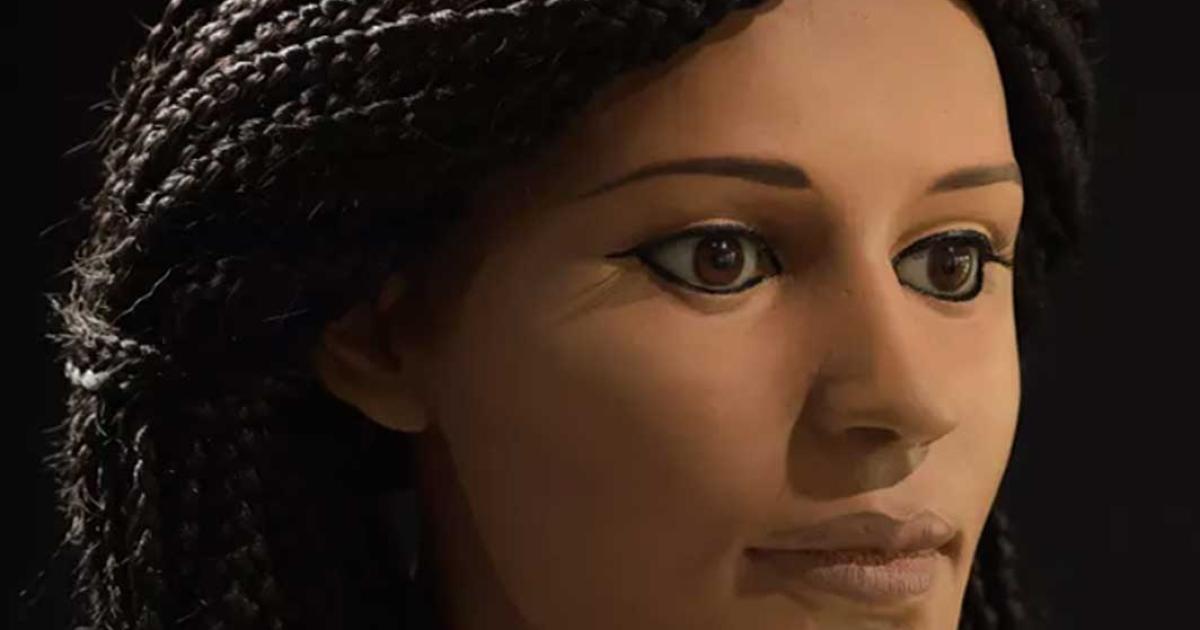
A young woman from ancient Egypt now looks back at us across two millennia—not as a myth, not as a symbol, but as a human being whose presence has been restored through technology.
And in that reconstructed face, we see something unexpectedly familiar: the continuity of humanity itself.