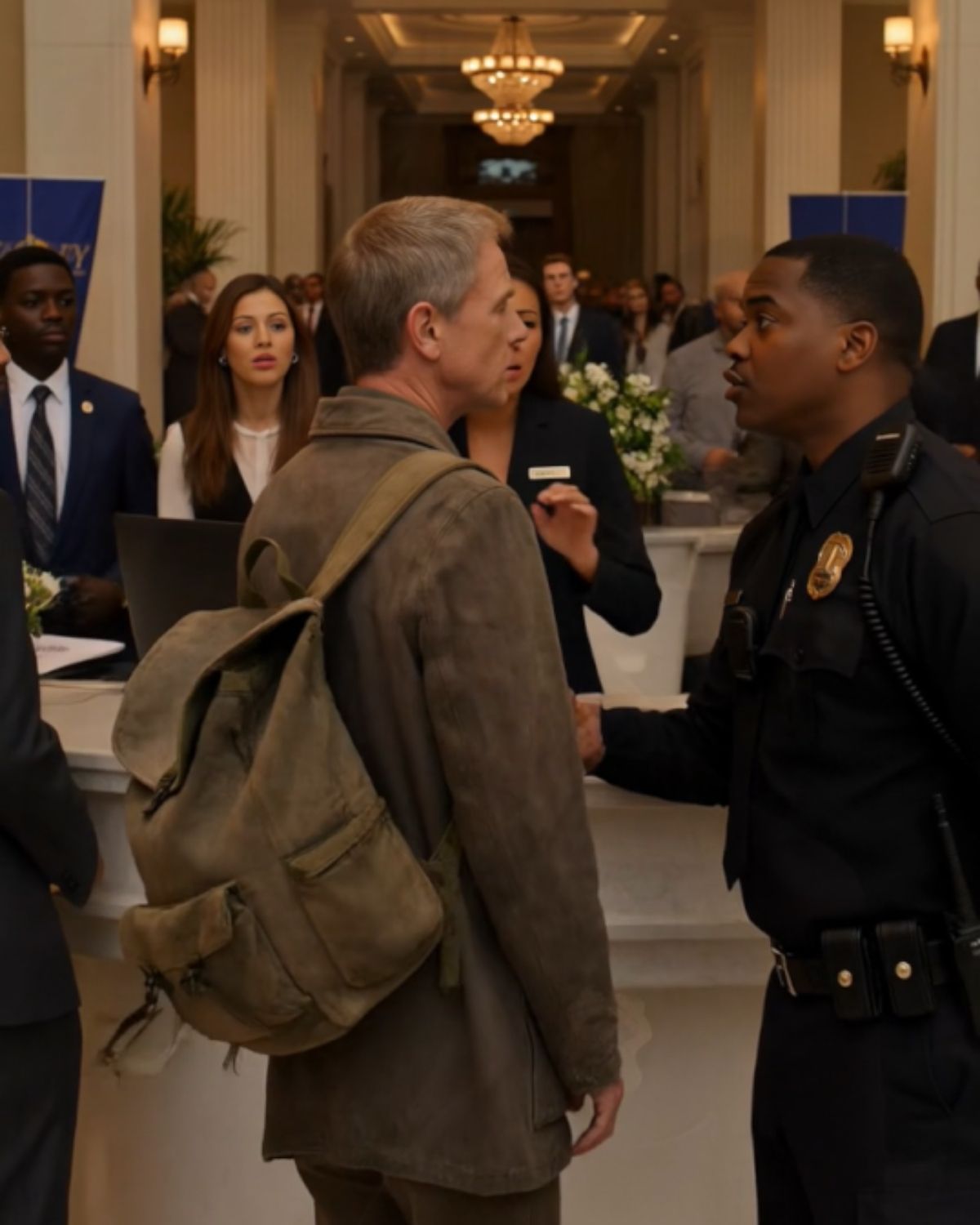
The security guard reached for the old man’s arm just as the hotel’s general manager entered the lobby.
“Sir,” the guard said, lowering his voice, “you need to leave now.”
The man did not resist.
He simply tightened his hand around the strap of his faded military backpack and looked down at the marble floor.
Then the general manager saw the badge pinned to the man’s worn coat.
He stopped walking.
The color drained from his face.
Outside the Harrington Grand Hotel, black cars lined the curb beneath a row of waving flags.
A veterans’ charity conference was taking place inside that afternoon. Large blue-and-gold banners stood on both sides of the entrance.
HONORING THOSE WHO SERVED
Men and women in formal suits moved through the revolving doors. Some wore military ribbons on their jackets. Others carried conference folders, donor badges, or engraved invitations.
Hotel employees stood beneath the awning, welcoming guests by name.
At the edge of the sidewalk, almost hidden behind a departing limousine, an older man paused and looked up at the building.
His name was Daniel Miller.
He was sixty-two years old.
His coat was too large for him and frayed around the cuffs. His trousers were clean but faded. The soles of his boots had been repaired more than once with adhesive and strips of black tape.
Over one shoulder, he carried an old military backpack that had once been green.
Years of sun and rain had turned it gray.
A small badge was pinned above the left pocket of his coat.
Most people walking past him did not notice it.
Those who did probably assumed it had come from a thrift store.
Daniel stood beneath the event banner for several seconds before taking one careful step toward the entrance.
A hotel doorman saw him approaching.
The doorman’s smile disappeared.
“Can I help you, sir?”
Daniel nodded.
“Yes. I’m looking for the veterans’ conference.”
The doorman glanced at Daniel’s backpack.
“The event is for registered guests.”
“I understand.”
Daniel reached into his coat and pulled out a folded envelope.
“I was invited.”
The doorman looked at the envelope but did not take it.
“You’ll need to speak with reception.”
“Thank you.”
The revolving glass door moved slowly.
Daniel waited until an elderly couple passed through before entering.
The lobby of the Harrington Grand was brighter than the street outside.
Afternoon sunlight poured through tall windows and reflected across the marble floor. Crystal lights hung above a wide staircase. Floral arrangements stood on polished tables beneath portraits of the hotel’s founders.
Conference guests gathered near the elevators.
A string quartet played beside the lounge.
Daniel stopped just inside the entrance.
The soft leather chairs, gold fixtures, and quiet conversations seemed to make him suddenly aware of every worn thread in his coat.
He reached up and touched the badge on his chest.
Then he began walking toward the reception desk.
Several people noticed him immediately.
A woman holding a champagne glass moved her handbag from the chair beside her and placed it in her lap.
A man wearing a donor ribbon watched Daniel cross the lobby, then leaned toward his companion.
“Is he with the event?”
His companion looked at Daniel’s boots.
“I doubt it.”
Daniel heard them.
He kept walking.
Behind the reception desk, a young employee named Allison was speaking with two conference attendees.
“Your welcome packages are already in your rooms,” she said brightly. “The reception begins at five.”
The guests thanked her and left.
Daniel stepped forward.
Allison looked up.
Her professional smile remained in place for less than a second.
“Excuse me,” Daniel said quietly. “Can you tell me where the veterans’ conference room is?”
Allison’s eyes moved over his coat, his unshaven face, and the backpack hanging from his shoulder.
“The conference?”
“Yes, ma’am.”
“Are you delivering something?”
“No.”
Daniel unfolded the envelope.
“I received an invitation. I only need the room number.”
Allison did not look at the paper.
Instead, she glanced toward the security station near the front doors.
“Do you have identification?”
Daniel reached into his coat again.
His fingers moved slowly from the cold.
“I have an old veterans’ card somewhere.”
Allison watched him search through his pockets.
The guests waiting behind him shifted impatiently.
One of them sighed.
Daniel removed a worn wallet and opened it.
Inside were a few small bills, a bus pass, an expired identification card, and a faded photograph.
He held out the veterans’ card.
Allison barely looked at it.
“This identification has expired.”
“I know.”
“Then I can’t verify that you are registered.”
“My name is Daniel Miller.”
He pointed to the envelope.
“It should be on your list.”
Allison typed something into the computer.
“What organization invited you?”
“The Harrison Veterans Foundation.”
Her fingers stopped.
The foundation was hosting the conference.
“Do you have a reservation at the hotel?”
“No.”
“Are you a speaker?”
Daniel shook his head.
“Just a guest.”
Allison looked toward security again.
This time, the guard noticed.
His name was Marcus.
He had worked at the Harrington Grand for nearly eight years and had learned to read the smallest signals from reception staff.
A glance.
A raised eyebrow.
A hand placed near the edge of the desk.
He left the security station and walked across the lobby.
Daniel saw him coming.
His shoulders tightened.
Marcus stopped beside him.
“Is there a problem?”
Allison lowered her voice.
“This gentleman says he is attending the conference, but he doesn’t have valid identification.”
Daniel held out the invitation.
“I have this.”
Marcus looked at the envelope.
The paper was creased and stained from being carried inside his coat.
The name Daniel Miller had been typed across the front.
Marcus did not open it.
“Sir, this is a private event.”
“I understand.”
“You need to be registered.”
“I was told I was registered.”
“By whom?”
Daniel looked down at the envelope.
“A woman from the foundation. She found me at the veterans’ center last month.”
Marcus and Allison exchanged a glance.
The veterans’ center was several blocks away. It provided meals, counseling, and temporary shelter referrals.
Daniel saw the look pass between them.
He knew what they had decided.
They believed someone from the center had given him a discarded invitation out of pity.
Or that he had found it.
Or taken it.
He tried again.
“I’m not asking for a room. I’m not asking for money. I only need to know where the conference is.”
Marcus folded his arms.
“Do you have a conference badge?”
“No. I was told I could collect it here.”
“Then you’ll have to contact the organizer.”
“I don’t have a telephone.”
Allison looked away.
A group of conference guests had begun gathering nearby.
Their voices lowered as they watched.
Daniel placed the invitation carefully on the counter.
“Could you call the foundation for me?”
Allison hesitated.
The telephone was directly beside her hand.
“There are several hundred guests registered,” she said. “The organizers are very busy.”
“I understand.”
Daniel waited.
Allison did not reach for the phone.
Marcus stepped slightly closer.
“Sir, you’re holding up the desk.”
Daniel turned.
Three guests stood behind him.
A woman in a navy suit looked annoyed.
A man beside her checked his watch.
Daniel picked up his envelope.
“I’m sorry.”
He stepped away from the desk.
For a moment, he stood near one of the marble columns, unsure of what to do.
The conference banners were visible near the hallway beyond the lobby.
One sign displayed an arrow.
VETERANS’ LEADERSHIP SUMMIT — EAST BALLROOM
Daniel studied it.
Then he began walking in that direction.
Marcus moved quickly and blocked his path.
“Where are you going?”
“The sign says the conference is that way.”
“I told you, you can’t enter without registration.”
“I only want to speak to someone from the foundation.”
“You can’t walk through a private event area.”
Daniel stopped.
The guests nearby were openly watching now.
A younger hotel employee whispered to another near the luggage desk.
“Security should take him outside.”
The other employee nodded.
“He probably came in for the food.”
Daniel heard that too.
His face remained still, but his hand closed tightly around the envelope.
There had been a time when people had stood when he entered a room.
Not because he was important.
Because he wore the uniform.
Because everyone in his unit understood that each man carried part of the others’ lives with him.
That had been more than thirty years ago.
Now strangers looked at his coat and saw only a problem to be moved.
Marcus lowered his voice.
“Sir, I’m going to ask you one more time to leave the hotel.”
Daniel looked toward the conference hallway.
“I traveled two hours by bus.”
“That doesn’t change the rules.”
“I was invited to attend a memorial presentation.”
Marcus’s expression hardened.
“What presentation?”
Daniel looked down.
“For members of my unit.”
Allison had stepped out from behind the desk.
“Marcus, perhaps we should just call someone.”
But the guard had already committed himself.
He had seen situations like this before.
People entered luxury hotels asking for directions, then wandered through private floors, took food from events, or refused to leave.
At least, that was what he told himself.
The truth was that Daniel’s clothes had decided the outcome before he finished speaking.
Marcus gestured toward the entrance.
“You need to go.”
Daniel did not move.
His voice remained calm.
“Please. Ask someone from the Harrison Foundation to come out.”
“I’m not debating this with you.”
“I fought with the men being honored today.”
Several guests turned at those words.
Marcus glanced around.
He seemed more embarrassed by the attention than moved by the statement.
“Sir, anyone can say that.”
Daniel’s eyes lifted.
Something changed in his face.
Not anger.
Something quieter.
He had slept in train stations, church basements, and abandoned buildings. He had waited in government offices for hours only to be given another form. He had learned how quickly a person became invisible once his clothes no longer looked respectable.
But being called a liar still reached somewhere deep.
Daniel opened his coat.
Pinned beneath the outer layer was a ribbon bar, carefully protected by a small plastic cover.
Marcus looked at it but did not recognize the colors.
“You need to stop,” he said.
Daniel closed his coat again.
“I’m not causing trouble.”
“Then don’t make this difficult.”
Marcus reached for Daniel’s arm.
Daniel flinched.
The movement was fast and instinctive.
For an instant, his body reacted before his mind did.
His right foot shifted back.
His free hand rose defensively.
Then he caught himself.
He lowered his hand.
“I’m sorry,” he said.
Marcus paused, surprised.
Daniel looked ashamed.
“Please don’t grab me without warning.”
That was when the general manager entered the lobby.
Jonathan Hale was crossing from the executive offices toward the ballroom corridor.
At forty-six, he had managed the Harrington Grand for six years. He knew the conference was the hotel’s most important charity event of the season.
His staff had spent weeks preparing for it.
The ballroom had been inspected twice.
The guest list had been checked three times.
The hotel had donated several suites for decorated veterans and their families.
Jonathan was reviewing a message on his phone when he heard Marcus’s voice.
“Sir, keep your hands where I can see them.”
Jonathan looked up.
He saw the guard.
The receptionist.
The growing circle of guests.
And an older man in a worn coat holding a faded backpack.
Jonathan walked toward them.
“What’s happening?”
Allison spoke first.
“This gentleman says he was invited to the conference, but he doesn’t have valid identification.”
Marcus added, “He refused to leave.”
Daniel looked at him.
“I asked you to call the organizer.”
Jonathan’s attention moved to the old man.
For a moment, he saw only what everyone else had seen.
The untrimmed beard.
The tired eyes.
The coat that had spent too many nights outdoors.
Then he noticed the badge.
It was pinned near the man’s left shoulder.
The metal had darkened with age, but the design was still visible.
A narrow sword.
A winged crest.
A small number engraved beneath it.
Jonathan stopped.
He had seen that symbol before.
Not in a book.
Not in a museum.
On a framed patch that had hung above his father’s desk for most of Jonathan’s childhood.
He stepped closer.
“That unit…”
Daniel’s eyes moved toward him.
Jonathan stared at the badge.
His father, Thomas Hale, had spoken rarely about combat.
But when he did, he always mentioned one night.
A damaged convoy.
A burning vehicle.
An enemy position above a narrow road.
And a young sergeant who refused to leave wounded men behind.
Jonathan’s voice dropped.
“Where did you get that badge?”
Daniel’s expression tightened.
“It was issued to me.”
“What was your unit?”
Daniel named it.
Jonathan’s breathing changed.
The lobby seemed to disappear around him.
He remembered his father sitting at the kitchen table late at night, rubbing the scar along his ribs.
He remembered asking how he got it.
His father had stared at the floor for a long time.
Then he said, “A man named Miller carried me out.”
Jonathan stepped closer.
“Were you Sergeant Daniel Miller?”
Daniel looked surprised.
“Yes.”
Jonathan stared at him.
“Sergeant Miller from the Third Reconnaissance Battalion?”
Daniel nodded slowly.
No one spoke.
Marcus released his grip.
Jonathan’s eyes filled with emotion.
“My father was Thomas Hale.”
Daniel searched his memory.
The name struck him.
His face changed.
“Hale.”
Jonathan nodded.
“Corporal Thomas Hale.”
Daniel lowered his backpack.
“He was in the second vehicle.”
Jonathan took another step forward.
“My father came home because of you.”
The words carried across the lobby.
A woman near the lounge covered her mouth.
The conference guests stopped whispering.
Marcus looked from Jonathan to Daniel.
Allison stood completely still.
Daniel shook his head.
“Your father came home because several men carried him.”
“He said you went back for him.”
“There were others.”
“He said the road was under fire.”
Daniel looked uncomfortable.
“He was wounded.”
“He said you had already been ordered to fall back.”
Daniel’s eyes moved toward the floor.
“We didn’t leave people behind.”
Jonathan’s voice broke.
“My father lived another twenty-eight years.”
Daniel looked up.
Jonathan swallowed.
“He raised three children. He saw five grandchildren born. He attended my graduation. He walked my sister down the aisle.”
Daniel’s face softened.
“I’m glad.”
Jonathan struggled to continue.
“My father told us that every year after the anniversary of that night.”
Daniel glanced at the people surrounding them.
He seemed to wish they would stop looking.
“I only did what anyone in my position should have done.”
“No,” Jonathan said. “You did what many people would have been too afraid to do.”
The hotel manager stood straighter.
Then, in the center of the grand lobby, beneath the chandeliers and charity banners, Jonathan Hale raised his hand to his brow.
He saluted.
The movement was sharp, formal, and full of respect.
Daniel froze.
His lips parted, but no words came.
Jonathan held the salute.
“This man is not to be removed,” he said firmly. “He is to be honored.”
The entire lobby fell silent.
Daniel’s hand trembled.
Slowly, almost uncertainly, he returned the salute.
For a few seconds, the worn coat disappeared.
The faded backpack disappeared.
The polished lobby disappeared.
There were only two men standing beneath a unit badge that had connected their lives long before they met.
Jonathan lowered his hand.
Daniel lowered his.
Marcus stepped back.
His face was pale.
“I didn’t know,” he said.
Daniel looked at him.
“No,” he replied. “You didn’t.”
The answer was quiet.
That made it worse.
Marcus’s eyes dropped toward Daniel’s taped boots.
“I’m sorry, Sergeant Miller.”
Daniel did not immediately respond.
Marcus swallowed.
“I judged you before I checked your invitation.”
Daniel looked toward the security station.
Then toward the hotel entrance.
“How many people have you removed without checking?”
Marcus could not answer.
Daniel nodded once, as though the silence told him enough.
Allison picked up the telephone.
“I’ll contact the foundation immediately.”
Jonathan turned to her.
“First, check the registration list.”
Her fingers shook as she typed.
The screen loaded.
Then her face changed.
“He is registered.”
Marcus closed his eyes briefly.
Allison continued reading.
“Daniel Miller. Special guest. Row one.”
Jonathan looked at the folded envelope in Daniel’s hand.
“May I?”
Daniel gave it to him.
Jonathan opened it.
Inside was a formal invitation and a handwritten note from the conference director.
Sergeant Miller, several families have asked for the opportunity to thank you. Your presence would mean more than you know.
Jonathan read the note twice.
Then he handed it back carefully.
“You were invited for the memorial presentation.”
Daniel nodded.
“Three men from my unit are being honored.”
“Why didn’t the foundation arrange transportation?”
“They offered.”
Daniel looked toward the doors.
“I missed the van from the veterans’ center. I didn’t want to make anyone come back.”
“So you took the bus?”
“Two buses.”
Jonathan glanced at Daniel’s backpack.
“Where are you staying?”
Daniel’s eyes shifted.
The answer became clear before he spoke.
“I move around.”
Jonathan remained quiet.
Daniel added quickly, “I’m working with the center. They’re helping me with housing.”
There was no dramatic confession.
No secret fortune.
No sudden revelation that Daniel owned property or had powerful friends.
He was homeless.
He was tired.
He had served his country, survived combat, and still ended up carrying everything he owned in a faded military bag.
The truth made the room more uncomfortable than any surprise could have.
A donor wearing a gold conference badge stepped forward.
“I’m on the board of the foundation,” she said. “Sergeant Miller, we’ve been trying to locate you since this morning.”
Daniel nodded.
“My bus was delayed.”
The woman looked toward Jonathan.
“He is one of the veterans being recognized.”
Daniel turned sharply.
“I was told it was for the others.”
“It is,” she said. “And for you.”
Daniel’s face tightened.
“I don’t need recognition.”
“That is not why we invited you.”
She looked toward the ballroom hallway.
“Two families are here because they wanted to meet the man who brought their fathers home.”
Daniel lowered his eyes.
For the first time since entering the hotel, he looked frightened.
Jonathan understood.
Combat had been easier to discuss than gratitude.
Orders had been easier than praise.
Daniel reached for his backpack.
“I should clean up first.”
Jonathan looked at the worn coat.
“You look like the man my father described.”
Daniel gave a small, tired smile.
“Your father remembered me younger.”
“He remembered you exactly as you were when it mattered.”
Behind them, Marcus slowly removed his hand from his utility belt.
He looked at the place where he had grabbed Daniel.
Then he faced him.
“Sergeant Miller, I have no excuse.”
Daniel studied the guard.
“You were protecting the hotel.”
Marcus shook his head.
“I was protecting the hotel from what I assumed you were.”
That honesty caught Daniel’s attention.
Marcus continued.
“I never looked at the invitation. I never checked the list. I saw your clothes and decided you didn’t belong.”
The guests nearby remained silent.
Daniel looked at him for several seconds.
“Then remember this the next time someone walks through those doors.”
Marcus nodded.
“I will.”
Daniel’s voice stayed calm.
“An apology only matters if it changes the next person’s experience.”
Marcus lowered his head.
“Yes, sir.”
Jonathan turned toward Allison.
“Please notify the ballroom that Sergeant Miller has arrived.”
She nodded.
“And ask housekeeping to prepare a suite.”
Daniel immediately shook his head.
“No. I’m not here for a room.”
“You traveled two hours to attend this event.”
“I’ll return to the center afterward.”
“The conference ends late.”
“I’ve traveled at night before.”
Jonathan looked at him.
“This is not charity.”
Daniel’s shoulders stiffened.
Jonathan continued carefully.
“It is hospitality. The same hospitality every honored guest receives.”
Daniel remained silent.
Jonathan did not push further.
“Attend the conference first. We can discuss the rest afterward.”
Daniel considered it.
Then he nodded once.
Jonathan extended his hand toward the veterans’ conference hallway.
“May I escort you?”
Daniel glanced toward the marble corridor.
A few minutes earlier, he had been blocked from entering it.
Now the hotel’s general manager stood beside him, waiting.
Daniel lifted the backpack onto his shoulder.
Jonathan reached for it.
“I can carry that.”
Daniel held onto the strap.
“I’ve got it.”
Jonathan nodded.
He did not insist.
They began walking together.
As they passed the reception desk, Allison stepped forward.
“Sergeant Miller.”
Daniel stopped.
Her eyes were red.
“I’m sorry I didn’t call the foundation when you asked.”
Daniel looked at the telephone beside her.
“It would have taken less than a minute.”
“I know.”
He nodded.
Then he continued walking.
The ballroom corridor was lined with photographs of veterans and their families.
Hotel employees stood near the doors.
Word had already begun to spread.
A conference organizer whispered to one of the guests.
The guest stood.
Then another stood.
A retired officer near the entrance saw Daniel’s badge and raised his hand in salute.
A woman beside him followed.
Within seconds, people throughout the hallway were on their feet.
Some saluted.
Others simply placed their hands over their hearts.
Daniel slowed.
His eyes moved from one face to another.
He had entered the hotel trying not to be noticed.
Now an entire hallway stood for him.
Jonathan walked beside him, matching his pace.
At the end of the corridor, the ballroom doors opened.
Inside, hundreds of guests turned.
On the stage, a large screen displayed photographs of Daniel’s old unit.
One image showed young soldiers standing beside a damaged vehicle.
Daniel was among them.
He was thinner.
His hair was dark.
His uniform was covered in dust.
But the badge on his chest was the same.
Daniel stopped at the doorway.
Jonathan’s father appeared in the photograph beside him.
Alive.
Standing.
Home because someone had refused to leave him behind.
Jonathan looked at the screen, then at the man beside him.
“My father always hoped he would see you again.”
Daniel’s eyes remained fixed on the photograph.
“I should have found him.”
“He never blamed you.”
“I lost touch with many people.”
“You carried more than most people knew.”
Daniel’s jaw tightened.
Jonathan did not ask for details.
He simply stood with him.
After a moment, Daniel took another step.
Then another.
The conference guests remained standing as he entered.
No one looked at his worn coat with suspicion now.
No one looked at his backpack as though it were dangerous.
But Daniel was still the same man who had walked through the front doors.
Nothing about his value had changed.
Only what the room knew about him.
Near the stage, two families waited.
An older woman held a framed photograph.
A middle-aged man beside her had tears running down his face.
Daniel saw them and stopped.
The woman approached him.
“My husband was Private Lawson.”
Daniel’s breath caught.
She held out the photograph.
“He came home because you went back.”
Daniel shook his head.
“We all went back.”
She took his hand.
“But you led them.”
The applause began softly.
Then it spread through the ballroom.
Daniel looked overwhelmed.
Jonathan remained beside him.
Not in front.
Not behind.
Beside him.
Back in the lobby, Marcus stood near the security station.
Through the open ballroom doors, he could see the guests applauding.
He looked down at his own polished shoes.
Then at the spot where Daniel’s taped boots had stood on the marble.
Minutes earlier, he had seen a homeless man and assumed the hotel needed protection from him.
Now he understood that a person’s hardest chapter could hide every chapter that came before it.
Daniel Miller had no home that afternoon.
He had no tailored suit, current identification, or reservation upstairs.
But long before anyone in that hotel knew his name, he had carried wounded men through gunfire so they could return to theirs.
And sometimes the person a room is quickest to remove is the very person everyone inside should have stood to honor.