Everyone laughed when the eleven-year-old boy placed a chipped blue piggy bank on the marble host stand and asked what he could buy with it.
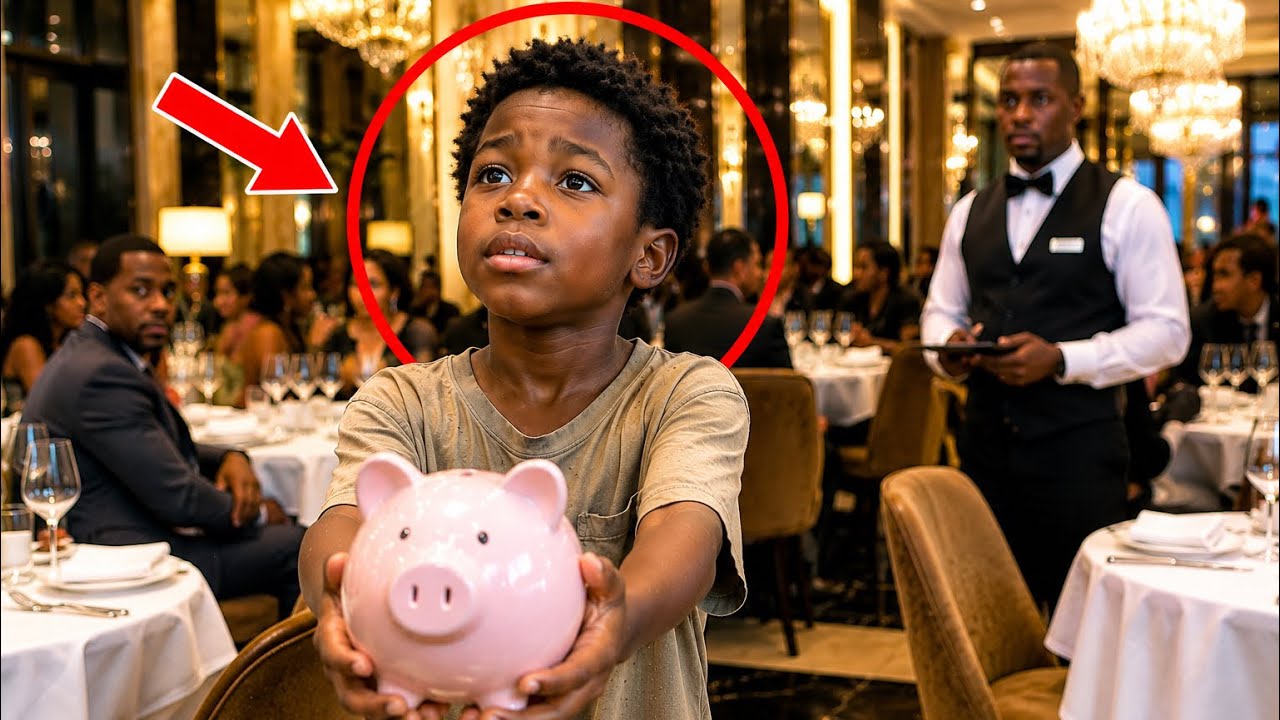
The laughter started with one waiter.
Then a woman at a nearby table covered her mouth, trying unsuccessfully to hide her smile. A man in a gray suit glanced at the boy’s worn sneakers and shook his head. Within seconds, the amusement had spread across the dining room like a ripple through water.
Malik Johnson stood beneath a crystal chandelier worth more than everything his family owned.
He tightened both arms around the piggy bank.
“I’m not asking for anything free,” he said quietly. “I have money.”
The restaurant was called Beaumont House, the kind of place where reservations were made weeks in advance and a single dinner could cost more than a month of groceries.
White tablecloths lay perfectly pressed beneath gold-rimmed plates. Soft piano music drifted through the room. Servers moved between tables carrying dishes arranged like works of art.
Malik looked as though he had stepped in from another world.
His faded red sweatshirt was too small at the wrists. One shoelace had been replaced with a piece of black string. Rainwater darkened the shoulders of his jacket.
But it was his face that made people stare.
He looked terrified.
Not embarrassed. Not confused.
Terrified.
At home, six blocks away, his mother was lying in bed with a fever so high that she had started speaking in broken sentences.
Angela Johnson had been sick for nearly a week.
At first, she called it a cold.
Then she called it the flu.
By the fourth day, she could no longer stand long enough to make food. By the fifth, the refrigerator was empty except for half a bottle of water and a packet of mustard.
That morning, Malik had found her trying to crawl from the bedroom to the bathroom.
“Mom!”
He had dropped beside her and helped her sit against the wall.
Angela’s skin felt hot, but her hands were cold. Her breathing came in fast, shallow pulls.
“I’m okay,” she whispered.
Malik stared at her.
She always said that.
She had said it when the electricity was shut off for three days.
She had said it when she skipped dinner and told him she had already eaten at work.
She had said it after losing her cleaning job at the downtown medical complex because she had missed too many shifts caring for him during a severe asthma attack.
But this time, the words sounded different.
Weak.
Far away.
“You need a doctor,” Malik said.
“We need food first.” Angela forced a smile. “I’ll feel better after I eat something.”

She reached for his hand.
“Don’t worry, baby. We’ve survived worse.”
Malik wanted to believe her.
Then she tried to stand and collapsed again.
He helped her back into bed, pulled two blankets over her trembling body and searched the apartment for money.
There was nothing in her purse.
Nothing in the kitchen drawer.
Nothing beneath the couch cushions.
Then he saw the piggy bank on top of his dresser.
Angela had bought it for him when he was six.
It was painted blue, with tiny white stars across its back. One ear had broken off when they moved apartments, and a crack ran beneath its left eye.
For five years, Malik had filled it with anything he could find.
Coins from sidewalks.
Change left in vending machines.
A dollar an elderly neighbor gave him for carrying groceries.

Three crumpled bills he had saved from his last birthday.
He had planned to use the money for a secondhand bicycle.
Instead, he wrapped the piggy bank in his sweatshirt, held it against his chest and ran into the rain.
The first two restaurants he entered told him to leave before he could finish explaining.
The third had already closed between lunch and dinner.
Beaumont House was the only place still serving food nearby.
Through the windows, Malik saw plates covered with roasted chicken, vegetables and bread.
He did not see luxury.
He saw something warm enough to help his mother sit up again.
Now, surrounded by strangers laughing at him, Malik placed the piggy bank carefully on the host stand.
A waiter named Derek Williams approached.
Derek was tall, sharply dressed and visibly irritated. He looked toward the entrance as though Malik were a puddle someone had tracked onto the floor.
“Where are your parents?” he asked.
“My dad doesn’t live with us.”
“Then where is your mother?”
“She’s home. She’s sick.”
Derek sighed.
“This is a restaurant, not a shelter.”
Malik swallowed.
“I know. I want to buy food.”
“With what?”
Malik pointed toward the piggy bank.
Another burst of laughter came from the nearest table.
Derek smiled now, encouraged by the attention.
“What exactly are you hoping to order?”
“Anything warm,” Malik said. “Soup. Bread. Chicken. It doesn’t matter.”
“And how much money is in there?”
“I don’t know exactly.”
“You came into Beaumont House without knowing how much money you have?”
“I saved it for years.”
Derek tapped the piggy bank with one finger.
Coins shifted inside.
The sound was small and metallic.
“You might be able to buy a glass of water,” he said.
A few customers laughed again.
Malik’s cheeks burned, but he did not move.
“My mother hasn’t eaten in three days.”
The laughter weakened.
Only for a moment.
Derek looked around the room, aware that people were watching him.
“Then you should call social services.”
“I don’t have a phone.”
“Ask a neighbor.”
“The lady next door is working. Everyone is working.”
“Then go to a hospital.”
“She told me not to.”
Derek gave a dry laugh.
“And you always do exactly what your mother tells you?”
Malik looked at him.
“No,” he said. “That’s why I’m here.”
The words silenced a few people.
But not the restaurant manager.
Richard Coleman had been observing from near the bar. He walked over with his hands clasped behind his back and the expression of a man preparing to remove an inconvenience.
“What’s happening?” he asked.
“This child is trying to pay for dinner with a toy,” Derek said.
“It isn’t a toy,” Malik replied.
Richard did not look at him.
“Get him outside.”
Malik grabbed the piggy bank.
“Please. I’m not asking for a full meal. Just something my mom can eat.”
“You’re disturbing our guests,” Richard said.
“I’ll sit outside.”
“No.”
“I can wait by the door.”
“No.”
“I’ll give you everything in here.”
Richard’s jaw tightened.
“Derek, escort him out.”
Derek reached for Malik’s shoulder.
At the rear of the dining room, a fork touched a plate with a clean, sharp sound.
A man stood up.
He was in his late forties, wearing a dark suit with no tie. Silver showed at his temples. Until that moment, he had been eating alone while reviewing documents beside his plate.
Several guests recognized him immediately.
Dr. Marcus Reed.
Founder of Reed Medical Group.
Chairman of the Reed Foundation.
A physician whose hospital network employed thousands of people across the state.
Marcus rarely gave interviews and almost never appeared at social events. People in the city knew his face from medical conferences, charity galas and newspaper profiles.
He walked across the restaurant without hurrying.
“Take your hand off him,” he said.
Derek froze.
Richard’s posture changed instantly.
“Dr. Reed, I apologize. We were just handling—”
“I wasn’t speaking to you.”
Marcus stopped in front of Malik.
Then, to the surprise of everyone watching, he lowered himself onto one knee.
They were now eye to eye.
“What’s your name?” Marcus asked.
“Malik.”
“How old are you, Malik?”
“Eleven.”
Marcus nodded toward the piggy bank.
“Tell me why you brought that here.”
Malik tried to answer, but his throat tightened.
He looked toward the floor.
“My mom is sick,” he managed. “She hasn’t eaten. I thought if she had something warm, maybe she could get better.”
Marcus’s voice remained calm.
“How long has she been sick?”
“Six days. Maybe seven.”
“Is she awake?”
“She was when I left.”
“Can she stand?”
Malik hesitated.
“She tried this morning.”
“And?”
“She fell.”
Marcus’s expression changed.
“Is she breathing normally?”
“No. Last night she was breathing really fast. Today it’s slower, but it sounds strange.”
The dining room had become completely silent.
Marcus asked for Angela’s age, whether she had been vomiting and whether she had complained of pain.
Malik answered as best he could.
Then Marcus stood.
“Where do you live?”
“Six blocks away.”
Marcus turned to the manager.
“Call emergency services. Tell them we may have an unresponsive adult with respiratory distress.”
Richard blinked.
“Right now?”
Marcus stared at him.
“Right now.”
He pulled out his phone and called his office.
“Cancel the afternoon meeting,” he said. “Cancel everything.”
The person on the other end apparently protested.
Marcus ended the call.
Then he looked at Malik.
“I’m a doctor. You’re going to take me to your mother.”
They left the restaurant together.
Malik ran most of the way.
Marcus stayed beside him despite his dress shoes striking the wet pavement. The piggy bank bounced against Malik’s chest with every step, the coins inside rattling like a desperate clock.
“Is she going to die?” Malik asked.
“I haven’t seen her yet.”
“But do you think she will?”
Marcus did not offer a false promise.
“I think you did the right thing by leaving to get help.”
Malik ran faster.
Their apartment building stood behind a laundromat and a boarded-up pharmacy. Paint peeled from the entrance. One window on the second floor had been covered with cardboard.
When Malik reached apartment 2C, the door was slightly open.
He stopped.
“I closed it before I left.”
Marcus moved in front of him.
“Stay behind me.”
Inside, the apartment was dark.
“Mom?” Malik called.
No answer.
He rushed toward the bedroom before Marcus could stop him.
Angela was lying on the floor beside the bed.
One arm was folded beneath her body. Her face was turned toward the wall.
For one suspended second, Malik made no sound.
Then the piggy bank slipped from his hands.
It struck the floor and cracked along its belly.
Coins rolled beneath the bed, across the worn carpet and into the hallway.
“Mom!”
Marcus was already moving.
He placed two fingers against Angela’s neck, checked her breathing and pulled one eyelid open.
“Malik, step back.”
“Is she dead?”
“She has a pulse.”
The words barely left Marcus’s mouth before Angela’s body shook with a weak cough.
Her eyes remained closed.
Marcus rolled her carefully onto her side and spoke into his phone, giving the dispatcher her symptoms and exact location.
Malik crouched against the wall, gripping his own knees.
“Please save her,” he whispered.
Marcus looked at him.
“We’re going to do everything we can.”
The ambulance arrived within minutes.
To Malik, it felt like an hour.
Paramedics filled the small bedroom. They placed an oxygen mask over Angela’s face, attached monitors to her chest and lifted her onto a stretcher.
One paramedic called out her blood pressure.
Another answered with a number Malik did not understand.
But he saw Marcus’s face.
The number was bad.
At the hospital, Angela disappeared through two swinging doors.
Malik was led to a waiting area beneath lights that never stopped buzzing.
He sat in a plastic chair with his wet sweatshirt clinging to his back. A nurse brought him crackers and juice, but he could not swallow.
One hour passed.
Then two.
Then three.
Every time the emergency room doors opened, Malik stood.
Every time, someone else came through.
Marcus had vanished behind those doors with Angela. No one explained whether he was still treating her or whether he had gone back to his own life.
Malik stared at the floor.
He imagined returning to the apartment alone.
He imagined waking up for school with no one reminding him to take his inhaler.
He imagined the empty chair beside the kitchen window where Angela drank coffee every morning, even when they had no breakfast.
He pressed both hands against his face.
“Please,” he whispered. “Please don’t take her.”
Near midnight, Marcus emerged.
His sleeves were rolled up. Exhaustion lined his face.
Malik jumped to his feet.
Marcus walked toward him but did not smile.
“We stabilized your mother.”
Malik exhaled so quickly that his knees weakened.
Then Marcus continued.
“But we’re not finished.”
The relief disappeared.
“Her fever wasn’t the main problem. She has a severe bacterial infection that spread into her bloodstream. It caused sepsis and began affecting her lungs and blood pressure.”
Malik stared at him.
“Is she going to live?”
“She is critically ill.”
“That’s not an answer.”
Marcus paused.
“No,” he said softly. “It isn’t.”
He pulled a chair closer and sat in front of Malik.
“She needs intensive treatment. We’ve started strong antibiotics, fluids and medication to support her blood pressure. I’ve called in two specialists.”
“Can I see her?”
“Not yet.”
Malik’s lips trembled.
Marcus leaned forward.
“Your mother is fighting. And she got here in time because you refused to walk away when something was wrong.”
Malik looked toward the emergency room doors.
“My mom always says that.”
“Says what?”
“That you don’t walk past someone in trouble.”
Marcus became very still.
“What did you say her full name was?”
“Angela Johnson.”
Marcus repeated the name under his breath.
“Has she ever worked in a hospital?”
“She cleaned offices at Reed Medical Center. Before she got fired.”
Marcus looked toward the doors again.
This time, something had changed in his eyes.
He stood abruptly.
“Stay here.”
He returned forty minutes later carrying an old employee file.
Inside was a faded identification photograph of Angela wearing a blue custodial uniform.
Marcus sat beside Malik and stared at the photograph for several seconds.
Then he told him the truth.
Eight years earlier, before Marcus Reed became one of the most powerful medical executives in the state, he had nearly died in the basement parking area of his own hospital.
He had been working for thirty hours without sleep. While walking toward his car, he suffered a sudden cardiac arrhythmia and collapsed behind a concrete pillar.
The security camera covering that area had been broken.
No doctors were nearby.
No nurses saw him fall.
The only person who found him was a night-shift cleaner.
She had been pushing a supply cart when she noticed a shoe extending from behind the pillar.
She ran toward him, called a medical emergency and began chest compressions.
For nearly four minutes, she kept blood moving through his body until the response team arrived.
Marcus remembered only fragments.
A cold floor.
A woman’s voice telling him not to give up.
And one sentence repeated again and again.
“You don’t walk past someone in trouble.”
The hospital later told him that an employee had found him.
But during his recovery, records were misplaced, the cleaning contract changed and the woman disappeared before he learned her name.
Marcus had spent years funding cardiac emergency programs because of that night.
He never knew the person who saved him had been Angela Johnson.
Until her son walked into a restaurant carrying a piggy bank.
Malik looked through the glass window toward the intensive care unit.
“My mom saved you?”
Marcus nodded.
“And today,” he said, “you gave me the chance to repay a debt I thought I would carry forever.”
At six the next morning, Angela’s blood pressure began to improve.
By afternoon, her oxygen levels stabilized.
The second night remained dangerous, but the infection responded to treatment.
On the third morning, Marcus entered the waiting room with a smile.
Malik was asleep across two chairs.
Marcus touched his shoulder.
Malik woke instantly.
“Your mother is going to be all right.”
For several seconds, he simply stared.
Then he threw both arms around Marcus.
The sound that came from him was half sob, half breath—the release of everything he had held inside since finding Angela on the floor.
Marcus closed his eyes and held him tightly.
Three weeks later, Angela walked out of the hospital.
She was thinner and still needed help climbing stairs, but she was alive.
A month after that, Marcus invited Angela and Malik to his office.
Angela arrived wearing the only formal blouse she owned. Malik sat beside her, looking around at shelves filled with medical awards and photographs of hospital openings.
Marcus placed a folder on the desk.
Inside was an employment contract.
Reed Medical Center was offering Angela a full-time position in its patient advocacy department. Her job would be to help low-income families navigate emergency care, food assistance, transportation and medical support.
The position included health insurance, paid training and a salary almost twice what she had earned cleaning offices.
Angela covered her mouth.
“I’m not qualified for this.”
Marcus shook his head.
“You noticed a man lying behind a pillar when everyone else walked past. You raised a boy who used everything he owned to help someone he loved. Compassion cannot be taught as easily as paperwork.”
Then he reached beneath his desk.
He placed a familiar blue piggy bank in front of Malik.
The crack had been repaired. The missing ear had been carefully rebuilt. Every coin had been cleaned and returned.
A small card was tied around its neck.
Malik opened it.
The message read:
“It was never the amount inside this piggy bank that changed your life. It was the love that placed every coin there.”
Malik looked up with tears in his eyes.
Marcus was not finished.
The Reed Foundation would cover Malik’s education through college, provided he kept working hard and continued helping others.
Angela began to cry.
Not quietly.
Not politely.
She reached across the desk and took Marcus’s hand, the same hand she had unknowingly helped keep alive eight years before.
In the months that followed, their lives changed.
Angela regained her strength and became one of the hospital’s most trusted patient advocates.
Malik transferred to a school with a strong science program. He kept the piggy bank on a shelf above his desk, but he never filled it with money again.
Instead, he placed handwritten notes inside it.
Names of people who had helped him.
Promises he intended to keep.
Reminders of the day a room full of wealthy adults laughed at a frightened child—and one man finally listened.
Derek and Richard did not escape the consequences of what happened.
Several restaurant guests had recorded the confrontation. After the video reached Beaumont House’s owners, both men were suspended pending an investigation.
The company later issued a public apology, introduced mandatory dignity and crisis-response training and began donating unsold meals to local shelters.
The same dining room that had laughed at Malik eventually hosted a fundraiser for families facing food insecurity.
Marcus attended.
So did Angela.
Malik stood between them, wearing the same repaired piggy bank on a strap across his shoulder.
Nobody laughed this time.
Because the smallest person in the room had already taught the city its largest lesson:
Never measure someone’s worth by what they carry in their hands—because love, courage and the power to change a life are things no piggy bank could ever hold.