Most Dutch students, if you put them on the spot, could not name a single country their country once colonized. The ones who did their homework might say Indonesia or Suriname. Very few would mention that the Dutch once ruled a large stretch of Brazil, and fewer still would know the name of the man who governed it. But in Brazil, children learn about him in school.
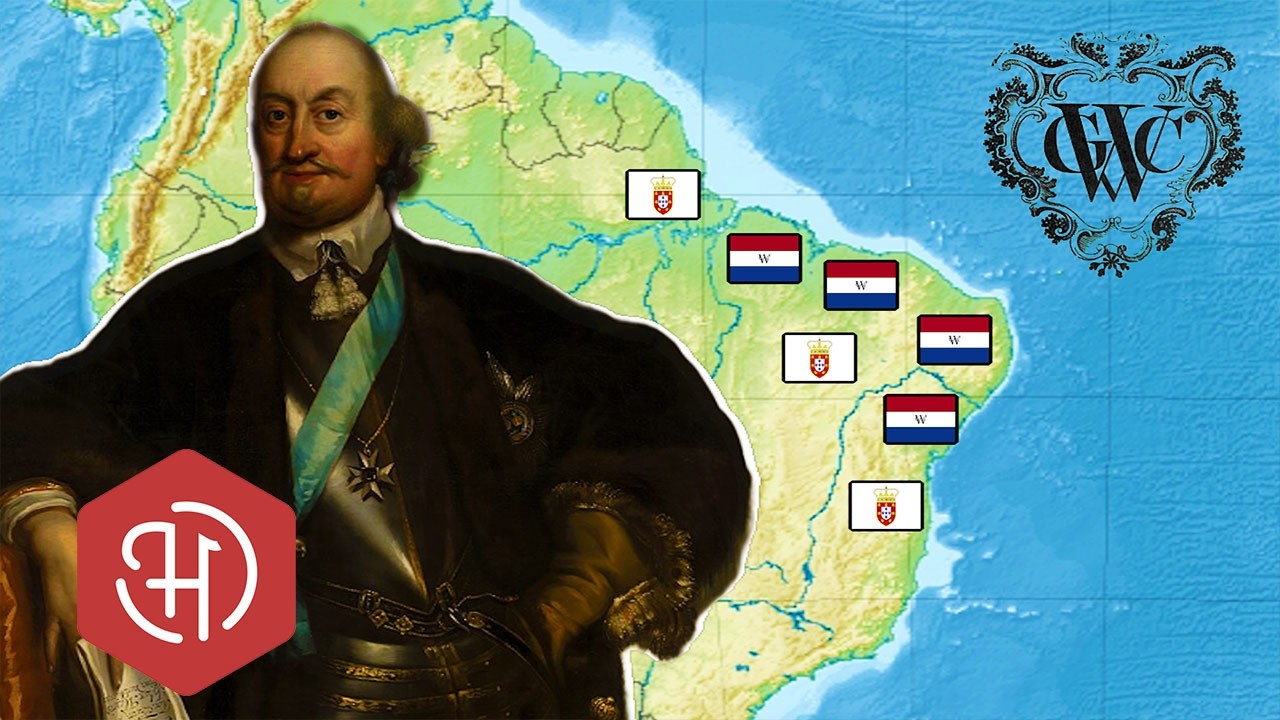
His name is Johan Maurits of Nassau-Siegen, and for a brief period in the seventeenth century, he ran a colony called New Holland at the edge of the South American continent. He was a German count from a younger branch of the Nassau family, not to be confused with his more famous namesake, Prince Maurits of Orange, the son of William of Orange. And while the Netherlands largely forgot him, Brazil never did. The story begins with money, as colonial stories so often do.
The Dutch West India Company, known as the WIC, was a trading enterprise built on plunder and profit. Its directors had their eyes on the sugar trade, which until then had been almost entirely in Portuguese hands. The Dutch Republic was fighting Spain in the Eighty Years’ War, and Portugal, at that time, was under Spanish rule. That made the Portuguese fair game.
Attacking Portuguese colonies was not just a business opportunity; it was a legitimate act of war. The first attempt came in 1624, when a Dutch fleet briefly seized the city of Salvador, also called Bahia. The Portuguese recaptured it quickly. The real breakthrough came in 1630, when the WIC, flush with cash after the privateer Piet Hein captured the Spanish silver fleet, launched a major military expedition.
The Dutch took a long strip of the northeast Brazilian coast, including the cities of Olinda and Recife. The conquered territory stretched roughly six hundred kilometers along the coast and ran about seventy kilometers inland. They called it New Holland. From Recife, the Dutch expanded their control.
They took over sugar plantations and tried to make the land pay. But governing a colony was harder than conquering one. The Portuguese did not surrender everywhere; they held their ground in the south and kept fighting. The WIC needed a strong leader on the ground, someone of high standing who could command respect and impose order.
That is how Johan Maurits of Nassau-Siegen entered the picture. He was born in 1604 at Dillenburg Castle, the same castle where his granduncle William of Orange had been born. He was one of twenty-five children of John VII of Nassau-Siegen, a nobleman with more offspring than money. The eldest sons received education and travel opportunities, but there was nothing left for Johan Maurits.
At sixteen, he chose a soldier’s life. He joined the Dutch States Army, which had been fighting Spain in the Dutch Revolt. A truce was in place at the time, so the young nobleman had room to learn his trade. He served as a cavalry officer under his relative Frederick Henry.
When the Twelve Years’ Truce ended in 1621 and the war resumed, he fought in campaigns and sieges across the region. His courage earned him a quick promotion to captain. In the winters, he lived in The Hague and took part in court life. In 1632, he bought land next to the Binnenhof and began building a palace, the building now known as the Mauritshuis.
Money likely played a part in his decision to go to Brazil. The WIC’s governing board, the Heren Nineteen, was looking for a governor for New Holland. They wanted someone with a noble title, military experience, and enough ambition to take on a difficult assignment. Johan Maurits was a natural candidate.
In 1636, he was appointed governor-general. The salary was high, and he was promised a share of the spoils. In October of that year, he sailed for Brazil, accompanied not only by soldiers but by artists and scientists tasked with documenting the land, its people, and its nature. When he arrived, he found a colony in rough shape.
The Dutch had captured territory, but they had not fully secured it. The Portuguese had retreated and burned their own sugar mills to deny the Dutch their profit. Crime and corruption were common. The colony was a mess.
Johan Maurits set to work immediately. He led military campaigns against the Portuguese and expanded the territory under Dutch control. He imposed order, tackling crime and corruption and establishing a legal system. He introduced standard measurements based on those used in Amsterdam.
He fortified Recife and built a new city across the river, called Mauritsstad, named in his own honor. At the heart of it stood his palace, Vrijburg. The palace was a statement. From its windows, one could see for kilometers across the ocean.
One room was furnished entirely in ivory: the table, the chairs, even the candlesticks. Around the palace stretched a park with vineyards and fountains. At the foot of the hill lay a neat city, its streets straight and intersecting at right angles, as if drawn from a drafting table. There was a hospital and an orphanage.
Mauritsstad looked like a piece of modern Europe transplanted into the American tropics. To connect the new city with old Recife, a bridge had to be built across the river. The current was so strong that the chief engineer declared a stone bridge impossible. Johan Maurits, who liked to design things himself, proposed a wooden central section.
The bridge was built. The current Ponte Maurício de Nassau stands in roughly the same location today and still bears his name. His ambitions went beyond construction. He understood that he could not defeat the Portuguese entirely, so he needed their cooperation.
He granted them equal rights. Portuguese residents were allowed to take part in city governance. In 1640, he convened a meeting of Dutch and Portuguese representatives, later regarded as the first parliament on the American continent. He granted religious freedom.
Catholics could practice their faith openly. Jews were permitted to gather and worship, and the first synagogue in South America was built in Recife under his rule. The building still stands today and is now a museum. To restore sugar production, he sold the abandoned plantations.
Portuguese owners could borrow money to buy back their land. The Dutch themselves had little knowledge of sugar cultivation and even less interest in doing the work. Few Dutch colonists came to Brazil, so the colony remained dependent on enslaved labor. Johan Maurits sent a fleet to Fort Elmina on the African coast, strengthening the Dutch slave trade.
It was a brutal system, and he built his colony on it, like everyone else in that era. His policies of tolerance and his flourishing capital made New Holland famous. The artists and scientists he had brought with him produced important work on tropical diseases, biology, and astronomy. Mauritsstad became the cultural center of the New World, with a botanical garden, a zoo, and a museum.
It seemed that nothing could stop the Dutch colony from thriving. But the WIC directors were not impressed. They were interested in profit and military success, not in botanical gardens and ivory rooms. By 1643, peace had been concluded between Portugal and the Dutch Republic, and the company wanted to cut costs.
They wanted fewer troops in Brazil. They looked at Johan Maurits’ expensive construction projects and his generous style of governance and found it excessive. They recalled him. He, in turn, complained that the company gave him insufficient support and held unrealistic expectations.
On May 11, 1644, Johan Maurits bid farewell to Brazil. Large crowds came to see him off. He left behind a colony that appeared prosperous and peaceful. It did not last.
After his departure, things declined quickly. His successors could not maintain peace. The Portuguese pressed harder. Mauritsstad was destroyed during the defense of Recife.
In 1654, the Dutch lost Brazil for good. Johan Maurits was already back in The Hague by then. His palace, the Mauritshuis, was complete. He filled it with Brazilian objects, stuffed animals, and paintings from the artists who had accompanied him.
During festivities, he offered guests exotic drinks and hosted Brazilian performers. He remained active in the army, rising to commander-in-chief in 1675. The following year, he withdrew from public life. He died in 1679 near Kleve, in Germany, and was buried there.
He never married and had no legitimate children. In Brazil, he is remembered as one of the best colonial administrators ever to govern the land. Schools, a bridge, and a university carry his name. His bust stands by the governor’s house.
He is known there as Maurício de Nassau, a hero of a certain kind. In Germany, he is remembered for the parks and construction projects he commissioned. In the Netherlands, his name is attached to the Mauritshuis, the museum that was once his palace, though many people confuse him with his distant cousin, Prince Maurits of Orange, after whom he was named. He is barely known in the country of his own adopted service.
The Dutch presence in Brazil was short. It lasted barely two decades, from 1630 to 1654. It began with the capture of a coastline and the promise of sugar money. It ended with the destruction of a city built to rival any in Europe.
But between those two moments, a German count built a palace, governed with an unusual degree of tolerance, and left a mark on Brazil that lasted long after the Dutch flag came down. His name faded in the Netherlands, but it never disappeared in the country he once ruled.