Nathaniel Prescott had learned how to live with ghosts.
Not the kind that rattled chains or whispered in hallways—but the quieter ones. The kind that sat beside you at breakfast. The kind that filled a child’s empty chair. The kind that made a man worth millions feel like he had lost everything that actually mattered.
Seven years earlier, his wife had drowned in the Blackridge River.
At least that was what everyone said.
The river had been swollen that night. Rain pounding so hard the ranch roads disappeared. Clara had been returning from town when her carriage was found overturned near the bridge. No body was ever recovered, only her shawl caught on a broken post downstream.
The sheriff called it “presumed drowning.”
The town called it tragedy.
Nathaniel called it the night his life ended.
But life, cruel as it is, didn’t stop there.
It simply narrowed.
Until all that remained was his son.
Ethan Prescott.
Eight years old now. Quiet eyes. A habit of watching people too closely, as if the world might disappear again if he blinked.
Nathaniel raised him the only way he knew how—through structure, silence, and money that could fix almost anything except absence.
And yet, every Sunday, Ethan still insisted on walking through the town square after church.
Nathaniel never asked why.
Until the day everything broke.
It was an ordinary morning when it happened.
Market day. Dust in the air. Vendors shouting prices. Horses tied near the fountain.
Nathaniel was mid-conversation with a supplier when he felt Ethan stop walking beside him.
Completely still.
Not the usual distracted child’s pause—but something sharper.
“Ethan?” Nathaniel asked without turning.
No answer.
Then came the whisper.
So faint it almost got lost in the noise of the square.
“Father… that woman…”
Nathaniel finally turned.
Ethan was staring across the square.
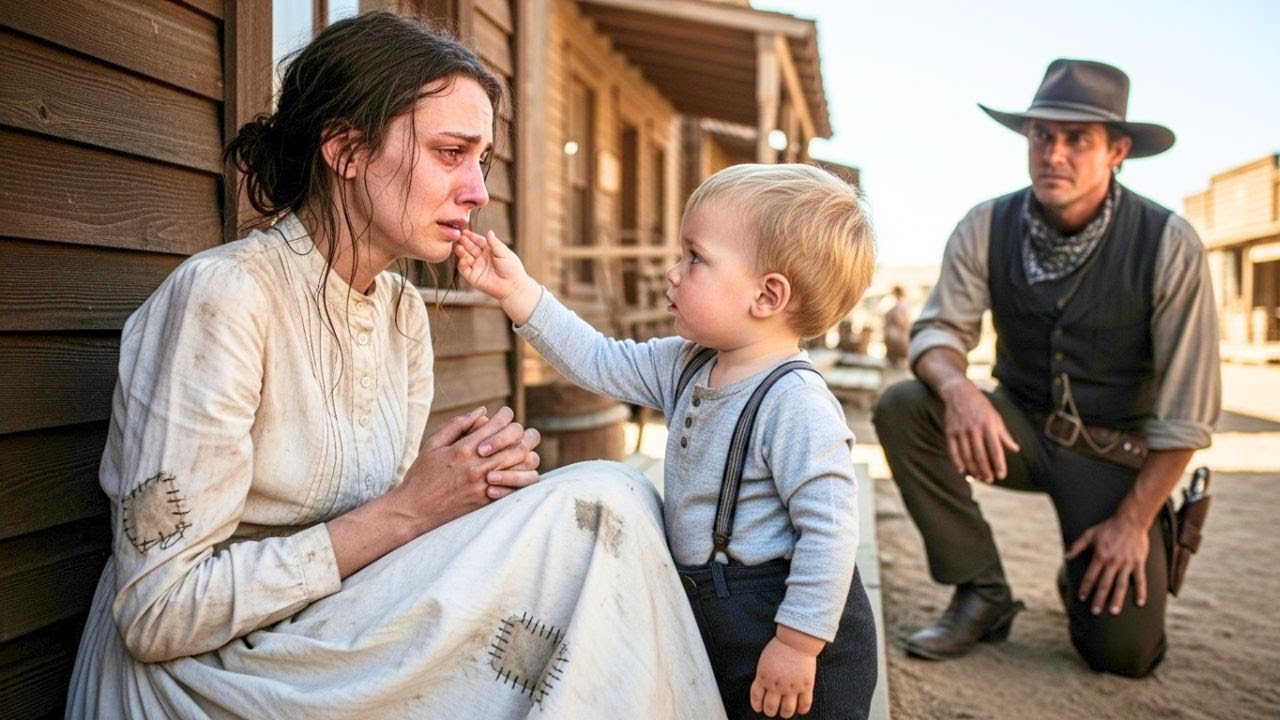
At a beggar woman sitting near the old stone steps of the church.
She was barefoot. Wrapped in a torn shawl that looked like it had survived too many winters. Her hair hung uneven, uncombed, as if time itself had forgotten her.
She wasn’t asking for anything.
Just sitting.
Still.
Watching nothing.
Nathaniel felt a brief discomfort—pity, maybe—and looked away.
But Ethan didn’t move.
His voice broke when he spoke again.
“She’s my mom.”
The world didn’t go silent.
It simply stopped making sense.
Nathaniel turned sharply now. “Ethan, don’t—”
But the boy had already pulled away.
And he was walking.
Straight toward her.
Nathaniel followed immediately, irritation rising like instinct. Children imagined things. Especially children who had lost too much too early.
But then Ethan stopped just a few feet from the woman.
And said it again.
Except this time, it wasn’t a statement.
It was recognition.
“Mom?”
The woman flinched.
Not like someone startled.
Like someone struck.
Her head turned slowly toward the boy.
Her eyes were hollow at first—clouded, unfocused. Then something inside them shifted. A flicker. A crack in a wall that had been holding too much back for too long.
Her lips parted.
No words came out.
But her hands began to tremble.
Nathaniel stepped forward now, anger mixing with disbelief. “Ethan, come away from her.”
The woman reacted instantly at his voice.
She recoiled.
As if the sound itself hurt.
And that was when Nathaniel noticed something he hadn’t before.
A scar near her wrist.
A thin, pale line shaped like a crescent.
Clara had the same mark.
He remembered because he used to trace it absentmindedly when she slept beside him.
His breath caught.
“No,” he said under his breath. “That’s impossible.”
The woman stood suddenly.
Unsteady. Like the ground beneath her didn’t belong to her feet.
She tried to step back—but Ethan grabbed her sleeve.
“Mom, it’s me. It’s Ethan.”
At his name, something broke completely inside her expression.
She looked at him.
Really looked.
And for the first time, she spoke.
One word.
Broken.
Barely audible.
“…Ethan?”
Nathaniel felt the air leave his lungs.
Because that wasn’t recognition learned from rumor or coincidence.
That was memory.
And memory didn’t lie.
But it also didn’t explain how a woman declared drowned seven years ago was standing barefoot in a town square like a ghost that refused to stay buried.
He took her to the hospital that afternoon.
She didn’t resist.
Not because she trusted him.
Because she didn’t seem to understand where she was at all.
Doctors spoke in careful tones. Words like “trauma,” “dissociation,” “possible captivity.” They ran tests, took blood, examined scars and old injuries that didn’t match any record Nathaniel had ever seen.
But when they showed her a photograph of Clara Prescott from years ago…
She broke down.
Not with clarity.
But with pain.
Hands clutching her head. Whispering fragments.
“Water… dark… don’t let him—no—please—”
Then silence.
And fear.
That night, Ethan refused to leave her side.
Nathaniel stood outside the hospital room, watching through the glass.
The woman—Clara, if she truly was Clara—sat on the bed like someone who didn’t know what a bed was for. Ethan held her hand carefully, as if afraid she might disappear again if he loosened his grip.
Nathaniel should have felt relief.
But what he felt instead was something colder.
Because grief is simple when it has closure.
But when the dead come back wrong…
it becomes something else entirely.
By morning, the story had spread.
Rich rancher’s wife found alive.
Beggar woman claims identity.
Town divided.
Some called it miracle.
Others called it delusion.
Nathaniel called for the only thing he trusted anymore.
Proof.
That was when the lawyer arrived.
And so did the first crack in reality.
“There is no official record of survival,” the lawyer said carefully. “But there is something else.”
He placed a file on Nathaniel’s desk.
Inside: a hospital admission record.
Seven years ago.
A woman had been found near the river, unconscious, unidentified.
Transferred to a private psychiatric facility under government contract.
Her name listed only as:
Jane Doe.
Nathaniel’s hand tightened on the paper.
“She was alive,” he said slowly.
“Yes,” the lawyer replied. “But she was never reported found.”
Nathaniel stood up so fast his chair scraped back.
“Someone buried her existence.”
The lawyer hesitated. “Or made sure it stayed buried.”
That was the first time Nathaniel thought of something other than loss.
He thought of intent.
Clara didn’t recover quickly.
She didn’t “wake up” like stories like to pretend.
She fractured.
Some days she recognized Ethan.
Some days she screamed at shadows no one else could see.
Some days she sat by the window whispering about water that wasn’t there.
But there was one constant.
She reacted to fear.
And one name triggered it more than anything else.
Dalton Reed.
Nathaniel’s ranch manager.
The man who had been by his side for nearly a decade.
The man who had handled everything after Clara’s disappearance.
The man who had been the last person to see her before the river.
When Nathaniel mentioned the name casually in conversation one evening, Clara froze completely.
Her fingers tightened around the blanket.
“No,” she whispered. “Not him.”
That was all she would say.
But it was enough.
Because fear like that doesn’t come from imagination.
It comes from memory.
The investigation began quietly.
Too quietly.
Because the deeper Nathaniel dug, the more resistance he met.
Records missing. Files sealed. Witnesses suddenly unavailable.
And always, always, someone was one step ahead.
Until Ethan drew a picture.
It was a simple thing.
Crayon on paper.
But what it showed made Nathaniel stop breathing again.
A barn.
A man standing inside it.
And a symbol on the wall.
A crescent shape.
The same mark on Clara’s wrist.
Ethan pointed at it and said softly,
“Mom drew this. Before she stopped talking.”
That night, Clara spoke clearly for the first time.
Not in fragments.
Not in fear.
But in truth.
“They didn’t save me from the river,” she said.
Nathaniel leaned forward instantly. “Who?”
Her eyes shook.
“Dalton.”
The room went still.
“He told everyone I drowned,” she continued. “But I didn’t. I was taken. Kept away. Every time I tried to tell someone who I was… they said I wasn’t her anymore.”
Nathaniel felt something inside him collapse into something sharp.
“You’re sure?”
Clara looked at Ethan.
Then back at him.
“I remember my son.”
That was the moment everything stopped being uncertain.
And started becoming war.
The court battle came quickly after that.
Dalton Reed denied everything.
Calm. Controlled. Sympathetic.
A man wrongfully accused, he said.
A grieving employer misled by trauma.
He even brought witnesses.
Men from the ranch.
Men Nathaniel had trusted for years.
But lies have a weakness.
They depend on silence.
And Ethan was no longer silent.
When asked in court if he was sure, the boy stood up.
Small. Eight years old.
And said clearly:
“She is my mother. And he is lying.”
The room shifted.
Because children don’t perform like that.
Not unless truth lives somewhere deeper than doubt.
Then the final proof arrived.
A hidden ledger recovered from Dalton’s office.
Payments.
Transfers.
A forged death certification routed through a corrupt county clerk.
Everything designed not just to erase Clara…
but to replace her legally.
The courtroom erupted.
But Nathaniel wasn’t listening anymore.
He was looking at Dalton.
Who was no longer calm.
For the first time, the man looked cornered.
Human.
And afraid.
The judge’s gavel struck like thunder.
Custody restoration. Investigation. Arrest order.
Dalton stood slowly.
And as security moved in, he looked directly at Nathaniel.
Not angry.
Not guilty.
Just empty.
“You think you got her back,” he said quietly.
Nathaniel didn’t answer.
Because Clara had just entered the courtroom.
And she wasn’t looking at Dalton.
She was looking at Ethan.
The boy ran to her immediately.
No hesitation.
No fear.
Just certainty.
And when she held him, something in her expression finally steadied for the first time in years.
Nathaniel approached slowly.
Carefully.
Like approaching something fragile enough to disappear again.
Clara looked at him.
And for a long moment, neither spoke.
Then she said softly,
“I didn’t think I would remember you.”
Nathaniel exhaled.
“I never stopped waiting.”
Her eyes filled—but not with confusion this time.
With recognition.
Outside, the world hadn’t changed.
The town still whispered.
The river still flowed.
The past still existed.
But inside that small courthouse step, something impossible had returned.
Not perfectly.
Not untouched.
But real.
Ethan held both their hands as they stood together.
As if afraid that letting go might break time again.
Nathaniel looked down at his son.
Then at Clara.
And understood something he had forgotten years ago.
Love doesn’t survive because it is protected.
It survives because someone refuses to believe it is gone.
Even when the world insists otherwise.
Even when the evidence says it is over.
Even when seven years say it is impossible.
And as they walked out together—three broken lives learning how to become whole again—Nathaniel realized the truth was never about what the river took.
It was about what it failed to erase.
Because some bonds don’t drown.
They wait.