The chandelier light in the Harkins Grand Ballroom didn’t feel warm.
It felt expensive.
Like everything in the room had been polished so long and so often that even the air reflected wealth back at itself.
Teresa Harkins moved quietly between tables, holding a tray steady with practiced precision. Black uniform. White gloves. Eyes lowered just enough to be invisible, but alert enough to survive.
She had learned early that in rooms like this, visibility was a privilege she didn’t own.
“Refill,” a guest snapped without looking at her.
Teresa nodded once.
“Yes, sir.”
No hesitation. No emotion. Just movement.
That was how people like her stayed employed.
Or stayed safe.
The ballroom was filled with people who smiled too easily and judged too quickly. Heirs of corporations. Families that had never known what it meant to choose between rent and food. Men who spoke loudly because silence never cost them anything.
And tonight, one of them was already drunk.
Too early.
Too confident.
A young heir from a shipping conglomerate leaned back in his chair, glass swinging loosely in his hand. His friends laughed too loudly around him.
Teresa passed behind him without looking.
That was her mistake.
Or maybe her only option.
At the far end of the hall, an elderly man stood alone near the buffet table. Simple suit. Slightly worn shoes. The kind of guest who didn’t belong but had somehow still been invited.
He reached for a glass of water.
The drunk heir noticed him.
And smirked.
“Hey,” the heir said loudly, standing up. “Old man. That seat’s not for you.”
The elderly man paused.
“I’m just getting water,” he said calmly.
That calmness seemed to irritate the heir more than defiance would have.
“Then move faster,” he said.
He grabbed a glass of red wine from the table.
And tilted it.
Teresa saw it before it happened.
Not because she was special.
Because she had spent her whole life noticing danger before it arrived.
She stepped in without thinking.
“Sir, please—”
The wine tipped.
But not onto the old man.
Onto Teresa.
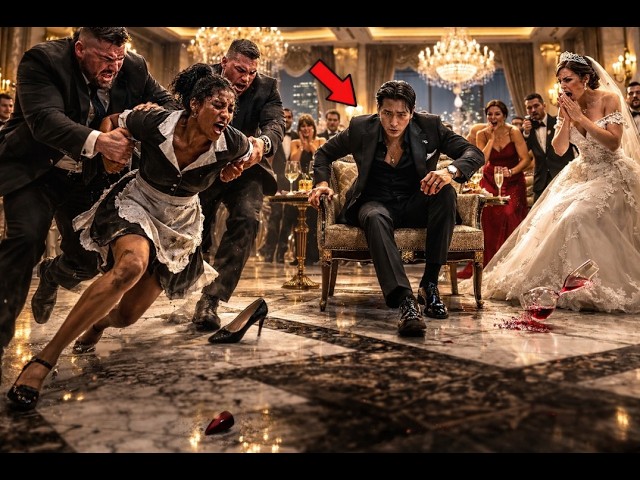
The red liquid spread instantly across her uniform like a wound.
A few guests laughed.
One of them actually applauded.
The heir froze for half a second, annoyed.
Then smiled.
“Oops,” he said. “Wrong target.”
Teresa didn’t react.
She simply took a breath.
And helped the elderly man step back.
“Are you okay?” she asked quietly.
The old man looked at her for a long moment.
“Yes,” he said softly. “Because of you.”
That was when security arrived.
Not for the heir.
For her.
“Remove her,” someone ordered.
Two guards grabbed Teresa’s arms immediately.
No questions.
No pause.
Just execution of hierarchy.
She didn’t resist.
Because resistance meant escalation.
And escalation meant pain.
Her tray fell first.
Then her gloves.
Then her dignity, piece by piece, across the marble floor as she was dragged out of the ballroom.
Someone laughed again.
Someone else filmed it.
The heir sat back down like nothing had happened.
The music never stopped.
Because in rooms like this, nothing stops for people who aren’t supposed to matter.
Except—
At the far end of the hall, the elderly man slowly straightened his posture.
And looked toward the exit where she was being dragged.
He picked up his phone.
And made a call.
One sentence.
That was all he said.
“Come to the ballroom.”
The doors reopened ten minutes later.
But the atmosphere didn’t just change.
It collapsed.
Kong Sukjene entered without announcement.
No entourage visible at first.
Just presence.
He didn’t walk like a guest.
He walked like a conclusion.
People noticed him immediately—not because he demanded attention, but because ignoring him felt like a mistake your body made before your mind caught up.
The chatter died mid-sentence.
Glass stopped clinking.
Even the drunk heir sobered slightly without knowing why.
Kong Sukjene didn’t greet anyone.
He looked across the room once.
And saw his father standing near the buffet, untouched glass still in hand.
Then he saw something else.
A smear of red wine on the marble floor leading toward the exit.
His eyes narrowed slightly.
“Who did that?” he asked quietly.
No one answered.
Because no one wanted to be first.
A trembling manager stepped forward.
“Sir… it was just a misunderstanding. One of the staff members—”
Kong didn’t look at him.
“Where is she?”
Silence.
Then a security guard hesitated.
“Downstairs holding room.”
That was enough.
Kong Sukjene walked.
And the entire ballroom followed the sound of his footsteps in their minds even after he left.
The holding room was small.
Bright.
Too bright.
Teresa sat on a metal chair, hands still shaking slightly from adrenaline she refused to show.
The door opened.
She looked up.
And saw him.
She didn’t recognize him.
But she recognized what followed him.
Authority that didn’t ask permission.
He looked at her for a long moment.
Then at the guards beside her.
“Let go,” he said.
They hesitated.
Only for a second.
Then obeyed.
Because hesitation around him felt like a dangerous idea.
When they left, the room fell silent.
Kong Sukjene stepped closer.
“You saved my father,” he said.
Teresa blinked. “I just—he needed help.”
“That is not what most people do,” he replied.
A pause.
Then he looked at her uniform.
At the wine still staining it.
At the marks on her wrists.
His expression didn’t change much.
But something inside it did.
“Do you know what happens now?” he asked.
Teresa shook her head slightly.
“I lose my job?”
A faint pause.
Then, unexpectedly:
“No,” he said. “You leave it.”
She frowned. “I don’t understand.”
Kong Sukjene tilted his head slightly.
“You will not return to that floor,” he said. “Not ever again.”
Teresa stood slowly. “Sir, I can’t just—”
“You can,” he interrupted. “Because I am telling you.”
Silence.
Then softer:
“You will become my house manager.”
She blinked.
“I don’t have qualifications for—”
“You have judgment,” he said. “That is rarer than qualifications.”
A pause.
Then he added:
“And you have something this city does not teach.”
Teresa hesitated.
“What’s that?”
Kong Sukjene looked at her directly.
“Mercy without calculation.”
That sentence landed differently.
Not like praise.
Like recognition.
By sunrise, the ballroom incident had already rewritten itself.
Not in gossip.
In structure.
The shipping heir’s family accounts were frozen pending investigation into multiple prior incidents that had never reached headlines.
Board members were replaced.
Legal protections dissolved under sudden scrutiny that no one could trace back cleanly.
By morning, the family’s influence in three sectors had quietly evaporated.
Not publicly destroyed.
Just… removed from relevance.
As if they had been standing on ground that suddenly stopped existing.
Teresa didn’t see most of it happen.
She was in a different place.
A quiet residence overlooking the city.
A house she had been told was temporary.
But felt permanent.
She stood near a window, unsure of where to place her hands.
Kong Sukjene entered without knocking.
“You haven’t eaten,” he said.
“I’m not hungry,” she replied.
A pause.
Then he placed a folder on the table.
“What is this?” she asked.
“Your new role,” he said.
She opened it slowly.
House operations. Staff oversight. Security coordination. Financial discretion within defined boundaries.
She stopped reading.
“This is too much,” she said.
“No,” he replied calmly. “It is what you should have always had access to.”
Teresa closed the folder.
“I don’t belong in your world.”
Kong Sukjene looked at her for a long moment.
Then said something quieter.
“No one belongs in it,” he said. “That is why it needs people like you.”
Silence.
Then Teresa asked:
“Why me?”
Kong didn’t answer immediately.
Instead, he walked to the window beside her.
Looked out at the city.
Then said:
“Because you did not decide your worth based on who was watching you.”
That was all.
The family that humiliated her didn’t fall in a dramatic explosion.
There was no public spectacle.
No headlines screaming revenge.
Just a gradual disappearance from systems they once controlled.
Contracts reassigned.
Influence redistributed.
All quietly.
Efficiently.
Irreversibly.
Months later, Teresa stood in the main house hallway, directing staff with a calm she didn’t recognize as her own.
She still wore black.
But it no longer meant invisibility.
It meant position.
One afternoon, she found Kong Sukjene in the garden.
“You never told me why you did all this,” she said.
He didn’t look up immediately.
Then answered:
“Because power that cannot recognize dignity is not power.”
A pause.
Then he finally looked at her.
“And because my father remembered your face before he remembered anything else that night.”
Teresa nodded slowly.
“I didn’t do anything special,” she said.
Kong Sukjene shook his head once.
“That,” he said, “is exactly why you matter.”
And in a city built on status and silence, a woman once dragged across marble learned something the world rarely admits:
Sometimes, the smallest act of mercy is not kindness.
It is disruption.
And in the right hands, disruption becomes the beginning of a new order.