The first thing Captain Mara Vale noticed was not the shove.
It was the silence that came before it.
The chow hall at Camp Pendleton had been loud three seconds earlier—forks scraping trays, boots dragging over waxed concrete, Marines laughing too hard at jokes they had already heard, the deep metallic clatter of breakfast pans being changed out behind the serving line. Rain hammered the long windows in gray sheets, turning the morning beyond the glass into a smear of asphalt, mud, and low clouds.
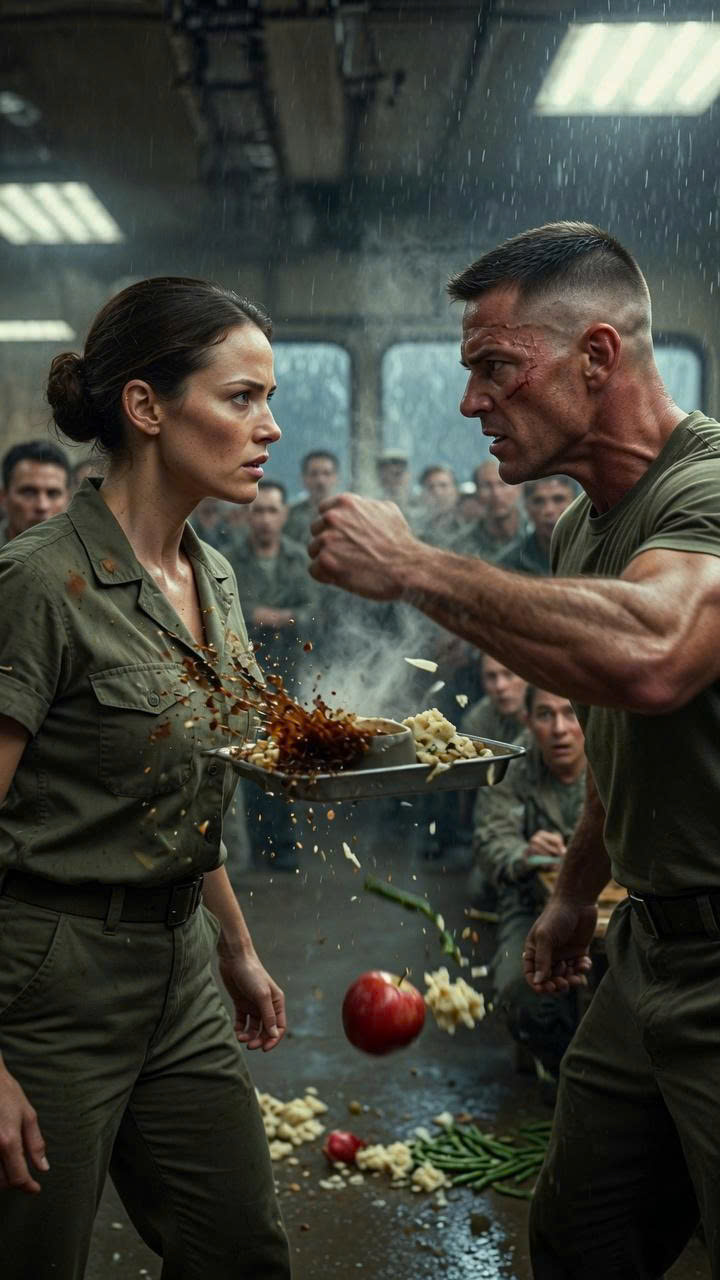
Then a tray hit the floor.
Mashed potatoes spread across the concrete like wet plaster. Green beans scattered under boots. A plastic cup rolled in a slow circle until it tapped against Mara’s heel.
She did not look down.
The Marine standing in front of her was big enough to block the fluorescent lights above him. Staff Sergeant Cole Reddick. Twenty-eight. Barrel chest. Fresh high-and-tight. A scar under his left eye from something he probably liked people to ask about. His jaw worked like he was chewing on a nail.
“You deaf, ma’am?” he said.
The last word came out wrong. Not respect. Not even mockery. A challenge wrapped in uniform.
Mara held her tray steady with both hands.
Coffee. Eggs. One apple. No bacon.
Behind Reddick, three Marines at his table watched with the stiff, hungry attention of men waiting to see whether blood would be drawn. Across the chow hall, a few conversations tried to restart and failed. Even the cooks behind the counter had stopped moving.
Mara’s left shoulder burned where his hand had struck her.
Not hard enough to break anything.
Hard enough to make a point.
She looked at the name tape above his pocket.
REDDICK.
Then she looked into his eyes.
“Move,” she said.
No volume. No threat. Just one word placed between them like a blade laid flat on a table.
Reddick smiled.
It did not reach his eyes.
“That table is for my platoon.”
Mara turned her head slightly.
The table behind her was half empty. Four men sat at the far end, eating without speaking. Civilian clothes. Plain hoodies. Ball caps pulled low. The sort of men most Marines ignored because they looked like contractors, or mechanics, or veterans who had wandered back onto base carrying old ghosts.
One of them had a tattoo disappearing under his sleeve. One wore sunglasses indoors despite the weather. Another had a paper cup of black coffee untouched in front of him.
None of them had moved.
Not yet.
Mara looked back at Reddick.
“I’m not sitting at your table.”
“You’re standing in my way.”
“No,” she said. “You stepped into mine.”
A murmur moved through the room.
Reddick’s smile thinned.
Somewhere near the coffee station, a young private whispered, “Oh, hell.”
Reddick heard it. His ears reddened.
He leaned closer until Mara could smell spearmint gum and the sharp starch of a uniform pressed too carefully.
“You know what your problem is?” he said.
Mara’s fingers tightened once around the edge of her tray.
The apple rolled against the coffee cup.
Reddick lowered his voice.
“You walk in here like everybody owes you space.”
For the first time, Mara’s expression changed.
Not fear.
Recognition.
As if she had heard the sentence before, years ago, in another room, from another man wearing another uniform.
Her throat moved once.
Reddick saw it and mistook it for weakness.
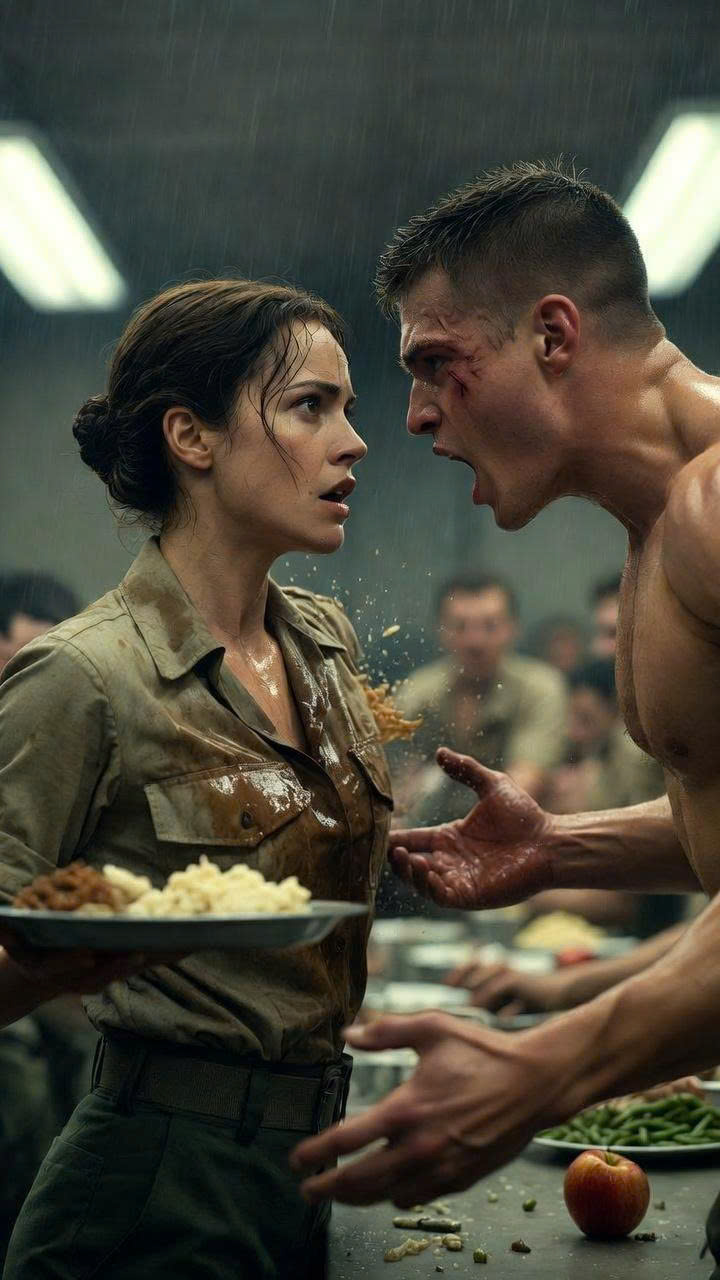
So he shoved her again.
This time the tray flew.
Coffee burst across her blouse. The cup cracked against the floor. The apple bounced twice and rolled beneath the table behind her.
Mara took one step back.
Only one.
Her right boot slid half an inch in spilled coffee.
The chow hall froze.
Reddick’s platoon stopped smiling.
Mara looked down at the dark stain spreading across her shirt. Steam rose from the fabric. The burn touched her skin in a thin, bright line.
Still, she did not raise her voice.
She set the ruined tray on the nearest table with care.
Then she reached for a napkin.
Reddick laughed once.
A short, ugly sound.
“Guess command sent us another briefing-room hero.”
Mara dabbed coffee from her wrist.
At the far end of the table behind her, the man with the untouched black coffee slowly took off his ball cap.
His hair was close-cropped. His face was weathered brown by sun and salt. A pale scar cut from his temple into his eyebrow. On his right hand, a wedding band was worn thin from years of friction against steel, rope, and weapon grips.
Commander Elias Voss did not speak.
He only stood.
The legs of his chair scraped backward.
The sound cut through the chow hall like a warning siren.
Reddick’s laugh died.
The man in sunglasses stood next.
Then the tattooed one.
Then the fourth.
Across the table, two more men rose from seats Mara had not even noticed. Then three from the next table. Then another near the wall.
One by one, every man sitting behind Mara stood up.
Not fast.
Not dramatic.
Worse.
Quietly.
Like a door locking.
Reddick looked past Mara for the first time.
His face changed by inches
.
Confusion first.
Then irritation.
Then something colder.
He recognized posture before he recognized faces. Feet shoulder-width apart. Hands empty but ready. Eyes calm in a way that did not belong in a normal cafeteria dispute.
These were not contractors.
They were SEALs.
Every one of them.
Mara folded the stained napkin once, placed it beside the tray, and turned around.
Commander Voss looked at her.
Not with surprise.
Not with pity.
With restraint.
As if he had been ordered not to interfere unless the line was crossed.
And the line, Mara knew, had just disappeared under Staff Sergeant Reddick’s boot.
Voss’s voice was low.
“Captain Vale,” he said, “do you want us to stand down?”
The entire chow hall heard the name.
Captain.
Reddick blinked.
Mara’s shoulders remained still, but something in her eyes darkened.
She looked at the SEALs behind her, then back at the Marine who had shoved her in front of half the room.
“No,” she said.
Reddick swallowed.
Mara stepped toward him, coffee still dripping from her sleeve.
“I want him to understand why they stood up.”
No one moved.
No one breathed.
And for the first time that morning, Staff Sergeant Cole Reddick realized he had not pushed a woman out of his way.
He had pushed open a door he was never meant to touch.
The rain struck harder against the windows.
Mara leaned close enough for only him to hear.
“Sit down, Staff Sergeant,” she said, “before the truth sits you down for me.”
Reddick’s eyes flicked to the SEALs again.
But pride is a dangerous thing in a room full of witnesses.
He lifted his chin.
“No, ma’am,” he said.
Mara nodded once.
Not disappointed.
Almost sad.
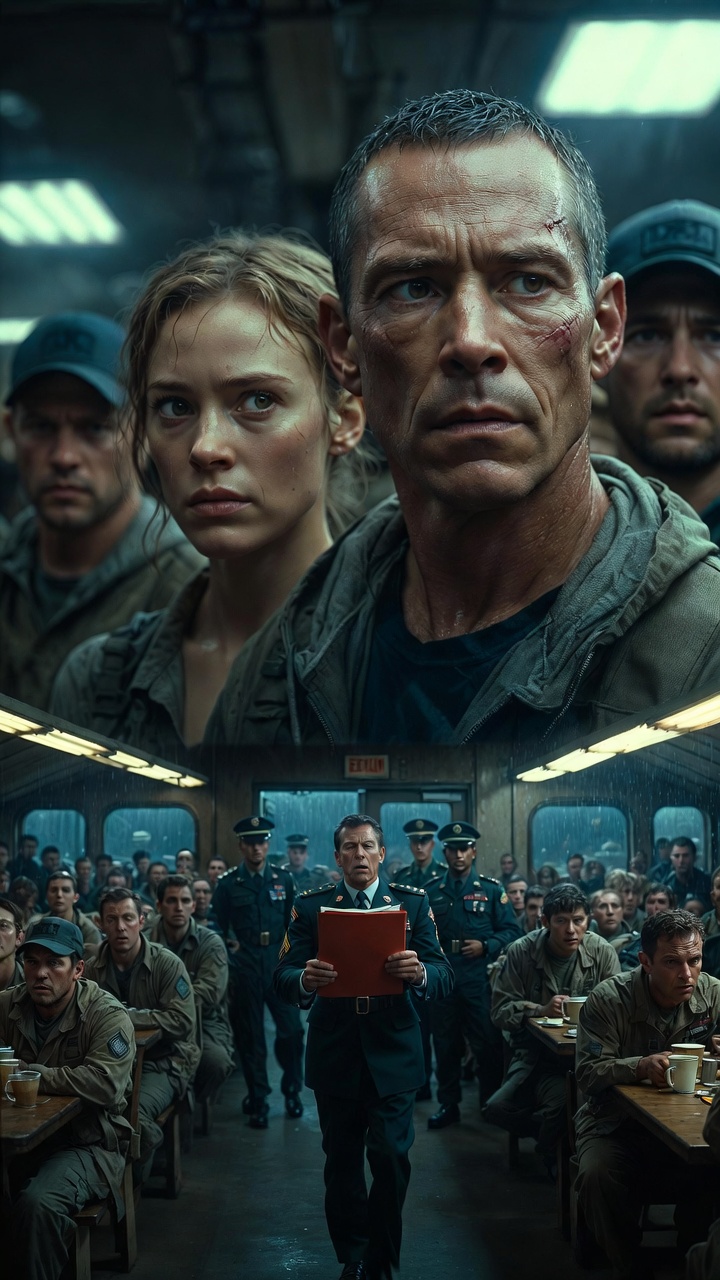
Then the chow hall doors opened behind them.
A colonel stepped inside with two military police officers at his back.
And in his hand was a red folder marked with a classification stripe no one in that room was supposed to see.
The colonel’s eyes found Mara.
His face went pale.
“Captain Vale,” he said, “we need to talk about what happened in Kandahar.”
Reddick’s mouth opened.
Mara did not turn around.
For three years, the truth had stayed buried under medals, sealed reports, and names blacked out in government ink.
Now it had walked into the chow hall before breakfast was even cold.
And everyone was watching.