The general asked the question three times before anyone realized the silence was the answer.
“Do we have an Apache pilot?”
No one moved.
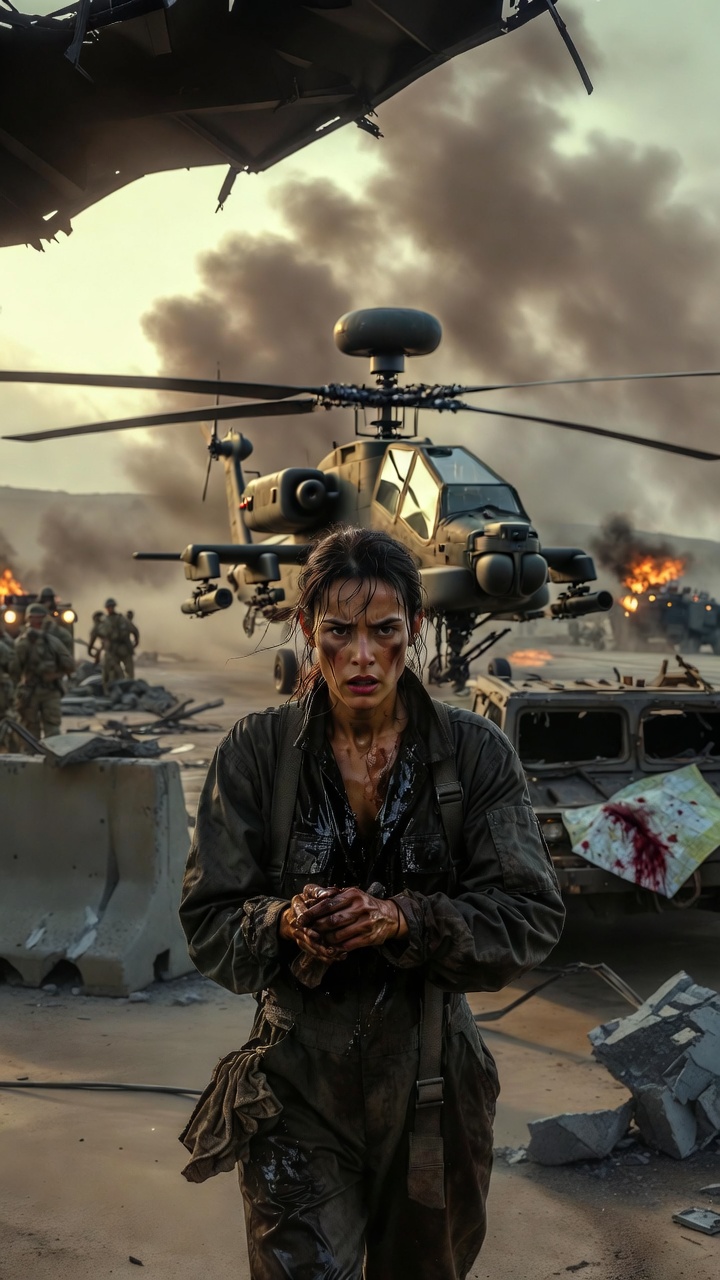
Smoke drifted through the shattered operations yard, mixing with dust and the bitter smell of burned wiring. Two armored vehicles were still smoldering near the eastern wall. The radio tower had taken a direct hit sometime before dawn, and the backup system was working only in short, unreliable bursts.
Along the concrete barriers, medics treated the wounded under emergency lights powered by a struggling generator.
The forward base had survived the night.
Barely.
One Apache attack helicopter remained on the flight line.
Its weapons were loaded.
Its systems were intact.
And there was no one left who could fly it.
Major General Thomas Mercer stood beside the operations shelter with a bloodstained map spread across the hood of a damaged transport truck. His uniform was covered in dust, and a strip of gauze had been taped above his right eyebrow.
He looked at the officers around him.
“Ask again.”
A captain lifted the field radio.
“All personnel, confirm. Any qualified Apache pilot on base, report immediately.”
Static answered first.
Then came the voices.
Two pilots were dead.
One had been evacuated with spinal injuries.
Another had severe burns and was unconscious.
A transport pilot volunteered, but he had never flown an attack helicopter. A reconnaissance pilot had logged simulator time years earlier, but no operational qualification. Everyone understood what that meant.
The Apache was not a machine someone could simply climb into and figure out.
It demanded trained instinct.
The kind built through hundreds of flight hours, emergency procedures, weapons drills, and mistakes survived in controlled conditions.
Mercer stared toward the aircraft sitting beneath a haze of smoke.
Beyond the western ridge, enemy forces were regrouping.
The first assault had failed to overrun the base, but only because the defenders had emptied nearly everything they had into stopping it. Ammunition was low. Communications were unstable. The perimeter had gaps wide enough for a vehicle to pass through.
Intelligence estimated the next attack would begin within the hour.
Without air support, everyone inside the base knew how it would end.
That was when the woman near the hangar stepped forward.
Most of them knew her only as Elena Ward.
Aircraft maintenance technician.
Quiet.
Reliable.
Easy to overlook.
She had spent the previous eighteen months servicing hydraulic systems, inspecting rotor assemblies, replacing damaged fuel lines, and crawling beneath Apache airframes while pilots stood nearby discussing missions as though she were part of the equipment.
Her coveralls were permanently stained with grease. Hydraulic fluid clung to the fabric no matter how often it was washed. Her dark hair was usually tied back tightly, and she rarely spoke unless someone asked a technical question.
Even then, her answers were brief.
In the dining hall, she sat near the wall.
She listened more than she talked.
Pilots told stories over coffee while mechanics ate in silence around them. Some officers knew the names of every aircrew member but referred to the maintenance teams collectively.
“Keep the wrench crew busy.”
“Tell the grease shop we need aircraft three by sunrise.”
“Someone find that mechanic woman.”
Once, a lieutenant had joked that maintainers were like landing gear.
Important, but not something anyone noticed unless it failed.
Elena had heard him.
She had simply continued eating.
No one knew much about her past. Her personnel file listed technical certifications, transfer dates, and maintenance assignments. It did not explain why she could identify incoming aircraft by rotor sound alone. It did not explain why she watched flight briefings from the edge of open hangar doors.
It did not explain why, during emergency drills, she always positioned herself where a pilot would have the clearest route to the aircraft.
People assumed she was private.
The truth was more complicated.
Elena had learned long ago that silence was easier than explaining a history that did not appear in ordinary personnel records.
So she arrived before the rest of the maintenance crew.
She finished inspections without complaint.
She corrected problems others missed.
Then she disappeared before anyone thought to thank her.
During the siege, that invisibility had become useful.
When an explosion tore open a fuel line near the primary hangar, Elena ran toward it while everyone else moved away. She shut the feed manually, crawled beneath falling debris, and sealed the rupture while mortar rounds landed close enough to shake bolts from the ceiling.
Later, when the eastern barricade collapsed, she joined three soldiers moving cargo containers into position around the remaining aircraft.
One of the men had shouted that the container was too heavy.
Elena adjusted the chain, changed the angle, and moved it with the damaged loader in less than two minutes.
No one praised her.
There had been no time.
By sunrise, half the base was nonfunctional.
The Apache remained alive because she had kept it alive.
Now the general was asking for a pilot.
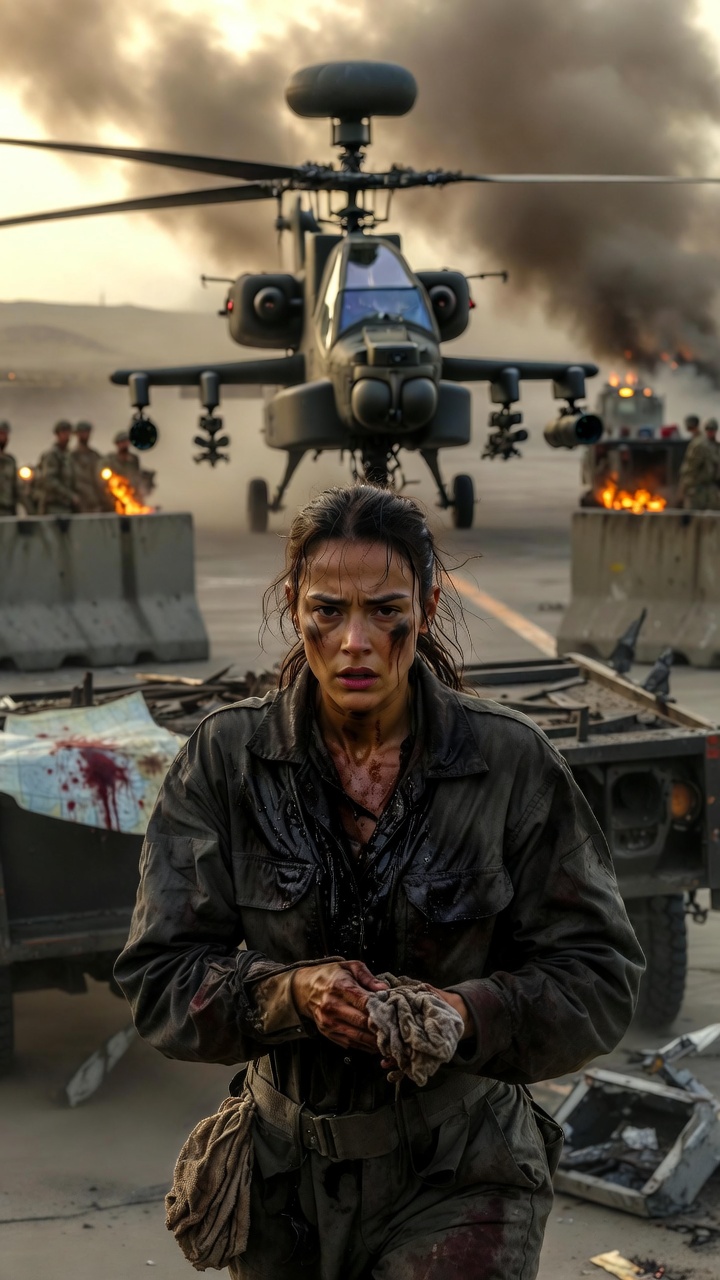
Elena pulled the oil rag from her belt and wiped her hands.
The movement was small.
But in the stillness around the operations shelter, it seemed louder than the distant gunfire.
A sergeant noticed her first.
“What is she doing?”
Someone behind him gave a nervous laugh.
“She’s a mechanic.”
Elena walked past the damaged truck and toward the Apache.
Major General Mercer turned.
For a moment, he appeared ready to order her back to the hangar. Then he watched the way she approached the aircraft.
Not with hesitation.
Not with curiosity.
With familiarity.
She did not look up at the rotor blades like a technician checking damage. She scanned the area, the wind indicators, the fuel truck position, and the open route beyond the blast wall.
Her eyes moved exactly where a pilot’s eyes would move.
Mercer stepped away from the truck.
“Technician Ward.”
She stopped.
Every face in the yard turned toward her.
Mercer studied her carefully.
“Where were you qualified?”
Elena looked at him.
There was no fear in her expression.
Only calculation.
Then she turned away without answering and climbed into the front cockpit.
A lieutenant stepped forward.
“General, she can’t—”
Mercer raised one hand.
“Let her continue.”
The lieutenant stared at him.
“Sir, with respect, she services the aircraft.”
“I know what her job title says.”
Inside the cockpit, Elena secured the harness and reached for the controls.
Her hands moved quickly, but not hurriedly.
Battery.
Power levers.
Fuel systems.
Avionics.
Flight controls.
Communications.
She checked each switch in sequence, pausing at the exact points required to confirm system response. When one display flickered, she did not panic. She reset the circuit, waited, and continued.
Outside, the maintenance crew stopped working.
They knew the startup procedure better than anyone.
They also knew when someone was copying from memory and when someone was moving through a routine embedded deep in muscle memory.
Elena was not guessing.
The auxiliary power unit began to whine.
The first turbine turned.
A deep mechanical pulse rolled across the yard as the Apache came alive.
The men who had laughed fell silent.
The rotor blades began to move.
Slowly at first.
Then faster.
Dust lifted around the landing gear and swept outward in widening circles.
Mercer did not take his eyes off the cockpit.
He had seen thousands of pilots start aircraft.
He recognized the calm.
He recognized the discipline.
Most of all, he recognized the absence of wasted movement.
Elena activated the helmet display, checked the targeting systems, and adjusted the controls.
The Apache rose several inches from the ground.
It held perfectly steady.
A crosswind pushed smoke across the flight line, but the aircraft barely shifted.
The general’s expression changed.
Not surprise.
Recognition.
Somewhere beneath the grease-stained coveralls and the anonymous maintenance record, Elena Ward had done this before.
Many times.
The Apache rotated smoothly, cleared the damaged barrier, and lifted above the base.
Every soldier in the yard looked up.
The woman they had walked past for eighteen months was now controlling the most powerful weapon they had left.
And she was flying it like she had never stopped.
Beyond the western ridge, the enemy had already begun preparing the second assault.
Vehicles were positioned along a dry riverbed. Ammunition had been moved beneath camouflage netting. Heavy weapons teams were assembling near the base of the slope where they believed the terrain would protect them from direct fire.
Their intelligence was clear.
The base’s pilots were dead or incapacitated.
The surviving Apache would remain grounded.
They expected to attack a wounded position with no air support.
Then the sound reached them.
A low, rhythmic thunder.
At first, it blended with the echoes of artillery in the valley.
Then it grew louder.
Soldiers on the ridge looked toward the tree line.
The Apache came in low.
So low that dust and leaves spiraled beneath it.
Elena used the terrain for cover, keeping the aircraft below the enemy’s clear line of sight until the last possible moment. The valley opened in front of her, and the helmet display filled with heat signatures.
Vehicles.
Weapons.
Ammunition.
Command position.
She identified the pattern immediately.
The enemy had concentrated its firepower for speed.
It was efficient.
It was also vulnerable.
Back at the base, the damaged radio crackled.
“Aircraft approaching enemy staging area.”
The voice came from an observation post on the western wall.
Mercer stood beside the radio operator.
“Can you identify the pilot?”
The operator listened.
“No call sign, sir.”
The Apache rose above the ridge.
Enemy fighters scattered.
Elena adjusted altitude, aligned the targeting system, and locked onto the largest ammunition position.
The first missile left the rail.
For a fraction of a second, it was only a streak of smoke crossing the valley.
Then the hillside erupted.
The blast tore through the ammunition stockpile and triggered a chain of explosions that rolled across the staging area. Vehicles disappeared behind fire. Heavy weapons were thrown from their positions. Men who had been preparing to advance were suddenly running in every direction.
At the base, soldiers heard the explosions seconds later.
A wave of sound struck the western wall.
Then the radio exploded with voices.
“Direct hit!”
“Enemy position is burning!”
“They’re breaking formation!”
A cheer rose from the infantry line.
It began with three or four soldiers.
Then it spread through the entire base.
Elena did not hear it.
She was already turning for the second pass.
A surface weapon fired from the slope.
She banked hard.
The Apache rolled away as tracer fire cut through the space where it had been moments earlier. She dropped below the ridge, followed the contour of the land, then climbed from another direction.
The maneuver was too controlled to be desperation.
It was experience.
She found the enemy command vehicle moving toward the northern road.
The targeting reticle settled.
The cannon fired.
Dust and metal erupted around the vehicle. It swerved, struck a ditch, and stopped. The vehicles behind it jammed together, blocking their own escape route.
The enemy assault lost coordination almost immediately.
Orders stopped reaching the forward teams.
Ammunition carriers turned back.
Several heavy weapons crews abandoned their positions.
The attack that had seemed inevitable less than twenty minutes earlier began collapsing before it could begin.
Elena stayed low and kept moving.
She never remained in one firing position long enough for the enemy to adjust. She used short bursts, deliberate strikes, and terrain masking to reduce exposure.
Each pass removed another part of the assault.
A weapons truck.
A communications relay.
A group preparing a mortar system.
A vehicle carrying fuel.
From the base, the Apache looked almost unreal as it moved through smoke and fire.
The same soldiers who had once referred to Elena as “the mechanic woman” now followed every turn with their eyes.
The lieutenant who had joked about the wrench crew stood near the damaged blast wall with his mouth slightly open.
He watched the aircraft bank between two ridges, disappear, then rise again behind the enemy position.
No one needed to tell him what he had misunderstood.
It was written across his face.
His earlier confidence was gone.
His shoulders had dropped.
When someone beside him whispered, “She’s saving us,” he did not answer.
He simply looked toward the sky.
The second assault never came.
By midday, the enemy forces were withdrawing from the valley.
Their command structure had been shattered, their ammunition destroyed, and their confidence replaced by confusion. What they had believed to be reliable intelligence had failed them at the worst possible moment.
The base had not lost air support.
It had only hidden its last pilot in plain sight.
Elena remained airborne until her ammunition was nearly gone.
On the return flight, warning indicators showed damage to one external panel and stress in a hydraulic line. She compensated, reduced speed, and approached the base from the south.
Word spread before the aircraft appeared.
People left the aid station, the communications shelter, and the defensive positions. Mechanics stood beside soldiers. Officers stood beside enlisted personnel. Even some of the wounded insisted on being helped outside.
They gathered around the flight line.
No one cheered yet.
They were too exhausted.
Too stunned.
The Apache appeared over the perimeter and descended into the crosswind.
Elena held it in a steady hover.
The damaged aircraft shifted once, then stabilized.
She lowered it slowly until the landing gear touched the ground with almost no visible impact.
The rotors continued turning.
Elena completed the shutdown procedure in full.
She checked the systems.
Recorded the faults.
Secured the weapons.
Only after the blades began slowing did she release the harness.
The crowd remained where it was.
No one rushed the cockpit.
No one shouted her name.
For the first time since she had arrived at the base, they waited for her.
Elena climbed down.
Her coveralls were still stained with oil.
A thin line of sweat ran along her temple. There was dust across one cheek, and the pressure marks from the helmet had reddened the skin around her forehead.
Major General Mercer stood several feet away.
When she approached, he stepped aside.
It was a subtle movement, but every officer present saw it.
A general had cleared the path for a maintenance technician.
Elena walked forward.
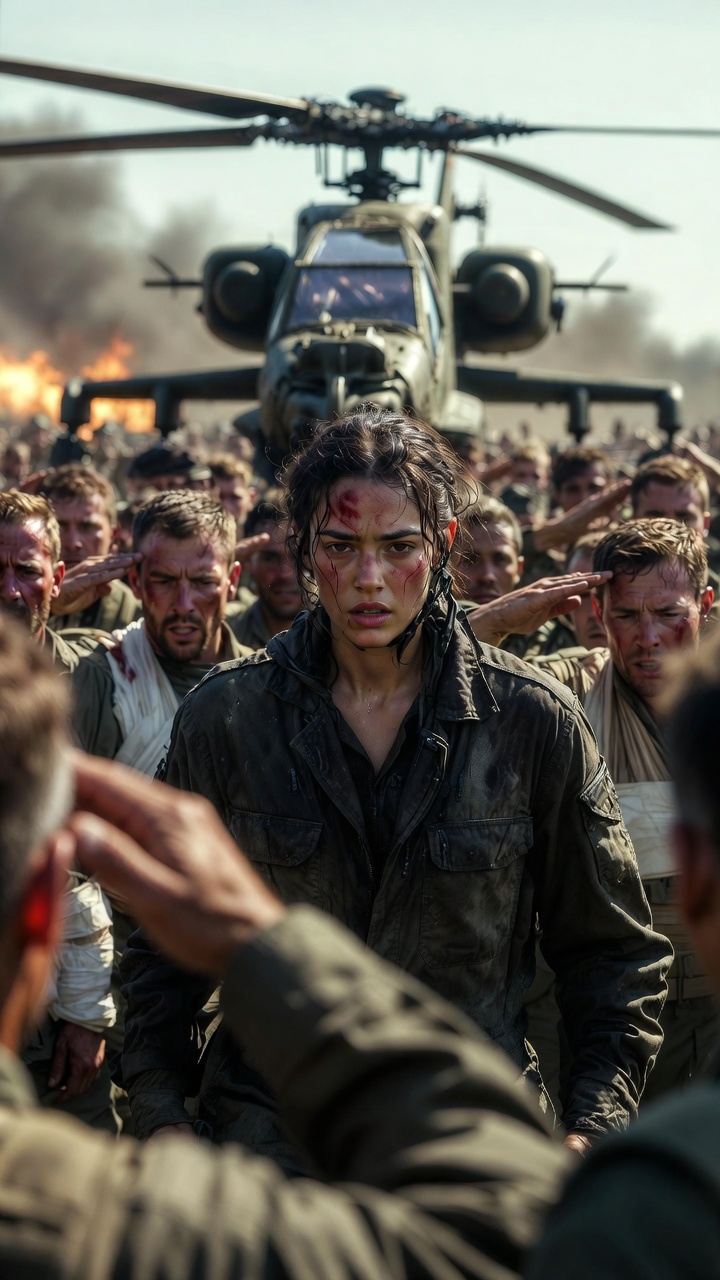
The first salute came from a wounded infantry captain with his arm in a sling.
Then another soldier saluted.
Then the lieutenant who had laughed.
His hand rose slowly.
His face had gone pale.
He tried to speak, but nothing came out.
Elena met his eyes for one second.
That was all.
He looked down.
Around him, dozens of men and women stood at attention.
Some were crying openly.
Not because they had witnessed a dramatic performance.
Because they had spent the morning preparing to die.
And the person who had given them another day was someone many of them had never bothered to know.
Elena did not give a speech.
She did not smile.
She did not ask anyone to explain why they had ignored her.
She walked through the line of saluting soldiers and returned to the hangar.
Near the tool bench, she found the oil rag she had dropped before climbing into the cockpit.
She picked it up.
Folded it once.
Then tucked it back into her belt.
A mechanic stared at her.
“You’re going back to work?”
Elena looked toward the Apache.
“It has a hydraulic leak.”
That was all she said.
Then she collected her tools and walked back toward the aircraft she had just flown into battle.
Later that evening, Mercer entered the operations shelter and requested Elena Ward’s complete personnel history.
The first file contained nothing unusual.
Maintenance assignments.
Technical qualifications.
Transfer orders.
No pilot certification.
He requested restricted access.
The second file arrived encrypted.
Several sections were still redacted.
But enough remained.
Captain Elena Ward.
Former attack aviation pilot.
Advanced Apache qualification.
Combat flight leader.
Multiple classified deployments.
Grounded after an incident that had never been publicly explained.
Transferred under a sealed personnel directive.
Mercer read the final page twice.
Then he added a handwritten note to the battle report.
Technician Ward is fully qualified on the AH-64 platform. Her direct actions preserved the installation, prevented loss of remaining personnel, and reversed the tactical situation. Immediate review of her status is required.
He paused before signing it.
Then he added one more line.
Her rank may have been removed from the visible record. Her ability was not.
Within weeks, the story traveled beyond the base.
It moved through maintenance crews, flight units, convoy teams, and field hospitals. The details changed slightly each time, as stories often do.
Some said she had destroyed an entire armored column.
Others said she had flown with one damaged engine.
A few claimed the general had recognized her from a classified mission years earlier.
Elena corrected none of them.
She did not encourage the story.
She did not pose for photographs or request recognition.
She continued reporting to the hangar before sunrise.
She inspected aircraft.
She replaced worn components.
She returned tools to their exact positions.
Her coveralls remained stained with grease.
She still sat near the wall in the dining hall.
But the room changed around her.
Pilots began asking her opinion before missions.
Officers learned her name.
Young mechanics watched the way she worked.
No one called the maintenance team “the grease shop” when she was within hearing distance.
Months later, whenever an Apache started on that base, conversations paused for a moment.
The turbine whine would rise.
The rotor blades would begin to turn.
And those who had survived the siege would remember the woman who stepped out of the background when every visible hero was gone.
They remembered the oil rag in her hand.
The silence before the engine started.
The lieutenant’s face when he realized the person he had dismissed understood the aircraft better than he ever would.
Most of all, they remembered what happened when ability no one had respected became the only thing standing between them and destruction.
Because silence is not weakness.
And the person everyone treats like part of the machinery may be the one holding the entire world together.