On the morning of May 28, 1946, a prisoner was led into the execution yard at Landsberg Prison in Allied-occupied Germany.
There were no barking dogs around him. No terrified prisoners waiting for his orders. No SS uniform to announce his authority.
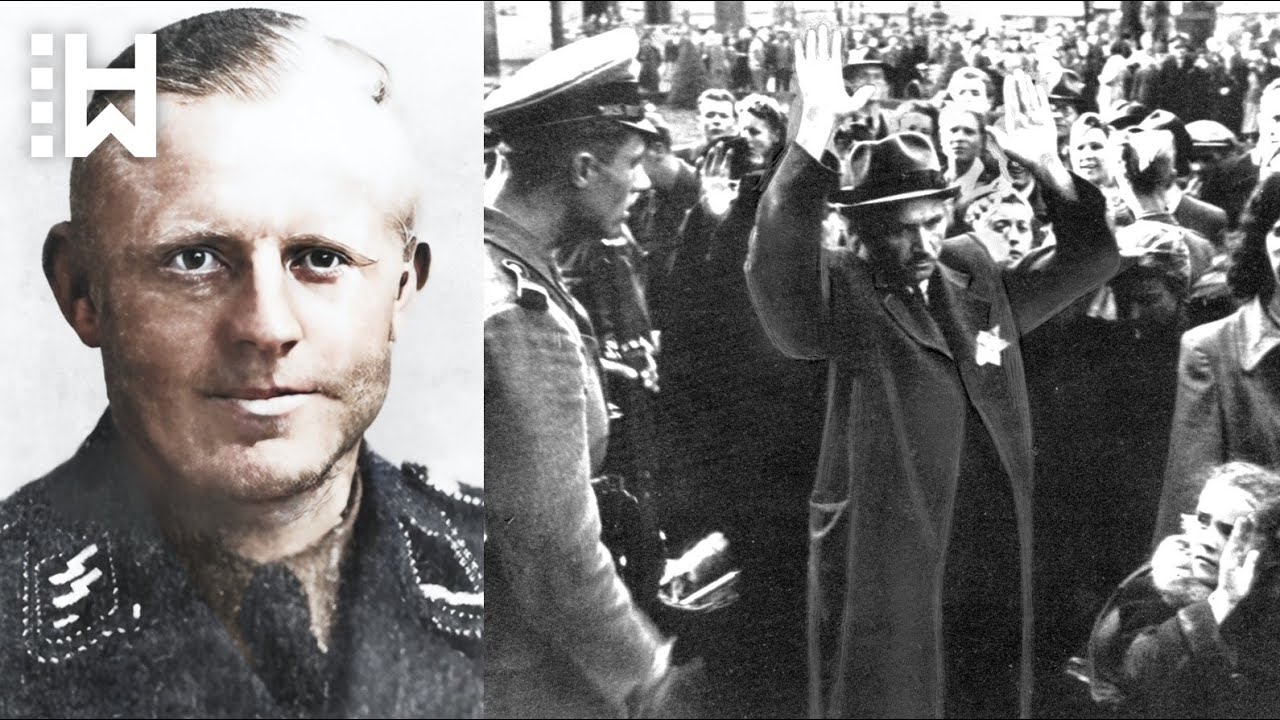
The man approaching the gallows was Otto Moll, the former supervisor of the crematoria at Auschwitz-Birkenau.
For years, Moll had decided when other people would work, kneel, run, suffer, and die. Now he could do nothing but walk where his guards directed him.
The official judgment contained none of the emotion carried by the survivors who remembered him. It stated only that the military court had sentenced Otto Moll to death by hanging “at such time and place as higher authority may direct.” The execution was carried out at Landsberg on May 28, 1946.
But the most disturbing part of Moll’s story was not how he died.
It was how ordinary he had looked while helping operate one of the greatest killing centers in human history.
Moll was not a famous general. He was not one of the leading politicians of Nazi Germany. He held the rank of SS-Hauptscharführer, roughly equivalent to a senior noncommissioned officer.
Yet inside Auschwitz, rank did not fully measure power.
The Auschwitz-Birkenau Memorial identifies Moll as the chief of the crematoria. He served at Auschwitz from 1941 until January 1945, holding positions that included labor-detail leader, subcamp director, and supervisor of the killing and cremation facilities at Birkenau.
That position placed him close to the machinery of mass murder.
Auschwitz was both a concentration camp complex and a killing center. Approximately one million Jewish people were murdered there, along with tens of thousands of Poles, Roma, Soviet prisoners of war, and others persecuted by Nazi Germany.
The killing depended on more than ideology.
It required schedules, transports, guards, selections, gas chambers, crematoria, forced labor, stolen property, and men willing to treat human beings as material passing through an industrial process.
Otto Moll became one of those men.
Before he supervised crematoria, Moll commanded Auschwitz’s penal company, where prisoners were subjected to some of the camp’s most brutal working conditions. In June 1942, prisoners from that unit attempted a mass escape after Moll unexpectedly ended their workday early because of heavy rain. Thirteen were killed during the immediate manhunt, two were recaptured, and only nine ultimately escaped.
The incident revealed something the SS never completely managed to destroy.
Even under starvation, beatings, armed guards, and the threat of collective punishment, prisoners still looked for openings. A storm, a confused whistle, or a moment of disorder could become a chance to reclaim the freedom the camp had taken from them.
Moll’s response to resistance was terror.
Survivors assigned to the Sonderkommando—the prisoners forced to remove bodies from gas chambers and operate the crematoria—later described him shooting prisoners without warning. Henryk Tauber recalled that when one prisoner failed to work quickly enough, Moll forced him into a pit containing burning human remains and boiling fat.
The purpose was not only to kill one man.
It was to make everyone else move faster.
The Auschwitz-Birkenau Memorial explains that such acts were used to intimidate the Sonderkommando and force them to carry out their horrifying tasks as rapidly as possible.
That was how Moll exercised power.
Not through speeches.
Through the constant possibility that a delay, a glance, or a moment of exhaustion could bring instant death.
By 1944, Nazi Germany was losing the war. But instead of slowing the genocide, the SS accelerated it.
Between May 15 and July 9, approximately 440,000 Jews were deported from Hungary. Most were sent to Auschwitz-Birkenau, where the majority were murdered in gas chambers shortly after arrival.
The existing crematoria could not keep pace with the number of victims.

The SS reopened old killing areas and ordered pits dug for the open-air burning of bodies. Otto Moll, who had experience supervising such operations, was brought back from the Gleiwitz subcamp to Birkenau.
The Auschwitz-Birkenau Memorial states plainly that he was transferred there in May 1944 to oversee the destruction of the Hungarian Jews in the crematoria.
Train after train arrived.
Families stepped onto the ramp carrying suitcases packed with clothing, photographs, food, religious objects, and documents. Many had been told they were being relocated for labor.
SS doctors and officers separated them within minutes.
Men were pushed into one line. Women and children into another. Those considered temporarily capable of forced labor were registered as prisoners.
The rest were sent toward the gas chambers.
Most had no way of knowing that their luggage was already being sorted, their valuables confiscated, and their deaths organized before the train had even stopped moving.
Moll worked behind that process, ensuring that its final stages continued.
He did not need to hate every individual victim personally. The system demanded something even more frightening: the willingness to perform mass murder as routine work.
And after the work, the SS men could relax.
One of the most chilling pieces of evidence about Auschwitz is not a photograph of violence. It is a photograph of leisure.
In the summer of 1944, while the deportation and murder of Hungarian Jews was taking place, senior Auschwitz personnel gathered at Solahütte, an SS retreat near the camp. Photographs show them eating, talking, laughing, and joining a sing-along led by an accordion player.
In the front group stood some of Auschwitz’s most notorious perpetrators: Rudolf Höss, Richard Baer, Josef Kramer, Josef Mengele—and Otto Moll.
The United States Holocaust Memorial Museum identifies Moll in the photograph as the supervisor of the gas chambers. The Auschwitz Memorial has noted that although he held a comparatively modest rank, senior officers appeared to treat him as an equal because of his position as head of the crematoria.
That photograph removes one comforting illusion.
Moll did not appear as a creature consumed by visible madness.
He appeared as a colleague among colleagues.
The men around him were not hiding in shame. They were socializing. They had created a world in which mass murder could be discussed as an assignment, completed as a duty, and followed by music.
That is one reason the image remains so disturbing.
It shows that evil does not always announce itself with rage. Sometimes it smiles for the camera.
By early 1945, the world that had protected Moll was collapsing.
Soviet forces were approaching Auschwitz. The SS evacuated nearly 60,000 prisoners from the camp complex, forcing them westward in freezing conditions. Thousands were killed or died during these evacuations. Around 7,000 sick and exhausted prisoners remained when Soviet troops liberated Auschwitz on January 27, 1945.
Moll eventually entered the Dachau concentration camp system, where he was taken into American custody as the Third Reich disintegrated.
The uniform that had given him authority now identified him as a suspect.
The guards who had obeyed him could no longer protect him. The regime that had turned his cruelty into a career no longer existed.
In November 1945, Moll stood before an American military court in the main Dachau concentration camp trial. He was one of 40 defendants accused of participating in a common system of cruelty, mistreatment, torture, starvation, and killing at Dachau and its satellite camps.
The courtroom created a reversal that would have been unimaginable only months earlier.
Former prisoners could speak.
SS personnel had to listen.
Documents that once recorded suffering as routine administration were now evidence. Orders were no longer shields. Rank was no longer protection.
But then came the twist.
Otto Moll was not sentenced to death after a complete trial for everything he had done at Auschwitz.
His role in the mass murder at Birkenau was not fully prosecuted in the case that sent him to the gallows. The Dachau tribunal concerned crimes committed within the Dachau camp system and its surrounding network.
The man who had supervised crematoria during the destruction of Hungarian Jewry was condemned through a narrower legal doorway.
History knew more about him than the charge sheet contained.
Even after receiving his death sentence, Moll was questioned about Auschwitz. In April 1946, American investigators confronted him with his former superior, Auschwitz commandant Rudolf Höss. Moll acknowledged involvement in the disposal and cremation of bodies but attempted to distance himself from the mass killing operation.
Höss described Moll’s responsibilities far more directly.
The confrontation exposed the final refuge of many perpetrators: reduce the crime to a job description, deny personal responsibility, and place the decisive act in someone else’s hands.
But the surviving records, photographs, administrative assignments, and prisoner testimonies told a different story.
On December 13, 1945, the court ordered the defendants to stand as their sentences were announced.
One name followed another.
When Moll’s turn came, the language remained formal and controlled. The court declared him guilty and sentenced him to death by hanging.
No surviving transcript describes exactly what crossed his face in that moment.
But the reversal was visible without needing explanation.
The man who had watched powerless prisoners await his decisions now stood powerless before the judgment of others.
He had no weapon.
No command.
No subordinate to punish.
Only his name, spoken in a courtroom, followed by a sentence he could not give to someone else.
For months, the punishment remained on paper.
Then, on May 28, 1946, the order became final.
At Landsberg Prison, the gallows had been prepared. A rope waited where no frightened prisoner could be forced to take Moll’s place.
The SS man who had helped send uncounted human beings toward death was led forward under guard.
The execution could end his life.
It could not measure his crimes.
No court could restore the parents separated from their children on the Auschwitz ramp. No sentence could return the people whose names had been replaced by numbers, or those who had been murdered before receiving even that.
Justice after the Holocaust was always incomplete.
Many perpetrators escaped. Others received sentences that survivors considered painfully inadequate. Evidence had been destroyed, witnesses had been murdered, and entire communities no longer existed to describe what had been done to them.
Otto Moll’s execution therefore cannot be understood as a neat ending.
It was a consequence.
For the first time, the state was no longer rewarding his brutality. It was naming it as criminal. The uniform, the orders, and the machinery around him could no longer transform murder into duty.
The greater judgment came afterward.
The photographs survived.
The court records survived.
The testimony of prisoners survived.
Moll had worked inside a system designed not only to murder people, but to erase the evidence that they had ever lived. Yet the evidence outlived him.
Today, the most important fact about May 28, 1946, is not that Otto Moll died on a gallows.
It is that the people he tried to reduce to ash were not completely silenced.
Their memories entered archives. Their families preserved their names. Their testimony exposed the men who had once believed no one would remain alive to accuse them.