Chapter One: Blue Lantern
At 11:38 on a Thursday night, my daughter texted me a photograph of an empty kitchen table.
There was a blue ceramic lantern in the center.
Nothing else.
No message.
No explanation.
My hand stopped halfway to the coffee mug.
The baseball game continued silently on the television across my living room. Rain tapped against the windows of my small house outside Richmond, Virginia. On the workbench near the back door, a lawnmower carburetor sat in pieces beside a bowl of screws.
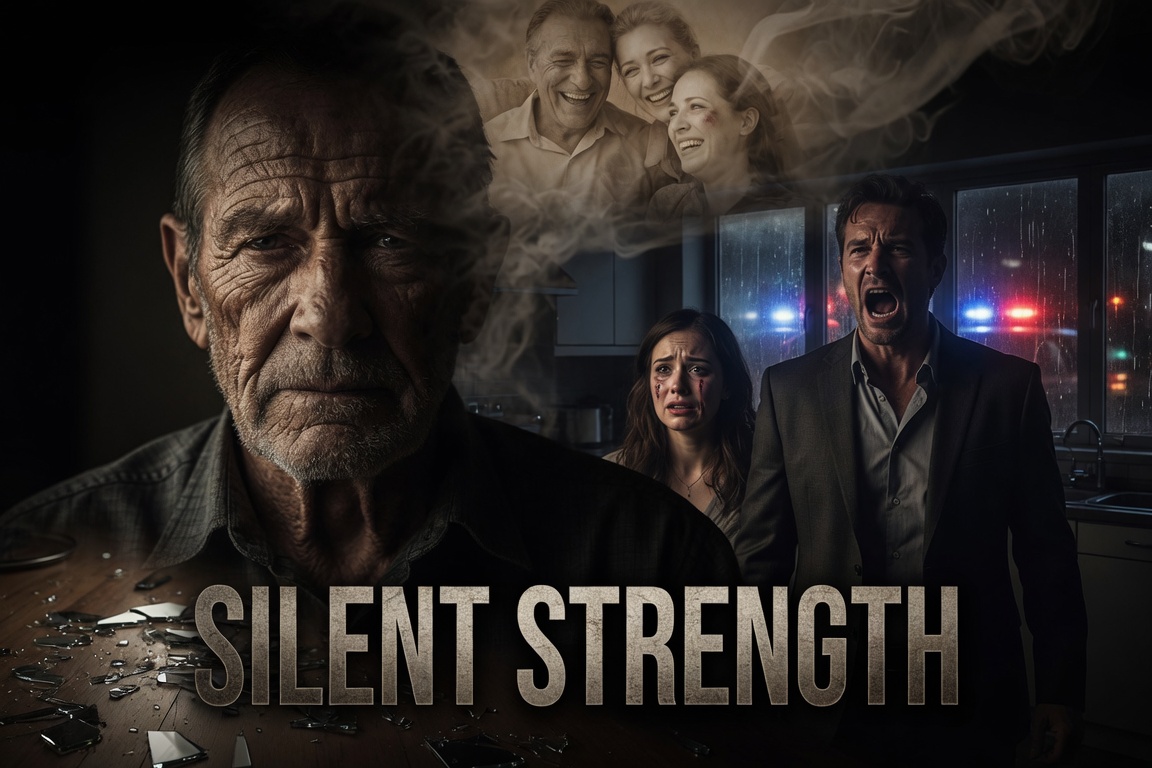
To anyone else, the photograph was meaningless.
To me, it meant three things.
She could not speak freely.
She was afraid.
And the danger was inside the house.
Blue Lantern had been our distress code since Emily was twelve.
Her mother, Joanne, created it before Emily’s first overnight school trip. We told her that if she ever felt unsafe but could not explain why, she should mention the blue lantern hanging on our old porch.
No questions.
No argument.
We would come.
Joanne died nine years ago, but the code remained.
Emily had used it once at sixteen when a friend’s older brother brought drugs to a party. I arrived, smiled at the parents, and took her home without making her explain herself in front of anyone.
She had not used it again.
Until now.
I opened the photograph and enlarged it.
The kitchen belonged to Emily and her husband, Daniel Mercer. White marble island. Brass fixtures. Cabinet lights glowing beneath shelves no one cooked near.
The lantern sat slightly left of center.
Behind it, reflected in the dark patio door, was the shape of a man.
Daniel.
His right arm was raised.
Emily stood near the refrigerator.
Her face was not visible, but one hand pressed against the counter as though she needed it to remain upright.
I checked the time the photograph had been taken.
11:34 p.m.
Four minutes earlier.
I called her.
The phone rang once.
Then the call ended.
A second text appeared.
Sorry, Dad. Wrong picture.
The wording confirmed the danger.
Emily had never called me Dad in a text when she felt safe. She called me Pop.
Daniel called me Dad when he was performing respect.
I stood.
My knees ached from an old injury, but they held.
I turned off the television, placed my phone on speaker, and dialed another number.
A woman answered before the first ring ended.
“Calder.”
“Blue Lantern.”
Silence.
Then her voice changed.
“Emily?”
“Yes.”
“Current address?”
I gave it to her.
“Immediate threat?”
“Unknown. Possible domestic violence. Daniel is present.”
“Children?”
“One. Lily, age six.”
“Are you going in?”
“No.”
That answer mattered.
The younger version of me might have driven straight through Daniel’s front door.
The older version understood that fear makes fathers impulsive, and impulsive fathers can increase the danger for the person they are trying to save.
Calder asked, “What do you need?”
“Quiet welfare confirmation. Nearest patrol supervisor. No lights unless necessary. Pull any recent calls from the address.”
“Understood.”
“And Ruth?”
“Yes?”
“Do not use my name yet.”
She paused.
“He still thinks you repair lawnmowers?”
“Among other things.”
“I’ll call in three minutes.”
I moved through the house with the lights off.
In the hall closet, behind an old winter coat, sat a black canvas bag. I had not opened it in four years.
Inside were a medical kit, a flashlight, two prepaid phones, a body camera, paper copies of identification, and a slim leather folder.
I left the handgun locked in the safe.
Tonight was not about proving I could hurt Daniel.
It was about making sure he could never hurt Emily again.
My second phone vibrated.
Ruth Calder.
“Richmond dispatch has no calls from the residence,” she said. “But Henrico County logged a noise complaint two months ago. Caller withdrew before units arrived.”
“Caller name?”
“Neighbor. Margaret Sloane.”
I knew the house. Large brick colonial in a gated community called Foxbridge. Daniel had chosen it because the entry road made visitors visible before they reached the front steps.
He called that privacy.
People who want privacy build fences.
People who want control build sightlines.
Ruth continued.
“Patrol supervisor is Lieutenant Aaron Pike. Good officer. I told him only that a credible family distress signal may indicate an unsafe domestic situation.”
“Where is he?”
“Six minutes away.”
“I’m twelve.”
“Stay outside until he arrives.”
“I know.”
“You say that like you’ve never ignored me.”
“Tonight is different.”
I picked up the black bag.
Before leaving, I opened the drawer beneath the telephone table.
Inside lay a photograph of Emily at nine, sitting on Joanne’s shoulders at a county fair. Her front teeth were missing. Cotton candy covered one cheek.
Joanne had written a sentence on the back.
She must always know home is a person, not a place.
I placed the photograph in my wallet.
Then I drove into the rain.
At 11:49, halfway to Foxbridge, Emily called.
I answered without speaking.
For three seconds, I heard only breathing.
Then Daniel’s voice came through the phone.
“You called him?”
Emily said something too softly to understand.
A hard sound followed.
Not a slap.
Something heavy striking a cabinet.
Daniel’s voice lowered.
“You think your father can help you?”
My hands tightened on the steering wheel.
He continued.
“He’s a retired old man who fixes neighbors’ lawn equipment for grocery money.”
Emily’s breath shook.
Daniel laughed.
“Call him. Go ahead.”
The line went dead.
At that moment, I knew two things.
Daniel had found the code.
And he wanted me to come.
Chapter Two: The Man at the Door
Lieutenant Pike’s unmarked SUV waited one block from the Mercer house.
I parked behind it.
Rain turned the pavement black beneath the streetlights. Foxbridge slept behind trimmed hedges and identical stone mailboxes. The silence was expensive, carefully maintained, and completely false.
Pike stepped from his vehicle.
He was in his early forties, tall, with a shaved head and a rain jacket over his uniform. His eyes moved first to my hands, then to the black bag.
“Mr. Hale?”
“Yes.”
“Ruth Calder asked me to treat your report seriously.”
“She usually has good judgment.”
“Usually?”
“She knows me.”
He studied my face.
Something in it caused him to look again.
“We have two units staged at the east gate,” he said. “No emergency call from inside. Without visible injury, an active disturbance, or consent, our options are limited.”
“I understand.”
“You have a key?”
“No.”
“Any firearms in the residence?”
“Daniel owns two pistols and a shotgun. Licensed.”
“History of threats?”
“Not reported.”
Pike’s jaw tightened.
“Reported is doing work in that sentence.”
“Yes.”
A curtain moved in the house across from Emily’s.
I pointed.
“That’s Margaret Sloane.”
“You know her?”
“I checked the property records on the drive.”
Pike raised an eyebrow.
“You did what?”
“Public county database.”
“In twelve minutes?”
“I wasn’t driving the entire time.”
Before he could answer, the Mercer garage door opened.
A black Mercedes backed into the driveway.
Daniel was behind the wheel.
Emily sat in the passenger seat.
Their daughter, Lily, was not visible.
The vehicle stopped before reaching the street.
Daniel lowered his window.
He saw me first.
Even through the rain, I could see the smile begin.
He stepped out slowly.
Daniel was thirty-nine, six feet two, broad through the shoulders, and handsome in the disciplined way of men who treat appearance as evidence of moral order. His hair was always cut on Thursdays. His dress shirts were arranged by color. His garage floor had no oil stains.
He worked as chief operating officer of Brighton Arc, a regional development company constructing luxury communities and medical office complexes.
At family dinners, he spoke of weakness the way some people speak of disease.
He looked at Pike.
“Officer, is there a problem?”
“We received a welfare concern.”
Daniel gave a tired laugh.
“My father-in-law overreacted to a photograph.”
He gestured toward me.
“Walter has trouble sleeping.”
Pike did not smile.
“Where is your daughter?”
Daniel glanced back toward the house.
“Upstairs. Asleep.”
“Your wife?”
“In the car.”
“May I speak with her?”
“You may ask.”
Pike approached the passenger side.
Daniel remained between me and the vehicle.
“You came fast,” he said.
“Emily called.”
“She misdialed.”
“She used a distress code.”
His smile stayed in place, but his eyes changed.
“So there is a code.”
“Now you know.”
He leaned closer.
“You’ve been teaching my wife to fear me.”
“No.”
“What do you call secret signals?”
“Insurance.”
The rain ran from his hair along his temple.
“You enjoy this, don’t you?”
“What?”
“Finally having a reason to interfere.”
I looked through the windshield.
Emily sat rigidly in the passenger seat. Her hair covered the right side of her face. Her hands lay flat against her thighs.
Pike opened the passenger door.
Emily flinched.
Daniel saw it.
His jaw tightened.
“Tell him you’re fine,” he said.
Pike turned.
“Sir, do not answer for her.”
Daniel lifted both hands.
“I’m trying to get my wife to the hospital. She fell.”
Every instinct in my body became quiet.
Not calm.
Quiet is what happens when fear becomes information.
I looked at Emily’s bare feet.
One ankle was swollen.
There was blood on the hem of her pajama pants.
“Where is Lily?” I asked.
Daniel ignored me.
Emily whispered something to Pike.
He bent closer.
“What was that?”
“Our daughter is in the basement.”
Daniel moved.
Only one step.
Pike’s hand dropped toward his holster.
“Stay where you are.”
Daniel stopped.
Emily began to cry.
“He locked her in the media room.”
Daniel’s face hardened.
“She threw a glass. I separated them.”
“Lily threw a glass?” Pike asked.
“Emily did.”
“I asked about Lily.”
Daniel’s eyes flicked toward the house.
That was enough.
Pike spoke into his radio.
“Units approach. Quiet until the drive.”
Red and blue light appeared through the trees.
Daniel turned toward me.
“You did this.”
“No.”
“You brought police to my home.”
“Emily did.”
His face twisted.
For one second, the polished executive disappeared.
“You have no idea what she’s been doing.”
Emily made a sound from the car.
Pike looked inside.
Her sleeve had shifted.
Dark marks circled her wrist.
He drew a slow breath.
“Mrs. Mercer, can you exit the vehicle?”
Daniel spoke quickly.
“She’s unstable.”
Pike’s eyes stayed on Emily.
“Can you walk?”
She nodded.
When she tried to stand, her injured ankle folded.
I moved forward.
Pike raised one hand without looking at me.
“Wait.”
I waited.
It was one of the hardest things I had ever done.
Another officer supported Emily beneath the arms and led her toward the patrol SUV.
Daniel watched her go.
The second unit reached the driveway.
Two officers moved toward the house.
Daniel’s control began to crack.
“You need a warrant.”
“We have a report that a six-year-old child is locked inside during a potential domestic assault,” Pike said. “We are checking immediate welfare.”
“I want my attorney.”
“You may call one.”
Daniel looked at me again.
“You think you’re taking them?”
“I think they are leaving.”
“You don’t decide that.”
“No.”
I glanced toward Emily.
“She does.”
The front door opened.
A small figure ran onto the porch.
Lily wore pink pajamas and one sock. She crossed the wet driveway before anyone could stop her.
I knelt.
She struck my chest hard enough to push me backward.
“Grandpa.”
I wrapped my coat around her.
Her entire body shook.
Behind us, an officer emerged from the house carrying a broken phone and a leather belt inside separate evidence bags.
Daniel saw them.
Then he looked at me.
The arrogance remained.
But beneath it, something new had appeared.
Not fear of the police.
Fear that I was not surprised.
Chapter Three: The Story He Built
Emily spent the night in the emergency room.
Her ankle was fractured.
Two ribs were bruised.
The marks around her wrist came from Daniel holding her against the kitchen island while demanding the password to her private email.
He had not hit Lily.
He had locked her in the basement media room after she tried to call me from Emily’s phone.
That distinction mattered to Daniel.
He repeated it three times during questioning.
“I never touched my daughter.”
Men like Daniel often construct morality from the one line they believe they have not crossed.
He had shoved his wife down a staircase.
He had controlled her money.
Read her messages.
Threatened to prove she was mentally unstable.
But he had never struck the child.
Therefore, in his mind, he was still a father protecting his family.
He was released at nine the next morning.
The prosecutor said the evidence supported emergency protective orders, but detention before arraignment was unlikely without more serious charges or a documented pattern.
Patterns exist long before systems recognize them.
By noon, Daniel’s attorney filed for temporary custody of Lily.
The petition claimed Emily suffered from depression, alcohol dependency, and episodes of paranoia.
Attached were photographs of prescription bottles, empty wine glasses, and a bedroom door damaged near the frame.
The prescriptions were for anxiety.
The wine glasses came from a dinner party.
The door had been damaged when Daniel kicked it closed.
Truth had been photographed from angles that made it useful to him.
Emily sat at my kitchen table wearing a gray hospital boot.
Lily colored beside her.
Sunlight entered through the window above the sink. The storm had passed, leaving water shining across the backyard. On the porch, my neighbor’s lawnmower waited beneath a tarp.
Emily read the custody petition without moving.
“He planned this.”
“Yes.”
“How long?”
“Long enough to organize the photographs.”
She looked at me.
“Why aren’t you shocked?”
I sat opposite her.
“Because people who control others usually prepare for the day control stops working.”
Her eyes narrowed.
“That sounds like something you learned professionally.”
“It is.”
She looked toward Lily.
“Pop, what exactly did you do before you retired?”
I had told her portions.
Federal work.
Risk management.
Overseas assignments.
She believed I inspected government buildings and helped corporations plan evacuations.
All of that was true.
Truth can become a lie when its missing pieces are chosen carefully.
“I worked for the Justice Department,” I said.
“I know.”
“I began as a field investigator. Later, I joined the Crisis Response Division.”
Her face stayed still.
“What kind of crisis?”
“Kidnappings. Hostage situations. Threat assessment. Family extractions involving protected witnesses.”
Emily stared at me.
“You were an agent?”
“For twenty-three years.”
“You said you were a consultant.”
“After I left the government, I was.”
“For who?”
I looked toward the porch.
A dark sedan had parked across the street.
Ruth Calder stepped out.
She wore a navy suit and carried a banker’s box.
“For a company I founded,” I said. “Hale Strategic Response.”
Emily’s eyes widened.
She knew the name.
Everyone in corporate America knew some version of it.
Hale Strategic Response advised hospitals, airlines, universities, and Fortune 500 companies on crisis planning, executive threats, and high-risk recovery. Five years earlier, business magazines valued it at more than eight hundred million dollars.
The public founder was listed as W. Joseph Hale.
Emily had never connected that name to Walter Joseph Hale, the father who grilled burgers in an apron that read KISS THE COOK OR FIX IT YOURSELF.
“You founded HSR?”
“Yes.”
“You told Daniel your pension covered the house.”
“It does.”
“You own a security company?”
“I transferred most ownership to an employee trust before retiring.”
“How much do you still control?”
“Enough.”
She pushed back from the table.
Lily looked up.
Emily lowered her voice.
“Why didn’t you tell me?”
“Because my work made people look at me differently.”
“I am your daughter.”
“That was the reason.”
She stood awkwardly, balancing on the boot.
“You let us think you were struggling.”
“I never said I was struggling.”
“You drive a fifteen-year-old truck.”
“It works.”
“You repair lawnmowers.”
“I like engines that admit when something is wrong.”
Her face tightened.
“This isn’t funny.”
“No.”
Ruth entered after knocking once.
She set the banker’s box on the table and hugged Emily gently.
“I’m sorry we’re meeting this way.”
Emily looked at her.
“You knew about Blue Lantern?”
“I helped your mother design it.”
Another hidden door opened.
Emily’s eyes filled.
“Mom knew?”
“She knew everything about his work,” Ruth said. “She also knew he would retire badly.”
“I retired well.”
Ruth glanced toward the disassembled lawnmower.
“You retreated to a shed and declared victory.”
Emily lowered herself into the chair.
“What is in the box?”
Ruth removed folders.
“Daniel Mercer.”
The first file contained corporate records from Brighton Arc.
The second held property transfers.
The third contained complaints from former employees, settlement agreements, and two sealed civil cases.
Emily stared at the stack.
“You investigated him.”
“Not until last night,” I said.
Ruth corrected me.
“Not formally.”
Emily looked at me.
“What does that mean?”
I had never liked Daniel.
That was not evidence.
He was attentive in public, generous with gifts, and skilled at turning every conversation toward the future he intended to provide.
But he often answered questions directed at Emily.
He corrected her memories.
He touched the back of her neck when she disagreed with him.
Small gestures.
Easy to dismiss.
Four months earlier, Emily arrived at a Sunday cookout wearing long sleeves in ninety-degree heat.
I asked no direct question.
Instead, I called Ruth.
She found nothing criminal.
Only smoke.
Now we had fire.
Ruth opened a red folder.
“Daniel’s company is preparing to sell Brighton Arc to a national investment group. The transaction closes in nine days.”
Emily wiped her eyes.
“What does that have to do with me?”
“You own twelve percent.”
She frowned.
“No, I don’t.”
“You inherited shares through Joanne’s estate.”
My wife had invested in Brighton Arc’s predecessor when it was a small architectural partnership. The shares sat inside a family trust.
Daniel managed sat inside a family trust.
Daniel managed the documents after our marriage because he claimed the trust needed restructuring.
“He told me those shares were worthless,” Emily said.
“They were,” Ruth replied. “Until Brighton Arc secured state hospital contracts.”
“How much are they worth now?”
“Approximately thirty-one million dollars.”
The room became very quiet.
Emily looked at me.
“You knew?”
“I knew your mother left an investment. I did not know Daniel had converted your interest into voting shares without proper disclosure.”
Ruth placed another document on the table.
“For the sale to close, Emily must sign a spousal consent and waive claims against the new holding company.”
Emily studied the signature page.
“He wanted my email password because the documents were sent there.”
“Yes,” I said.
“And the custody petition?”
“Leverage.”
Her hand covered her mouth.
Daniel had not lost control during an argument.
He had been trying to force a transaction.
The violence was personal.
The timing was financial.
Lily held up her drawing.
Three people stood beneath a blue lantern.
One was very tall.
One had yellow hair.
The third had gray hair and square shoulders.
Behind them, a black figure stood outside the house.
“Is that Daddy?” Emily asked.
Lily shook her head.
“That’s the monster Daddy turns into.”
The front doorbell rang.
Ruth checked the security camera on her phone.
Daniel stood on my porch holding flowers.
And beside him was a television news crew.
Chapter Four: The Performance
Daniel faced the camera before I opened the door.
His left hand held white roses.
His right rested against his chest.
“I love my wife,” he told the reporter. “Emily is experiencing a serious mental health crisis, and our family’s private pain has been manipulated by outside interests.”
Outside interests.
That meant me.
Behind the reporter, two neighbors stood on the sidewalk pretending to walk dogs.
I opened the door but left the storm door locked.
Daniel turned.
His expression changed for less than a second.
Then the grieving husband returned.
“Walter.”
The reporter leaned toward the glass.
“Mr. Hale, do you have a response to allegations that you removed Mrs. Mercer and her child from their home during a marital disagreement?”
“I did not remove anyone.”
“Daniel claims you used private security contacts to influence police.”
“I called law enforcement after receiving a distress signal.”
Daniel lowered the flowers.
“Emily fell.”
I looked at him.
“You photographed her medication.”
His face remained composed.
The reporter glanced toward him.
“You prepared a custody petition before the incident?”
Daniel’s jaw tightened.
“Those documents concern ongoing health issues.”
“You photographed her medication,” I repeated, “and stored the images in a folder named Transition.”
This time, he could not hide the reaction.
A small turn of the head.
A fraction too fast.
Ruth had found the folder during a lawful forensic review of the broken phone Lily attempted to use. Daniel had synced family cloud storage across their devices.
His own organization had betrayed him.
“Who told you that?” he asked.
“You just confirmed it.”
The reporter moved closer.
Daniel’s eyes darkened.
“You think this is one of your little operations?”
The phrase was not meant for the camera.
But the microphone caught it.
I saw the realization enter his face.
He had researched me.
Not enough.
“You came here with news cameras,” I said. “That makes it your operation.”
He turned toward the reporter.
“This man has spent years undermining my marriage. He trains people to treat ordinary conflict like a threat.”
“Did you lock your daughter in the basement?” she asked.
Daniel’s face hardened.
“I separated a frightened child from an unstable adult.”
The storm door opened behind me.
Emily stepped into the hallway.
She wore the gray boot and a dark bruise along her temple.
Every camera moved toward her.
Daniel’s performance broke.
“Go inside,” he said.
Not loudly.
Automatically.
Emily stopped.
For years, two words had been enough.
Go inside.
Sit down.
Not now.
You’re tired.
Let me handle this.
Her fingers tightened around the doorframe.
Then she stepped beside me.
“No.”
Daniel looked at the reporter.
“She is medicated.”
Emily opened the storm door.
Ruth stood behind her, recording.
“My husband shoved me down the basement stairs,” Emily said. “He held my wrist until I gave him my email password. He locked our daughter in another room. I will provide my medical records and statement through counsel.”
The reporter’s eyes widened.
Daniel stepped toward the door.
I did not move.
He stopped before crossing the property line.
For the first time, he studied me not as an elderly obstacle but as a variable he had miscalculated.
“You rehearsed this,” he said.
Emily shook her head.
“No. You just never let me finish a sentence before.”
The words landed harder than shouting.
Daniel’s mouth tightened.
The camera captured it.
He placed the flowers on the porch.
“You’ll regret turning our family into a spectacle.”
Emily looked at the news van.
“You brought the cameras.”
He had no answer.
As he walked away, I noticed a silver SUV parked at the end of the block.
Not part of the news crew.
The driver lowered a phone as Daniel approached.
Ruth noticed too.
“Do you know the vehicle?” I asked.
“No.”
Emily’s face changed.
“I do.”
“Who?”
“Martin Keene.”
Daniel’s chief financial officer.
Ruth photographed the license plate.
Emily gripped my sleeve.
“Martin was at the house last night.”
“When?”
“Before I sent the code. He and Daniel were arguing in the study.”
“About the sale?”
“I heard Daniel say the words ‘missing reserve.’”
Ruth looked at me.
“How much?”
Emily shook her head.
“I don’t know. But Martin said if the buyers discovered it, all three of us would lose everything.”
“All three?” I asked.
“Daniel, Martin…”
She swallowed.
“And me.”
Daniel had placed my daughter’s name somewhere it did not belong.
That night, Ruth’s team found where.
Three Brighton Arc reserve accounts had guaranteed loans to a private development project.
The borrower was an LLC.
The managing members were Daniel, Martin Keene, and Emily Mercer.
Emily’s electronic signature appeared on every loan.
She had never seen them.
If the sale failed, the lenders could pursue her personally for forty-eight million dollars.
The flowers on my porch had never been an apology.
They were a deadline.
Chapter Five: Who I Really Was
Daniel learned who I really was the following morning.
Not from me.
From the nine people who entered Brighton Arc’s boardroom at 8:00 a.m.
He arrived expecting an emergency transaction meeting.
Instead, he found Ruth Calder seated beside the company’s general counsel.
Across from her sat two forensic accountants, a former federal prosecutor, representatives of the purchasing investment group, and Brighton Arc’s lead independent director.
At the far end of the table, an empty chair waited.
Daniel remained near the door.
“What is this?”
The independent director, Samuel Ortiz, closed the glass doors.
“A special committee review.”
“Authorized by whom?”
“Me.”
“You do not have authority to delay the sale.”
“I do if fraud threatens shareholder consent.”
Daniel looked at Ruth.
“I know you.”
“You know my former title.”
She had served as deputy director of the Justice Department’s Crisis Response Division before joining HSR.
Daniel’s eyes moved toward the empty chair.
Then toward the frosted glass wall.
A shadow approached.
I entered wearing the only dark suit I still owned.
Daniel laughed.
The sound came out wrong.
“Walter fixes lawnmowers now.”
Samuel looked at him.
“Mr. Hale founded Hale Strategic Response.”
The laughter stopped.
The purchasing group’s counsel opened a folder.
“HSR has been retained by the special committee to conduct emergency risk review, financial integrity assessment, and witness protection planning.”
Daniel’s gaze returned to me.
For three years, he had seen me at cookouts wearing faded jeans, turning burgers, and asking Lily about school.
He believed quiet meant unimportant.
Old meant harmless.
Kind meant unprepared.
“What witness?” he asked.
I took the empty chair.
“My daughter.”
His face tightened.
“This is a family dispute.”
“No.”
I placed copies of the forged loan guarantees on the table.
“This is financial fraud with a domestic violence component.”
“You cannot prove she didn’t sign.”
Ruth slid forward device records.
The signatures had been applied from Daniel’s office computer during times Emily’s phone showed her at Lily’s school and a medical appointment.
Daniel looked at the forensic accountant.
“These systems can be manipulated.”
“So can wives,” Ruth said. “Systems leave better records.”
His composure cracked.
“You are not law enforcement.”
“No,” I said. “Which is why every relevant document has also been preserved for the authorities.”
The purchasing counsel spoke.
“The acquisition is suspended.”
Daniel turned.
“You suspend this deal, you destroy the company.”
“No,” Samuel said. “You used that threat to prevent oversight.”
“Hundreds of employees depend on closing.”
“Then you should have protected the reserves.”
Daniel looked at Martin Keene.
The CFO sat near the window, sweating through his collar.
“Tell them.”
Martin did not look up.
“Martin.”
The former prosecutor opened a cooperation agreement.
Daniel understood.
His shoulders lowered by half an inch.
“You went to them.”
Martin’s voice shook.
“You said Emily would sign.”
“She was going to.”
“You said her father was nobody.”
Every eye moved toward me.
Daniel stared at Martin.
Then he smiled.
It was not confidence.
It was the expression of a man who had reached the point where contempt felt safer than fear.
“He is nobody,” Daniel said. “A retired bureaucrat with rich friends.”
I folded my hands.
“Your mistake was never misunderstanding my résumé.”
“What was it?”
“You believed Emily had nowhere to go because you had reduced her world to people you controlled.”
I looked around the table.
“You did not understand that every year I spent away from my family was spent building systems designed to bring people home.”
The room remained silent.
I did not feel powerful.
Power would have been protecting Emily before she needed a code.
This was consequence.
Not victory.
The former prosecutor reviewed the evidence.
Forged signatures.
Misappropriated reserves.
False loan guarantees.
Coercion related to shareholder consent.
Potential obstruction.
Daniel responded to each allegation with a technical distinction.
The money was invested, not stolen.
Emily’s signature had been authorized through marital financial power.
The locked room was a parenting decision.
The staircase fall was accidental.
Every answer moved guilt into a smaller container.
Finally, I asked one question.
“Did Emily send the text voluntarily?”
Daniel looked at me.
“What text?”
“The message saying she had sent the wrong photograph.”
His eyes shifted.
Ruth noticed.
“So you wrote it,” she said.
“No.”
“You just identified the wording.”
Daniel pushed back from the table.
“This meeting is over.”
Samuel remained seated.
“For you, yes.”
Two security officers waited outside the doors.
Not HSR personnel.
Richmond police financial crimes detectives.
They entered with warrants covering Daniel’s office, devices, and company records.
Daniel did not resist.
He looked at me as one detective placed a hand near his arm.
“You planned all of this overnight?”
“No.”
I stood.
“You spent years planning it for us.”
The detectives led him out.
Martin covered his face.
Samuel stared at the forged loan documents.
Ruth gathered her files.
I remained beside the empty chair.
My phone vibrated.
Emily.
Her voice was barely audible.
“Pop, Daniel’s mother took Lily.”
The room disappeared around me.
“What?”
“She picked her up from school. The protective order says Daniel cannot contact us, but it doesn’t name his mother.”
“Where are you?”
“At the school.”
“Stay with the principal.”
“Her phone is off.”
I looked at Ruth.
She had already read my face.
“Blue Lantern?” she asked.
“No.”
I picked up my coat.
“This is worse.”
Chapter Six: The Other Mother
Daniel’s mother, Vivian Mercer, lived ninety miles west in a farmhouse outside Charlottesville.
She was sixty-eight, widowed, and had spent most of Daniel’s childhood moving between rental homes after his father disappeared.
Vivian believed two things with religious certainty.
A family’s private problems should remain private.
And her son must never lose what his father abandoned.
She did not think she was kidnapping Lily.
She believed she was preserving the family until Emily “came to her senses.”
That distinction did not make Lily safer.
Ruth coordinated with state police while I sat beside Emily in the school office.
The principal, a young woman named Mrs. Dawson, kept apologizing.
Vivian was listed as an approved emergency contact.
She arrived with identification and said Emily had been injured.
The office followed procedure.
Procedures are often designed for ordinary people.
Manipulators study them more carefully than ordinary people do.
Emily’s hands would not stop shaking.
“She’ll take Lily to Daniel.”
“Daniel is in custody.”
“She’ll find a way.”
“Look at me.”
Emily did.
“We know where Vivian lives. State police are moving now.”
“She has a gun.”
“What kind?”
“Daniel gave her a revolver after someone broke into the barn.”
I told Ruth.
She relayed it.
Emily covered her mouth.
“This is my fault.”
“No.”
“I kept letting Daniel explain things away.”
“No.”
“I knew he scared Lily.”
“You knew pieces. He controlled the picture.”
“I should have left.”
“Perhaps.”
She looked at me, wounded by the word.
I continued.
“But shame is not a time machine. It cannot take you back. It can only make you less useful now.”
Her breathing slowed.
That was something Joanne used to say to me after difficult operations.
Guilt is only useful if it changes your next decision.
At 10:22, a trooper located Vivian’s truck at a gas station near Waynesboro.
The child was not inside.
Vivian told him Lily was with “family friends.”
She refused names.
The trooper detained her.
Ruth requested her phone records.
There was one recent outgoing call to a prepaid number.
The number had moved east toward Richmond.
Someone else had Lily.
At 10:39, Daniel’s attorney received a message.
Withdraw the financial complaint and the custody filing, or Emily would not see her daughter before the sale deadline.
Daniel was still in custody.
He could not have sent it.
Martin Keene was cooperating inside the boardroom.
That left a fourth person.
Someone protecting the transaction.
Someone Daniel trusted enough to include beyond his family.
Ruth placed Brighton Arc’s corporate chart on the school conference table.
Emily pointed to a photograph.
“Charles Vane.”
Brighton Arc’s head of security.
Former military police.
Responsible for executive travel, building access, and crisis planning.
He had attended Christmas dinner once.
He brought Lily a wooden puzzle box.
I remembered his hands.
Scarred knuckles.
Careful movements.
A man who watched exits without appearing to.
“Why would he help Daniel?” Emily asked.
Ruth opened another file.
“Vane owns a consulting company receiving two hundred thousand dollars a year from Brighton Arc’s private projects.”
“Dirty money?”
“Possibly. But that may not be the motive.”
I looked at his employment history.
Charles Vane’s younger brother had died during an apartment fire fifteen years earlier. The landlord ignored repeated electrical complaints.
Since then, Vane viewed developers as either predators or protectors.
Daniel hired him after promising Brighton Arc would build safer housing.
Daniel had given his fear a uniform and a mission.
“He thinks Daniel protects people,” I said.
Ruth nodded.
“And he thinks we are destroying the one man willing to build at scale.”
Emily stared at the photograph.
“So he took Lily to save the company?”
“People rarely say they are saving a company,” I said. “They say they are saving the families who depend on it.”
At 11:05, Vane called me.
Not Emily.
Me.
His voice was low and controlled.
“Mr. Hale.”
“Charles.”
“You know who I am.”
“I remember the puzzle box.”
A pause.
“Lily solved it in four minutes.”
“She is observant.”
“She’s safe.”
“Let me hear her.”
Movement.
Then Lily’s voice.
“Grandpa?”
“I’m here, Bean.”
“Mr. Charles says Daddy needs help.”
“Are you hurt?”
“No.”
“Are you inside a car or a building?”
Vane took the phone back.
“Do not do that.”
“You called a crisis negotiator.”
“I called a grandfather.”
“Same man.”
Silence.
Then he said, “Daniel made mistakes. The company cannot be destroyed because of a marriage.”
“The company is not being destroyed.”
“The buyer will leave.”
“Perhaps.”
“Six hundred workers.”
“Then bring Lily home and help protect them honestly.”
“You know honesty is expensive.”
“So is prison.”
His breath changed.
Not fear.
Anger.
“You men sit in rooms and decide which laws matter after the damage is done.”
“You are holding a six-year-old child.”
“I am keeping her away from chaos.”
“You removed her from school without her mother’s consent.”
“Her grandmother authorized it.”
“Her grandmother is detained.”
Another pause.
That was new information.
“You are alone now, Charles.”
“No.”
His certainty weakened.
“Yes. Daniel is in custody. Martin is cooperating. Vivian has been detained. Whoever promised to protect you can no longer do it.”
“I don’t need protection.”
“Then why use a prepaid phone?”
He said nothing.
I continued.
“You built this as a controlled extraction. School pickup through an approved contact. Vehicle transfer. Disposable communications. Location unknown to the first participant.”
His breathing became audible.
“You are not a grandfather talking about feelings,” he said.
“No.”
“Who are you?”
“The man offering you the last clean decision available.”
“Which is?”
“Bring Lily to a public location. Walk away from the vehicle. Call the police yourself. Tell them she was never threatened.”
“And Daniel?”
“Daniel answers for Daniel.”
“Easy for you to say.”
“No.”
I looked at Emily.
“Nothing about this is easy.”
Vane ended the call.
Ruth traced the last tower contact.
West of Richmond.
Industrial district near the river.
There were fourteen Brighton Arc properties in that area.
One was an unfinished medical office complex scheduled to open in six weeks.
A building with backup power, security cameras controlled by Vane, and underground parking.
The perfect location for a man who believed buildings could make chaos obey.
Chapter Seven: The Unfinished Hospital
State police established a perimeter three blocks from the construction site.
The building rose against the afternoon sky in pale concrete and blue glass. Wind pushed plastic sheeting through unfinished window frames. The parking garage entrance descended beneath a sign reading:
BRIGHTON ARC
BUILDING SAFER TOMORROWS
Emily remained in the command vehicle.
I wore a body camera beneath my coat and an audio transmitter in my collar.
Ruth stood beside the tactical commander.
“You do not enter unless Vane confirms Lily is with him.”
“I know.”
“You do not improvise.”
“I negotiate.”
“That is another word for improvising professionally.”
I looked at the building.
“Charles needs someone who understands his argument.”
“He also has a child.”
“Yes.”
That was why armed entry remained the last option.
People imagine tactical teams solve hostage situations through strength.
Most are solved through time.
Time allows fear to become language.
Language creates choices.
At 2:17, Vane called again.
“You found us.”
“You chose a company property.”
“I chose a safe building.”
“It has exposed electrical panels and incomplete fire suppression.”
A bitter laugh.
“You read the inspection report.”
“I wrote part of the standard it failed.”
Silence.
Then he said, “Come inside alone.”
“No.”
“Then we wait.”
“Lily needs her mother.”
“Emily needs to withdraw her accusations.”
“Those are separate matters.”
“Not to Daniel.”
“Daniel is not there.”
“He built all of this.”
“He used your loyalty to hide what he broke.”
Vane’s voice sharpened.
“You don’t know him.”
“I know men who build moral systems around one person.”
“And you didn’t?”
The question struck cleanly.
For years, HSR had used my judgment as final authority during emergencies. Joanne once told me that certainty had become my most dangerous addiction.
“I did,” I said.
Vane hesitated.
“And?”
“I retired before I turned everyone I loved into subordinates.”
Ruth looked at me through the glass of the command vehicle.
Emily closed her eyes.
Vane said, “East entrance. No police visible.”
“I’ll come to the entrance. You bring Lily where I can see her.”
“No.”
“Then you are not asking for conversation. You are asking for surrender.”
“I need leverage.”
“You have a frightened child.”
“She trusts me.”
“Then do not teach her that trust means she cannot leave.”
The line remained open.
Wind struck the construction fencing.
Finally, Vane said, “Five minutes.”
I approached the east entrance with empty hands.
Officers watched through optics from surrounding rooftops.
The unfinished lobby smelled of concrete dust, wet plywood, and metal.
Vane appeared on the mezzanine.
Lily stood beside him wearing her school uniform and red backpack.
He held no visible weapon.
“Grandpa!”
Her voice echoed through the building.
I stopped beneath the mezzanine.
“Hello, Bean.”
“I want Mom.”
“I know.”
Vane rested one hand on the railing.
“She’s safe.”
“She is not where she chose to be.”
“She would have been dragged through a custody war.”
“She still will.”
“Daniel loses the company, he loses everything.”
“Then he should not have risked everything.”
Vane’s jaw tightened.
“You speak like consequences are clean.”
“No.”
I looked up at him.
“They are usually dirty, late, and expensive.”
Lily began to cry.
Vane’s hand moved toward her shoulder.
She stepped away.
The movement changed his face.
He had expected her trust to remain.
Children do not understand ideology.
They understand doors that will not open.
“Charles,” I said, “Daniel told you my daughter was unstable.”
“Yes.”
“He told you the financial accusations were fabricated.”
“Yes.”
“He told you Lily needed protection.”
“Yes.”
“What did he tell you would happen after you took her?”
Vane said nothing.
“Did he give you a destination?”
“No.”
“A lawyer?”
“No.”
“A secure contact?”
His silence deepened.
“He gave you a prepaid phone and a belief.”
Vane looked toward the windows.
“He said he would handle the rest.”
“He expected you to carry the crime while he argued he knew nothing.”
Lily wiped her face.
“Mr. Charles, can I go now?”
He looked down at her.
The gun appeared at his waist.
Not drawn.
Visible.
His hand hovered near it.
Every rifle outside the building settled on him.
I kept my voice even.
“Charles, move your hand away from the weapon.”
His eyes met mine.
“I’m not going to hurt her.”
“I believe you.”
“Do you?”
“Yes.”
Ruth’s voice whispered through my earpiece.
“Walter, do not overcommit.”
I continued.
“But men who intend no harm still make movements others cannot interpret.”
Vane’s hand lowered.
“Good,” I said.
He laughed once.
“You still talk like a commander.”
“No. Commanders give orders.”
“What are you doing?”
“Reminding you that you still have a decision.”
He looked at Lily.
Her red backpack had slipped from one shoulder.
“Walk her halfway down the stairs,” I said.
“And then?”
“I walk halfway up.”
“You take her?”
“Yes.”
“And the police take me.”
“Yes.”
His face twisted.
“So there is no clean decision.”
“No.”
I looked at him.
“Only one that prevents the next damage.”
For nearly a minute, he did not move.
Then Vane removed the gun.
Several officers inhaled sharply over the audio channel.
He held it by the barrel.
Slowly, he placed it on the floor.
He took Lily’s hand.
They descended.
I climbed.
We met at the landing.
Lily threw herself against me.
Vane stepped back.
His eyes were wet.
“Daniel said you were weak.”
I held Lily with one arm.
“He needed you to believe that.”
Vane looked toward the entrance where officers began to appear.
“No,” he said quietly. “I needed to believe it too.”
He raised his empty hands.
The police took him into custody.
As I carried Lily out of the building, she pressed her face against my neck.
“Grandpa?”
“Yes?”
“Are you a spy?”
Despite everything, I laughed.
“No.”
“What are you?”
I looked toward Emily running from the command vehicle.
“A man who came when you called.”
Chapter Eight: The Trial Before the Trial
Daniel spent three nights in jail before bond.
By then, Brighton Arc’s sale had collapsed.
The board removed him as chief operating officer.
The company’s lenders froze the private development accounts.
Martin Keene provided evidence linking Daniel to the forged guarantees and missing reserves.
Vivian Mercer faced charges related to Lily’s removal but accepted a plea that included probation, counseling, and no unsupervised contact.
Charles Vane cooperated fully.
He did not ask for forgiveness.
That made his apology more credible.
Daniel did not apologize.
He revised.
First, he said Emily’s injuries were accidental.
Then he said she attacked him.
Then he said stress from the sale impaired his judgment.
Each version placed the cause outside himself.
His criminal case would take months.
The custody case moved faster.
Family court convened six days after Lily’s recovery.
Daniel arrived in a gray suit without a tie. The bruising beneath his eyes made him look younger, almost vulnerable.
That was dangerous.
People understand visible villains.
Daniel looked like a man who needed one more chance.
His attorney argued that Emily had conspired with a wealthy, secretive father to destroy her husband and seize control of marital assets.
He displayed photographs of HSR vehicles outside my home.
He showed corporate biographies.
He described my government history.
Then he called me to the stand.
“Mr. Hale, you concealed your professional background from Mr. Mercer.”
“I did not discuss it.”
“You allowed him to believe you were an ordinary retiree.”
“I am an ordinary retiree.”
A few people smiled.
The judge did not.
The attorney continued.
“You possess extensive surveillance and crisis-response resources.”
“HSR does.”
“You retain influence over HSR.”
“Yes.”
“And you used that influence immediately after receiving your daughter’s message.”
“Yes.”
“You did not call Mr. Mercer to ask what happened.”
“No.”
“You assumed abuse.”
“I reported a credible distress code and asked law enforcement to verify welfare.”
“You prepared for conflict.”
“I prepared for safety.”
He approached the witness stand.
“Isn’t it true that you disliked my client from the beginning?”
“Yes.”
Daniel looked up.
Emily’s attorney shifted.
The courtroom became quiet.
The questioner smiled.
“Why?”
“Because he treated courtesy as ownership.”
“Specifics, Mr. Hale.”
“He answered for Emily. Corrected her in public. Controlled transportation to family events. Reviewed her purchases. Isolated disagreement, then reintroduced it as evidence she was irrational.”
“You observed all this?”
“Yes.”
“And did nothing?”
The smile disappeared from his face as soon as he understood the question he had asked.
I looked toward Emily.
“That is correct.”
Her eyes filled.
The attorney stepped back.
“Why?”
“Because she said she was happy.”
“And you accepted that?”
“I wanted to.”
The answer hurt more than accusation.
I had recognized the signs.
I had also feared that confronting Daniel would push Emily away.
So I watched.
Documented.
Waited.
I told myself respect meant allowing an adult daughter to make her own choices.
Part of that was true.
Another part was cowardice.
The attorney returned to his table.
“No further questions.”
Emily’s lawyer stood.
“Mr. Hale, did you order your daughter to leave her marriage?”
“No.”
“Did you instruct her to seek custody?”
“No.”
“Did you offer to use your company to make Daniel disappear?”
Daniel’s head lifted.
“No.”
“What did you offer?”
“A bedroom. A lawyer. Childcare. Time.”
“And what did you ask in return?”
“Nothing.”
The judge reviewed Lily’s school account, hospital records, the photographs, the cloud messages, and Vane’s statement.
She granted Emily temporary sole custody.
Daniel received supervised visitation pending criminal proceedings and psychological evaluation.
When the order was read, he showed no reaction.
Outside the courtroom, he approached me before deputies redirected him.
“You won.”
I looked at him.
“No.”
“You took my wife, my daughter, and my company.”
“They were never yours in the way you mean.”
His face tightened.
“You think money makes you different?”
“No.”
“Power does.”
“No.”
“Then what?”
I looked through the courthouse glass at Emily kneeling to zip Lily’s coat.
“The willingness to let people leave.”
For the first time, Daniel’s expression emptied.
Not anger.
Not contempt.
Confusion.
He had built his life around the belief that love was measured by who remained under pressure.
He did not understand that love without exit was captivity.
He turned away.
Before reaching the elevator, he looked back.
“Emily will come back.”
I said nothing.
Not every lie requires an answer.
Chapter Nine: Joanne’s Box
Emily moved into my house temporarily.
Temporary lasted seven months.
She and Lily took the two bedrooms upstairs. I slept in the small room near the workshop because Lily said the attic pipes sounded like someone whispering at night.
The house changed.
Shoes appeared in the hallway.
Purple toothpaste stained the bathroom sink.
Cartoons replaced baseball on Saturday mornings.
Lily named every lawnmower I repaired.
A red Toro became Margaret.
A green riding mower became Mr. Pickles.
Emily began therapy.
Some days, she spoke with clear anger.
Other days, she defended Daniel.
Healing did not move in a straight line.
It circled.
Returned.
Changed its story.
One afternoon, she found Joanne’s wooden box in the hall closet.
Inside were letters, photographs, and a notebook labeled Family Emergency Plans.
Emily brought it to the kitchen.
“Mom made all this?”
“Yes.”
“Medical contacts. School pickups. Safe hotels.”
“She liked preparation.”
“She liked you.”
“That too.”
Emily turned a page.
A list appeared in Joanne’s handwriting.
What Walter forgets:
- Protection is not the same as control.
- Silence is not always dignity.
- Children should know enough truth to trust their own instincts.
- Retirement will not make him less annoying.
Emily laughed.
Then she began crying.
I sat beside her.
“Why didn’t you tell me who you were?”
“I wanted home to be the one place my work did not enter.”
“But it entered anyway.”
“Yes.”
“You taught me to use a code without explaining why you knew we might need one.”
“Your mother believed every child should have a way to ask for help.”
“And you believed?”
“I believed if I gave you enough tools, I would not have to discuss danger.”
She wiped her face.
“That sounds like you.”
“Yes.”
She closed the notebook.
“I stayed with Daniel because I thought admitting fear meant admitting I had chosen badly.”
“Many people stay for that reason.”
“I thought you would say, ‘I knew it.’”
“I did know parts.”
“That is not reassuring.”
“No.”
I looked toward the backyard where Lily chased a moth through the grass.
“I also knew you loved him. And I knew that if I treated you like a hostage before you saw the cage, you would defend the bars.”
Emily stared at the notebook.
“Do you hate him?”
“Sometimes.”
The honesty surprised her.
“What do you do with that?”
“Wait for it to become something more useful.”
“Like what?”
“Clarity.”
She leaned her head against my shoulder.
“What if I miss him?”
“You will.”
“What if part of me still loves him?”
“It probably does.”
“Does that make me weak?”
“No.”
I looked at the blue lantern on the windowsill.
“Love is not proof that someone is safe.”
The criminal case ended the following year.
Daniel pleaded guilty to aggravated assault, financial fraud, and conspiracy related to Lily’s removal. Additional charges were dismissed in exchange for cooperation recovering the missing reserves.
He received six years.
Some people said it was too little.
Others said his life had already been destroyed.
Both reactions misunderstood justice.
Justice was not a measurement of how miserable Daniel became.
It was the restoration of choices to the people he had taken them from.
Brighton Arc reorganized under independent leadership.
Emily’s shares were returned to her trust.
She refused an executive role.
Instead, she directed thirty percent of the recovered funds into housing and legal support for survivors trying to leave coercive relationships.
The financial press called it generous.
Emily called it overdue.
She bought a small house six blocks from mine.
No gates.
No surveillance system beyond a normal doorbell camera.
The kitchen table was oak, scratched, and always covered in something Lily had built.
On the first night there, Emily placed the blue lantern in the center.
Then she handed me a key.
“For emergencies.”
I looked at it.
“Only emergencies?”
“And Sunday dinner.”
“That is a broad category.”
“You bring dessert.”
I placed the key on my ring.
For the first time since Joanne died, Blue Lantern no longer meant danger.
It meant there was still a door between us.
But it opened both ways.
Chapter Ten: The Man He Never Saw
Three years after the night Emily sent the photograph, I attended Lily’s school safety fair.
HSR had donated emergency communication equipment, but my name appeared nowhere on the banner.
I preferred it that way.
Lily stood beside a cardboard model of a house with removable walls.
She had designed a “safe room” that was not locked from the outside.
When the judges approached, she explained the rule.
“A safe place has to let you leave when you want.”
Emily and I exchanged a look.
Children listen even when adults believe they are merely surviving nearby.
After the fair, we grilled burgers in my backyard.
Ruth came with her husband.
Lieutenant Pike brought potato salad.
Emily invited Vivian.
That decision surprised me.
Vivian had completed counseling, followed every court condition, and accepted supervised contact for two years without complaint. She looked smaller than I remembered.
She sat beneath the maple tree while Lily showed her a collection of painted rocks.
People wanted me to forbid the relationship.
But boundaries are not the same as permanent exile.
Emily chose the conditions.
Vivian respected them.
That was enough for one afternoon.
Near sunset, Lily found the old black canvas bag in the workshop.
She carried it outside.
“Grandpa, is this your spy bag?”
“It was a work bag.”
“Mom says you saved important people.”
“Sometimes.”
“Like presidents?”
“No.”
“Rich people?”
“Occasionally.”
She frowned.
“Who was most important?”
I looked at Emily.
She stood beside the grill, laughing at something Ruth had said. The light caught the scar near her hairline. She no longer covered it.
“You were.”
Lily rolled her eyes.
“I mean before me.”
“Your mother.”
Emily heard.
Her laughter stopped.
For a moment, Joanne’s absence stood among us.
Not empty.
Present.
Lily opened the bag.
Inside were expired credentials, a flashlight, and the body camera I had worn at the hospital construction site.
“Can I see the video?”
“No.”
“Why?”
“Because some moments belong to the people who survived them.”
She considered this.
Then she found my old Justice Department identification.
The photograph showed me at thirty-six, dark-haired, hard-eyed, and twenty pounds lighter.
“That’s not you.”
“It was.”
“You look scary.”
“I thought it helped.”
“Did it?”
“Sometimes.”
She held the card beside my face.
“You look nicer now.”
“I repair more lawnmowers.”
She nodded as though the explanation made perfect sense.
Across the yard, a delivery van stopped.
The driver carried a long package.
Inside was a restored wooden puzzle box.
Charles Vane had made it in prison.
He sent it to Lily with permission from his attorney and Emily.
There was no letter requesting forgiveness.
Only one sentence burned into the underside.
A lock should protect what is inside, not keep it from leaving.
Lily solved the box in six minutes.
Inside lay a small brass key.
It opened nothing.
That was the point.
She placed it beside the blue lantern in Emily’s kitchen.
Years later, people still asked when Daniel learned who I really was.
They expected the answer to be the boardroom.
The badges.
The company.
The moment he discovered the harmless old father-in-law had spent decades handling crises more dangerous than him.
But that was not when he learned.
Daniel learned who I was when I refused to strike him in the driveway.
When I waited for police instead of forcing the door.
When I allowed Emily to speak for herself.
When I did not use money to buy her decisions.
When I helped build a case instead of staging revenge.
He understood strength only as the ability to make another person stay.
I understood it differently.
Strength was giving my daughter a code and honoring it without demanding an explanation first.
It was standing close enough to help without stepping so far into her life that she disappeared again.
It was facing the truth that I had seen warning signs and waited too long.
It was allowing the law to handle the man I wanted, in darker moments, to handle myself.
Most of all, strength was making sure Lily never confused fear with respect simply because both could make a room quiet.
One Sunday evening, rain began tapping against my kitchen windows.
Emily and Lily were late for dinner.
For half a second, my body remembered the photograph.
The blue lantern.
Daniel’s reflection in the glass.
Then headlights turned into the driveway.
Lily ran through the rain carrying a school project over her head.
Emily followed with a pie box.
The front door opened.
Noise entered.
Shoes struck the floor.
Lily shouted that I had overcooked the burgers again.
Emily placed the blue lantern on the table because she had brought it for a new battery.
No distress code.
No hidden warning.
Only family arriving safely.
I looked at the two of them beneath the warm kitchen light.
Joanne had been right.
Home was never the house.
It was the person who came when the signal arrived.
And the person who, once the danger had passed, knew how to let you live without needing the signal again.