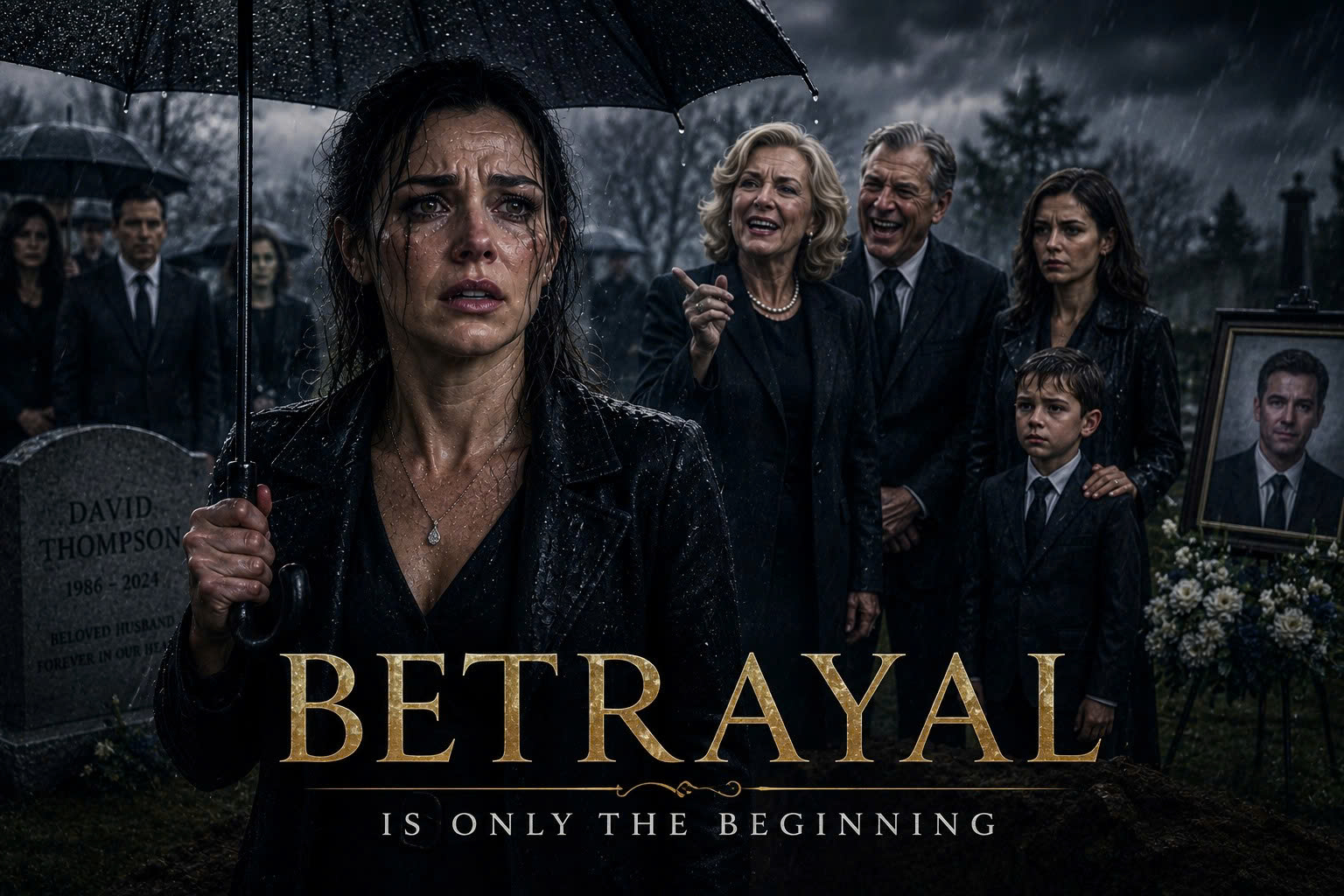
The rain began before the coffin was lowered.
It was not a dramatic storm, only a thin, freezing rain that seemed to pass through coats, umbrellas, and skin. It settled over the cemetery in a gray veil, turning the grass dark and shining against the fresh earth.
Claire Reynolds stood beside her husband’s grave with both hands wrapped around a black umbrella she could barely feel.
David had been dead for six days.
At forty-one, he had collapsed in the private elevator of Zenith Solutions, the technology company he had founded twelve years earlier. The official cause was a massive heart attack. One moment, he had been giving orders over the phone. The next, he was on the marble floor while his assistant screamed for security.
Claire had spent nearly a week moving through hospitals, funeral arrangements, legal forms, sympathy calls, and rooms full of people who spoke about David as though they had known him better than she had.
She had not slept for more than two hours at a time.
She still expected to hear his key in the front door.
She still checked her phone whenever it vibrated.
She still woke in the dark believing she had forgotten to tell him something important.
The priest finished the final prayer.
Around the grave stood more than a hundred people: employees, investors, clients, neighbors, former classmates, and executives who had flown in from New York, Atlanta, and Seattle.
David’s mother, Patricia, stood a few feet away beneath a wide black umbrella. His father, Richard, rested one hand on her shoulder. David’s sister, Samantha, wore dark glasses despite the absence of sunlight.
Jamal Carter stood beside them.
Jamal had served as David’s financial adviser, strategic consultant, and unofficial second-in-command for nearly seven years. He was also Samantha’s husband.
He had spent the week speaking to bankers and board members as though David’s death had already promoted him.
Claire noticed the way he checked his watch during the prayers.
The priest closed his book.
The funeral director stepped forward.
Then Patricia raised one gloved hand.
“Before everyone leaves,” she announced, “there is something that must be acknowledged.”
Claire looked at her.
This was not part of the service.
A few guests exchanged confused glances.
Patricia turned toward the row of black cars parked beside the cemetery road.
A woman stepped out from behind one of them.
She was in her early thirties, with long chestnut hair and a black coat cinched tightly around her waist. Beside her walked a boy of about five.
The child held her hand.
Claire’s body recognized the truth before her mind did.
The boy had David’s eyes.
Not merely the same color. The same heavy upper lids, the same slight upward angle at the corners, the same serious expression David wore when he believed he was being studied.
The child also had a small indentation in his chin.
Claire had kissed that indentation on David’s face thousands of times.
The woman approached the grave.
Patricia placed an arm around her.
“This is Rachel,” she said. “And this is Leo.”
The rain tapped against the umbrellas.
Nobody moved.
Patricia looked directly at Claire.
“Leo is David’s son.”
A sound escaped somewhere behind Claire. A gasp, perhaps, or someone whispering a name.
Claire did not turn.
Rachel lowered her eyes as though overwhelmed by grief. The boy stared at the coffin.
Patricia continued.
“For years, David was trapped in a life that did not reflect who he truly was. Rachel and Leo were his real family.”
The words struck Claire more deeply than the sight of the child.
His real family.
At her husband’s funeral.
In front of his employees.
His board.
Their friends.
Patricia had not brought Rachel quietly. She had waited until the grave was open and the crowd was watching.
This was not a revelation.
It was a public removal.
Rachel stepped forward.
“I never wanted it to happen this way,” she said, her voice trembling with practiced restraint. “David was going to tell everyone himself.”
Claire looked at her.
Rachel wiped one tear from her cheek.
“He said he was finally ready to stop living a lie.”
A camera clicked.
One of the younger employees quickly lowered his phone when Claire looked toward him.
Jamal moved beside Patricia holding a cream-colored envelope.
“There are legal matters that should be clarified before misinformation spreads,” he said.
The grave had not yet been filled.
David’s coffin was still visible.
Claire stared at the envelope.
Jamal spoke with the calm authority of a man accustomed to explaining other people’s money.
“David updated his estate plan six months ago.”
Claire’s attorney, Harrison Cole, stood several rows behind her. She heard him move closer.
Jamal removed a document.
“The revised will names Leo as David’s sole beneficiary.”
A murmur passed through the crowd.
Rachel pressed a hand to the boy’s shoulder.
“Under the terms of the trust,” Jamal continued, “Rachel, Patricia, and Richard will act as guardians and trustees until Leo reaches adulthood.”
Claire’s voice came out quieter than she expected.
“What exactly does the will transfer?”
Jamal looked almost pleased that she had asked.
“David’s controlling interest in Zenith Solutions. The Chicago residence. Liquid accounts held in his name or jointly. Intellectual property rights. Investment holdings. Personal property and all associated business interests.”
The Chicago residence was worth nearly two million dollars.
The company had been valued at more than forty million in its last financing round.
Several people turned toward Claire, expecting her to collapse.
She did not.
Harrison stepped beside her.
“We have not verified that document.”
Jamal folded it carefully.
“You will receive a copy on Monday.”
“Why Monday?” Claire asked.
“Because the probate filing will be completed then.”
“And until then?”
“Certain accounts have been restricted to protect the estate.”
Claire looked at him.
“Restricted?”
“The joint accounts are frozen.”
Patricia answered before Jamal could continue.
“You will also need to leave the house.”
The cruelty was so direct that even Samantha looked uncomfortable.
Patricia did not.
“The house belongs to David’s heir,” she said. “Rachel and Leo should be able to move into it without conflict.”
Rachel lowered her head again.
The act of modesty could not hide the anticipation in her face.
Claire watched the boy.
Leo looked confused and cold.
He was not responsible for any of this.
He had not chosen the cemetery, the announcement, or the adults using him as proof of victory.
Claire returned her attention to Jamal.
“You froze my access before David was buried.”
“We protected Leo’s inheritance.”
“You removed me from my home before the will was reviewed.”
“The documents are clear.”
“You seem very certain.”
Jamal gave her a small, sympathetic smile.
“You should prepare yourself for a difficult adjustment.”
For years, David’s family had treated Claire as a decorative assistant to a brilliant founder.
Patricia introduced her as “David’s wife, who does some consulting.”
Richard once asked whether she still helped companies “close their spreadsheets.”
Samantha called her work depressing.
Jamal referred to her as an administrative specialist.
None of them seemed to understand that Claire was a senior corporate liquidator.
She did not merely close companies.
She entered failed corporations, mapped every obligation, traced concealed assets, examined priority claims, and dismantled financial structures piece by piece. She knew how to identify who was secured, who was exposed, and who would be left holding worthless ownership after the real creditors arrived.
David had always laughed when his family underestimated her.
At the time, Claire believed he was defending her privately.
Now she wondered whether he had encouraged their ignorance.
Perhaps it had been useful to him.
Harrison touched her elbow.
“We should leave.”
Patricia stepped closer.
“I hope you will not make this ugly.”
Claire looked at the woman who had just introduced her dead son’s mistress beside his open grave.
“No,” Claire said. “I would never want to make this ugly.”
Patricia did not hear the warning.
None of them did.
Claire walked away while the rain continued to fall.
Behind her, workers began covering David’s coffin with earth.
She did not return to the house.
Instead, she drove directly to Zenith Solutions.
The headquarters occupied twelve floors of a glass building beside the Chicago River. At nearly seven in the evening, most of the employees had gone home, but the executive floor remained lit.
Claire entered through the private garage using her security pass.
The elevator recognized her fingerprint.
For the moment, at least, the company still did.
David’s office had not been touched.
His jacket hung behind the door. A glass of water sat beside the monitor. A handwritten list rested on his desk.
CALL OHIO
REVIEW OBSIDIAN TERMS
MOVE BALANCE BEFORE QUARTER END
Claire read it twice.
She sat in David’s chair and stared at the dark windows.
Only then did she allow herself to cry.
Not loudly.
Not for long.
The tears came from somewhere deeper than humiliation. They came from remembering the person she thought David had been.
The man who made coffee at midnight when she worked late.
The man who held her hand through fertility appointments.
The man who sat beside her after the second failed treatment and said they still had each other.
At the same time, he had a son in Ohio.
Possibly conceived while Claire was injecting hormones into her body and apologizing for not becoming pregnant.
Her phone rang.
Harrison.
She answered.
“I want an emergency petition filed tonight,” he said. “We challenge the will, freeze the transfer, demand full disclosure, and request a paternity test.”
“No.”
There was a pause.
“No?”
“Not yet.”
“Claire, they have frozen your accounts and are trying to remove you from the marital home.”
“I know.”
“The will may be fraudulent.”
“It may also be genuine.”
“That does not mean you surrender.”
“I’m not surrendering.”
“Then what are you doing?”
Claire looked at David’s handwritten note.
“Letting them inherit.”
Harrison was silent.
“Claire, I need you to explain that sentence.”
“Jamal wants control of the company. Patricia and Richard want the house. Rachel wants legitimacy. They all want David’s assets immediately.”
“Yes.”
“So let them claim everything.”
“This is not how probate strategy works.”
“It is how liquidation works.”
She opened David’s computer.
His main password had already been disabled, but Claire knew the architecture of the company’s internal systems. She had helped restructure Zenith’s debt during its second expansion.
“Pull every operating record you can lawfully obtain,” she said. “Tax records. Payroll filings. Loan documents. UCC filings. Vendor obligations. Guarantees. Board minutes. Insurance. Everything.”
“You believe the company is insolvent?”
“I believe David maintained two families and lied to both. People who lie that thoroughly rarely keep clean books.”
“That is an assumption.”
“It is a hypothesis.”
“And if you are wrong?”
“Then we fight the will later.”
Harrison exhaled slowly.
“What do you need from me tonight?”
“Do not challenge Jamal’s appointment.”
“That could give him control.”
“That is the point.”
She ended the call and opened her personal banking application.
The joint accounts displayed restricted access.
The household reserve was frozen.
The primary investment account was under estate review.
Jamal had acted quickly.
Claire switched to a secure platform hidden behind a private authentication key.
APEX HOLDINGS.
Balance: $3,184,220.
David did not know about Apex.
The money came from Claire’s career before their marriage: deferred fees, profit participation from liquidation projects, and several early investments. She had kept it separate because financial independence was one of the few lessons her mother had taught her before dying.
Never place every exit inside someone else’s house.
David had teased Claire for being cautious.
Now that caution meant Jamal had frozen only what Claire had allowed him to see.
She began constructing a timeline.
David’s repeated trips to Ohio.
The unexplained charges near Columbus.
A child’s plastic cup she once found in the rear of his car.
The sweet smell of baby shampoo on his coat.
The Saturday he missed their fertility consultation because a client had “an emergency.”
Rachel had posted a photograph online that same weekend from a children’s hospital in Ohio.
Leo had been two months old.
By midnight, Claire understood that the affair had not been hidden by David alone.
Patricia and Richard had visited Ohio repeatedly.
Samantha had liked old photographs on Rachel’s private account.
Jamal’s advisory company had paid several expenses associated with Rachel’s home.
They had not merely known.
They had helped operate the second life.
The following morning, Claire returned to Zenith Solutions.
Her badge flashed red.
A security guard she had known for five years stepped in front of the gate.
“I’m sorry, Mrs. Reynolds.”
“Who disabled my access?”
He looked toward the elevators.
Jamal emerged wearing a dark suit.
Samantha walked beside him.
Several employees watched from behind the reception desk.
Jamal carried a folder.
“Under a temporary probate order, I have been appointed interim chief executive and estate representative for corporate matters.”
“That was quick.”
“The board required stability.”
“The board met before sunrise?”
“David’s death created an emergency.”
Claire looked at Samantha.
She avoided eye contact.
Jamal extended the folder.
“You are no longer authorized to enter the building.”
Claire opened it.
The order was narrow and temporary, but Jamal had presented it as complete control.
Exactly as she expected.
She allowed her face to change.
Her shoulders lowered.
Her eyes moved across the lobby as if searching for help.
“You cannot do this today,” she whispered.
Jamal’s expression softened with triumph.
“Claire, do not create another scene.”
“I need access to my personal files.”
“They will be reviewed and returned.”
“My husband’s office—”
“Belongs to the company.”
Samantha finally looked at her.
“You should focus on rebuilding your life.”
Claire let her lips tremble.
“Where am I supposed to go?”
Jamal glanced at the employees.
“That is not a corporate matter.”
The security guard opened the door behind her.
Claire stepped outside.
She walked to the corner before calling Harrison.
“He took the position,” she said.
“You sound remarkably calm for someone who was just removed from her husband’s company.”
“He announced himself as interim CEO in front of employees.”
“Yes.”
“He accepted operational control.”
“Yes.”
“Good.”
“Claire.”
“He is now the person signing decisions, responding to creditors, supervising payroll, and certifying records.”
Harrison understood.
“Oh.”
“Exactly.”
“You think there are hidden liabilities.”
“I think David’s note mentioned Obsidian terms.”
“I will search every filing.”
“Do not contact Jamal.”
“He may destroy documents.”
“He believes the documents belong to him now. Men like Jamal preserve evidence when they think it proves ownership.”
Two days later, Patricia and Samantha arrived at Claire’s house with movers.
Rachel was not with them.
Claire stood in the foyer as Patricia handed her another court document.
“You have until noon.”
“This is still my residence.”
“It is an estate asset.”
“You could allow me a week.”
Patricia looked around the house.
“Rachel and Leo need stability.”
Claire stared at the family photographs on the console table.
Her wedding day.
A trip to Paris.
David cooking in the kitchen.
A photograph from the night Zenith received its first major investment.
All of it now looked like documentation from a fraudulent enterprise.
Samantha began opening closets.
“We should separate anything that clearly belongs to Claire.”
Patricia gave a dry laugh.
“Most of it was purchased with David’s money.”
Claire said nothing.
She had selected the silence carefully.
The more possession they asserted, the more useful the record became.
Patricia threw several dresses across the banister.
A mover carried Claire’s boxes outside.
Samantha lifted a framed wedding photograph.
“Do you want this?”
Claire looked at David’s smiling face.
“No.”
Samantha dropped it into an open carton.
The glass cracked.
By the time the rain started again, Claire’s clothing, books, shoes, and personal photographs had been placed on the front lawn.
Neighbors watched through windows.
Samantha recorded part of the removal on her phone.
“Please,” Claire said softly. “I need more time.”
Patricia folded her arms.
“You should have considered that before threatening Leo’s inheritance.”
“I have not threatened anything.”
“You hired a lawyer.”
“My husband died.”
“And now his family is protecting his wishes.”
The front door closed.
The lock changed electronically.
Claire stood in the rain beside two cheap suitcases she had deliberately brought with her.
She sent Harrison a message.
Eviction completed. Physical possession accepted. Trap closed.
Then she drove to a penthouse owned by Apex Holdings.
The apartment was not extravagant. It was private, secure, and registered through a structure no member of David’s family knew existed.
Three monitors waited in the office.
Claire removed her wet coat and went to work.
By then, Harrison had obtained copies of several public debt filings and tax-related records.
Claire also had encrypted backups of operational data David once asked her to review.
She began with payroll.
The numbers did not reconcile.
Zenith had withheld federal payroll taxes from employees, but the corresponding deposits were incomplete.
Quarter after quarter, the gap widened.
Claire calculated the total twice.
Eight million dollars.
David had withheld taxes from hundreds of employees and redirected the money.
Some funded operating expenses.
Some moved through shell companies.
Some paid for Rachel’s house, medical costs, travel, and Leo’s private-school deposits.
The rest had been used to create the appearance that Zenith was profitable.
Claire stared at the screen.
This was not aggressive accounting.
It was federal tax theft.
She opened another set of documents marked OBSIDIAN.
Obsidian Credit was a private lender specializing in distressed companies that traditional banks would not touch. David had borrowed five million dollars through a mezzanine facility.
The interest provision was catastrophic.
Thirty percent after default, compounded under an acceleration clause.
The company had already missed required performance covenants.
If the lender declared default, the full balance became due immediately.
The collateral schedule included Zenith’s intellectual property, equipment, receivables, and controlling equity.
Then Claire saw the personal guarantees.
The Chicago house.
Patricia and Richard’s retirement home in Ohio.
Jamal and Samantha’s house outside Atlanta.
All three properties had been pledged.
Claire read the signature pages.
David’s signature.
Richard’s.
Patricia’s.
Jamal’s.
Samantha’s.
They had signed as guarantors.
Perhaps David had told them it was temporary.
Perhaps Jamal believed the company could refinance.
It no longer mattered.
They had attached their homes to a failing company whose payroll-tax accounts had been emptied.
Claire called Harrison.
“We found the bomb.”
“How large?”
“Eight million in unpaid payroll taxes.”
He swore under his breath.
“And a five-million-dollar toxic loan.”
“To whom?”
“Obsidian Credit.”
“That name is not encouraging.”
“It gets worse. The company is in default. All three houses are collateral.”
There was a long silence.
“The Chicago house?”
“Yes.”
“Patricia and Richard’s home?”
“Yes.”
“Jamal and Samantha’s?”
“Yes.”
Harrison understood the structure.
“If they inherit and formally assume the liabilities—”
“They become the owners of a burning building.”
“The guarantees already exist.”
“But Jamal’s public acceptance of operational control and a written assumption of liabilities eliminates his easiest escape. He cannot claim he was merely a passive adviser.”
“What are you planning?”
“To buy the fire.”
Claire contacted Donovan Cross the next morning.
Donovan was a restructuring broker who specialized in distressed debt transactions. He had worked with Claire on three corporate collapses and asked no unnecessary questions.
“Obsidian holds a five-million-dollar position,” she told him. “The borrower is in undisclosed tax distress.”
“What is the realistic recovery value?”
“Between one and two million if enforced quickly.”
“What are you offering?”
“One point eight.”
“Through whom?”
“Apex Holdings.”
“Will the borrower know?”
“Not until assignment.”
Donovan was silent for a moment.
“You are buying a defaulted loan secured by three houses and a technology company.”
“Yes.”
“Personal?”
“Professional.”
“That answer means personal.”
“Can you complete it?”
“I can make the approach.”
Obsidian accepted within forty-eight hours.
The lender had already concluded that Zenith was collapsing. A cash sale at $1.8 million allowed it to exit without litigation.
Apex Holdings became the senior secured creditor.
Claire updated the UCC filings and recorded the assignment of liens.
She now controlled the debt that could seize the company, its intellectual property, and the homes belonging to the people who had thrown her possessions into the rain.
She did not immediately enforce.
That would be too early.
Ownership had to become undeniable.
Claire prepared an anonymous disclosure package for the Internal Revenue Service.
It included the missing payroll deposits, account movements, shell-company references, and documentation showing that Jamal had assumed executive control after David’s death.
The package did not accuse Jamal of creating the theft.
It did something more dangerous.
It identified him as the person currently responsible for the company holding the unpaid obligation.
Meanwhile, Rachel began telling her story publicly.
She posted photographs of David and Leo.
In one, David held the boy on his shoulders.
In another, they sat beside a lake.
Her caption read:
Some families are hidden because the truth threatens people who built their lives on control. David loved his son more than anything. Now we will protect the future he wanted.
Thousands of strangers shared it.
Comments described Rachel as brave.
Claire was called cold, greedy, infertile, bitter, and obsessed with money.
Samantha shared the post.
Jamal’s public-relations consultant sent it to business reporters.
Several of Claire’s acquaintances stopped answering calls.
One former friend wrote:
I think it is best that we keep some distance while the truth comes out.
Claire saved everything.
Screenshots.
Dates.
Comments.
Messages.
Not because the insults mattered.
Because coordinated reputational destruction often appeared before coordinated asset seizure. It demonstrated intent.
Jamal called her on the twenty-first day after David’s death.
Claire answered in a weak voice.
“I need access to the household account.”
“That account is part of the estate.”
“I cannot buy groceries.”
“You have a career.”
“You removed me from the company.”
“You were never employed by Zenith.”
“I helped build it.”
“You advised David occasionally.”
Claire closed her eyes and pictured him standing in the company lobby.
“I am asking for five thousand dollars.”
He laughed.
“Five thousand?”
“For temporary housing.”
“Rachel and Leo are living in the house now. The estate has obligations.”
“I was David’s wife.”
“And you are contesting his wishes.”
“I have not filed anything.”
“Because you know you will lose.”
Claire allowed several seconds of silence.
“What do you want me to do?”
Jamal’s voice lowered.
“Stop resisting. Sign the waiver. Release your claims. Accept that David chose his son.”
“And then you will unfreeze something?”
“If you cooperate, we can discuss a transition payment.”
“How much?”
“That depends on your behavior.”
The call ended.
Claire sent the recording to Harrison.
“He thinks you are starving,” Harrison said.
“He needs to.”
“Montgomery contacted me about mediation.”
Montgomery represented the estate.
“Schedule it,” Claire said.
“You are ready?”
“They have accepted the house, the company, and the public narrative. Now they need to accept the liabilities.”
For the mediation, Claire wore an old gray cardigan, inexpensive shoes, and no makeup. She tied her hair loosely and pulled a worn suitcase behind her.
Patricia, Richard, Samantha, and Jamal were already seated in the conference room when she arrived.
Rachel sat at the far end beside Leo.
The child colored quietly on a sheet of paper.
Montgomery opened the session.
“Our clients are prepared to resolve all potential marital and estate claims.”
Claire sat beside Harrison.
She kept her eyes lowered.
“I do not want to fight anymore.”
Patricia relaxed.
Jamal leaned back.
Claire continued.
“I want the freezes removed. I want enough money to find somewhere to live. I will surrender the house, the company interests, and any claim against the estate.”
Rachel watched her carefully.
“Do you acknowledge Leo as David’s heir?” Montgomery asked.
“I acknowledge that I do not have the strength to fight you.”
It was not the same answer.
But they heard what they wanted.
Montgomery slid a draft settlement across the table.
Claire read it slowly.
She allowed her hands to shake.
The agreement released marital claims and transferred disputed estate interests to a family trust created for Leo.
It referred generally to assets.
Not liabilities.
Claire looked at Harrison.
“I want to be certain that after I sign this, I cannot be blamed for anything connected to David’s company.”
Jamal smiled.
“You are not important enough to be blamed.”
Harrison spoke mildly.
“The agreement should expressly state that the trust assumes all related liabilities.”
Montgomery looked up.
“That is unnecessary.”
Claire pulled her hands back from the document.
“I cannot sign unless it is clear.”
Patricia sighed.
“She is stalling.”
“I am afraid,” Claire whispered. “David kept things from me. I do not know what obligations exist.”
Jamal turned toward Montgomery.
“Add it.”
Montgomery hesitated.
“Jamal, broad assumption language may be inadvisable without further review.”
“We are taking the assets,” Jamal said. “Of course we are taking the ordinary liabilities.”
Harrison looked at him.
“All liabilities, disclosed or undisclosed, associated with the transferred assets and corporate ownership?”
Jamal’s pride answered before his attorney could.
“Yes.”
Samantha touched his arm.
“Maybe we should review—”
“There is nothing to review,” he said. “Zenith is worth tens of millions.”
Claire looked toward Rachel.
“And the house?”
“Belongs to the trust,” Rachel said.
“The liquid accounts?”
“The trust.”
“The intellectual property?”
Jamal’s smile widened.
“The trust.”
Claire lowered her head.
“Then I surrender all claims.”
Montgomery added the clause.
At Jamal’s insistence, the agreement stated that the family trust and its acting representatives voluntarily accepted all assets, duties, debts, risks, guarantees, tax obligations, and contingent or undisclosed liabilities connected to David’s estate and Zenith Solutions.
Each adult signed.
Patricia.
Richard.
Samantha.
Jamal.
Rachel, acting as Leo’s guardian.
Claire signed last.
When they left, Patricia paused beside her.
“You could have saved yourself a great deal of humiliation by accepting reality earlier.”
Claire looked up.
“I needed to understand what I was giving you.”
Patricia smiled.
“Everything.”
After the door closed, Harrison placed a certified copy of the agreement in front of Claire.
“They signed the broadest clause I have ever seen opposing counsel accept.”
“Jamal wrote his own obituary.”
“Financial obituary.”
“Those last longer.”
The probate hearing occurred nine days later.
The courtroom was crowded.
Rachel arrived wearing a cream-colored suit and holding Leo’s hand. Patricia wore pearls. Richard carried himself with the solemn importance of a man protecting a family legacy.
Jamal spoke with reporters in the hallway.
Samantha stood beside him but looked tired.
Montgomery organized several binders at counsel table.
Claire entered wearing the same gray cardigan from mediation.
People whispered as she passed.
One reporter took her photograph.
Inside the courtroom, Claire sat quietly beside Harrison.
The judge reviewed the revised will, the waiver, and the settlement agreement.
“Mrs. Reynolds,” he said, “you understand that you are releasing your claims to the residence, corporate interests, estate-controlled accounts, and other transferred property?”
“Yes, Your Honor.”
“And you signed voluntarily?”
“Yes.”
The judge turned toward Jamal.
“You are acting as representative for the family trust and interim executive of Zenith Solutions?”
“Yes, Your Honor.”
“You understand that the settlement includes assumption of all liabilities associated with the assets, including contingent and undisclosed obligations?”
Montgomery stood.
“Your Honor, the intent is to preserve David Reynolds’s legacy for his son.”
The judge looked directly at Jamal.
“I asked whether you understand the language.”
Jamal raised his chin.
“I do.”
“You accept those liabilities voluntarily?”
“Yes.”
Patricia smiled at Rachel.
The judge signed the transfer order.
Jamal exhaled.
Claire removed the gray cardigan.
Beneath it, she wore a crisp white blouse and a dark tailored jacket.
She pulled the loose tie from her hair and secured it neatly at the back of her head.
The movement was simple.
But everyone at the other table noticed.
Jamal’s smile disappeared.
Claire stood.
“Your Honor, there is one additional matter.”
Montgomery frowned.
“The settlement is complete.”
“I am not reopening the settlement.”
“Then sit down.”
Harrison rose beside her.
“My client appears in a separate capacity.”
The judge looked over his glasses.
“What capacity?”
Claire faced the court.
“As senior authorized representative of Apex Holdings, the current secured creditor of Zenith Solutions.”
Silence spread through the room.
Jamal stared at her.
Montgomery opened his binder quickly.
“I am not aware of Apex Holdings.”
“You should be,” Harrison said.
He placed a document on the evidence table.
“Assignment of secured debt from Obsidian Credit to Apex Holdings.”
Montgomery took the paper.
His eyes moved rapidly over the first page.
Then the second.
He turned toward Jamal.
“When did you receive a default notice?”
“What default notice?”
Harrison placed three certified notices beside the assignment.
“Zenith Solutions is in default on a five-million-dollar mezzanine loan, now subject to accelerated interest and enforcement.”
Patricia looked at Richard.
Richard looked at Jamal.
The judge lifted one of the documents.
“What collateral secures this facility?”
Claire answered.
“Zenith’s intellectual property, receivables, equipment, controlling equity, the Chicago residence, a property in Ohio owned by Patricia and Richard Reynolds, and an Atlanta residence owned by Jamal and Samantha Carter.”
Samantha stood.
“Our house?”
The judge told her to sit.
She did not seem to hear him.
“Jamal, you said the guarantee was temporary.”
Jamal stared at the documents.
“It was supposed to be refinanced.”
Claire spoke calmly.
“It was not.”
Patricia grabbed Richard’s arm.
“You signed our Ohio house?”
Richard’s face reddened.
“David said it was a formality.”
Montgomery continued reading.
“Who controls Apex Holdings?”
Harrison placed a corporate record on the table.
Montgomery read it aloud without intending to.
“Claire Reynolds, managing director.”
Rachel rose halfway from her seat.
“You bought the loan?”
Claire looked at her.
“Yes.”
“With what money?”
“My money.”
“You said you could not afford food.”
“I asked Jamal for access to funds he had frozen.”
Jamal’s face darkened.
“You lied.”
Claire tilted her head.
“At my husband’s funeral, you introduced his mistress, froze my accounts, seized my home, and told a cemetery full of people that I had no legal rights.”
“That does not give you the right—”
“To purchase debt offered for sale?”
Harrison interrupted.
“It does.”
Montgomery looked toward the judge.
“This appears to be retaliatory.”
“The motive of a lawful creditor does not void a valid assignment,” Harrison said.
Claire opened another folder.
“And the secured debt is not the largest problem.”
Jamal went still.
Harrison placed a federal notice on the table.
“The Internal Revenue Service has opened an investigation into approximately eight million dollars in unpaid payroll-tax deposits withheld from Zenith employees.”
The courtroom changed.
The family had reacted loudly to the houses.
The federal tax notice produced silence.
Montgomery read the summary.
His expression became grave.
“Eight million?”
“Based on current records,” Claire said.
Jamal turned toward her.
“David handled payroll.”
“You accepted executive control.”
“I did not create the problem.”
“But you signed an agreement accepting all tax obligations, disclosed and undisclosed.”
“You designed that language.”
“No. Your attorney objected to it.”
Claire looked at Montgomery.
“You insisted.”
Jamal remembered.
The color left his face.
The judge reviewed the settlement agreement again.
“You confirmed this assumption under oath less than fifteen minutes ago.”
Jamal’s mouth opened.
No answer came.
Rachel pulled Leo closer.
“Does this affect his inheritance?”
Claire looked at the child before answering.
“It means there may be no inheritance.”
Rachel’s grief vanished.
“What do you mean, no inheritance?”
“Zenith’s apparent value depended on money David should have sent to the government. The company also owes a secured lender. Equity receives value only after priority creditors and tax authorities are paid.”
Patricia stared at Claire.
“You knew this at mediation.”
“Yes.”
“And you let us sign.”
“You demanded the assets.”
“You knew they were worthless.”
“Not worthless. Encumbered.”
Richard slammed one hand against the table.
“You trapped us.”
The judge warned him.
Claire remained calm.
“You removed me from the house before the funeral flowers died. You took control of the company before reviewing its books. You accepted every asset because you believed ownership was the same as wealth.”
Samantha turned on Jamal.
“You said you had reviewed the company.”
“I reviewed the valuation.”
“You did not review the debt?”
“There was no time.”
“There was enough time to lock Claire out!”
Rachel took Leo’s coat from the chair.
“I am not staying for this.”
Patricia grabbed her wrist.
“You signed the agreement too.”
Rachel pulled away.
“I signed because you said Leo would be rich.”
“He is David’s son.”
“He is not inheriting your debt.”
She dragged Leo toward the courtroom doors.
Jamal called after her.
“Rachel!”
She did not turn.
Claire watched the boy leave.
Again, she felt no anger toward him.
Only pity.
He had been brought to a funeral as an heir and taken from a courtroom as a burden.
Adults had placed a price on his identity before he was old enough to understand it.
Montgomery spoke quietly to Jamal.
“We may need to seek rescission.”
Harrison heard him.
“On what grounds?”
“Mutual mistake.”
Claire shook her head.
“There was no mutual mistake. I raised the possibility of undisclosed obligations. Your clients insisted on accepting them.”
“Fraudulent concealment,” Jamal said.
“You controlled the company. You had the books. You removed my access. You represented that you understood its finances.”
The judge looked toward Montgomery.
“That will be difficult to unwind.”
Patricia began crying.
Not soft funeral tears.
Panicked, breathless sobs.
“Our house in Ohio is all we have.”
Claire looked at her.
“At the cemetery, you told me the Chicago house belonged to David’s real family.”
“You cannot take our retirement home.”
“I am not taking anything today.”
Hope entered Patricia’s face.
Then Claire continued.
“Apex Holdings is issuing a thirty-day demand for payment of the accelerated secured balance.”
Harrison placed the formal demand before Montgomery.
“If payment is not made,” Claire said, “we will enforce against collateral according to priority.”
Richard looked at the amount.
“Five million dollars?”
“With accrued default charges.”
“We do not have five million dollars.”
“Then the collateral will be sold.”
Samantha turned toward Claire.
“You would foreclose on our house?”
“You threw my belongings onto a wet lawn and filmed it.”
“That was Patricia.”
Patricia looked at her daughter.
“You helped.”
“I did not know Jamal had pledged our house!”
“You signed the guarantee,” Claire said.
Samantha faced her husband.
“What else did you sign?”
Jamal did not answer.
His silence was enough.
The family began speaking at once.
Patricia blamed David.
Richard blamed Jamal.
Samantha blamed Patricia for pushing them to seize the estate.
Jamal accused Montgomery of failing to review the language.
Montgomery reminded him that he had advised against it.
For the first time, Claire saw them without the protection of a common enemy.
Their unity had never been loyalty.
It had been shared appetite.
Once the inheritance disappeared, so did the family.
Jamal stepped around the table.
“Claire, please.”
She looked at him.
“We can negotiate.”
“We are negotiating. The demand gives you thirty days.”
“You know we cannot pay it.”
“That is not a defense.”
“Reduce the amount.”
“No.”
“Release the houses and take the company.”
“The company is under federal investigation.”
“You will destroy all of us.”
Claire’s expression did not change.
“No. I am collecting a debt.”
Patricia moved closer.
“David would not want this.”
Claire felt something inside her finally become still.
“David stole employee tax money, pledged three family homes, hid a child, and died before the consequences reached him. None of us knows what David wanted.”
“You loved him.”
“Yes.”
The admission surprised them.
Claire continued.
“I loved the person I believed he was. That person never existed.”
Richard lowered his voice.
“We made mistakes.”
“You made decisions.”
“We accepted what David told us.”
“You also accepted Rachel while I sat through fertility treatments.”
Patricia looked away.
Claire understood then that Patricia had known about those treatments.
She had called after every appointment.
She had offered advice.
She had told Claire not to lose hope.
All while visiting David’s son in Ohio.
That betrayal hurt more than the house.
More than the money.
More than the will.
But pain was no longer in control.
The judge concluded the hearing and instructed counsel to handle enforcement through the appropriate civil process.
Claire gathered her papers.
Jamal remained standing.
“What do you want from us?” he asked.
She paused.
For weeks, they had assumed she wanted the house, the company, the title of wife, or a share of David’s estate.
They had never considered that she might want none of it.
“I want you to own what you fought to inherit.”
Claire and Harrison left the courtroom.
Outside, the rain had stopped.
Sunlight reflected from the windows of the courthouse and spread across the cold pavement.
Reporters waited near the steps.
Harrison glanced at her.
“Do you want to make a statement?”
“No.”
“They will tell their own version.”
“They always do.”
“What happens now?”
“IRS takes priority where applicable. We enforce the secured position. Zenith enters restructuring or liquidation. The houses are sold unless they find capital.”
“And Rachel?”
“Leo may have independent support rights against the estate. We do not interfere with those.”
Harrison looked at her.
“You are protecting the child.”
“I am refusing to punish him for the adults who used him.”
They walked toward a waiting car.
Behind them, raised voices came through the courthouse doors.
Samantha shouting at Jamal.
Patricia demanding that Richard call someone.
Montgomery insisting that no one speak to reporters.
The family that had arrived together was breaking apart before reaching the street.
Three months later, Zenith Solutions entered formal liquidation.
Its intellectual property was sold to a competitor.
The proceeds covered only part of the tax liability and secured debt.
The Chicago house was sold.
Patricia and Richard’s Ohio home went into foreclosure.
Jamal and Samantha listed their Atlanta property before enforcement, but the sale proceeds were claimed under the guarantee. Their marriage ended before the liquidation was complete.
Rachel withdrew her petition to control the estate trust after learning there would be no meaningful assets. Through an attorney, she pursued only the support rights available to Leo.
Jamal resigned from every corporate board that had once displayed his name.
The business press described him as the executive who inherited a company without examining its liabilities.
Patricia gave one interview claiming Claire had manipulated a grieving family.
The interview received little sympathy after documents showed that Patricia had known about Rachel for years and helped remove Claire from the marital home.
Claire never returned to the Chicago house.
She did not bid at the sale.
She did not want the rooms where David had lived two lives.
Apex Holdings recovered part of its investment through collateral enforcement. The company then purchased several distressed but legitimate businesses whose employees needed protection during restructuring.
Claire expanded her liquidation practice.
One year after David’s funeral, she stood in a new office overlooking the Chicago River.
On her desk rested two framed documents.
The first was her certificate as managing director of Apex Holdings.
The second was the signed assumption-of-liabilities agreement.
Not as a trophy.
As a reminder.
Ownership was not the same as value.
An inheritance was not always a gift.
And people who fought hardest to possess something rarely paused to ask what it owed.
Harrison entered carrying a file.
“We have a new matter.”
“What kind?”
“A founder died unexpectedly. The family is fighting over control.”
Claire looked through the documents.
“Debt?”
“Substantial.”
“Personal guarantees?”
“Three.”
“Hidden tax exposure?”
“Possible.”
She closed the file.
“Do the heirs know?”
“They are in court tomorrow demanding immediate transfer.”
Claire looked out at the city.
For a moment, she remembered the cemetery.
The rain.
The open grave.
Rachel leading Leo through the crowd.
Patricia announcing that Claire had never been David’s real family.
Jamal holding the will like a weapon.
They had expected a young widow to break in public.
They did not understand that grief had not erased Claire’s training.
It had sharpened it.
A liquidator did not judge a company by its buildings, headlines, or declared valuation.
She looked beneath the surface.
She asked what had priority.
What had been pledged.
What had been hidden.
What appeared valuable only because someone had delayed the bill.
David’s family had read the will and seen a technology company, a mansion, and millions in assets.
Claire had read the books.
She had seen unpaid taxes, accelerated debt, personal guarantees, and a structure already collapsing.
They thought she had surrendered the fortune.
In reality, she had allowed them to stand beneath it when it fell.
Harrison waited beside the door.
“What should I tell the new client?”
Claire picked up the file.
“Tell them not to fight over the assets yet.”
“Why?”
“Because first, we count the liabilities.”
She walked toward the conference room.
The sun climbed higher above Chicago, bright against the river and courthouse towers.
For the first time since David’s death, Claire did not feel like a widow.
She did not feel discarded, replaced, or defeated.
She felt free.
David’s company was gone.
His family’s illusion of wealth was gone.
The house, the lies, and the marriage had all been liquidated.
What remained belonged entirely to her.
Her work.
Her judgment.
Her future.
At the funeral, Jamal had told her that Monday would change everything.
He had been right.
He simply had not understood whose life was about to be taken apart.