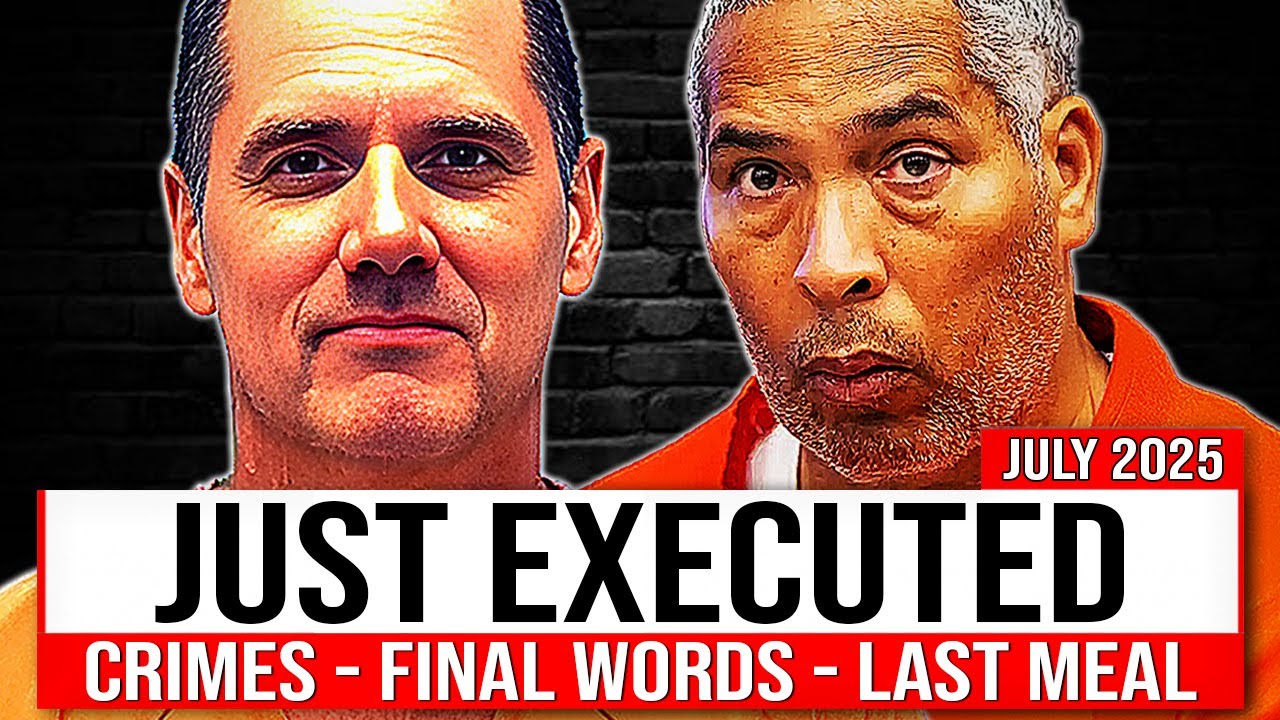
Jeffrey Glenn Hutchinson, a 62-year-old former Army Ranger, was executed by lethal injection on May 1st, 2025, at a Florida prison, ending a 26-year wait on death row for the brutal shotgun murders of his girlfriend and her three young children in their Crestview home back in 1998.

The execution, which began at approximately 8:00 p. m. , took just over 15 minutes to complete.
Witnesses reported that Hutchinson’s legs shook sporadically and his body convulsed for several minutes before falling still. He was formally pronounced dead at 8:15 p.
, bringing a close to one of the most haunting multiple-murder cases in the Florida Panhandle’s history.
When asked if he had any final words, Hutchinson remained silent. However, witnesses inside the death chamber observed his lips moving softly, almost inaudibly, as if he were whispering a prayer or speaking to himself during the procedure. He offered no apology, no explanation, and no final statement to the families of his victims.
For his final meal, Hutchinson requested salmon, mahi-mahi, asparagus, a baked potato, and iced tea. Earlier that day, he received three visitors, including his sister and a spiritual advisor, according to prison officials. The modest meal stood in stark contrast to the violence that defined his legacy.
The crimes that sent Hutchinson to death row occurred on the night of September 11th, 1998, in a quiet residential neighborhood in Crestview, Florida. Inside a small home, Renee Flaherty, 32, and her three children, Jeffrey, 9, Amanda, 7, and Logan, 4, were each shot execution-style in the head. There was no mercy shown and no chance for any of them to escape.
The killer was not a stranger who broke in from the night. It was Jeffrey Hutchinson, the man who lived under the same roof, the man who had helped raise those children, played with them, and tucked them into bed. From the outside, the household appeared peaceful, and friends later said there were no obvious red flags or major fights that raised concern.
On the evening of the murders, Renee made a casual call to a friend around 7:00 p. m. The conversation was normal and contained no hint of trouble.
At one point, Hutchinson could be heard in the background, cheerful and relaxed, greeting the friend by name. Everything seemed completely ordinary inside that home at that moment.
But by 7:30 p. m. , everything had changed.
Renee called another friend, and her voice cracked the moment she spoke. She admitted she and Jeffrey had a fight, a really bad one. He had packed up some clothes, grabbed his guns, and stormed out of the house.
Renee believed the worst was over. She was tragically wrong.
Hutchinson did not go far after leaving. He ended up at a local bar where the couple were regular customers. There, he drank heavily and vented to anyone who would listen, telling the bartender that Renee was upset and that they just needed time to cool down.
But he was not cooling down. He was spiraling toward violence.
Less than an hour after storming out, Hutchinson got back into his truck with a Mossberg 12-gauge shotgun beside him and drove home. He walked back into that small, quiet house and immediately opened fire. Renee was shot first, once in the head.
Then Hutchinson moved methodically from room to room, hunting down the children he had once cared for.
He found 9-year-old Jeffrey first and shot him in the chest. When the boy did not die immediately, Hutchinson stood over him and fired a second shot, this time to the head. Seven-year-old Amanda and 4-year-old Logan were each killed with a single shotgun blast, their lives ending in an instant
Four lives were wiped out in a matter of minutes
After the massacre, Hutchinson picked up the phone and calmly called 911, telling the operator, “I just shot my family.” When officers arrived, they found him sitting in the garage, phone still in hand, still connected to the dispatcher. He did not resist arrest.
He did not attempt to flee. He simply stood up and surrendered without a struggle.
Inside the house, investigators discovered the full scope of the horror. Renee and her two youngest children, Amanda and Logan, were found together in the bedroom. The body of 9-year-old Jeffrey lay alone in the living room.
The scene was described by first responders as one of the most brutal they had ever encountered.
Hutchinson initially told a bizarre story, claiming that two men wearing ski masks had broken into the house, killed everyone, and fled. But the evidence quickly dismantled that narrative. Police found gunshot residue on Hutchinson’s hands.
They recovered shotgun shells on the kitchen counter and discovered tissue from the boy’s body on Hutchinson’s leg. There were no signs of forced entry.
Forensic evidence pointed overwhelmingly to one person. No evidence suggested anyone else had been inside the home that night. Every piece of physical evidence placed Hutchinson at the scene as the sole shooter, and his changing story only further undermined his credibility in the eyes of investigators and, later, the jury.
To understand how a decorated soldier became a mass murderer, one must look at Hutchinson’s life before that September night. Born on November 6th, 1962, he grew up in Florida in a large household with multiple brothers and sisters. While home life was not perfect, it was not considered dangerous or abusive by those who knew him.
Hutchinson was diagnosed with ADHD as a child, but acquaintances remembered him as having a fairly normal upbringing. After high school, he drifted through various jobs, working as a mechanic and later as a security guard. Employers had no complaints about him.
He showed up on time and kept his head down.
Then came the military. Hutchinson trained as a paratrooper and eventually earned a spot as an Army Ranger, an elite designation that requires exceptional discipline and physical fitness. He served overseas during the Gulf War, including participation in Operation Desert Storm in 1991.
He was a veteran who had fought for his country.
But when he returned home from war, something had shifted inside him. His family noticed the change immediately. He was angrier and quieter than before.
He struggled to sleep, and when sleep would not come, he turned to alcohol. The Army honorably discharged him, but civilian life did nothing to heal whatever wounds he carried.
His first marriage ended in divorce. His second marriage did not last long either. Whatever demons Hutchinson brought back from the war, he never managed to shake them off.
Over time, his condition only deteriorated. Then he met Renee Flaherty, a single mother working hard to build a stable life for her children.
Hutchinson and Flaherty eventually relocated from Washington State to Florida with the three children. For about a year and a half, the family appeared to be thriving. Hutchinson seemed to care deeply for the kids, treating them as if they were his own.
Friends and family saw no signs of the darkness that was building beneath the surface.
But on that night in September 1998, something inside Hutchinson snapped. The trial began in early 2001, and his defense team mounted an aggressive case. They argued that Gulf War trauma, alcohol abuse, and mental illness had rendered him unable to control his actions.
Experts testified that Hutchinson was bipolar and not fully in control when he pulled the trigger.
The jury was not convinced. The judge later noted there was no correlation between the murders and Hutchinson’s diagnosis of Gulf War illness. Whatever he had been through in the military, the court ruled, it did not explain or excuse the cold-blooded execution of a woman and three defenseless children in their own home.
After nine days of testimony, the jury found Hutchinson guilty of all four murders. At sentencing, the judge imposed a life sentence for the killing of Renee Flaherty, citing his military service and lack of prior criminal record as mitigating factors. But for the children, the judge showed no such leniency.
The judge ruled that because the children were so young and helpless, the punishment had to match the horror of the crimes. Hutchinson received three death sentences, one for each child he murdered. He was transferred to Florida’s death row, where he would remain for more than two decades.
Over the following years, Hutchinson filed a series of appeals. He argued he had not received a fair trial, that the death penalty was inappropriate in his case, and that his mental health history had not been fully considered. Court after court reviewed his claims and rejected them, upholding his sentences.
His attorneys continued to fight, citing his military service and psychological struggles. They painted a picture of a broken veteran who had served his country and deserved mercy. But prosecutors countered with the undeniable brutality of the crimes and the vulnerability of the victims, children aged 9, 7, and 4.
As the execution date approached, advocacy groups and legal teams made last-minute attempts to halt the procedure. They argued that Hutchinson’s mental state and the circumstances of his military service warranted a commutation of his sentence. Florida Governor Ron DeSantis declined to intervene, and the courts rejected all emergency motions.
On the afternoon of May 1st, 2025, Hutchinson was moved from his death row cell to a holding area near the execution chamber. He spent his final hours meeting with his sister and a spiritual advisor. Prison officials confirmed that he appeared calm, though he declined to make any formal statement about his crimes.
The execution chamber at Florida State Prison in Starke was prepared for the procedure. Hutchinson was led in, strapped to the gurney, and the lethal injection protocol was initiated. Witnesses, including members of the media and representatives of the victims’ family, observed the process from an adjacent room.
When the warden asked Hutchinson if he wished to make a final statement, he said nothing. The silence was deafening, according to witnesses. As the drugs began to flow into his system, Hutchinson’s lips moved as if in silent prayer, but he never spoke an audible word to anyone present.
The execution was not without complications. Witnesses reported that Hutchinson’s legs shook sporadically and his body experienced spasms for several minutes before going still. The movements were consistent with the effects of the drugs used in the lethal injection protocol, but they prolonged the emotional weight of the moment for those watching.
The entire procedure took approximately 15 minutes. At 8:15 p. m.
, Jeffrey Glenn Hutchinson was pronounced dead. He was 62 years old. His death marked the end of a legal saga that had spanned more than a quarter-century and the closure, however painful, for the families of his four victims.
Renee Flaherty’s family, who had waited 26 years for this moment, released a brief statement expressing relief that justice had finally been served. They described Renee as a devoted mother who worked hard to give her children a good life, only to have it violently taken away by someone they had welcomed into their home.
The three children, Jeffrey, Amanda, and Logan, were remembered by those who knew them as bright and innocent souls whose lives were cut short by an act of incomprehensible violence. A family friend noted that the children loved Hutchinson and trusted him, which made the betrayal of their murders all the more devastating.
Hutchinson’s case has also reignited discussions about the treatment of veterans with post-traumatic stress disorder and other service-related mental health conditions. Advocates argue that more must be done to support returning soldiers, while legal experts note that the court’s ruling drew a clear line between mental illness and premeditated violence.
Florida remains one of the most active states in the nation when it comes to carrying out executions. Hutchinson was the latest in a series of death row inmates to be put to death in the state. His execution was conducted under protocols that have been refined over years of legal challenges from anti-death-penalty organizations.
For the community of Crestview, the memory of that September night in 1998 remains seared into the collective consciousness. The small, quiet neighborhood where four lives were extinguished has never fully moved past the tragedy. Residents say the case serves as a grim reminder that violence can come from the most unexpected places.
The investigation into the murders was thorough and methodical. Law enforcement officers who responded to the scene that night described it as one of the most disturbing calls of their careers. The sight of a 4-year-old child killed by a shotgun blast is not something that ever leaves a person, they said.
Prosecutors who handled the case said they never doubted Hutchinson’s guilt. The evidence was overwhelming, they noted, from the gunshot residue to the shells on the counter to the tissue on his leg. His initial claim of masked intruders was quickly dismissed as an obvious fabrication designed to evade responsibility.
Defense attorneys who represented Hutchinson during his trial maintained that he was a troubled man whose military service had left deep psychological scars. They argued that the justice system should have shown more understanding of his condition. However, even they acknowledged the horror of what he did to Renee and her children.
The execution was witnessed by a small group of people, including representatives of the media who were selected through a lottery system. Their accounts of the proceedings will be included in the official record of the execution. The Florida Department of Corrections will conduct a review of the procedure, as is standard.
Hutchinson’s body was transported from the execution chamber to an undisclosed location. Under Florida law, unclaimed remains of executed inmates are handled according to established protocols. His family has not publicly announced funeral arrangements or burial plans as of this report.
The case has drawn attention from national media and death penalty opponents, who have used Hutchinson’s execution to highlight broader concerns about capital punishment in the United States. Protests were held outside the prison leading up to the execution, though they remained peaceful and did not disrupt the proceedings.
As the sun set on May 1st, 2025, the state of Florida carried out one of its most significant executions in recent memory. Jeffrey Hutchinson, a man who had once served his country with distinction, died as a convicted mass murderer, leaving behind a legacy defined not by his military service but by the four innocent lives he took.
In the aftermath of the execution, the focus now shifts to the surviving family members of Renee Flaherty and her children. They have spent more than two decades navigating grief, legal proceedings, and the painful process of watching the man who destroyed their family fight to avoid the ultimate punishment.
While the execution brings a formal close to the criminal justice proceedings, the emotional wounds will likely never fully heal. Those who knew Renee describe her as a warm and dedicated mother who worked tirelessly to provide for her children. She trusted Hutchinson, and that trust cost her everything.
The three children murdered that night, Jeffrey, Amanda, and Logan, were described by relatives as the light of their mother’s life. Their deaths left a void that can never be filled. A family spokesperson said the children’s laughter and joy are still remembered by all who had the privilege of knowing them.
The state of Florida has scheduled additional executions in the coming months, as multiple death row inmates have exhausted their appeals. The Department of Corrections has confirmed that its execution team is prepared to carry out these procedures in accordance with state law and court orders.
Hutchinson’s case will likely be studied for years by legal scholars and mental health professionals. It raises difficult questions about the intersection of military service, mental illness, and criminal responsibility. It also highlights the enduring debate over whether the death penalty is ever an appropriate punishment.
For now, justice has been carried out as ordered by the courts. The state of Florida has spoken, and Jeffrey Hutchinson has paid the ultimate price for his crimes. But for the families who lost Renee, Jeffrey, Amanda, and Logan, the pain of that September night in 1998 will remain with them forever.